
The Piazzetta dei Leoncini is one of those places in Venice that people cross almost without noticing, even though it is next to one of the most observed places in the world. Set to the side of St. Mark’s Basilica, it belongs to the same urban scene but remains on its margins, more intimate and less obvious. Its name comes from two small sculptures, but its interest goes beyond the curious detail: here the perspective, rhythm and measure of the space change. Looking at it carefully means reading a minor but significant fragment of the St. Mark’s area.
Where the Piazzetta dei Leoncini really is
The Piazzetta dei Leoncini is not the large Piazzetta that descends toward the St. Mark’s basin, between the Doge’s Palace and the Marciana Library. It is a much more intimate place: it opens on the northern side of St. Mark’s Basilica, therefore to the left of the main façade if you stand in St. Mark’s Square looking at the church.
The easiest way to orient yourself is to look for the side space between the basilica and the buildings of the Patriarchate. Here the flow of passers-by often narrows: some arrive from the area of the Clock Tower, others cut through toward the calli behind, but many do not stop to read the place.
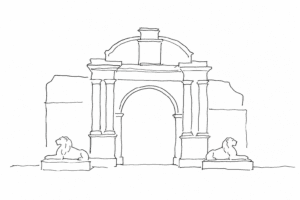
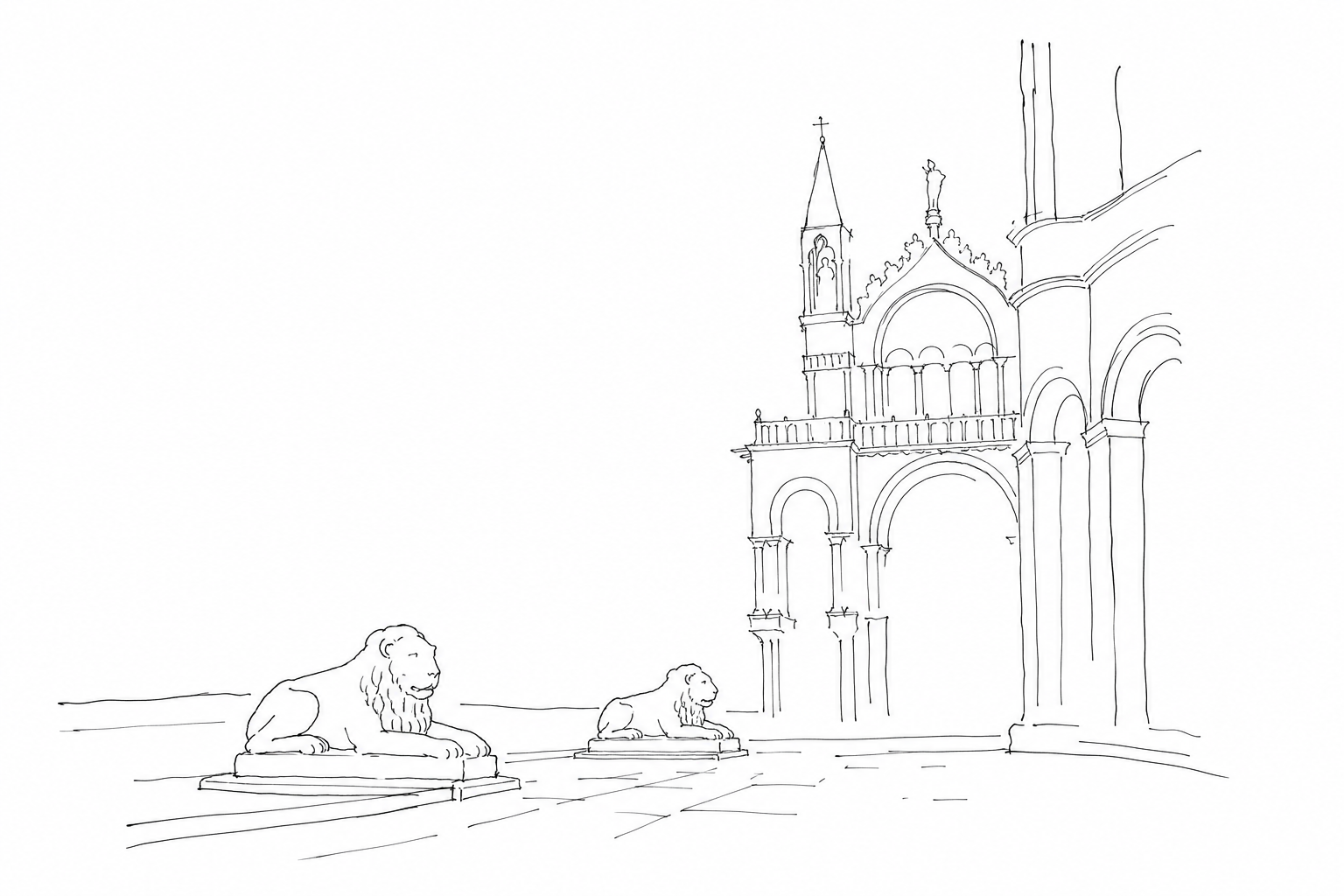
The name comes from the two small red marble lions placed in the piazzetta, discreet presences compared with the great symbols of St. Mark. This smaller scale is precisely the key: not a monumental entrance, but a side threshold, useful for understanding how St. Mark’s is also made of corners, passages and urban backdrops.
Why it is called this: the two small lions
The name derives from a very concrete detail: the two crouching lions found in the side space near the basilica. They are not the great winged symbols linked to the official image of Venice, nor figures placed high up to dominate the scene. They are, precisely, leoncini: animals on a lower scale, observable almost at passer-by level.
The sculptures, in red Verona marble, are generally attributed to the early eighteenth century and to the hand of Giovanni Bonazza, an artist active in the Venetian sphere. The material matters: that warm red makes them different from the white and gold that many immediately associate with St. Mark’s, and makes them stand out as autonomous presences, not simple minor decorations.
The diminutive should not be understood as an affectionate affectation. It serves to distinguish this place from the great surrounding public scenography: here the lion is not a political monument, but an urban sign. Those who cross the piazzetta without stopping often miss precisely this key: the name does not describe an area, but two specific sculptures.
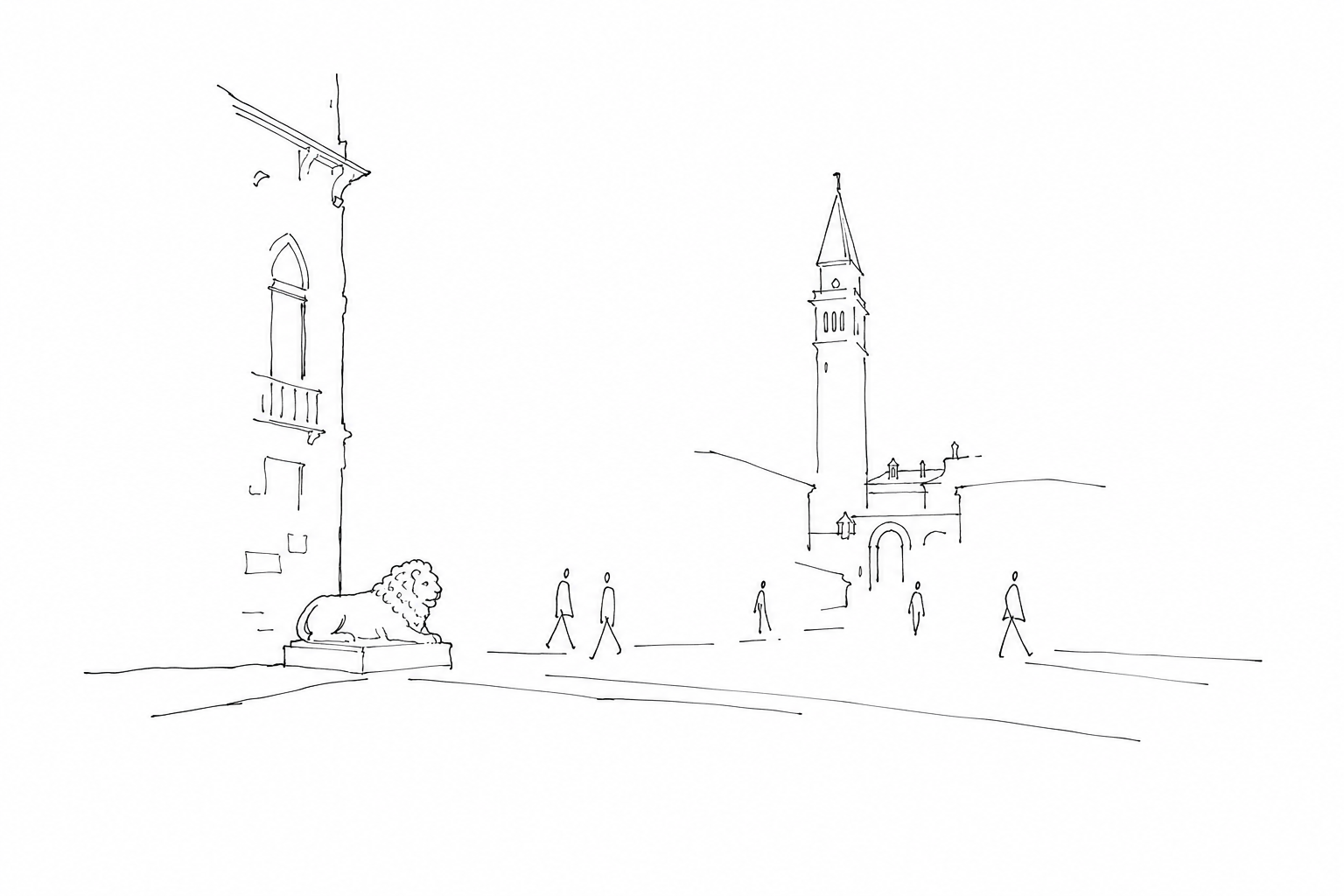
The less observed side of the Basilica
In this small open space, the right way to look is not frontal, but oblique. The north façade of St. Mark’s, less photographed than the one facing the great Square, clearly shows the composite nature of the building: marbles of different colors, capitals that are not all alike, frames, small arches and reliefs inserted like precious fragments into a surface built by accumulation.
One point to look for is the Porta dei Fiori, on the northern side: its sculpted apparatus, with plant motifs and sacred figures, makes it clear that even this secondary access had a decorative dignity; it was not simply a rear side. Looking higher up, the surfaces reveal the dialogue between Byzantine taste, Romanesque elements and reused materials, typical of St. Mark’s.
On the other side, the Patriarchal Palace closes the space with a more regular and sober language. The contrast is useful: on one side the richly detailed skin of the church, on the other a more disciplined urban backdrop. It is precisely this proximity that explains why many pass through without understanding: here the value does not lie in the scenic effect, but in the details of the façades facing each other.
How to cross it without missing it
To understand it, avoid cutting diagonally across with your gaze already fixed on the Square. Enter slowly from the edge near the Clock Tower and stop before the small lions: from there the proportions change, because the side of St. Mark’s does not dominate with a single image, but with a sequence of marbles, arches, reliefs and shadows.
- First stop: look at the two red marble animals not as simple furnishings, but as low, almost domestic signs that give measure to the passage.
- Second stop: turn toward the opposite front: the comparison between ancient surfaces and more regular lines explains the intimate character of the place.
- Third stop: raise your gaze along the side of the basilica; capitals, columns and fragments inserted into the masonry tell of a construction also made of reuse and stratifications.
The trick is to stay for a few minutes, letting the flow of passers-by move out: only then does the open space stop being a corridor and become a small lesson in Venetian architecture.
Stopping in the Piazzetta dei Leoncini does not require a long detour, but a change in attention. It is enough to step out of the main flow for a moment, observe the two lions, the side of the Basilica, the more intimate proportions of the space and the way Venetians and visitors cross it. It is a small place, but useful for understanding that St. Mark’s is not only a monumental façade: it is also margin, passage, urban detail. Precisely for this reason it deserves not merely to be crossed.
Related Posts
Hidden St. Mark’s lions: where to look for Venice’s symbol away from the flags
A guide to the less obvious St. Mark's lions: reliefs, coats of arms, stones and façades to observe among calli, campi and the lagoon.The Porta Magna of the Arsenale: lions, symbols and propaganda carved at the entrance to Venetian naval power
History and interpretation of the Porta Magna of the Arsenale, amid Renaissance architecture, marble lions and Venetian political messages.
Sansovino’s Loggetta: the small precious building at the foot of the Campanile
History, architecture and sculptures of Sansovino’s Loggetta, at the foot of St. Mark’s Campanile.Questions Answered
Where exactly is the Piazzetta dei Leoncini located?
It is on the northern side of St. Mark’s Basilica, left of the main façade.Why is the Piazzetta dei Leoncini named after lions?
The name comes from two small red marble lions placed there.What architectural features distinguish the northern façade of St. Mark’s Basilica?
It features varied marbles, capitals, arches, and a mix of Byzantine and Romanesque elements.How should visitors approach the Piazzetta dei Leoncini to fully appreciate it?
They should stop, observe the lions and façades, and avoid rushing through.
Read St Mark’s beyond the square
Want to move from the famous monuments to details that explain power, art and public life?
 The Bocche di Leone: secret denunciations and administered fear in the Venice of the SerenissimaHistory, function and urban reading of the Bocche di Leone, boxes for secret denunciations in the Venice of the Serenissima.
 Calle Larga XXII Marzo: luxury, hotels and modern transformations near San MarcoHistory and urban reading of Calle Larga XXII Marzo, a modern axis of luxury between San Moisè, Giglio and San Marco.
 The Moors of St. Mark’s: why two statues strike the hours above the cityWho the Moors of the Clock Tower are, why they strike the bell, and what they tell about Venice’s public time.
 The Scala Contarini del Bovolo: why a spiral staircase became one of Venice’s strangest detailsHistory, form and urban context of the Scala Contarini del Bovolo, a Venetian spiral between family prestige, architecture and views over the...