
The Porta Magna of the Arsenale is not just a monumental entrance: it is a political declaration carved in stone. In the Castello district, where Venice built and guarded its naval strength, this Renaissance façade brings together architecture, military memory and symbols of dominion. The lions that watch over it are not simple decorations: they come from different places, telling of conquests, appropriations and continuity of power. Observing it carefully means reading, in just a few meters, the way in which the Serenissima wanted to present itself to the world.
A monumental entrance in the Castello district
In the Castello district, the Porta Magna marks the point where the civilian city meets the military and productive machine of the Serenissima. It is not a simple threshold: it is the public face of the Arsenale, the complex of shipyards, workshops and docks from which galleys, warships and the instruments of Venetian maritime power emerged.
Built in the fifteenth century, traditionally dated to 1460, the gate introduces a new language for Venice: a monumental arch in Renaissance style, inspired by the solemnity of ancient triumphal arches. For this very reason it dominates the outer space: it transforms access to a technical and guarded area into a political declaration carved in stone.
Its position, near the rio and the campo of the Arsenale, makes visible the continuity between water, naval work and the authority of the State. Anyone arriving in front of the gate encountered coats of arms, reliefs and lions: not isolated decorations, but a symbolic program designed to recall that Venice’s strength was born here, behind that controlled passage.
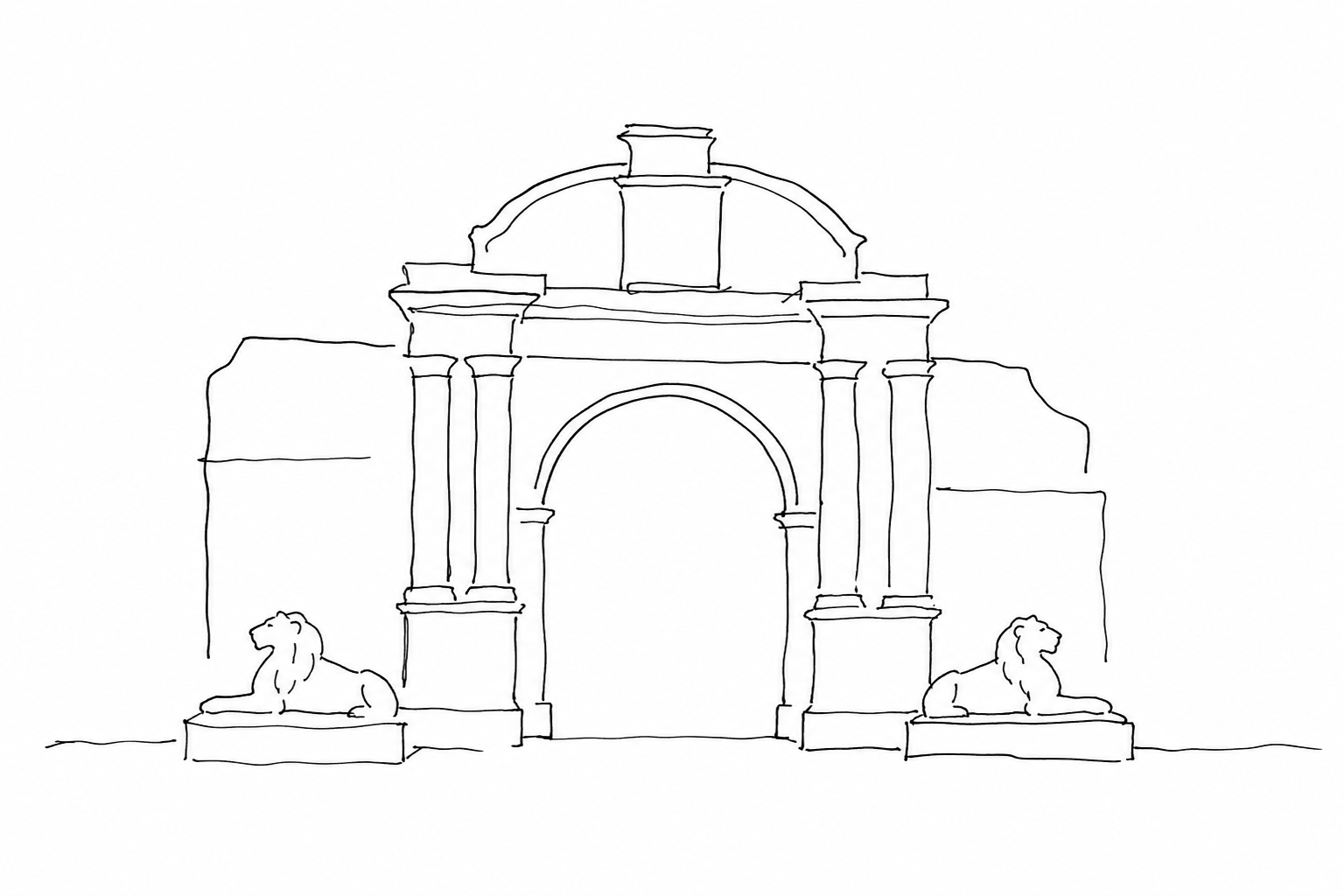
The Porta Magna, built in the mid-fifteenth century and traditionally attributed to Antonio Gambello, introduces the Arsenale with a language that is surprising for Venice: not the flowery Gothic of the palaces on the Grand Canal, but an all’antica composition, austere and celebratory. The central arch, framed by columns and architectural members in Istrian stone, recalls the Roman models of triumphal arches, transforming a military entrance into a declaration of public power.
The proportions are part of the message. The verticality is controlled, the surface is organized into legible registers, and the decorative apparatus does not overwhelm the structure: the formal discipline alludes to the productive discipline of the Arsenale, where ships, weapons and workers were organized as instruments of the State. Above, the Lion of Saint Mark dominates the façade and links the architecture to Venetian sovereignty.
This Renaissance choice is not only aesthetic: it presents Venice as a conscious heir of antiquity and as a power capable of transforming classical culture into carved propaganda, right at the entrance to its naval heart.
The lions: booty, memory and dominion over the sea
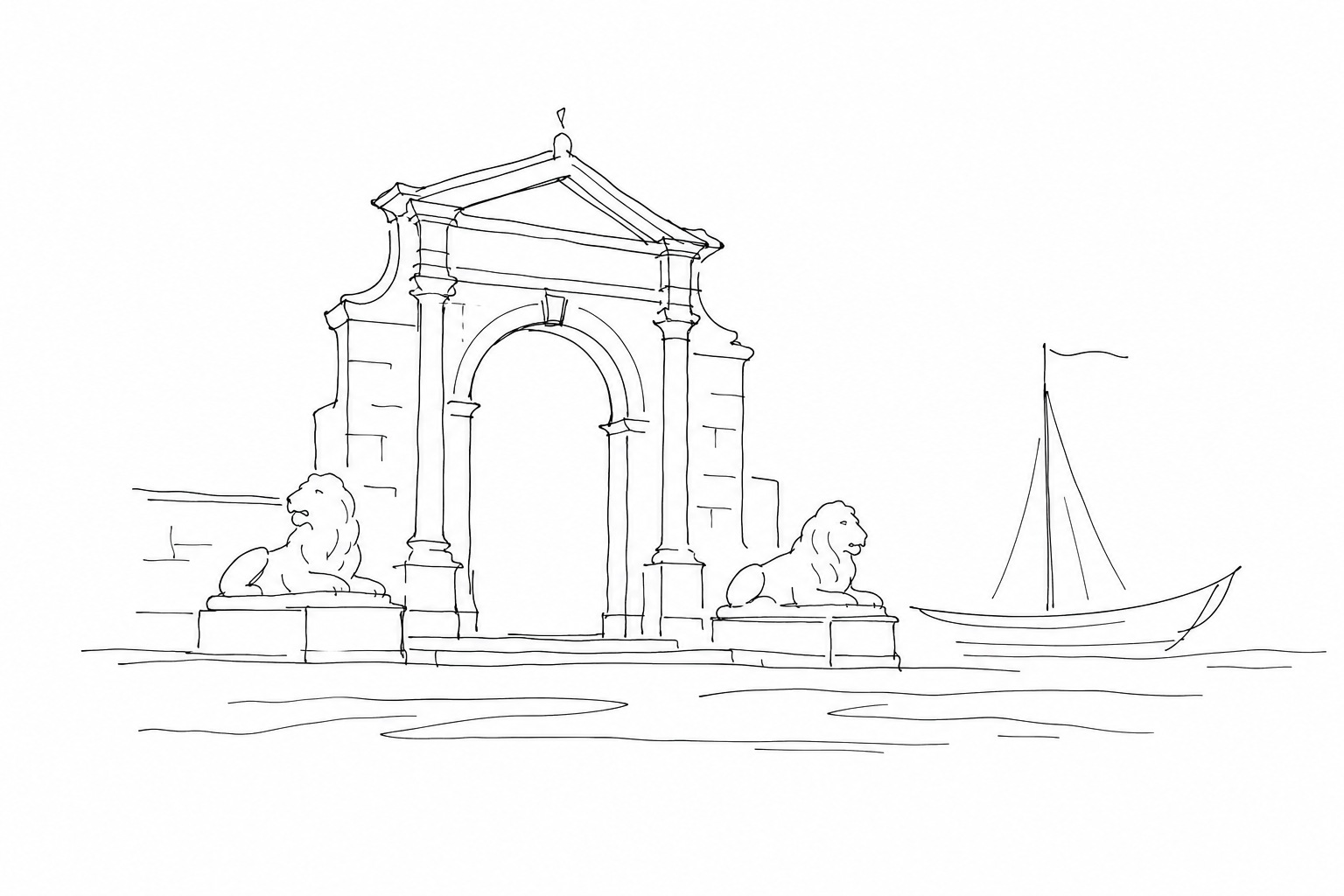
The four marble lions in front of the Porta Magna do not belong to the fifteenth-century project: they are an addition charged with political meaning, the result of the military campaigns and collecting of spolia by the Serenissima. They transform the entrance to the shipyard into a threshold watched over by ancient trophies, where sculpture becomes visible proof of conquest.
The most famous is the great Piraeus lion, taken in 1687 during the expedition led by Francesco Morosini against the Ottomans in Greece. Originally it stood near the Athenian port; on its flanks it preserves runic inscriptions probably carved by Scandinavian warriors in Byzantine service, a rare detail that adds a layered memory to the statue: Greek, Nordic and Venetian.
Alongside the other examples from the Aegean, the lion dialogues with the symbol of Saint Mark without fully coinciding with it: it does not hold the book nor show the wings of Saint Mark, but amplifies the idea of maritime dominion. Placing these animals in front of the entrance meant declaring that the Republic’s naval power was not limited to building fleets: it incorporated cities, ports, prestigious ruins and memories of the eastern Mediterranean.
Carved propaganda: what to observe today
To read the passage on site, it is best to step back a few meters and look at the façade on three levels. At the bottom is the military threshold: the controlled, austere passage, designed to separate the ordinary city from the strategic shipyard of the fleet. At the center dominates the language of the ancient triumphal arch, with columns, pediment and classical proportions: it is not simple ornament, but a way of presenting the Republic as heir to Rome.
Then look for the signs of Saint Mark: the winged lion, the coats of arms, the inscriptions, all elements that transform stone into political declaration. The message is twofold: inside, ships were produced; outside, the authority that those ships made possible was displayed. The ancient marbles placed in front complete the reading: they do not merely decorate, but add memory of conquest and control of the Mediterranean. The whole therefore functions as a visual manifesto, legible even without entering the complex.
In front of the Porta Magna, the Arsenale still appears as a threshold between the everyday city and strategic history. The façade, the lions, the coats of arms and the inscriptions should not be viewed as isolated details, but as parts of a narrative constructed to impress, remember and legitimize. Today this entrance makes it possible to better understand a less fragile and more operational Venice: maritime capital, military workshop, diplomatic power. Stopping here, even for just a few minutes, helps read the city beyond the surface of its best-known routes.
Related Posts
The Porta della Carta: entering the Doge’s Palace by reading stone, power and propaganda
A close reading of the Porta della Carta: ceremonial threshold, Gothic sculpture and political manifesto between St. Mark's and the Doge's Palace.The Molo of San Marco: columns, departures and the maritime power of the Serenissima
History and interpretation of the Molo of San Marco: the columns, the Basin, State departures and the language of Venetian power.
The Venice Arsenal: the place where the Serenissima built its power
History, spaces and meaning of the Arsenal, the productive and military heart of maritime Venice.Questions Answered
What is the Porta Magna of the Arsenale?
A monumental Renaissance entrance symbolizing Venetian naval and state power.What do the lions at the Porta Magna represent?
They are political trophies symbolizing Venice’s military conquests and maritime dominion.How does the architecture reflect Venetian power?
It recalls ancient triumphal arches to embody authority and continuity with antiquity.Why is the Porta Magna important to understand Venice?
It reveals the city’s naval strength, diplomacy, and strategic history beyond tourist views.
From the Arsenal walls to the lagoon
Want to see how labour, technology and the sea built a decisive part of Venetian power?
 The Arsenale ropewalks: where the ropes that held Venetian naval power together were bornHistory, function, and interpretation of the Arsenale ropewalks, the long space where Venice produced the ropes for its fleet.
 The Venice Arsenal: the place where the Serenissima built its powerHistory, spaces and meaning of the Arsenal, the productive and military heart of maritime Venice.
 The marangoni of the Arsenal: the wood artisans who built the strength of the SerenissimaHistory of the marangoni of the Arsenal, ship carpenters who transformed wood into galleys, hulls and Venetian maritime power.
 The Ships Pavilion: seeing Venice from the side of boats, not postcardsA route through the Ships Pavilion, among the Arsenale, historic boats and Venice seen from the water.