
At the foot of St. Mark’s Campanile, almost crushed by the monumental scale of the square, Sansovino’s Loggetta is one of those buildings that the eye passes over without really stopping. Yet, in its reduced dimensions, it concentrates a precise idea of Venice: civic power, architectural invention, richness of materials and control of urban space. Looking at it up close means reading a façade like a text, where columns, marbles and statues are not simple ornaments, but parts of a political and artistic narrative built in the heart of the Serenissima.
Where the Loggetta is and why it is little noticed
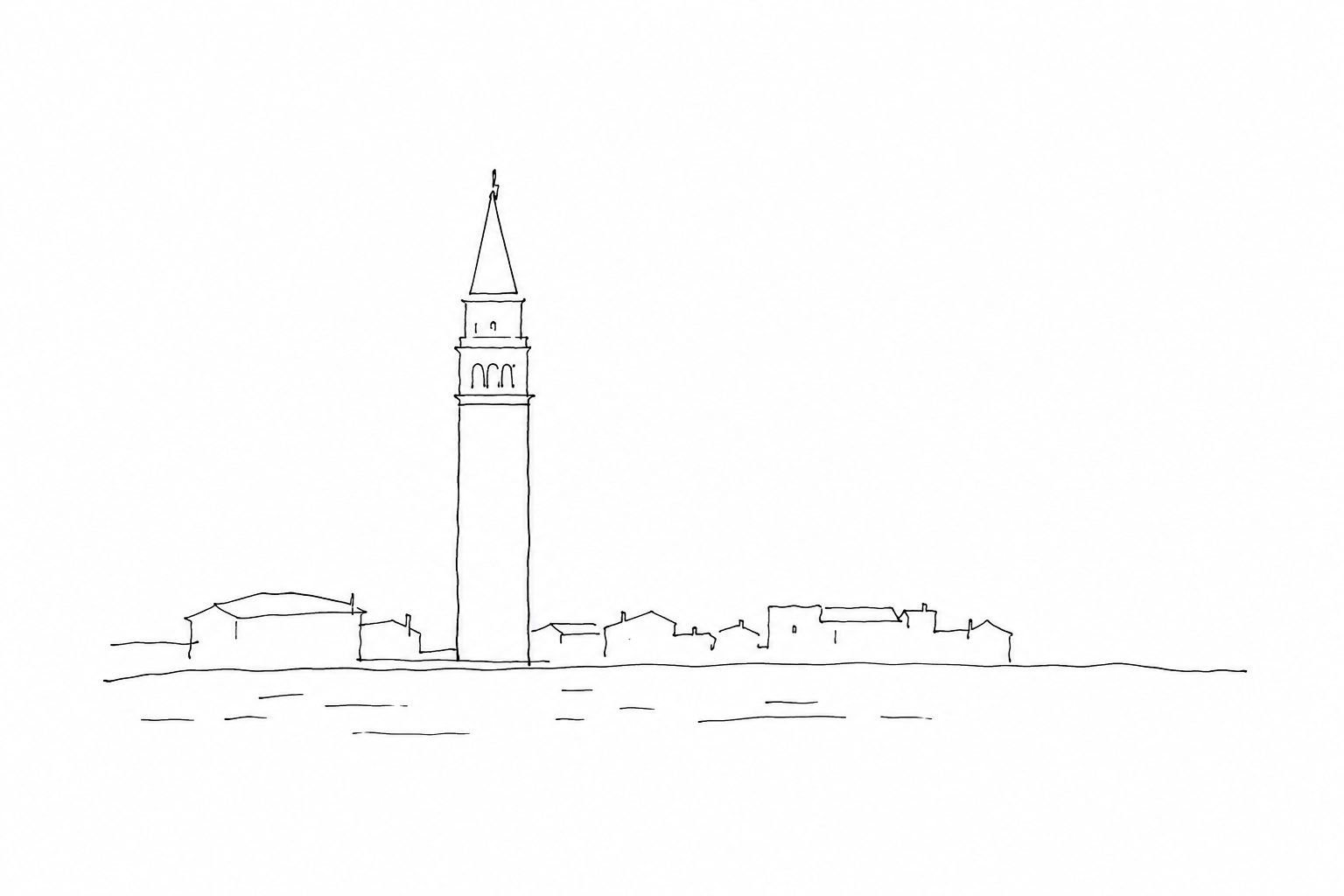
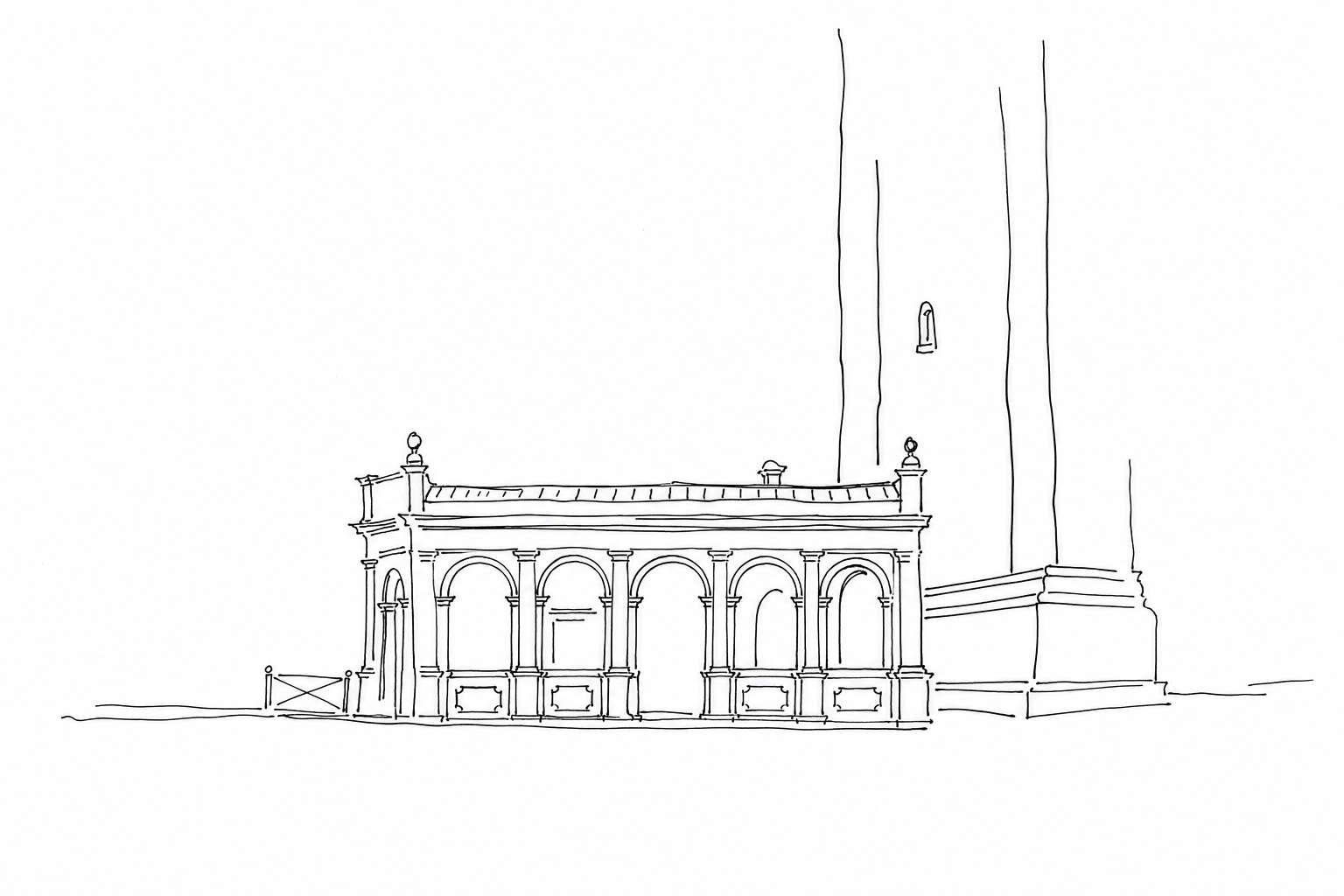
Sansovino’s Loggetta is located in the most exposed heart of Venice and, paradoxically, precisely for this reason it risks going unnoticed. It is set against the base of St. Mark’s Campanile, at the point where the great square opens toward the Piazzetta, the Marciana Library and the Doge’s Palace: a very dense urban threshold, where the eye is contested by the Basilica, the tower, the arcades of the Procuratie and the movement of visitors.
Its reduced dimensions contribute to the effect. Next to the Campanile, which dominates the space vertically, the Loggetta appears almost like a decorated base or a secondary entrance. In reality it is an autonomous building, designed by Jacopo Sansovino in the sixteenth century, intended to ennoble that strategic point of the square with marbles, columns, reliefs and bronze sculptures. To recognize it, one has to lower one’s gaze: not toward the top of the tower, but to its monumental root.
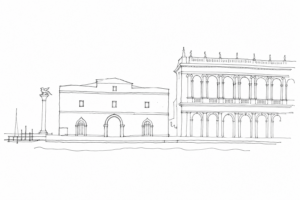
Sansovino, the Serenissima and a political façade
The Loggetta was born in the sixteenth century, when Venice entrusted Jacopo Sansovino with the task of updating the monumental image of St. Mark’s Square. A Florentine sculptor and architect, who arrived in the lagoon after the Sack of Rome, Sansovino became proto of the Procurators of St. Mark and worked on a program that transformed the Marciana area into a scene of civic power.
The small building at the foot of the Campanile was therefore not a simple ornament. It served as a place of representation and gathering for the patricians, connected to the institutional life of the Serenissima; later it was also associated with the presence of guards during the sessions of the Great Council. Its position, beside the tower and in front of the Doge’s Palace, made it a symbolic outpost in the most political point of the city.
The façade speaks the language of ancient Rome: columns, polychrome marbles, niches and bronze statues build a sort of miniature triumphal arch. The allegorical figures, between civic virtues and classical divinities, presented Venice as a wise, armed and prosperous republic. In just a few meters, Sansovino condensed architecture, sculpture and State propaganda.
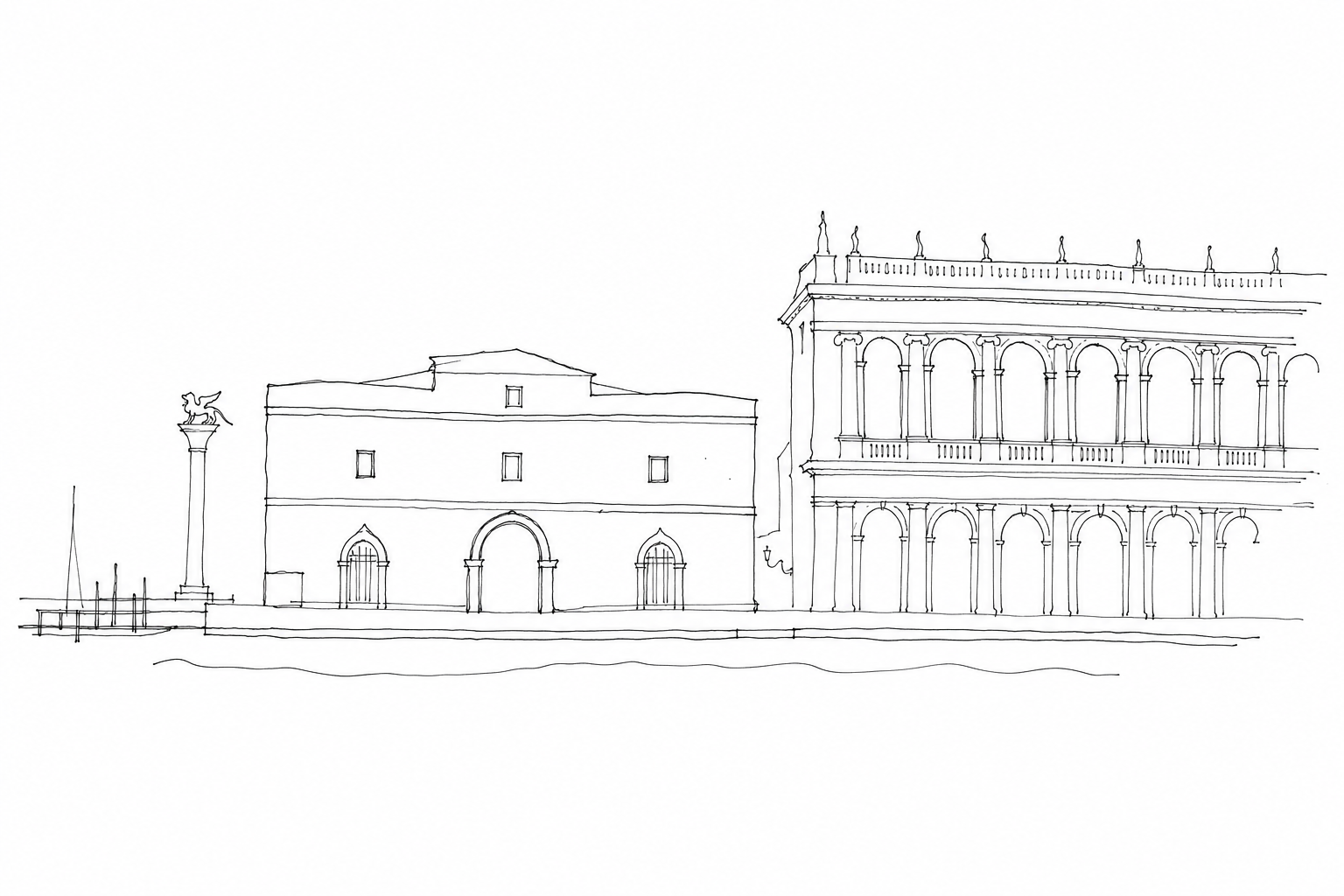
The front can almost be read like a sculpted page. At the base, the arches create a short but solemn rhythm: three openings framed by columns and pilasters make the building seem larger than it really is. The richness arises above all from the contrast between Istrian stone, colored marbles, dark backgrounds and bronze inserts, a combination designed to capture the mobile light of St. Mark’s Square.
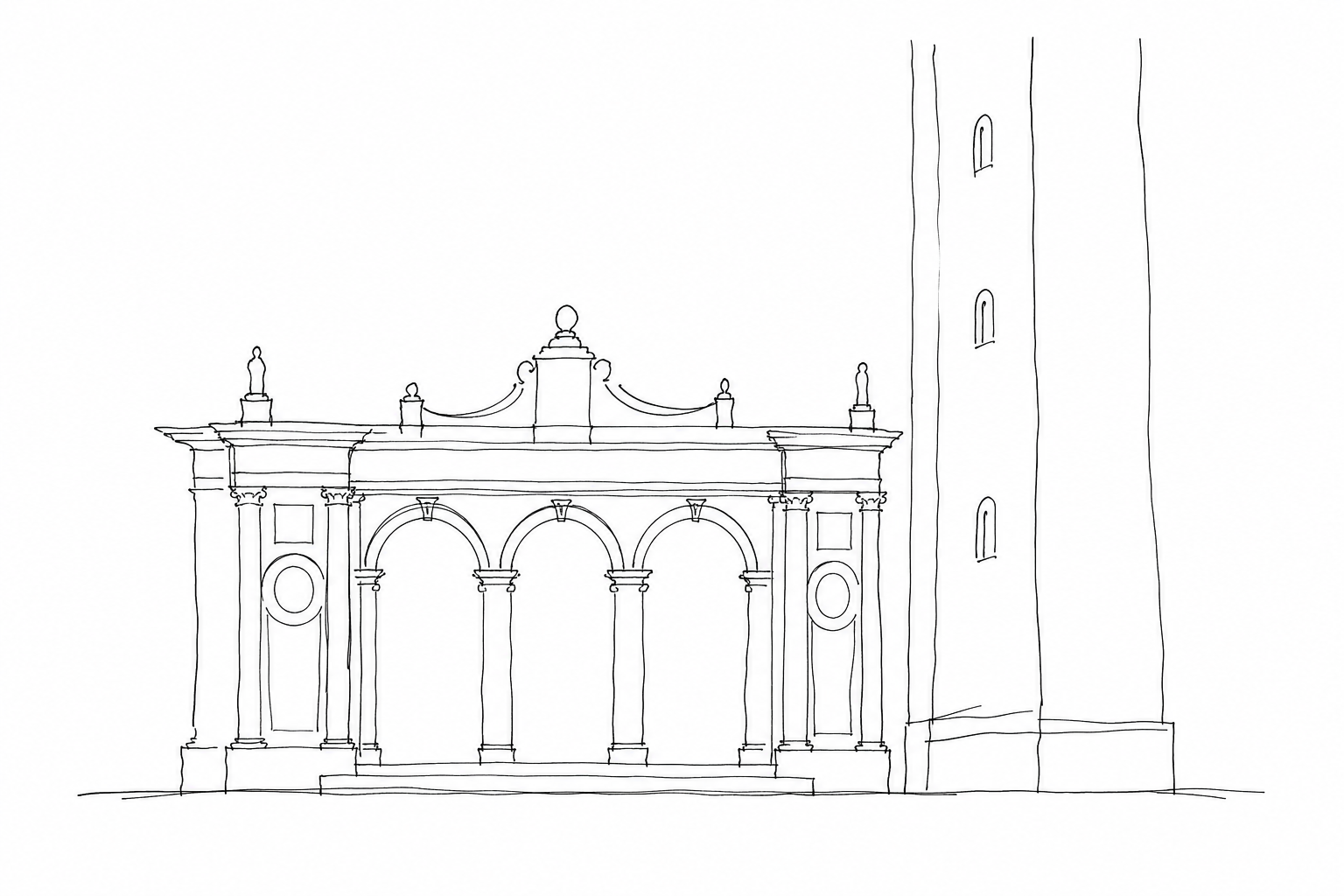
The columns are not simple supports: they order the gaze and separate the narrative zones. The capitals, cornices and sculpted profiles show the classicist taste of Jacopo Sansovino, who transferred to Venice an antique-style language without making it cold or purely archaeological. Every detail has a visual function: to give measure, prestige and depth to a very small volume.
The four bronze statues in the niches are the symbolic core of the front. Minerva recalls wisdom and defense; Apollo alludes to harmony and the arts; Mercury refers to exchanges and prosperity; Peace completes the political message, showing the Serenissima as an ordered, cultured and stable power. The bronze, darker than the marbles, makes the figures emerge as authoritative presences.
Above, reliefs and decorations complete the reading: not casual ornament, but a coherent program. As one approaches, it becomes clear that this small building at the foot of the Marciana tower concentrates precious materials, sculpture and architecture in a manifesto-façade.
The collapse of the tower and the recomposition of the Loggetta
On July 14, 1902, the sudden fall of the Marciana tower also overwhelmed the Renaissance structure at its foot. It was not marginal damage: columns, marbles, reliefs and decorative parts ended up broken under the rubble, abruptly interrupting the material continuity of the sixteenth-century work.
The reconstruction was not conceived as a free invention. The recovered fragments were identified, catalogued and reinserted where possible; the missing parts were integrated to restore the architectural and iconographic whole. For this reason, looking closely, some joints, variations in tone in the marble and more regular surfaces tell a second story: that of the twentieth-century rescue.
Visiting this space today therefore means reading two overlapping times: Jacopo Sansovino’s project and the patient recomposition after the disaster. For any access methods or internal visit, it is prudent to check updated information with official sources.
Sansovino’s Loggetta invites you to slow down in one of the most crowded points of Venice. Its history is not exhausted in the beauty of the façade: it passes from the daily function of a guard post, from the symbolic ambition of the Republic, to the recomposition after the collapse of the Campanile in 1902. Today it remains a building that is small only in appearance, capable of conveying, in just a few meters, the complexity of St. Mark’s and its architecture. Stopping to observe it is a concrete way to better see everything around it as well.
Related Posts
The Scuola Grande di San Marco: the most elegant façade in front of the civil hospital
A reading of the Scuola Grande di San Marco, from its confraternal history to the Renaissance façade that today stands in front of the Civil…The Venice Mint: Coins, Metal, and Public Trust Beside the Marciana Library
History and urban reading of the Venice Mint, between coinage, solid architecture, and public role on the Molo of San Marco.
The Porta della Carta: entering the Doge’s Palace by reading stone, power and propaganda
A close reading of the Porta della Carta: ceremonial threshold, Gothic sculpture and political manifesto between St. Mark's and the Doge's Palace.Questions Answered
Where is Sansovino’s Loggetta located and why is it often overlooked?
It is at the base of St. Mark’s Campanile but overshadowed by larger monuments.What was the political and artistic purpose of the Loggetta?
To symbolize Venice’s civic power through sculpture and architecture.What do the bronze statues in the Loggetta represent?
They symbolize wisdom, arts, prosperity, and peace as virtues of Venice.How was the Loggetta restored after the collapse of the Campanile?
Using catalogued fragments and integrating missing parts to preserve the original design.
From the square to the rooms of power
Would you like to follow other places showing how Venice represented itself at the heart of St Mark’s?
 The Venice Mint: Coins, Metal, and Public Trust Beside the Marciana LibraryHistory and urban reading of the Venice Mint, between coinage, solid architecture, and public role on the Molo of San Marco.
 The Golden Staircase of the Doge’s Palace: ascending toward power amid stucco and political controlThe Golden Staircase as a political threshold of the Doge’s Palace: architecture, stucco, access and messages of power in the Venice of...
 The Giants’ Staircase: where the doge became doge before the cityHistory, ritual and details of the Giants’ Staircase in the courtyard of the Doge’s Palace.
 St Mark’s Campanile: looking at Venice from above without forgetting that it is a reconstructionClimbing St Mark’s Campanile means reading Venice from above and remembering the collapse of 1902, the reconstruction and the urban meaning of...