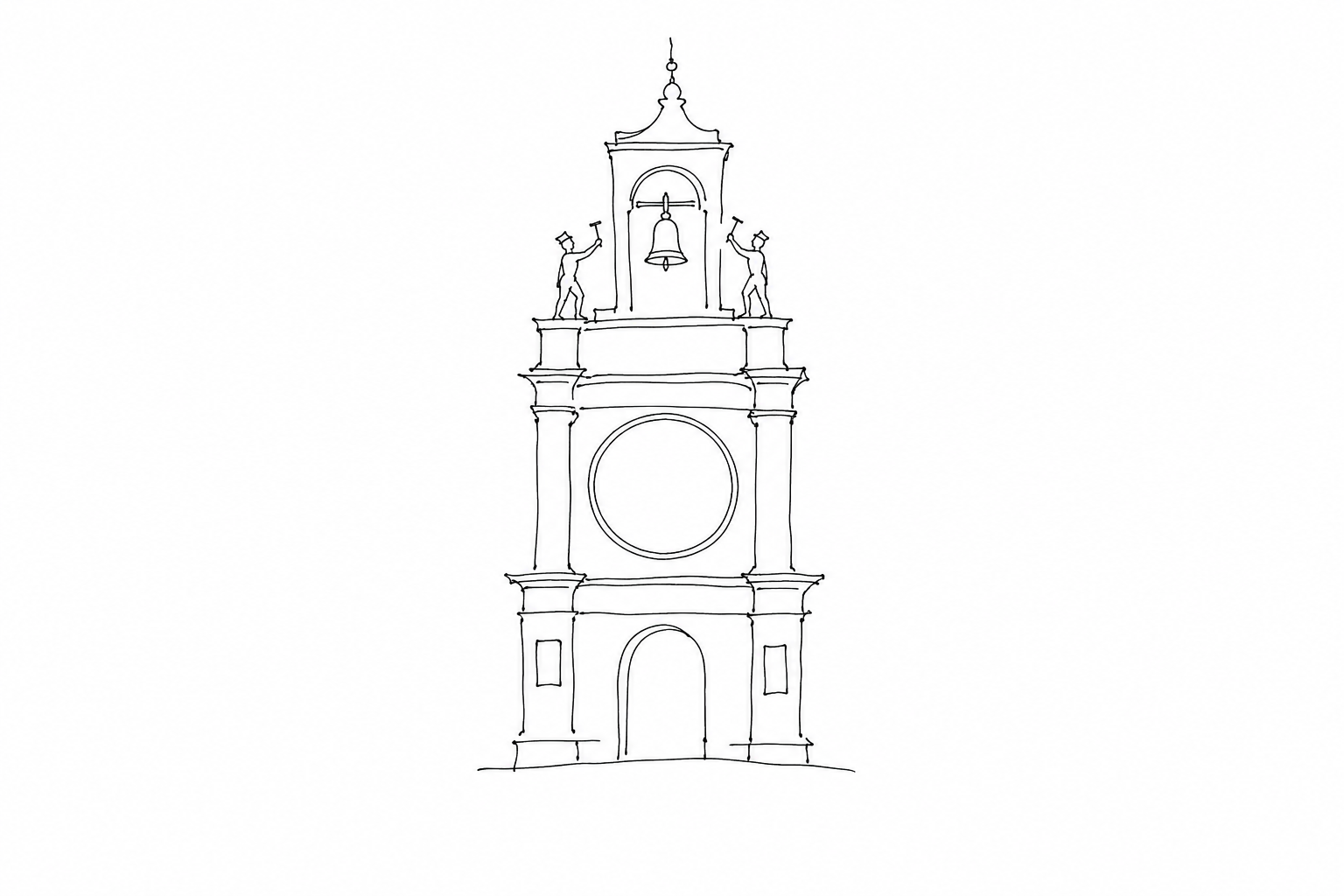

Above St. Mark’s Square, two dark figures raise their hammers and mark time with an ancient gesture, visible from afar yet often observed only in passing. The so-called Moors of the Clock Tower are not a simple scenic detail: they are part of an urban machine designed to speak to the city, to merchants, to travelers, to Venetian power. Understanding who they are, where they are located, and why they strike the hours helps you read St. Mark’s beyond the surface of wonder.
The Moors are located at the top of the Clock Tower of St. Mark’s, on the northern side of the Square, where the building’s arch leads into the Mercerie. Their position is not secondary: they stand above the large astronomical dial, higher than the Lion of St. Mark and the Madonna and Child, almost closing the façade vertically.
They are two bronze figures, darkened by the patina of time; for this reason, in Venetian speech, they became the Moors. They do not simply represent two men: they are monumental automatons charged with giving bodily form to time. At set intervals they strike a large bell with their hammers, transforming the hour into a visible and audible gesture.
They are immediately noticeable because they occupy a theatrical point in the city: anyone entering St. Mark’s Square from the Mercerie naturally raises their gaze toward the clock, and above the dial sees those two still silhouettes, ready to move. In Venice, public time also passes through there.
The name is misleading. The two figures at the top of the Clock Tower are called Moors not because they necessarily depict North African or Muslim men, but because of the dark appearance assumed by the bronze exposed to the salty air. The blackened patina transformed the nickname into a popular identity, stronger than any official definition.
In reality, the figures appear as two sturdy shepherds or guardians, bare-chested, with skins and hammers. Their physiognomy is not aimed at ethnic portraiture: what matters is the mechanical, powerful, almost archaic gesture with which they strike the great bell. It is precisely this simplicity that makes them recognizable even from afar.
The pair also introduces a symbolic contrast: one has more mature features, the other younger ones. Venice thus reads the hour not only on the dial, but also through two different bodies, one linked to the past and the other to the advance of the present. The dark bronze, therefore, does not conceal the meaning: it concentrates it in two memorable silhouettes above St. Mark’s.
Why they strike the hours over the city
Their gesture does not serve only to amaze those who look at the Clock Tower from St. Mark’s Square. When the hammers strike the great bell, the hour becomes a public signal: audible, recognizable, shared by merchants, sailors, magistrates, confraternities, and inhabitants.
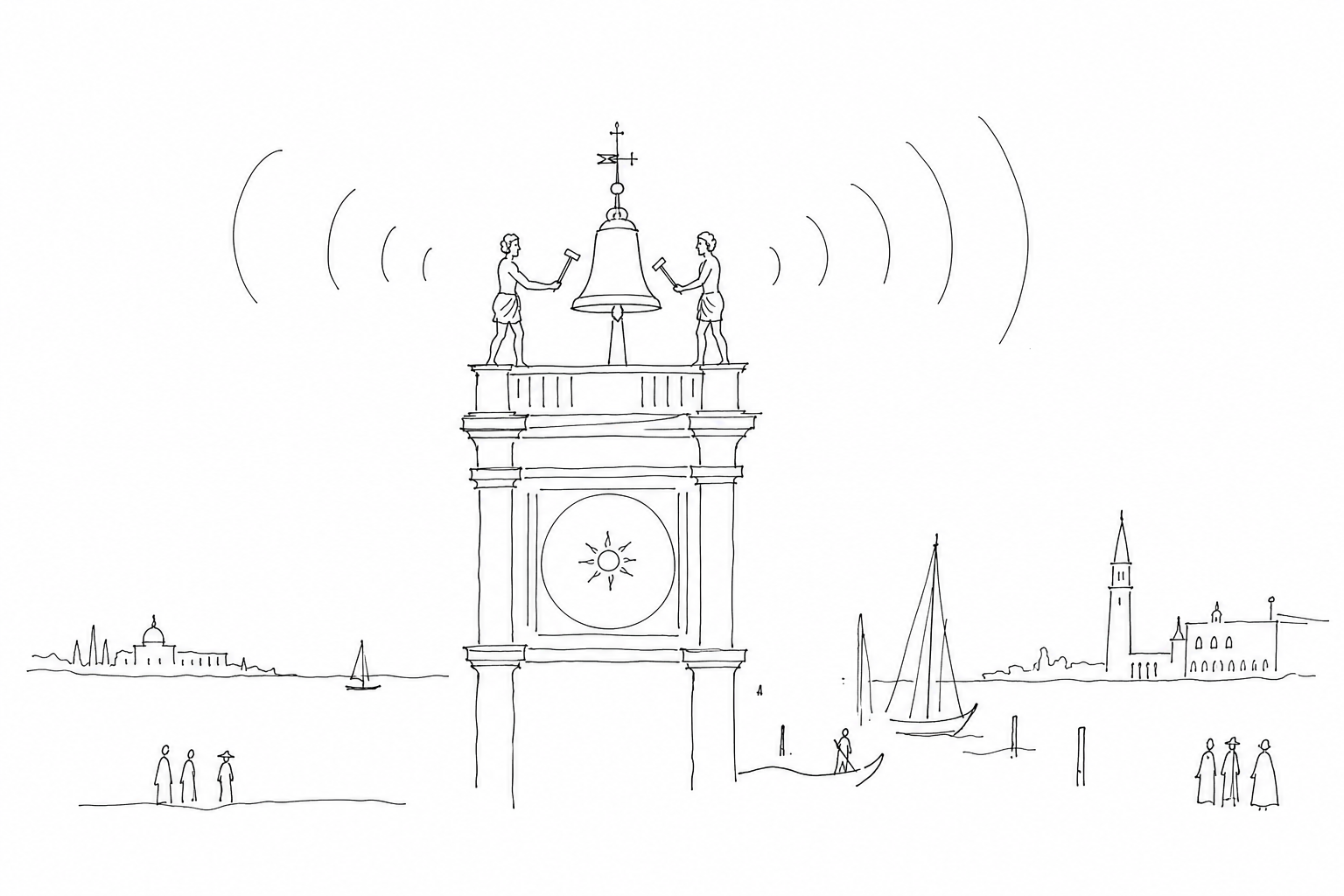
In Renaissance Venice, the measurement of time had decisive practical value. It regulated openings, hearings, exchanges, departures in the lagoon, religious functions, and administrative life. Bringing that signal to the most representative point of city power meant transforming punctuality into civic order.
The striking also had a strong symbolic value. The two figures do not indicate the hour discreetly: they proclaim it with a physical action, visible from afar and linked to the sound of bronze. In a city built on trade, routes, and collective decisions, time does not remain private: it belongs to the community.
Since 1499, the year the tower was inaugurated, this mechanism has combined technique, urban theater, and public authority. The statues strike the hours because Venice wanted the city’s rhythm to have an official voice, placed in the political and ceremonial heart of the city.
How to look at them today, without stopping at curiosity
To read them in person, it is best to start from a distance. In St. Mark’s Square, do not immediately look for the detail: first observe the silhouette of the two bronze figures against the sky and the bell in the center. Their high position is not accidental: it transforms a mechanism into a signal visible even to those crossing the public space.
As you get closer, then notice the difference between the two bodies. Tradition interprets them as a mature man and a younger one, a pair that alludes to the passage of time without the need for words. The dark patina of the bronze encouraged the popular name of Moors, but the essential point is their role: they do not merely decorate the Clock Tower, they set it in motion.
During the visit, compare them with the dial below, rich in astronomical and religious signs. Above, the gesture is simple, sonorous, almost theatrical; lower down, the reading becomes learned and symbolic.
Looking at the Moors today means pausing on a precise point of the Venetian landscape and recognizing how art, technique, and daily life have been intertwined for centuries. Great explanations are not needed to notice them, but a few more details change your gaze: the blackened bronze, the measured movement, the position above the flow of the square. In a few hammer blows, these figures remind us that Venice is not only image, but also rhythm, work, ingenuity, and shared time.
Related Posts
The Clock Tower: Moors, gears and Venetian time above St. Mark’s Square
History and interpretation of St. Mark’s Clock Tower: Moors, dial, automata and Venetian public time.Campo dei Mori: statues, merchants and legends carved on the walls of Cannaregio
A brief guide to Campo dei Mori, among walled-in statues, eastern merchants and legends of Cannaregio.
The Molo of San Marco: columns, departures and the maritime power of the Serenissima
History and interpretation of the Molo of San Marco: the columns, the Basin, State departures and the language of Venetian power.Questions Answered
Where are the Moors located on St. Mark’s Clock Tower?
They stand at the top, above the astronomical dial on the northern side.Why are the figures called the Moors?
Because their bronze darkened by time resembles the skin tone attributed to Moors.What is the symbolic meaning of the two Moors?
They embody time’s passage with one mature and one younger figure.What is the purpose of the Moors striking the bell?
To make the hour audible and visible, regulating civic life in Venice.
St Mark’s seen through its details
Want to connect architecture, ceremony and power without stopping at the postcard view?
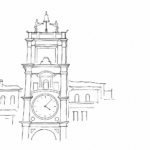 The Clock Tower: Moors, gears and Venetian time above St. Mark’s SquareHistory and interpretation of St. Mark’s Clock Tower: Moors, dial, automata and Venetian public time.
 St Mark’s Campanile: looking at Venice from above without forgetting that it is a reconstructionClimbing St Mark’s Campanile means reading Venice from above and remembering the collapse of 1902, the reconstruction and the urban meaning of...
 The Procuratie up close: how St. Mark’s Square became a perfect urban machineThe Procuratie read up close: architecture, power, porticoes and the urban rhythm of St. Mark’s Square.
 The floor of St. Mark’s: marble waves, geometries and the feeling of walking on waterA journey across the floor of St. Mark’s Basilica: marbles, waves, geometric mosaics and a slow reading of a Venetian detail.