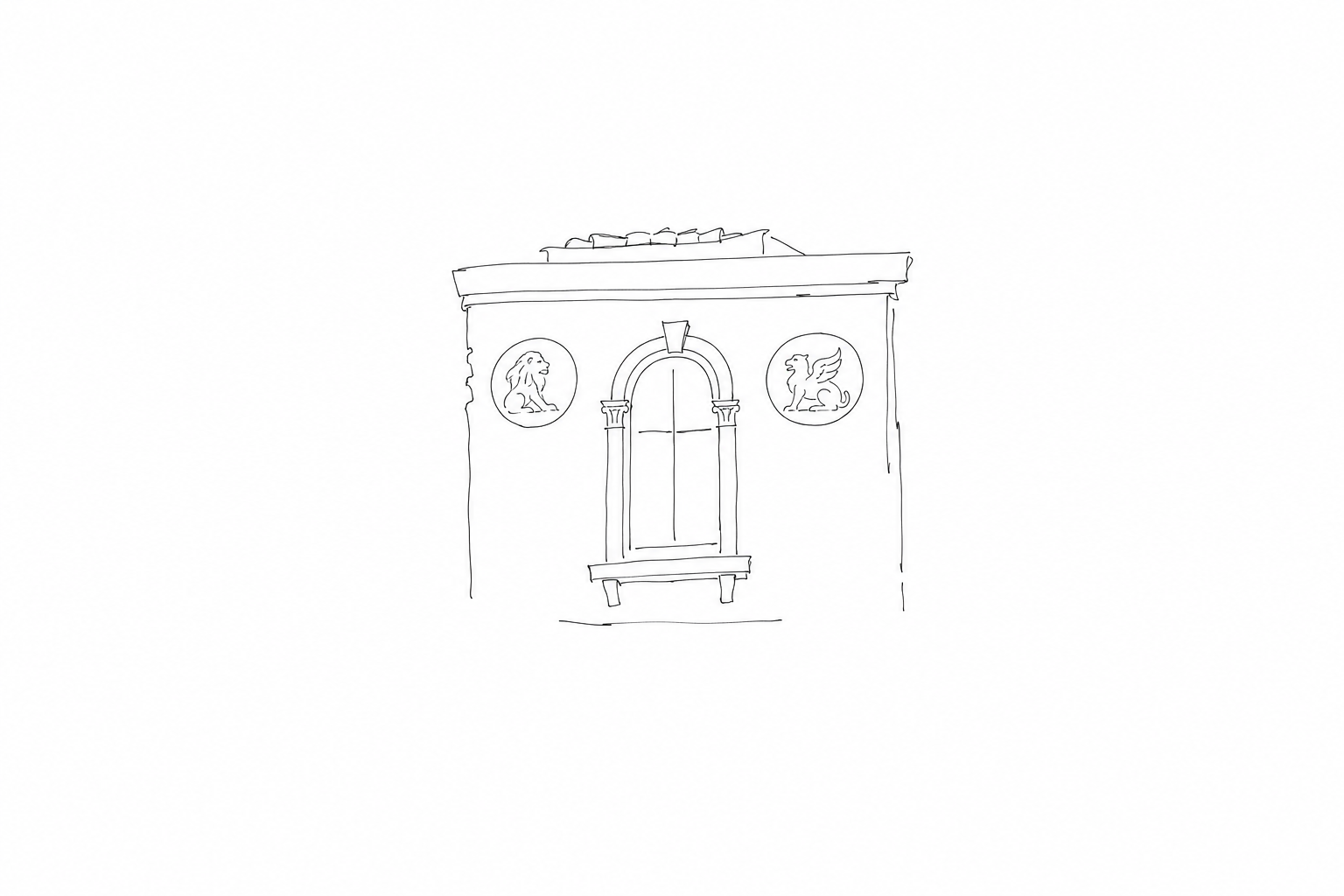

On Venetian façades, often just above eye level, small discs of carved stone appear: facing animals, birds, lions, fantastic creatures, interlacings and figures worn by time. They are paterae, walled-in fragments that tell of a precise taste for reuse, decoration and prestige. They are not simple ornaments: they carry with them Byzantine traces, trade, medieval building sites and a Venetian way of transforming materials and symbols into a living part of the city.
What Venetian paterae are
Venetian paterae are discs or panels of carved stone, often in Greek marble or Istrian stone, walled into the façades of houses, palaces and churches in the lagoon. The name recalls the Latin patera, a shallow ritual cup: the circular shape of many examples derives precisely from this idea of a sacred or auspicious object.
In Venice they appear mainly between the 11th and 13th centuries, when the city looked to the Byzantine East and imported materials, craftsmen and decorative models. Many paterae were inserted as ornament and as a sign of prestige; others may have been reused elements, coming from older buildings or from Mediterranean contexts reached by Venetian trade.
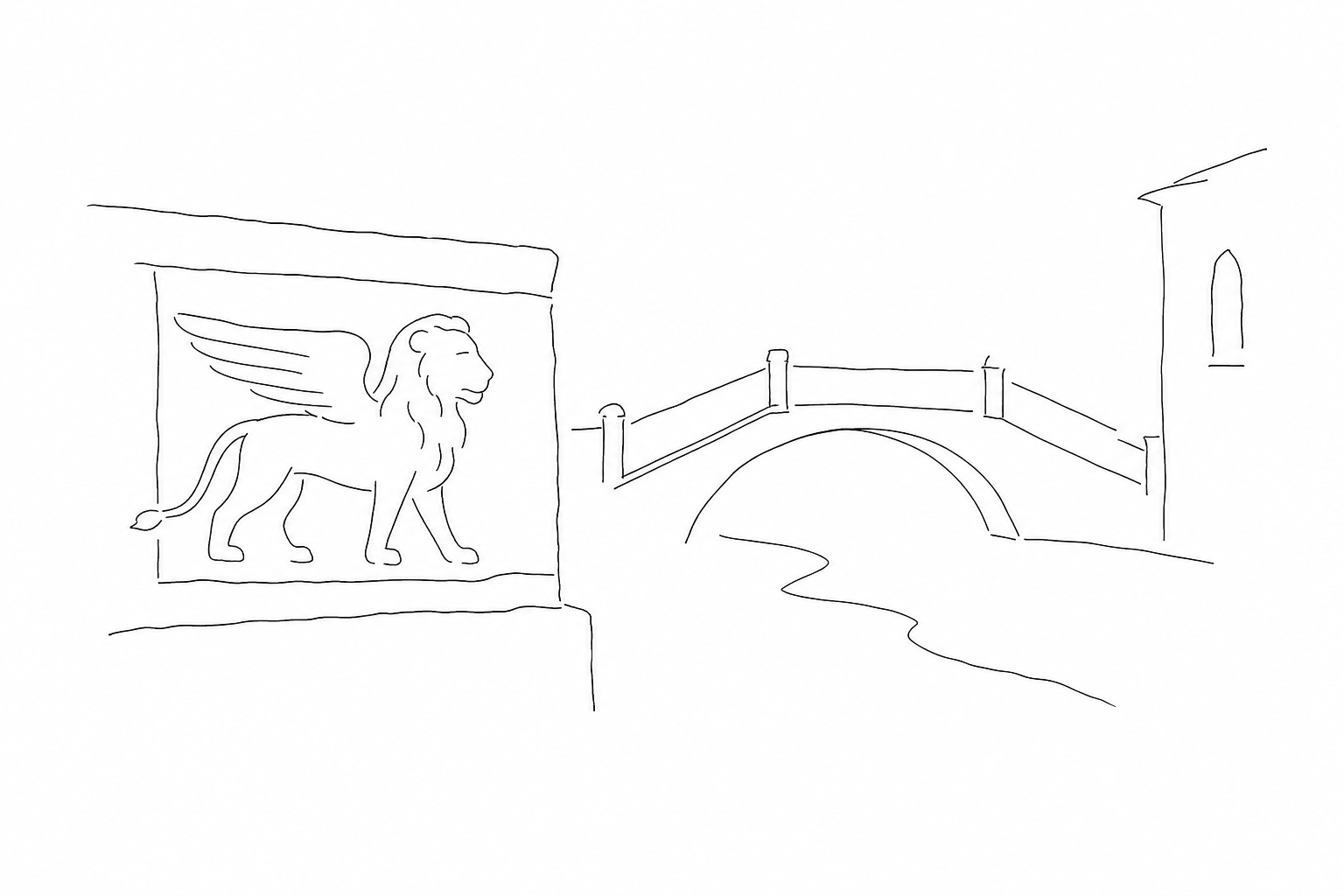
The most recognizable motifs are facing animals, lions, griffins, eagles, peacocks, crosses and vegetal interlacings. They are not simple decorations: they alluded to protection, strength, salvation and good omen, transforming the façade into a symbolic surface readable from the street or from the canal.
Byzantine origin, reuse and Venetian taste
Many Venetian paterae derive from the Byzantine horizon: carved discs, slabs and decorative fragments arrived in the lagoon through trade routes that connected Venice to Constantinople, the Aegean and the Levant. Not everything should be read as booty: alongside materials that arrived after the Fourth Crusade of 1204, pieces circulated that were purchased, recovered, reused or imitated by local craftsmen.
Reuse, that is spolio, had a practical and symbolic value. An ancient or eastern stone gave prestige to the house, declared familiarity with the sea and with Mediterranean markets, and brought to the façade a recognizable language: facing griffins, peacocks, lions, eagles, crosses, rosettes and tendrils. These motifs, frequent in Byzantine and Romanesque art, were adapted to Venetian taste, more narrative and urban.
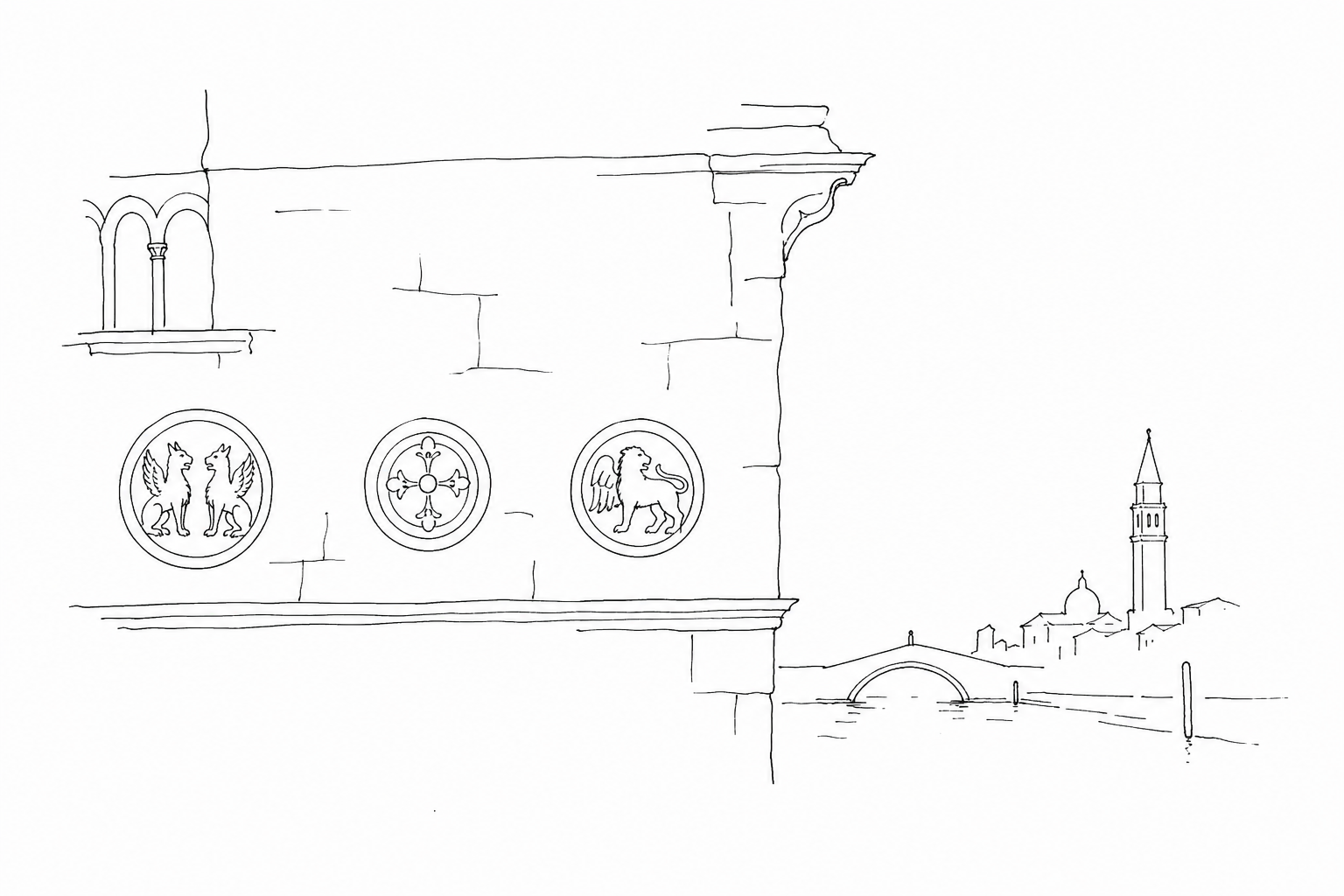
Walling a panel into the wall did not mean only decorating. It was a way to transform goods, memories of travel and sacred or noble fragments into city identity. The Venetian façade thus became an archive of stone, visible from calli and canals.
Animals, struggles and symbols: a quick reading
To observe Venetian paterae it is best to start from the scene, not from the single animal. Two creatures facing each other, often separated by a tree, a vase or a tendril, indicate a symmetrical order: an image of balance, abundance or guardianship. If instead a beast bites a deer, a hare or a bird, the theme becomes struggle: strength against fragility, instinct against salvation, or simply a decorative motif inherited from eastern repertoires.
- Lions and griffins: figures of power and vigilance, suited to thresholds, courtyards and exposed façades.
- Eagles: they recall authority, height and dominion; in Byzantine stones they often appear with wings spread.
- Peacocks: linked to immortality and splendour, recognizable by their tail and frontal bearing.
- Serpents and dragons: ambiguous signs, sometimes threatening, sometimes protective if placed in an apotropaic function.
- Tendrils, rosettes, palmettes: not simple fillers, but signs of fertility, continuity and Byzantine ornamental taste.
The reading should not be understood as a fixed dictionary: the same animal can change value according to position, pair, gesture and place on the wall. Precisely this ambiguity makes the reliefs so Venetian: ancient fragments readapted to new façades, where the symbol remains visible even when the original meaning has become uncertain.
Where to look without turning them into a treasure hunt
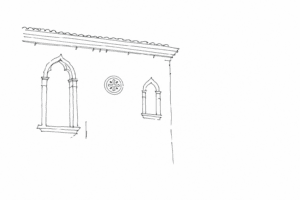
The best way to encounter these reliefs is not to compile a list of addresses, but to raise your gaze in the oldest and most inhabited parts of the city: between Rialto and San Polo, in the calli of Cannaregio, in Castello, around campi where the houses preserve irregular masonry and marble inserts. Often the discs are not at the centre of the composition: they appear above a portal, near a window, at the height of the first floor, or walled in next to other Byzantine fragments.
It is best to observe them with a slow pace, without blocking passage or taking photographs while invading private thresholds. The raking light of morning or late afternoon helps to read paws, wings, interlacings and worn frames. Looking at the context is decisive: a stone reused on a merchant house tells both the eastern origin of the fragment and the Venetian choice to display it in everyday life.
Observing Venetian paterae means changing rhythm: raising your gaze, stopping in front of a façade, distinguishing a figure almost erased by humidity or by light. There is no need to seek them as trophies, but to let them emerge along calli, campi and courtyards, where they dialogue with bricks, arches, coats of arms and windows. In those small walled-in reliefs Venice shows one of its subtlest qualities: preserving fragments of distant worlds and making them become everyday details.
Related Posts
Venetian patere: small Byzantine reliefs set into facades that almost no one notices
A brief guide to Venetian patere: what they are, where they come from, what figures they show and how to recognize them on the facades…Votive shrines in the calli: everyday religiosity hidden on the corners of Venice
Guide to the votive shrines in the calli of Venice: origin, forms, places and urban reading.
Hidden St. Mark’s lions: where to look for Venice’s symbol away from the flags
A guide to the less obvious St. Mark's lions: reliefs, coats of arms, stones and façades to observe among calli, campi and the lagoon.Questions Answered
What are Venetian paterae?
They are carved stone discs or panels walled into façades with symbolic and decorative roles.What is the origin of Venetian paterae?
Many derive from Byzantine sources and arrived through trade or reuse of older materials.What do the animal motifs symbolize on these paterae?
Motifs like lions and griffins represent power, protection, and good omen.Where is the best place to see Venetian paterae in the city?
In older, inhabited parts like Rialto, San Polo, Cannaregio, and Castello.
Keep looking at Venice through details
Want to move from this feature to urban signs that are easy to miss on a quick visit?
 Votive shrines in the calli: everyday religiosity hidden on the corners of VeniceGuide to the votive shrines in the calli of Venice: origin, forms, places and urban reading.
 Salizada: the oldest Venetian streets and the sign of routes that were already importantWhat a salizada indicates in Venice: origin of the name, paving, historic routes and urban interpretation among calli, campi and sestieri.
 Venetian sottoporteghi: small urban tunnels where the city suddenly changes rhythmGuide to Venetian sottoporteghi: covered passages between calli, campi and rii, urban thresholds where light, sound and pace suddenly change.
 The mascareta: small, agile and Venetian, long before the regatta photosHistory and use of the mascareta, a light boat created for rii, canals and the lagoon.