
At San Pantalon the gaze rises almost by instinct: above the nave, the ceiling seems to open into a boundless vision, populated by bodies, light and movement. The surprise does not depend only on the scenic effect, but on the way it is constructed: not a fresco, as one would expect in a church, but an immense painted canvas, a typically Venetian visual machine. Understanding this difference helps to read Gian Antonio Fumiani’s work better, its relationship with the real space of the church and with a city accustomed to transforming painting, architecture and daily life into a single theater.
Why the ceiling of San Pantalon surprises immediately
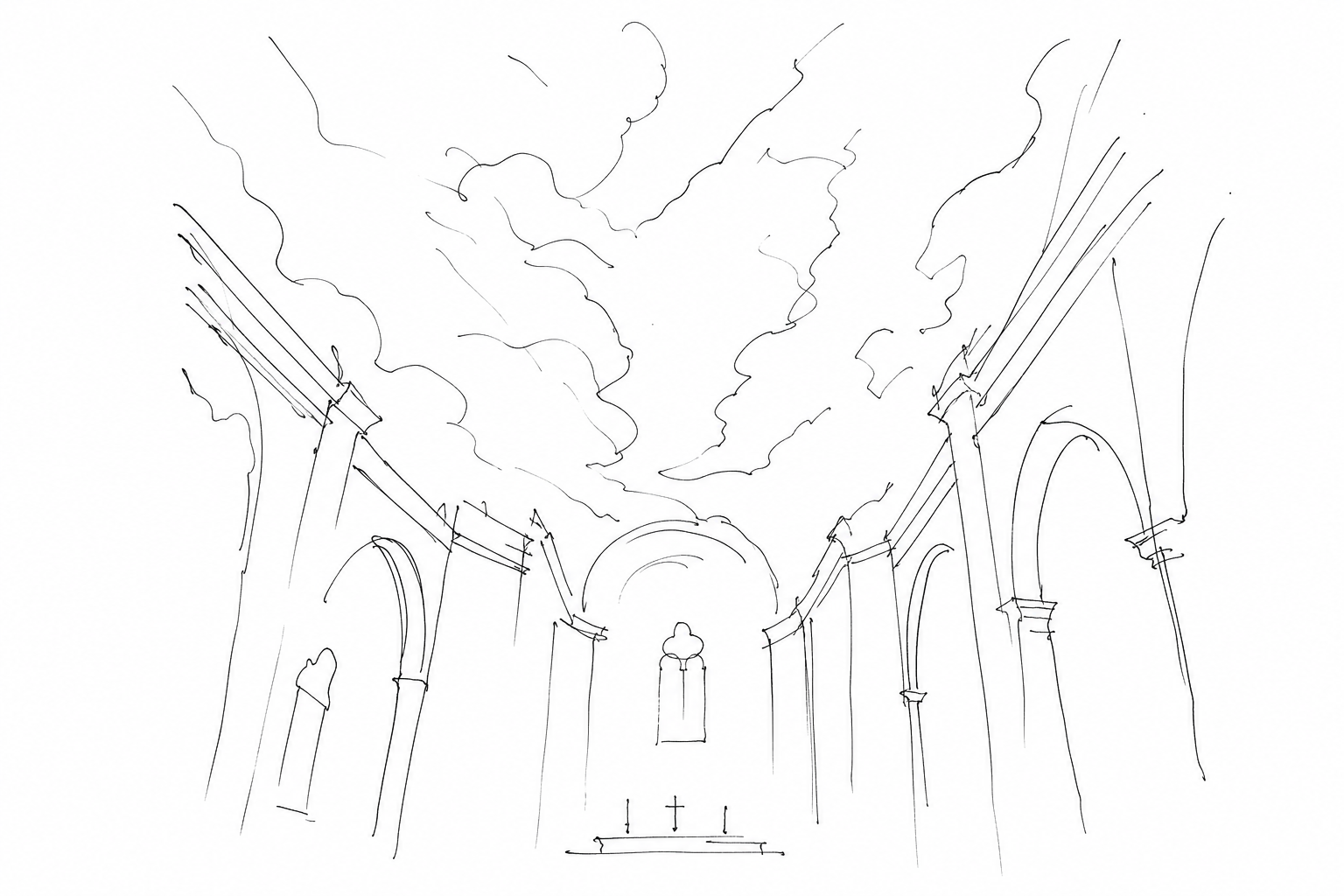
Entering San Pantalon, in the Dorsoduro district, the gaze is drawn upward by an almost theatrical effect: the nave seems to open, as if the roof had been broken through by a moving sky. The surprise also comes from a decisive detail: it is not a fresco. The great ceiling is composed of canvases painted in oil, mounted together until they transform the entire covering into a single scene.
The work, attributed to Giovanni Antonio Fumiani and created between the end of the seventeenth century and the beginning of the eighteenth century, represents the martyrdom and glory of Saint Pantaleon, a physician and Christian martyr. Figures, painted architectures and clouds are constructed with illusionistic perspectives: columns and frames seem to continue beyond the real space of the church, while the figures appear suspended above the faithful. It is this visual deception, more than size alone, that makes San Pantalon immediately memorable.
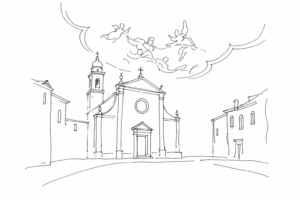
The ceiling of San Pantalon is not a fresco: it does not arise from color absorbed by still-wet plaster, but from a vast pictorial machine composed of canvases painted in oil and mounted above the nave. This is a decisive fact, because it explains both the brilliance of the tones and the complexity of the whole: the artist could work on portions of canvas, correct, glaze, intensify the shadows and then make the parts fit together into a single visual field.
The work is attributed to Giovanni Antonio Fumiani, who worked on it between the end of the seventeenth century and the beginning of the eighteenth century. The subject is the Martyrdom and glory of Saint Pantaleon, developed over an immense surface, often indicated as about 443 square meters. The Venetian tradition of the telero, that is, large painting on canvas intended for walls or ceilings, is here pushed to a spectacular limit.
The fiction of the breakthrough also depends on perspective: painted architectures, clouds, figures foreshortened from below and areas of light are calculated to be read from the nave. It is not only a scene “hung” on the ceiling, but an optical device built to transform the wooden covering into open sky.
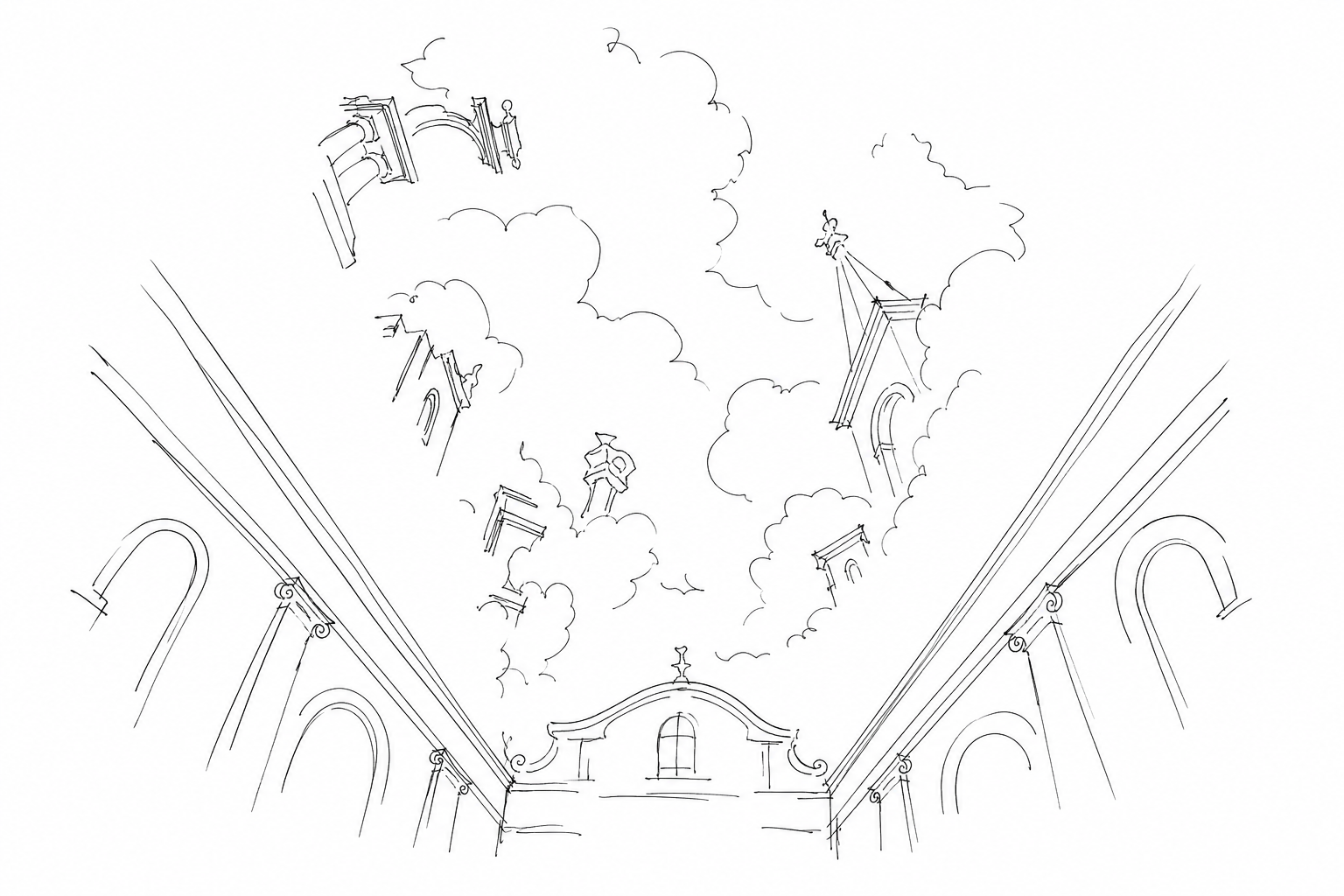
Giovanni Antonio Fumiani’s visual direction does not ask the viewer to look at a single, flat scene, but to follow its ascent. The great telero dedicated to the martyrdom and glory of Saint Pantaleon functions like a theatrical construction: below is the earthly narrative, with foreshortened bodies, executioners, instruments of torture and agitated gestures; higher up the scene opens into a celestial vision, where angels, clouds and light guide the eye toward the triumph of the saint.
The decisive point is perspective. Fumiani uses false columns, painted architectures and diagonal cuts to make it seem as though the covering of the nave opens beyond its real limits. The figures are not distributed neutrally: some plunge toward the observer, others recede into an imaginary depth. This continuous passage between near and far produces the effect of breakthrough.
The best reading starts from the center of the nave, not from the edges. From there the perspective distortions recompose themselves and the movement becomes legible: the martyrdom does not remain only a narrative episode, but is transformed into a spiritual ascent. It is here that the work reveals its Baroque nature: it does not simply illustrate a story, but organizes the space of the church as a visual experience in motion.
How to look at it inside the church
To truly read the great canvas, it is best not to stop immediately under the entrance. Move forward into the nave and look for a central point: from there the whole recomposes itself, the figures seem to rise and the painted architecture dialogues better with the real one.
- First look at the perimeter: observe where the real masonry ends and where the painted opening begins. It is the boundary that makes the “breakthrough” believable.
- Then follow the diagonals: bodies, clouds and gestures are not distributed at random, but guide the gaze upward.
- Finally look for the material: it is not a fresco on plaster, but an enormous cycle in oil on canvas, composed of several parts. The joins and the different rendering of the surface help to understand its technique.
It is also worth moving toward the sides: the illusion changes, and precisely these variations reveal the ingenuity of the visual construction.
Looking at the ceiling of San Pantalon requires a few minutes of slowness: it is not enough to recognize the illusionistic effect, one must follow its directions, the apparent fractures, the point where the painted canvas seems to replace the architecture. It is precisely this ambiguity that makes the church so interesting: a secluded place, set within the most lived-in Venice, that preserves one of the boldest pictorial undertakings of the Venetian seventeenth century. On leaving, the feeling remains of having seen not only a masterpiece, but a different way of understanding sacred space: less static, more theatrical, surprisingly urban.
Related Posts
San Pantalon and the Painted Ceiling That Pretends to Be a Fresco
At San Pantalon, in the Dorsoduro sestiere, an enormous painting on canvas creates the illusion of a fresco: history, technique and details to observe.Santa Maria dei Carmini: the Tiepolo ceiling that many miss while rushing toward Dorsoduro
A brief guide to the Carmini: church, Scuola Grande and Tiepolo ceiling, often skipped between Campo Santa Margherita and Dorsoduro.
The Scuola Grande di San Rocco: Tintoretto and the pictorial cycle that transforms a confraternity into sacred theater
History, rooms and reading of Tintoretto’s cycle at the Scuola Grande di San Rocco, between confraternity, architecture and sacred theater.Questions Answered
Why does the ceiling of San Pantalon surprise visitors?
Because it is an immense oil-painted canvas creating an illusion, not a fresco.Who created the San Pantalon ceiling and when?
Giovanni Antonio Fumiani, between the late seventeenth and early eighteenth century.How does the artist achieve the illusion of the sky breaking through the ceiling?
Through illusionistic perspectives and painted architectures extending beyond real space.What is the best way to view and appreciate the ceiling’s visual effects?
From the center of the nave, observing the material and painted architecture interaction.
Stay a little longer in Dorsoduro
Would you like to move from this place to nearby stories among churches, palaces and fondamenta?
 Santa Maria dei Carmini: the Tiepolo ceiling that many miss while rushing toward DorsoduroA brief guide to the Carmini: church, Scuola Grande and Tiepolo ceiling, often skipped between Campo Santa Margherita and Dorsoduro.
 The Church of San Sebastiano: Veronese’s pictorial refuge hidden in DorsoduroGuide to the church of San Sebastiano in Dorsoduro, where Veronese worked for years and was buried.
 Ca’ Rezzonico and Pietro Longhi: everyday Venice in the eighteenth century, between masks and salonsAn itinerary at Ca’ Rezzonico to read Pietro Longhi and Venetian life in the eighteenth century through social rituals, masks, salons and...
 Angelo Raffaele: Tobias, the dog and a Dorsoduro church with an almost narrative toneA reading of the church of Angelo Raffaele in Dorsoduro, between Tobias, the dog, Guardi and the sacred story in Venetian space.