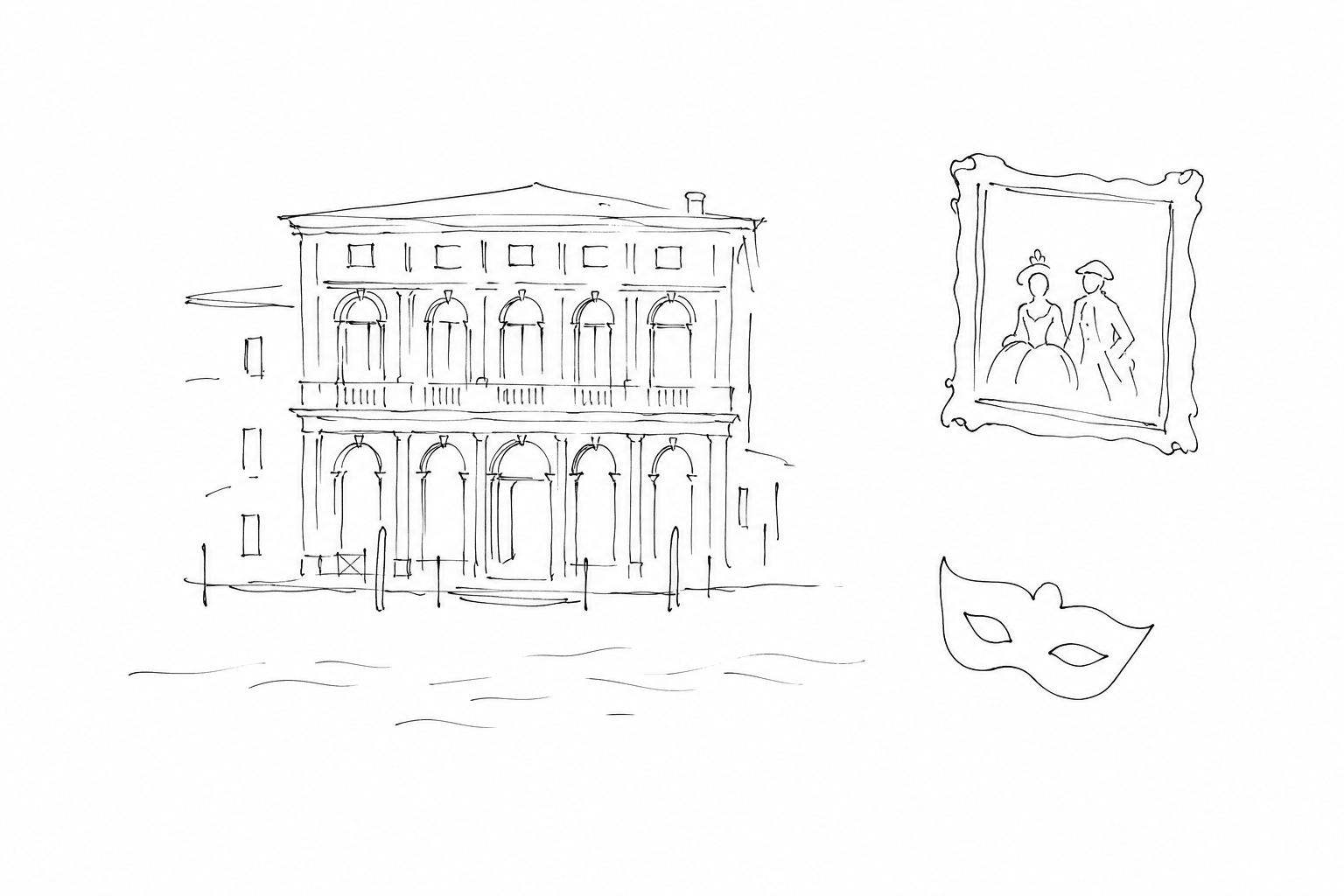

Ca’ Rezzonico is not just a museum overlooking the Grand Canal: it is one of the places where eighteenth-century Venice can be observed in its most concrete dimension, among reception rooms, furnishings, social gestures and small habits. In this context, Pietro Longhi’s paintings become a valuable lens: they do not celebrate great events, but record conversations, masks, visits, curiosities and domestic rituals. Looking at them inside a palace of the time means entering a less scenic and more everyday Venice, where the theatre of the city also passes through a salon, a covered face, an apparently secondary detail.
Ca’ Rezzonico, a palace on the Grand Canal for understanding the eighteenth century
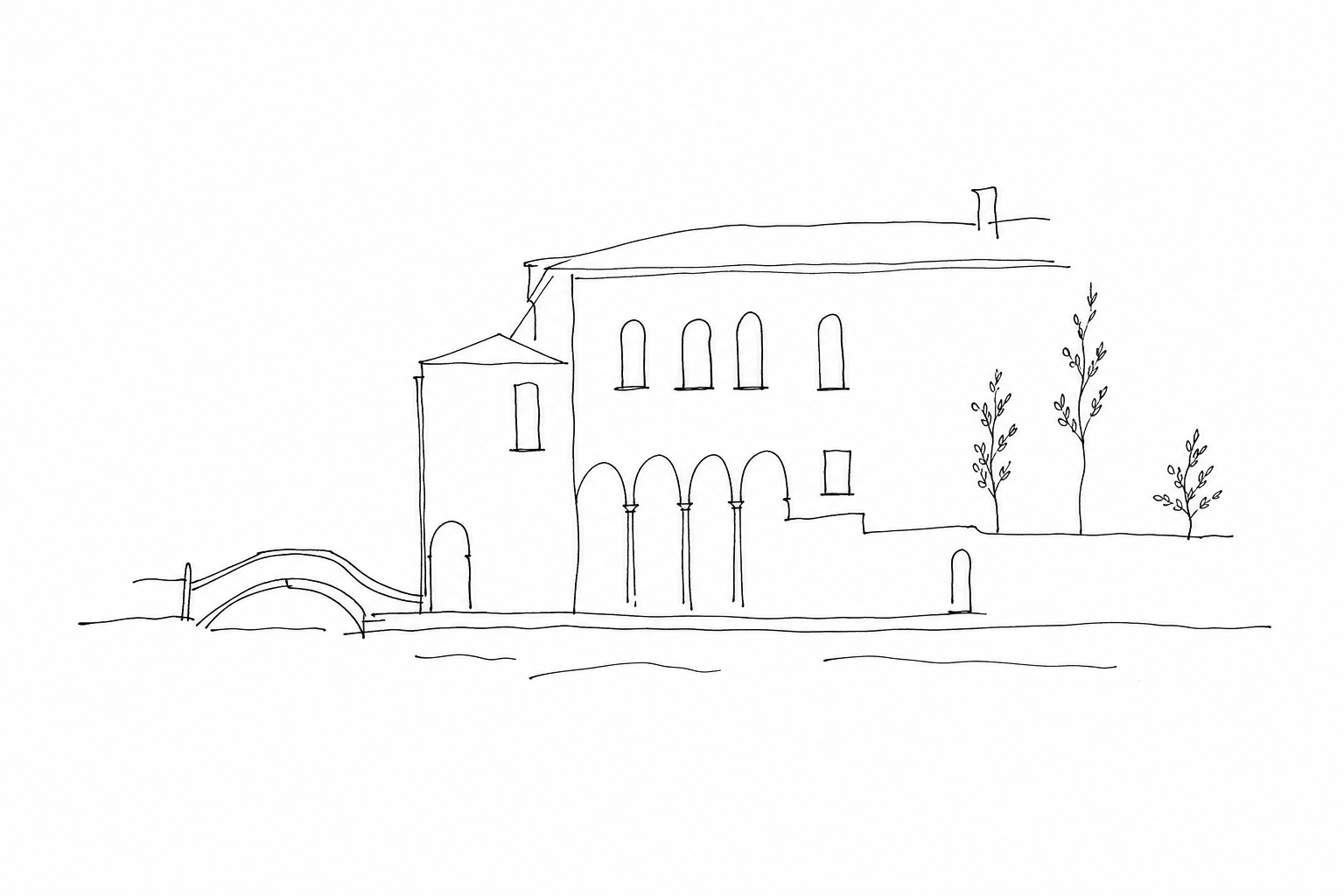
Ca’ Rezzonico is one of the most suitable places for reading eighteenth-century Venice because it brings together patrician architecture, furnishings, painting and social life in the same itinerary. Overlooking the Grand Canal, the palace was designed by Baldassare Longhena in the seventeenth century and completed in the eighteenth century by Giorgio Massari for the Rezzonico family, which had then entered the Venetian patriciate and quickly risen to the top of the city, up to the election of Pope Clement XIII.
Its monumental façade, staircases, ballroom and decorated rooms tell of the ambition of a nobility that used the home as a public stage. In this context, Pietro Longhi’s works find a natural setting: they are not simple “genre scenes,” but precise observations of conversations, visits, masks, chocolates, games and domestic rituals.
Visiting Ca’ Rezzonico therefore means entering a Venice that is both everyday and theatrical, where the salon becomes a stage and the mask does not belong only to Carnival, but to an entire culture of the gaze.
Pietro Longhi: small paintings, great observation of everyday life
Pietro Longhi is central to understanding eighteenth-century Venice because he shifts attention from grand celebratory painting to the small-scale scene: rooms, conversations, games, visits, performances, professions. In his paintings, the narrative does not proceed through heroic gestures, but through details: a hand pointing, a sideways glance, a mask protecting identity, a garment revealing rank and habits.
His painting works almost like chamber theatre. In small-format canvases, suited to private interiors, Longhi observes patricians, bourgeois people, servants, ladies and curious onlookers as they inhabit the social city: salons, ridotti, shops, dance lessons, gallant encounters. For this reason he is often compared to Carlo Goldoni: both recount a concrete Venice, made of conventions, ironies and everyday relationships.
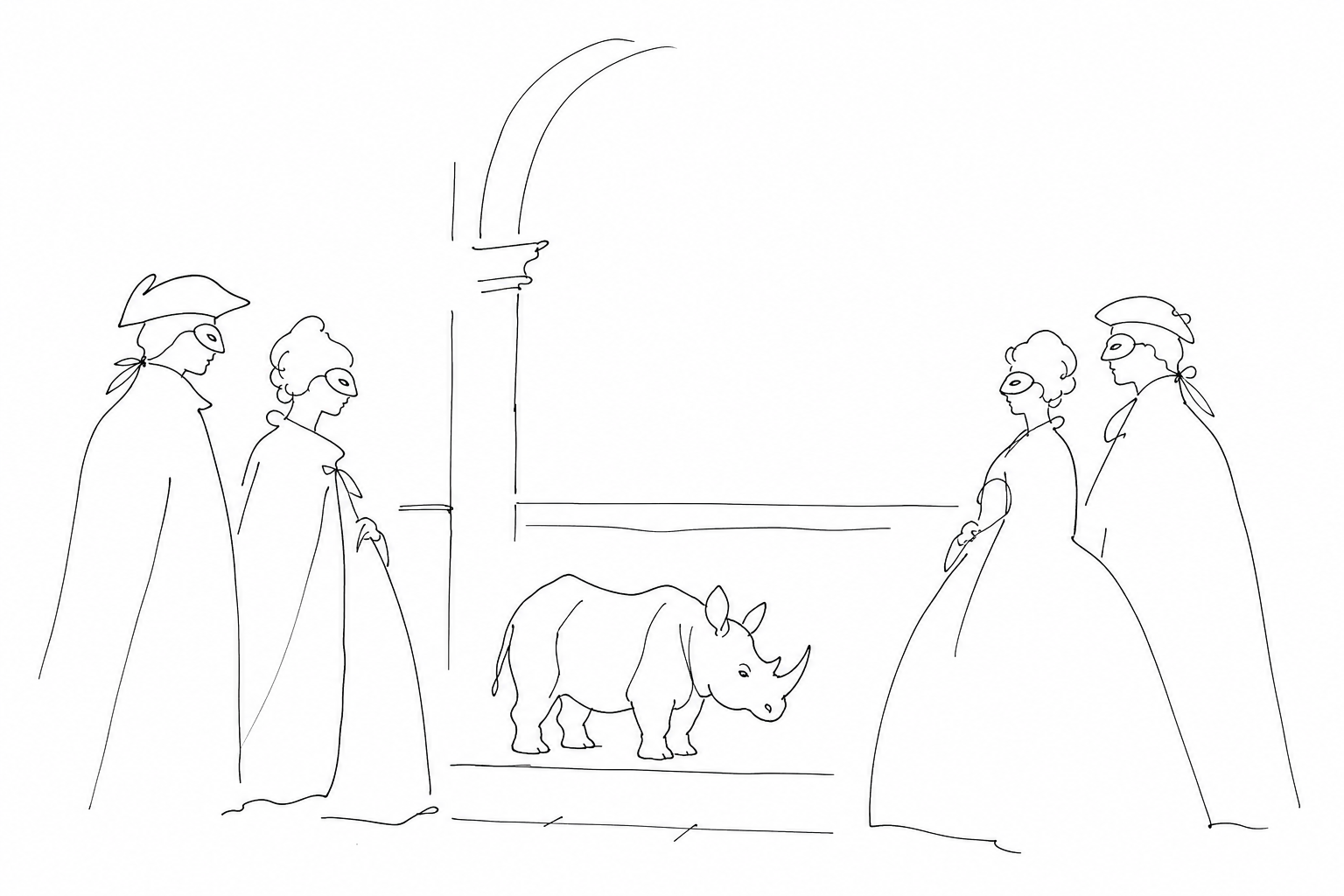
An emblematic example is The Rhinoceros, linked to the arrival in the city of the famous Clara in 1751: the exotic animal is important, but so are the masked spectators, motionless and composed, who transform wonder into a worldly ritual. Longhi does not openly judge; he records. It is precisely this apparent discretion that makes his paintings valuable: they show how eighteenth-century Venice constructed public identities through clothes, postures, masks and settings.
Masks, salons and rituals: what to look at in the paintings
In front of Pietro Longhi’s scenes, it is worth slowing down your gaze: the subject is often simple, but the meaning lies in the details. Masks do not indicate only Carnival; the bauta, with its white face, tricorne and cloak, allows one to move through society while softening rank, age and identity. In a domestic interior, the presence of masked figures therefore suggests a controlled play between privacy and public representation.
Then observe the arrangement of the bodies. Who is seated, who remains standing, who looks and who is looked at: in eighteenth-century salons, hierarchy passes through minimal postures. A dance lesson, a conversation, a gallant visit or an exotic curiosity such as the famous rhinoceros Clara become small social theatres, where every gesture has a function.
- Clothes: silks, lace, fans and tabarri distinguish role, occasion and desire to appear.
- Objects: small cups, musical instruments, playing cards and furnishings reveal rituals of conversation, leisure and courtship.
- Spaces: intimate rooms, boxes, shops or entertainment spaces show the shifting boundary between private life and social life.
The key is to read these works as chronicles of behaviour: they do not recount an exceptional event, but the way in which a society stages itself every day.
Visiting Ca’ Rezzonico attentively: from the museum to the inhabited city
To truly understand Longhi’s scenes, the visit should not remain confined in front of the canvases. The residence on the Grand Canal, begun by Baldassare Longhena and completed by Giorgio Massari for the Rezzonico family, helps imagine the social route that preceded those gestures: the arrival from the water, the passage through the portego, the climb toward the piano nobile, the entrance into the reception rooms.
This connection between architecture and painting is essential. The conversations, visits, masks and salons painted by the artist do not belong to an abstract world: they arise from a Venice made of thresholds, calli, campi, bridges and rooms where public and private continually touch.
Stepping out into the sestiere of Dorsoduro, the museum thus returns to dialogue with the inhabited city: not as a simple frame, but as the everyday space of the same social habits observed in the paintings.
Visiting Ca’ Rezzonico by following the traces of Pietro Longhi helps read Venice beyond its monumental image. The palace recounts the taste, ambitions and forms of aristocratic living; the paintings, instead, lower the gaze onto relationships, social codes and the small stagings of urban life. It is precisely in this dialogue between architecture, painting and everyday life that eighteenth-century Venice appears closer and more complex. Leaving the museum, even calli, campi and cafés may seem less anonymous: fragments of an inhabited city, made of observation, customs and roles continually performed.
Related Posts
Ca’ Pesaro: why modern art in Venice lives in a palace on the Grand Canal
Why Venice’s Gallery of Modern Art is in a Baroque palace on the Grand Canal: the history, architecture, collections and urban meaning of Ca’ Pesaro.Carpaccio in Venice: where to look for the city’s painted stories among saints, animals and everyday details
A route through the Accademia, the Scuola degli Schiavoni and the Correr to read Carpaccio through saints, animals and everyday life.
Casa Goldoni: entering Venetian theater through a palace in San Polo
Casa Goldoni, in Palazzo Centani in San Polo, tells the story of Carlo Goldoni, the Venetian scene and the theater born among calli, campielli and…Questions Answered
What makes Ca’ Rezzonico a unique lens to eighteenth-century Venice?
Its combination of architecture, furnishings, and social rituals tells a concrete story.How do Pietro Longhi’s paintings differ from traditional historical art?
They focus on small-scale everyday scenes over grand historical events.What role do masks play in Venetian social life according to the article?
Masks soften rank and identity in a subtle social performance.How does visiting Ca’ Rezzonico enhance understanding of Longhi’s works?
The palace’s spaces contextualize the social settings depicted in the paintings.
Dorsoduro between art and walking
Which nearby stops are worth connecting without turning the district into a checklist?
 Angelo Raffaele: Tobias, the dog and a Dorsoduro church with an almost narrative toneA reading of the church of Angelo Raffaele in Dorsoduro, between Tobias, the dog, Guardi and the sacred story in Venetian space.
 San Pantalon: the ceiling that pretends to break through the church without using frescoesThe ceiling of San Pantalon in Venice explained through canvas, illusion, Fumiani and the view from below.
 The Church of San Sebastiano: Veronese’s pictorial refuge hidden in DorsoduroGuide to the church of San Sebastiano in Dorsoduro, where Veronese worked for years and was buried.
 Ca’ Dario: beauty, superstition and dark legends on the Grand Canal’s most unsettling façadeHistory, façade and dark fame of Ca’ Dario, a Renaissance palace on the Grand Canal among art, famous names and dark tales.