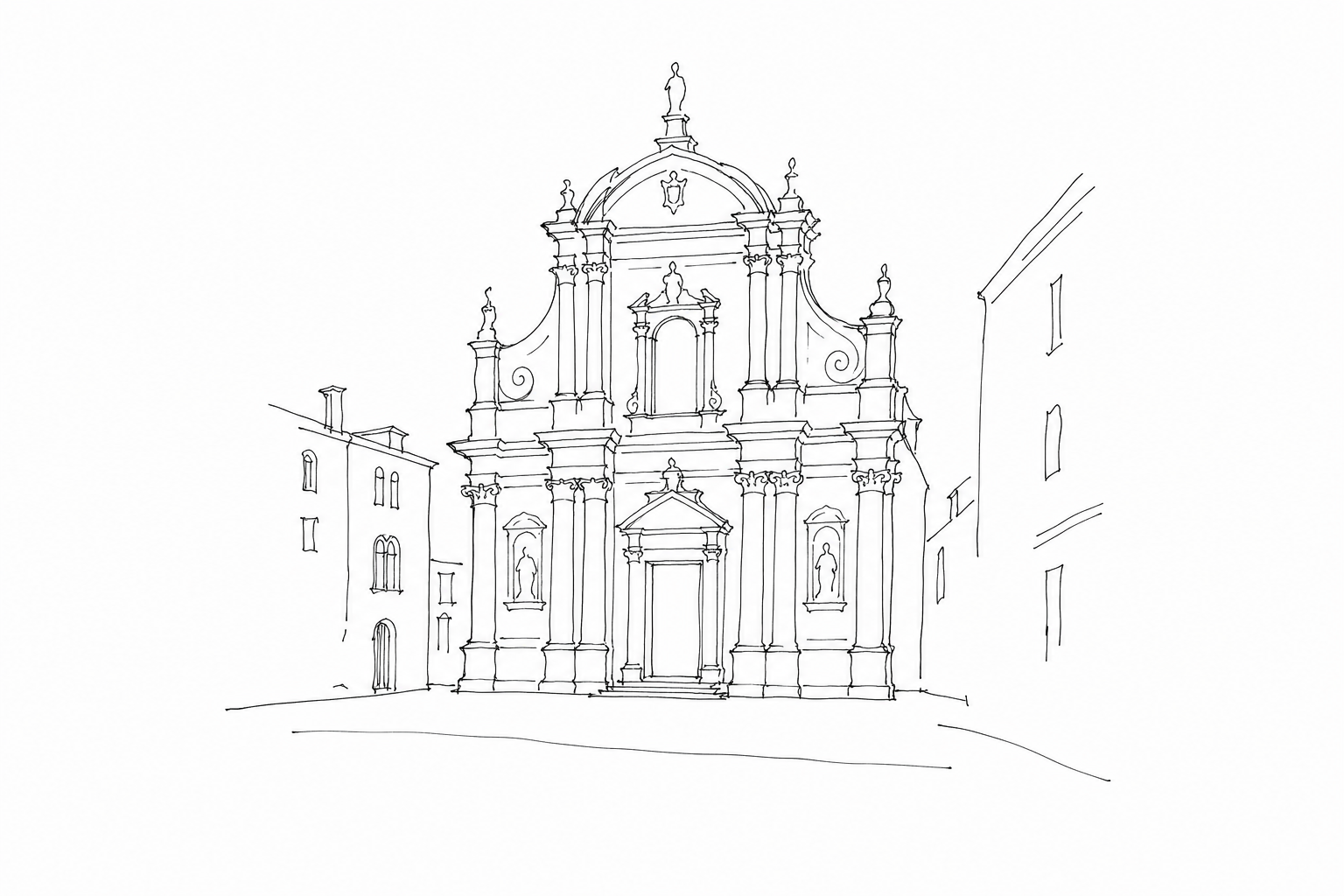

Just steps from St. Mark’s Square, San Moisè appears almost suddenly, squeezed between calli, hotels, shop windows and constant passageways. Its Baroque façade does not seek discretion: it piles up columns, statues, reliefs, solemn gestures and celebratory details until it turns the church into an urban stage. Precisely for this reason, for centuries, it has divided the gaze of those who encounter it: a theatrical masterpiece for some, a cumbersome excess for others. Looking at it carefully means entering a less predictable Venice, where devotion, family prestige, artistic taste and daily life overlap in the space of a small fondamenta.
Where San Moisè is located and why it immediately stands out
San Moisè is found in the sestiere of San Marco, in the campo of the same name, a few minutes from St. Mark’s Square and along one of the busiest routes between the elegant calli of the area and the Orseolo basin. Its position is already part of the effect: it does not appear isolated in a large square, but almost compressed within the Venetian urban space, with the façade advancing like a theatrical scene.
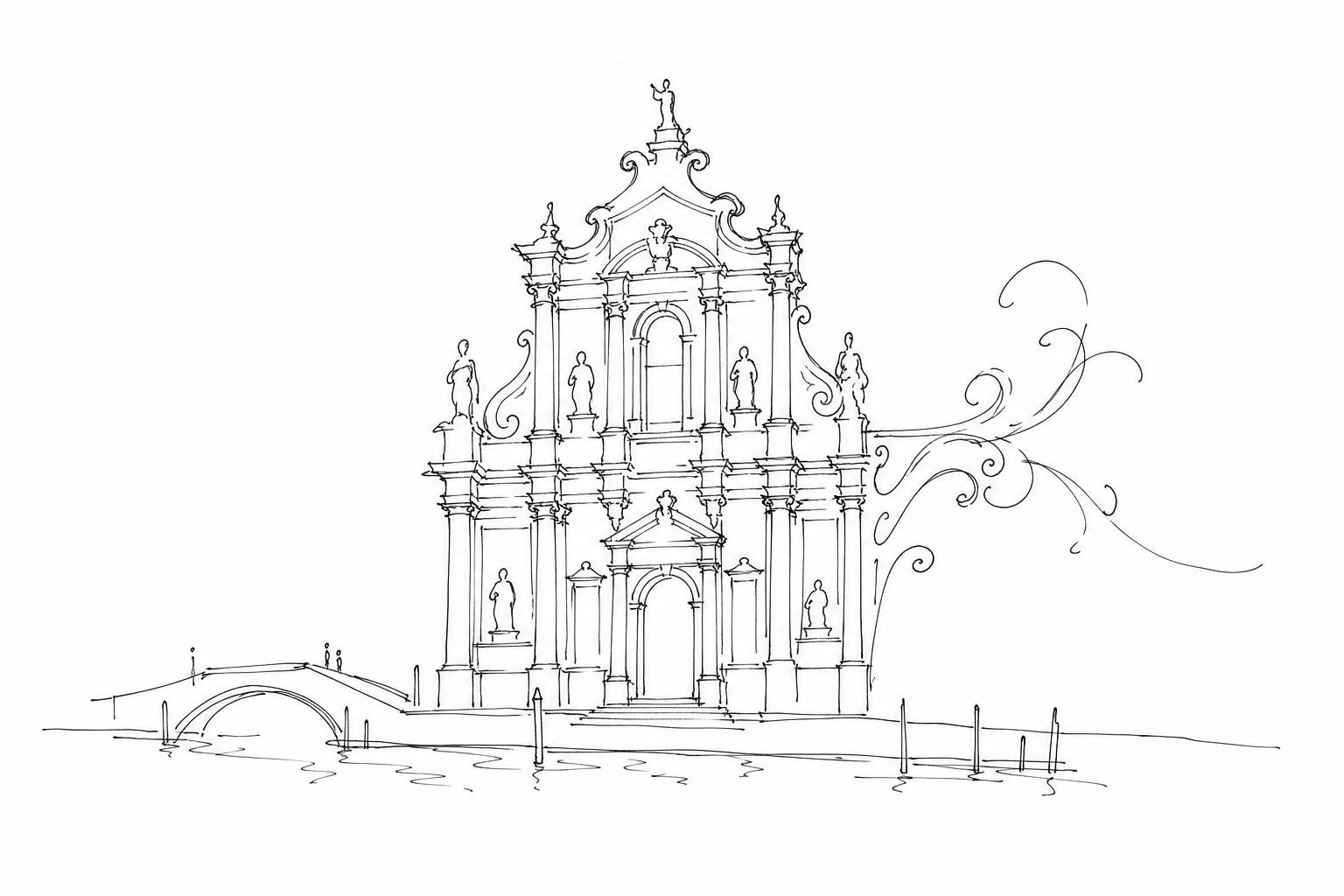
The first impression is that of a deliberately overloaded Baroque. Columns, niches, statues, reliefs and coats of arms occupy the surface with a dense rhythm, closer to a celebratory apparatus than to a sober façade. Rebuilt in the seventeenth century, it is linked to the name of the architect Alessandro Tremignon and to the Fini family, who wanted to leave a monumental mark in the heart of the most representative Venice. It is precisely this spectacular and almost provocative ostentation that explains why San Moisè continues to divide Venetians.
The façade of San Moisè should be read as a scene, not as a simple elevation. Alessandro Tremignon, commissioned in the seventeenth century, built a wall dense with columns, niches, broken pediments, cartouches and statues: elements that seem to advance toward the campo, creating an effect of continuous movement.
The entrance dominates at the center, framed by Corinthian columns and by a decorative apparatus that pushes the gaze upward. Above the portal appears the bust of Vincenzo Fini, the patrician who financed the intervention: a decisive detail, because it also transforms the façade into a family monument. Private celebration thus enters the sacred space with an almost theatrical force.
- The columns do not merely organize the surface: they fragment it, creating deep shadows.
- The statues, attributed in part to the circle of Heinrich Meyring, accentuate the scenographic tone.
- The cartouches and coats of arms recall the Fini patronage and explain many Venetian criticisms.
- The broken lines of the crowning make the stone unstable, almost posed.
The result is a deliberately excessive Baroque façade: for some a masterpiece of scenic energy, for others an intrusive display, where devotion seems to compete with patrician self-promotion.
Why it still divides Venetians
At San Moisè, the disagreement is not only a matter of taste. In a city accustomed to measuring prestige and devotion with balance, the Fini frontage appears almost like a challenge: the commissioning family occupies the church with coats of arms, busts, inscriptions and allegorical figures, transforming the sacred entrance into a dynastic manifesto. This is where the local annoyance arises: the work seems to speak less to the faithful and more to the passerby, demanding attention in a small campo, just steps from the Marcian area.
Famous criticisms have fueled this reputation. John Ruskin, extremely severe toward Venetian Baroque, considered it an example of decadence compared with the Gothic and Byzantine Venice he loved. Yet precisely what irritates many visitors and residents explains its fascination: the excess is legible, almost narrative; the marbles, the projecting volumes and the strange sculpted presences make immediate the tension between faith, money and social ambition. It is not a pacifying beauty, but a presence that still forces one to take a position.
In front of San Moisè, it is best to resist the first judgment, whether irritated or amused. The space of the campo is restricted: precisely for this reason the frontage should be looked at in two stages. First step back as far as possible, seeking the axis of the portal; only from there can one understand the effect of a scenic machine designed to strike those arriving from the St. Mark’s area.
Then move closer and read the stone by registers. Below, columns, plaques and apparatuses recalling funerary monuments dominate; at the center, coats of arms and inscriptions linked to the Fini emerge; above, the composition thickens around the sacred figures, with Moses providing a fragile religious balance to so much private self-representation.
- Look at the shadows: niches, frames and statues are designed to create depth, not to be ordered in a “classical” way.
- Look for the portraits: the family busts transform the church into a dynastic declaration.
- Compare solids and voids: the wall almost disappears beneath the sculptural emphasis.
San Moisè is not a church to be dismissed with a quick judgment. Its façade asks for time, distance, even a little patience: it should be observed in its solids and voids, in its relationship with the calle, in the density of its symbols and in the ambition of those who wanted it so conspicuous. It may please or irritate, but precisely this reaction still makes it alive in the Venetian landscape. Stopping in front of San Moisè means accepting that Venice is not made only of light harmonies and perfect views, but also of contrasts, vanity, memory and stone pushed to the limit of the stage.
Related Posts
San Zulian: the small church near St. Mark’s where Sansovino left his mark
A brief guide to San Zulian, a church between St. Mark's and the Mercerie, with the facade linked to Sansovino and the physician Tommaso Rangone.Santa Maria Formosa: one campo, two façades, and a Venice that changes sides with every step
A narrative guide to Santa Maria Formosa: the campo, the two façades, the bell tower, and the details that change the way you look.
The Scuola Grande di San Marco: the most elegant façade in front of the civil hospital
A reading of the Scuola Grande di San Marco, from its confraternal history to the Renaissance façade that today stands in front of the Civil…Questions Answered
Where is San Moisè located and what makes its façade stand out?
It’s in San Marco near St. Mark’s Square with a densely decorated Baroque façade.Who designed the San Moisè façade and why?
Alessandro Tremignon rebuilt it in the 17th century for the Fini family’s prestige.Why does the façade divide opinions among Venetians?
The façade mixes religious devotion with patrician self-promotion, causing debate.How should visitors approach viewing San Moisè’s façade?
By stepping back for the full view and then examining its detailed symbolic layers.
Keep exploring the Venice of St Mark’s
Which spaces help you read the square as a system of symbols, institutions and images?
 The Procuratie up close: how St. Mark’s Square became a perfect urban machineThe Procuratie read up close: architecture, power, porticoes and the urban rhythm of St. Mark’s Square.
 The Horses of Saint Mark: originals, copies and a centuries-long journey above the basilicaHistory and interpretation of the Horses of Saint Mark: copies on the loggia, originals in the museum, from Constantinople to Venice and...
 The floor of St. Mark’s: marble waves, geometries and the feeling of walking on waterA journey across the floor of St. Mark’s Basilica: marbles, waves, geometric mosaics and a slow reading of a Venetian detail.
 The Clock Tower: Moors, gears and Venetian time above St. Mark’s SquareHistory and interpretation of St. Mark’s Clock Tower: Moors, dial, automata and Venetian public time.