
Next to Rialto, where the traffic of goods became price, credit and tax, the Palazzo dei Camerlenghi tells of a Venice that is less scenic and more concrete: that of offices, registers, public coffers. Its position is no coincidence. Here the economic power of the Republic was measured every day against merchants, debtors, magistrates and passers-by. Looking at it means reading a part of the city in which architecture, administration and daily life overlap, without separating beauty from function.
Why the Palazzo dei Camerlenghi is right at Rialto
The location of the Palazzo dei Camerlenghi is no coincidence: it stands next to the Rialto Bridge, at the point where Venice concentrated exchanges, credit, minor customs duties and control of goods. Here money was not an abstract idea, but passed every day among banks, fondaci, shops and magistracies.
The Camerlenghi were officials responsible for managing public revenue and the State treasury. Having their offices in the economic heart of the city meant making the authority of the Republic visible precisely where profits, debts and taxes were formed. Proximity to the market also allowed more direct control over commercial and fiscal flows.
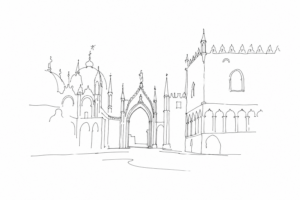
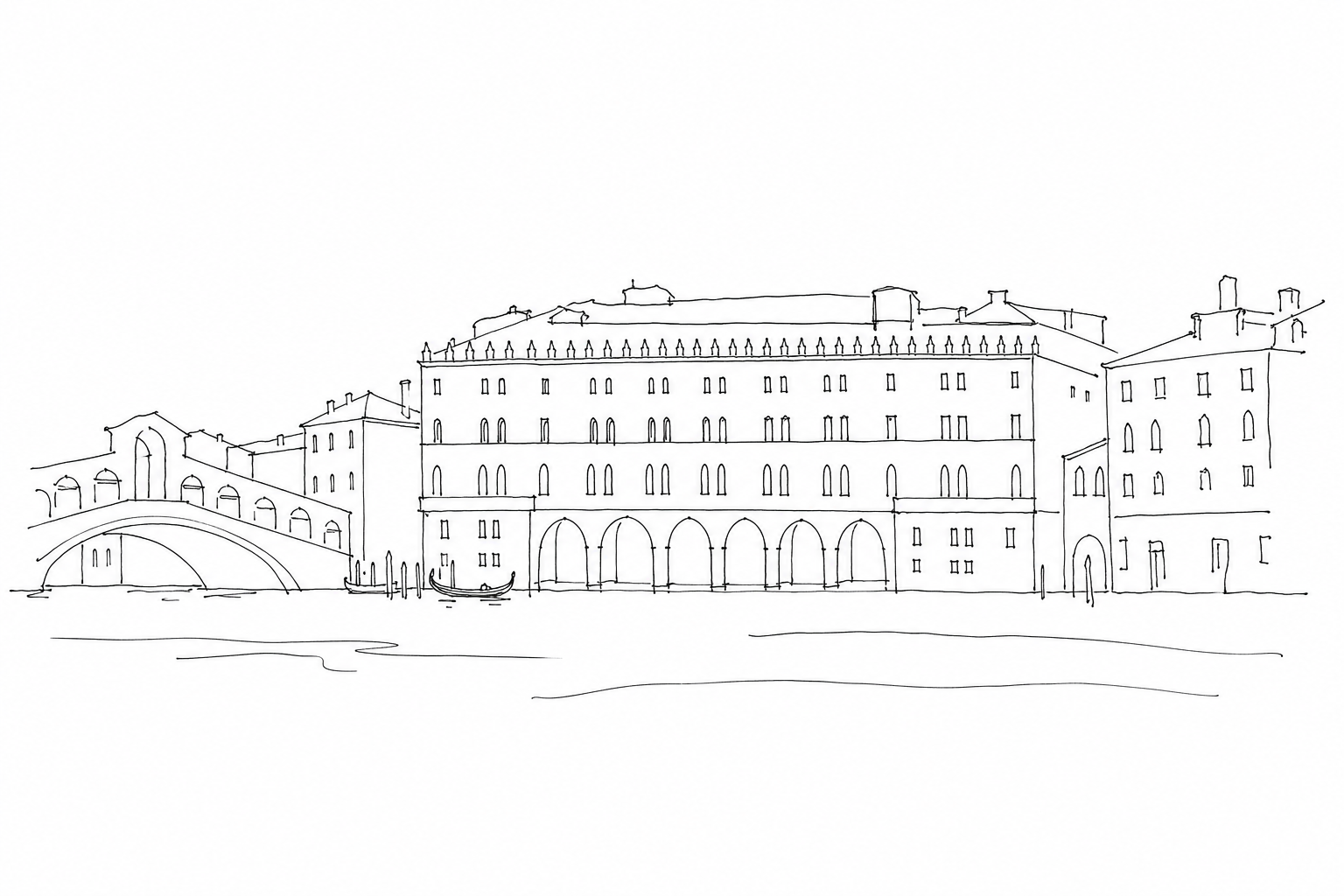
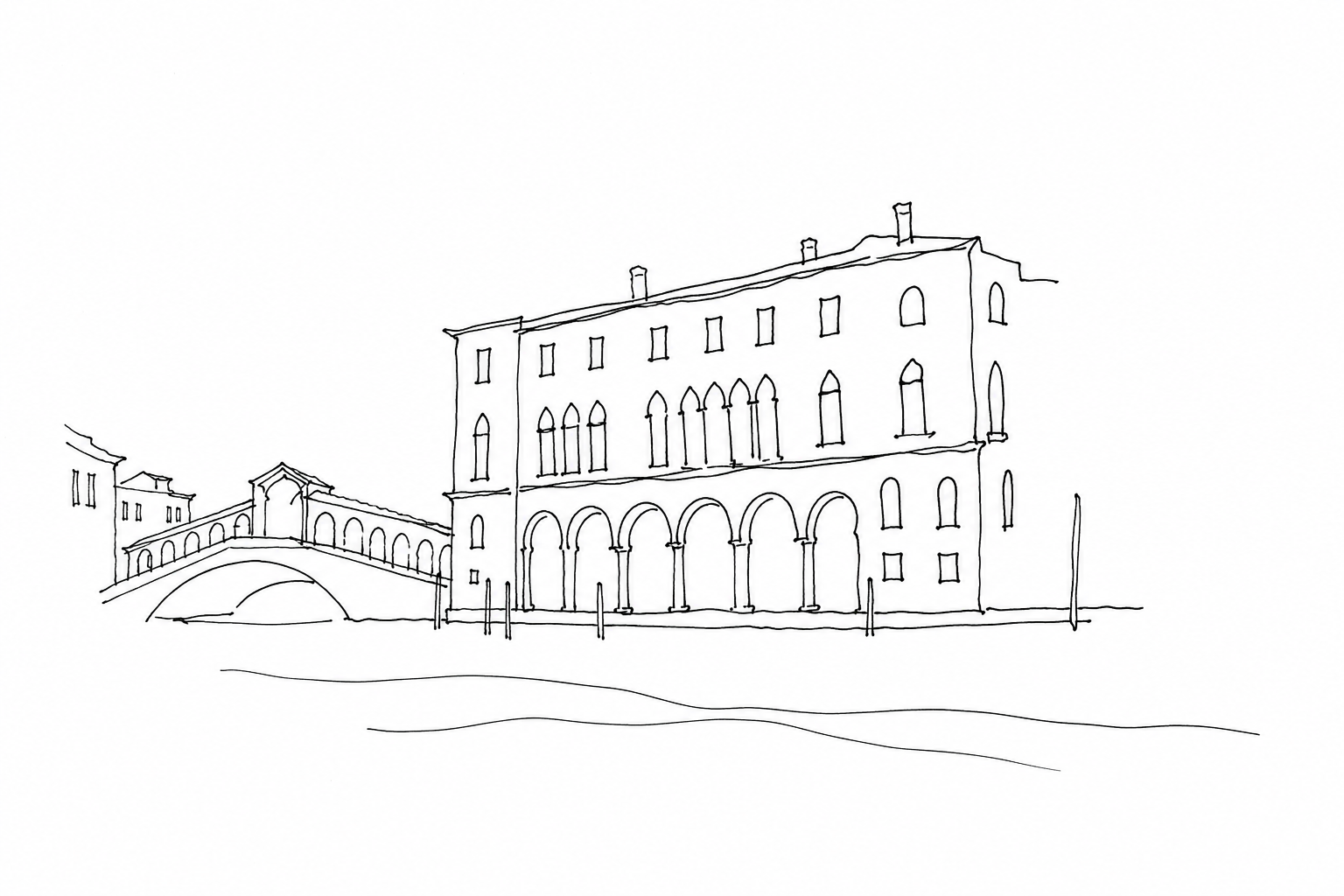
The building, rebuilt in the sixteenth century, faces the Grand Canal like a façade of public power: not a private palace of merchants, but an administrative seat placed in the most mercantile place in Venice. Rialto, in this sense, was at once a financial square, an urban node and the stage of Venetian economic sovereignty.
Who the Camerlenghi were and what they administered
The Camerlenghi de Comun were Venetian financial magistrates: not private merchants, but officials entrusted with safeguarding and controlling public money. Their name recalls the camera, that is, the treasury, understood as an accounting place even before a material deposit.
Their responsibilities included registers, collections, payments and checks on revenue from duties, taxes, fines, confiscations, tax contracts and state income. In a city founded on trade, credit and navigation, administering those flows meant overseeing the point where private wealth and public authority met.
The seat at Rialto gave visibility to this control. Those who worked in the market saw that the State was not far away: it was physically next to the exchanges, ready to transform transactions, obligations and sanctions into official records. The palace, therefore, did not represent only a technical office; it made Venetian economic power recognizable.
The political value was evident: counting, collecting and authorizing payments meant guaranteeing trust, financing wars, public works and diplomacy, and maintaining the balance between the patriciate, the market and institutions.
Architecture of a public office on the Grand Canal
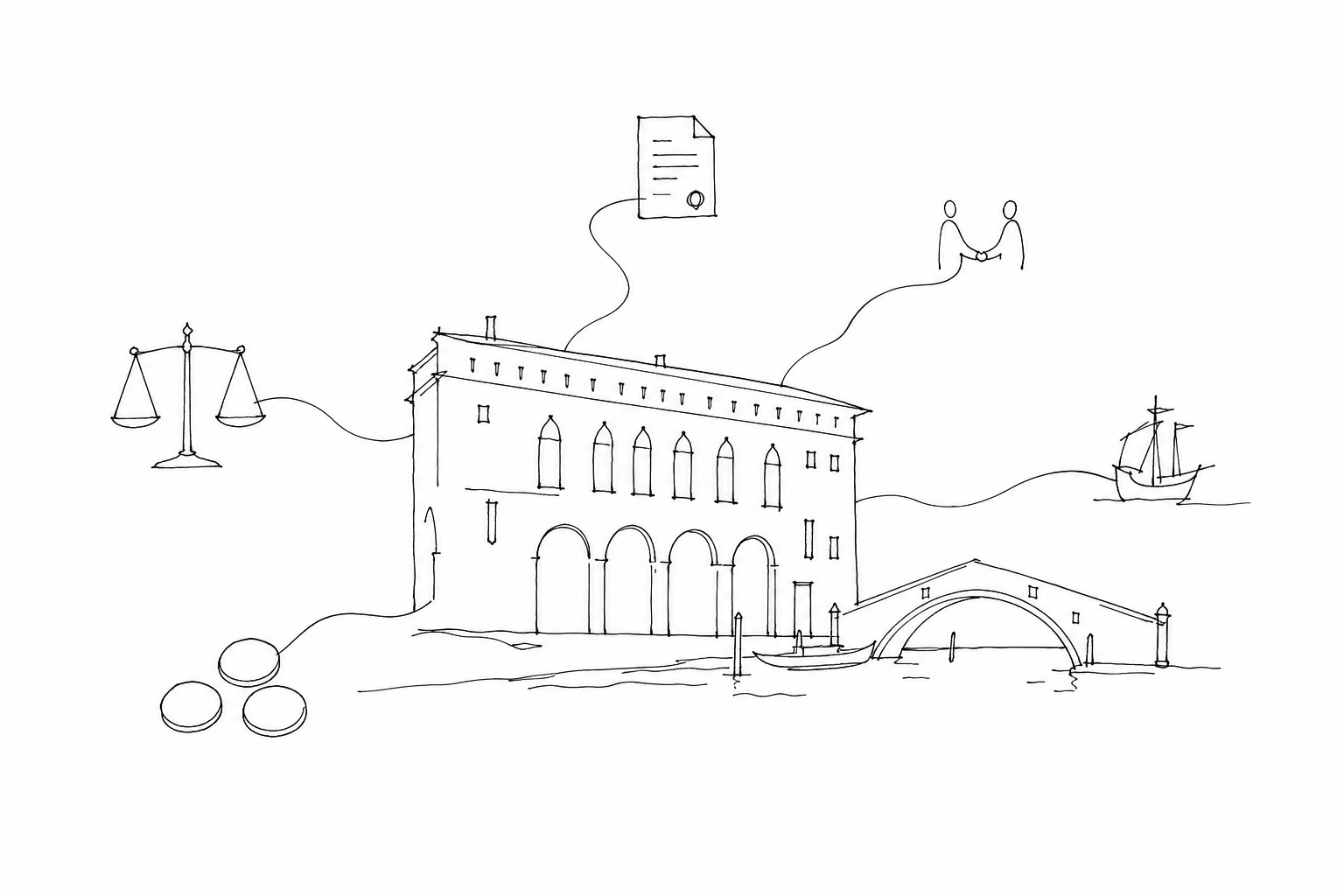
The sixteenth-century seat designed by Guglielmo dei Grigi, known as il Bergamasco, was built between 1525 and 1528 in a place where architecture had to be seen almost in motion: from the shore, from the bridge and from the boats on the Grand Canal. It is not a noble residence adapted to administrative functions, but a public machine designed to declare order, control and continuity.
The irregular plan, conditioned by the block near Rialto, produces several visible fronts. The façades use a recognizable Renaissance language: Istrian stone, arched openings, horizontal cornices and a tight repetition of windows. This rhythm does not seek a domestic effect, but the image of an archive of money: readable levels, aligned offices, authority distributed along the entire elevation.
The relationship with the water is decisive. The base facing the canal symbolically connects revenues, goods, taxes and accounting records; above, the geometric order transforms the commercial flow into institutional form. Seen next to the market, the building shows how Venice translated economic power into stone, measure and public visibility.
Works and civic memory: what to read from the outside
To understand this financial seat without entering, it is worth remembering that the offices did not live only on registers. The rooms were decorated with votive paintings commissioned by the magistrates at the end of their term: a way to link public accounting, devotion and personal reputation. Many canvases, now preserved elsewhere, bear crucial names of the Venetian sixteenth century, including Tintoretto, Veronese and Bonifacio de’ Pitati. In those images, saints, allegorical figures and portraits of officials made visible the idea that economic administration also had to be morally controlled.
From the outside, observe three concrete elements:
- The position: between the bridge, the market and the Grand Canal, at the point where goods, credit and taxation met every day.
- The regularity of the openings: windows and façades communicate order, rather than aristocratic ostentation.
- The relationship with the water: the building presents itself to those arriving by boat, that is, to commercial and institutional traffic.
If you wish to check any internal access or dedicated routes, it is always best to check up-to-date information from official sources.
The Palazzo dei Camerlenghi invites you to stop at Rialto with a different gaze, beyond the bridge and the market. Its façades, the history of the financial offices and the memory of the works it housed show how much Venice built its own balance also through controls, accounting and public responsibilities. It is not only an elegant sixteenth-century building: it is a threshold between trade and government, between private money and collective interest. Observing it today helps us better understand the real city that lay behind its splendor.
Related Posts
The Fondaco dei Tedeschi: from house of northern merchants to contemporary terrace over Rialto
History, architecture and current interpretation of the Fondaco dei Tedeschi, between Rialto, the Grand Canal and the terrace.The Porta della Carta: entering the Doge’s Palace by reading stone, power and propaganda
A close reading of the Porta della Carta: ceremonial threshold, Gothic sculpture and political manifesto between St. Mark's and the Doge's Palace.
Ateneo Veneto: the Scuola dei Picai and the harsher side of Campo San Fantin
History, architecture and memory of the Scuola dei Picai, today the Ateneo Veneto, in the campo next to La Fenice.Questions Answered
Why is the Palazzo dei Camerlenghi located next to the Rialto?
Its position placed public financial authority at the heart of trade and taxation.Who were the Camerlenghi and what did they administer?
They were financial magistrates managing public revenue, taxes, and state finances.How does the architecture of the building reflect its function?
The Renaissance design expresses order, control, and public institutional power.What civic and moral roles did the Palazzo’s offices play beyond accounting?
They combined public accounting with devotional art to signify moral oversight.
Keep reading Rialto
Want to see how the market, churches, shops and palaces tell the story of the same commercial heart?
 San Cassiano: Tintoretto, market and silence a few minutes from the chaos of RialtoA short route between Rialto and San Cassiano: market, quiet calli, church and canvases by Tintoretto.
 San Giovanni Elemosinario: the almost invisible church hidden among the shops of RialtoA short guide to the church of San Giovanni Elemosinario, amid the Rialto market, Renaissance history, and works by Titian and Pordenone.
 The Rialto Fish Market: how to read stalls, columns and details of a market still aliveA short guide to observing the Rialto Fish Market: stalls, architecture, marine signs and the daily rhythm of the market.
 Ruga Rialto: a street of shops for understanding Venetian commerce before global storefrontsA reading of Ruga Rialto as a living trace of Venetian commerce: shops, place names, markets and urban rhythm before global chains.