
In Venice, marbled paper seems to arise from a natural intuition: color that floats, water that draws, a hand that holds the instant. But behind those veins there is a concrete history of workshops, binderies, trade and everyday objects. It is not a simple decorative souvenir: it is a small visual grammar, made of slow gestures and sensitive materials, that dialogues with the city without imitating it. Entering a workshop means observing a craft balanced between precision and surprise.
Why marbled paper speaks well of Venice
Marbled paper seems born to be understood in Venice: an art in which the design is not traced directly, but left to float on a liquid surface before being captured by the sheet. Colors dispersed on the water, combs that open orderly waves, pigments that move like currents: everything recalls a city built on the unstable and skillful relationship between matter and lagoon.
In Venetian workshops this technique takes on an almost alchemical character. The vat becomes a small basin, the paper a landing place, the artisan’s gesture a mediation between control and surprise. The result is never identical: veins, feathers, shells and vortices transform every sheet into an unrepeatable image.
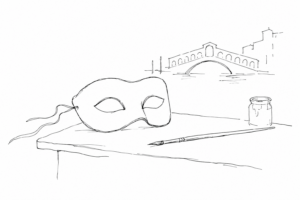
Its presence also dialogues with the city’s material culture: bookbinding, publishing, prints, notebooks, book coverings and writing-desk objects. It is not simple decoration, but a tactile memory of Venetian work, where water, color and paper meet with silent precision.
From bindings to notebooks: a history of paper and trade
In Venice, marbling found natural ground not only because of the presence of water, but because of the strength of the book trade. Between the fifteenth and sixteenth centuries the city was one of the great European centers of printing: printers, bookbinders, merchants and stationers worked in a dense supply chain, fueled by trade with the East and by the demand for manageable volumes, registers, address books and account books.
Marbled sheets entered above all into bindings: inner endpapers, light coverings, cases, decorative edges. They protected and embellished, but also had a practical function: they made an everyday object recognizable, from an account book to a notebook. In the wave, fan and vein patterns one could read the Venetian taste for precious but living surfaces, never perfectly identical.
Bookbinding and stationery workshops thus transformed a refined technique into a commercial material: not an isolated luxury, but a concrete presence on the desks of merchants, scholars, notaries and travelers.
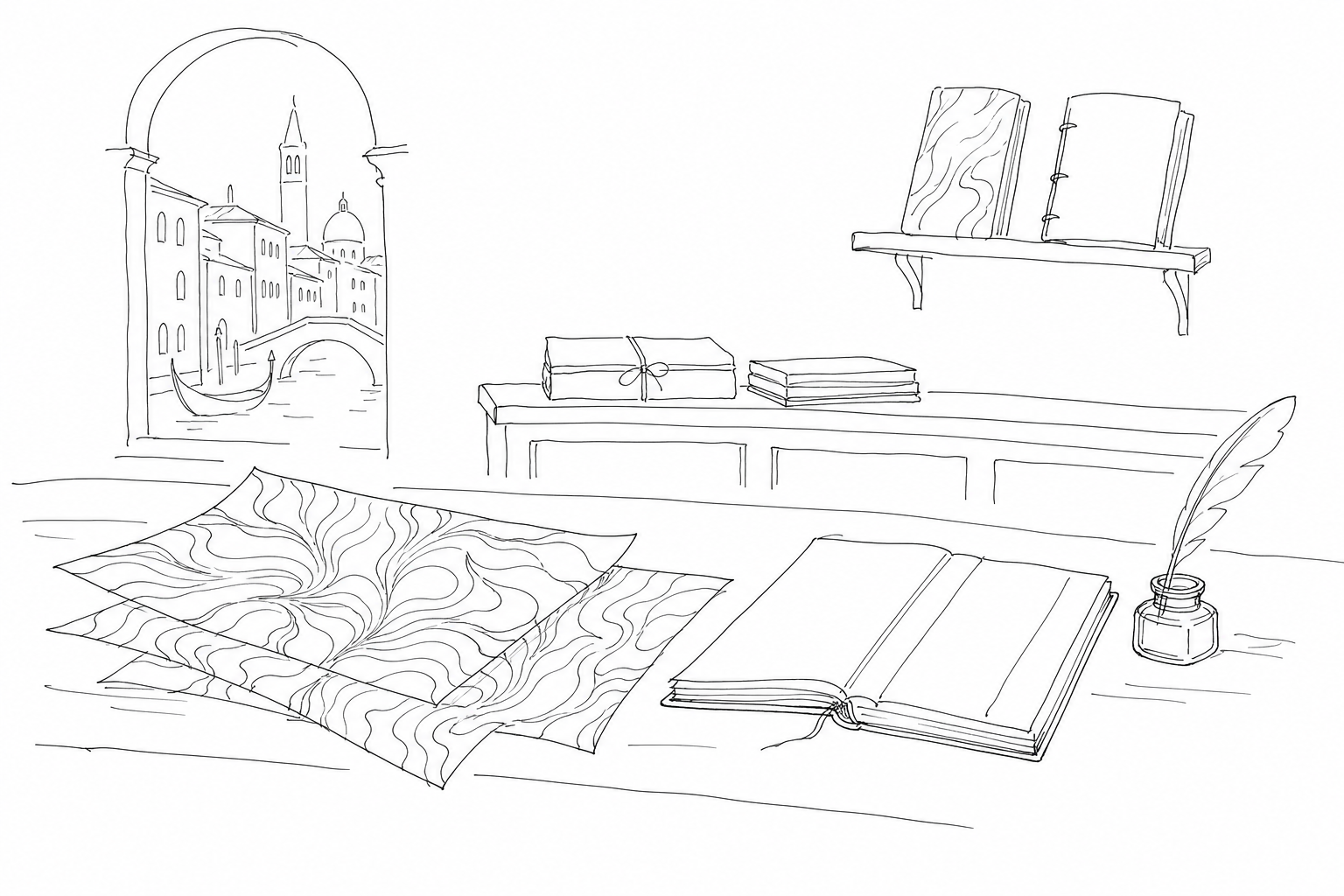
Inside a workshop: combs, vats and alchemist’s gestures
Entering a Venetian marbling workshop means seeing work that seems slow, but allows no hesitation. On the bench there is a low, rectangular vat, filled with a thickened bath: not simple water, but a solution made more viscous with plant mucilages, such as carrageenan or gum tragacanth. It is this density that supports the colors on the surface, preventing them from sinking immediately.
The pigments are prepared in small bowls and adjusted with substances that regulate their spreading. A drop that is too “strong” widens aggressively; one that is too weak remains closed, almost timid. The artisan observes the edge of the stain, not only the hue: there he understands whether the mixture is ready.
The design is born with simple tools. With thin points veins are traced, with sticks the patches are moved, with metal combs regular waves, feathers, shells and bouquet patterns are built. Each step modifies the previous one: it is not erased, it is transformed.
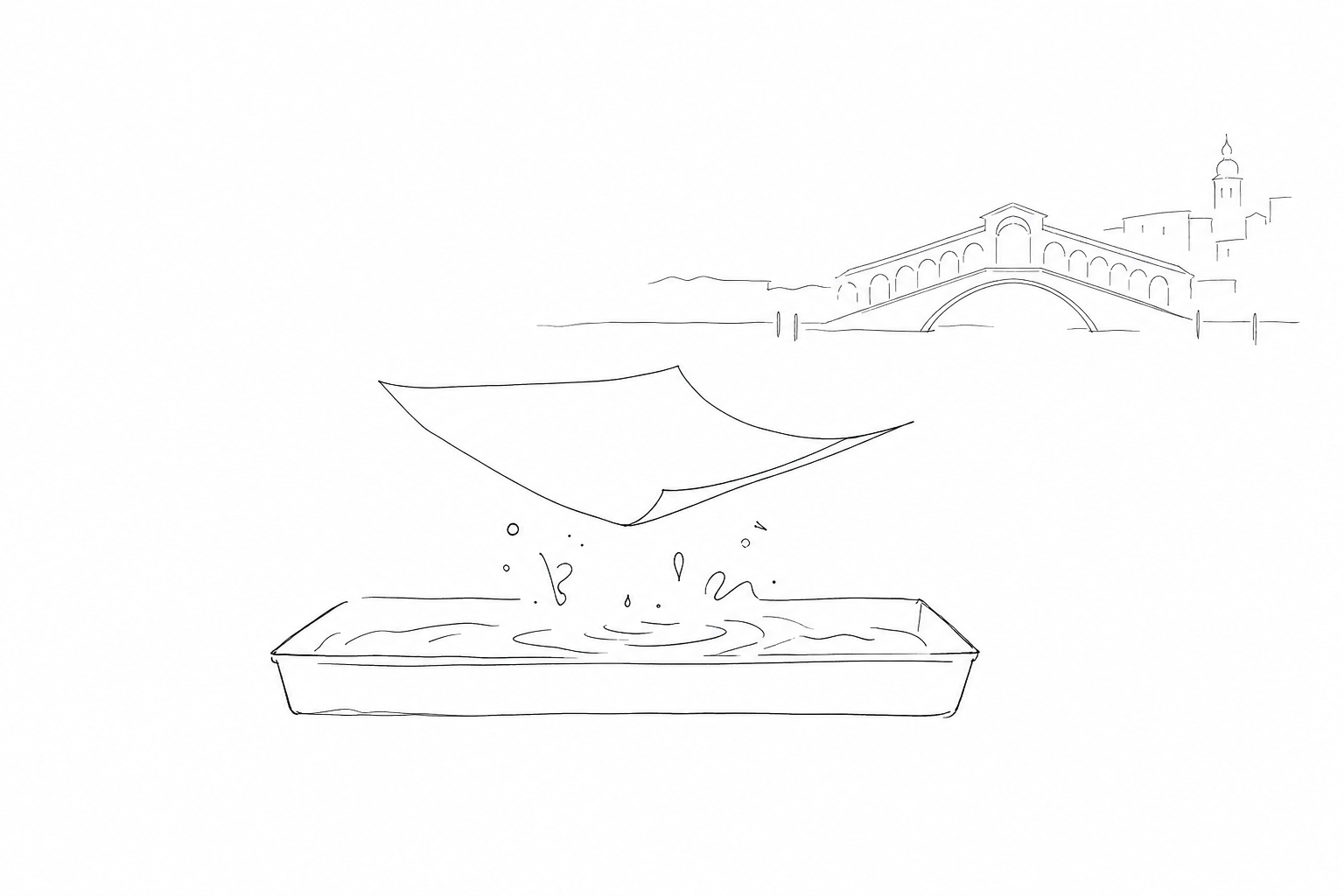
When the motif is complete, the sheet is laid down with one continuous gesture, from the edge toward the center, to avoid bubbles. Then it is lifted: the image, which before was floating, adheres to the fiber. In that moment the workshop truly seems like a laboratory of Venetian alchemy: color, time and hand become a decorated surface.
How to read and choose marbled paper in Venice
Faced with a marbled sheet, it is best to look first at the rhythm: the veins should move without stiffening into a mechanical repetition. Small asymmetries are a good sign, because they tell of the manual passage between color suspended on the water and absorbent support.
Then observe the margins: in a successful work the design reaches the edges alive, but it may show slight variations, as happens in the ancient endpapers of Venetian books. The grain also matters: a support that is too glossy can make the decorative motif colder, while a more material surface better retains nuances and vibrations.
- For bookbinding: choose small-scale patterns, capable of accompanying the volume without dominating it.
- For frames or walls: broad waves, feathers, shells or “stone” effects work better.
- To recognize the hand: look for slight irregularities, tonal transitions and colors that are not flat.
Choosing marbled paper in Venice requires the same gaze with which one crosses the city in its best moments: attention to surfaces, details and traces of work. A well-made sheet tells of the quality of the pigments, the confidence of the gesture, the harmony between chance and control. Whether it becomes a cover, notebook, endpaper or simple memory to keep, it carries with it something deeply Venetian: not the most obvious image of the city, but its ability to transform water, time and craft into form.
Related Posts
Decorated Paper in Venice: Marbling, Bindings and the Tactile Side of Printing
A journey through Venetian decorated paper, among marbling, bindings, workshops and books to be observed with eyes and hands.Venetian papier-mâché masks: what distinguishes a real workshop from an ordinary souvenir
How to recognize a Venetian papier-mâché mask made in a workshop: materials, gestures, finishes and signs to observe before buying.
Aldus Manutius in Venice: the printer who invented the paperback before cultural tourism
Aldus Manutius transformed Venice into a laboratory of the modern book: portable classics, italic type, learned publishing and a city of paper.Questions Answered
What makes Venetian marbled paper unique?
Its designs float on viscous water baths creating unrepeatable patterns.How did marbled paper become part of Venetian culture?
Through the strong demand in the book trade and printing industry.What materials and techniques are used in marbling?
Plant mucilages to thicken water and metal combs to shape pigments.What should one look for when choosing marbled paper?
Live rhythm, asymmetry, edge detail, and paper texture.
From paper to Venetian type
Which other stories reveal the material and creative side of books made in Venice?
 Decorated Paper in Venice: Marbling, Bindings and the Tactile Side of PrintingA journey through Venetian decorated paper, among marbling, bindings, workshops and books to be observed with eyes and hands.
 Aldus Manutius in Venice: the printer who invented the paperback before cultural tourismAldus Manutius transformed Venice into a laboratory of the modern book: portable classics, italic type, learned publishing and a city of paper.
 Italic type was also born here: Venice, publishing and typefaces that changed the way people readHow Venice, Aldus Manutius and Aldine typefaces changed books, reading and the printed page.
 The Marciana Library: books, painted ceilings and public knowledge next to San MarcoEditorial guide to the Marciana Library: history, rooms, books, paintings and public role in the heart of San Marco.