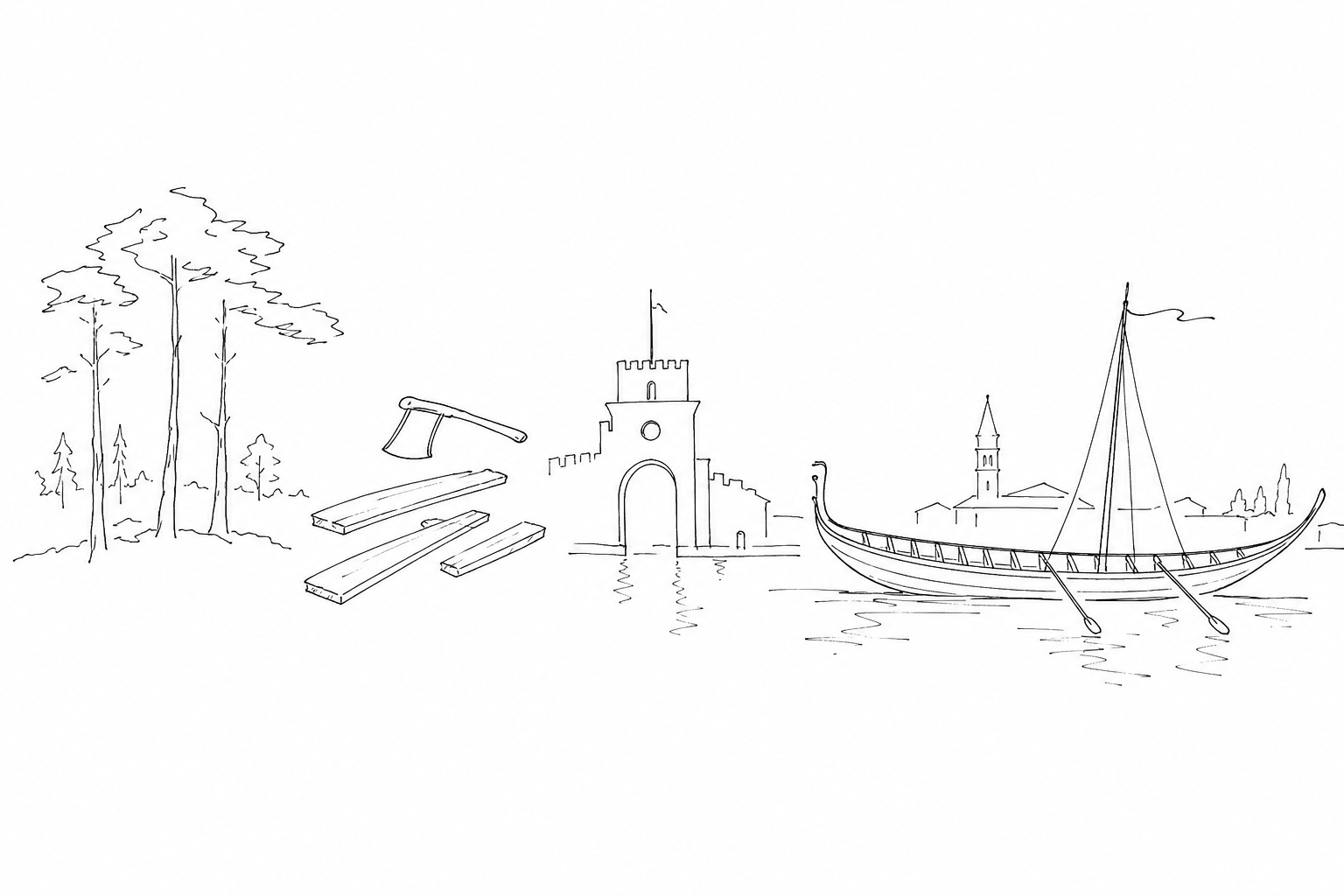

Before being image and memory, the Arsenal was above all work: the noise of saws, the smell of resin, stacked planks, hands capable of transforming wood into ships. The marangoni, specialized carpenters of the Serenissima, were among the decisive figures in this enormous productive organism. By following their craft, one better understands how Venice built its maritime strength: not only with political strategies and trade routes, but with technical skills, shipyard rules, carefully chosen materials and a working-class daily life engraved in the urban space between the Arsenal and Castello.
Who the marangoni of the Arsenal were
In the Venetian vocabulary, the marangoni were wood artisans: joiners, carpenters and specialized workers capable of transforming trunks, planks and beams into naval structures. Inside the Arsenal, the great productive complex of the Serenissima, their work was not a marginal trade, but a decisive component of Venetian maritime power.
Their expertise concerned above all the hull: frames, planking, decks, masts, oars and internal parts of the ships required technical precision and knowledge of materials. The wood had to be chosen, seasoned, cut and assembled according to different functions: strength for the keel, elasticity for some parts of the hull, resistance to water and salt.
In the Arsenal the marangoni worked in an organized environment, close to caulkers, blacksmiths, sailmakers and ropemakers. Their manual skill was part of a public production chain, controlled by the Venetian State, which made it possible to build and repair galleys, merchant ships and military units rapidly.
Wood as a strategic material
At the Arsenal wood was not a simple raw material: it was a military resource. The power of the Serenissima depended on the ability to choose different wood species for different functions, because an effective ship was born even before its launch, in the forest and in the warehouse.
Oak, hard and resistant, was precious for frames, keel and parts intended to withstand impacts and torsion. Fir and larch, lighter and more workable, were used for masts, planking, hull planking and components that required elasticity. From the Alpine areas, from Cadore, Istria and Dalmatia came selected trunks, transported along rivers and lagoon routes toward the Venetian warehouses.
The knowledge of the wood masters consisted in reading grain, knots, natural curves and degree of seasoning. A curved piece could become a perfect structural part; a poorly chosen plank could open up infiltrations, slow the ship or weaken it in battle.
For this reason technical expertise inside the Arsenal was also naval power: it transformed distant forests into hulls, oars, masts and the ability to dominate the sea.
Inside the shipyard: gestures, rules, specializations
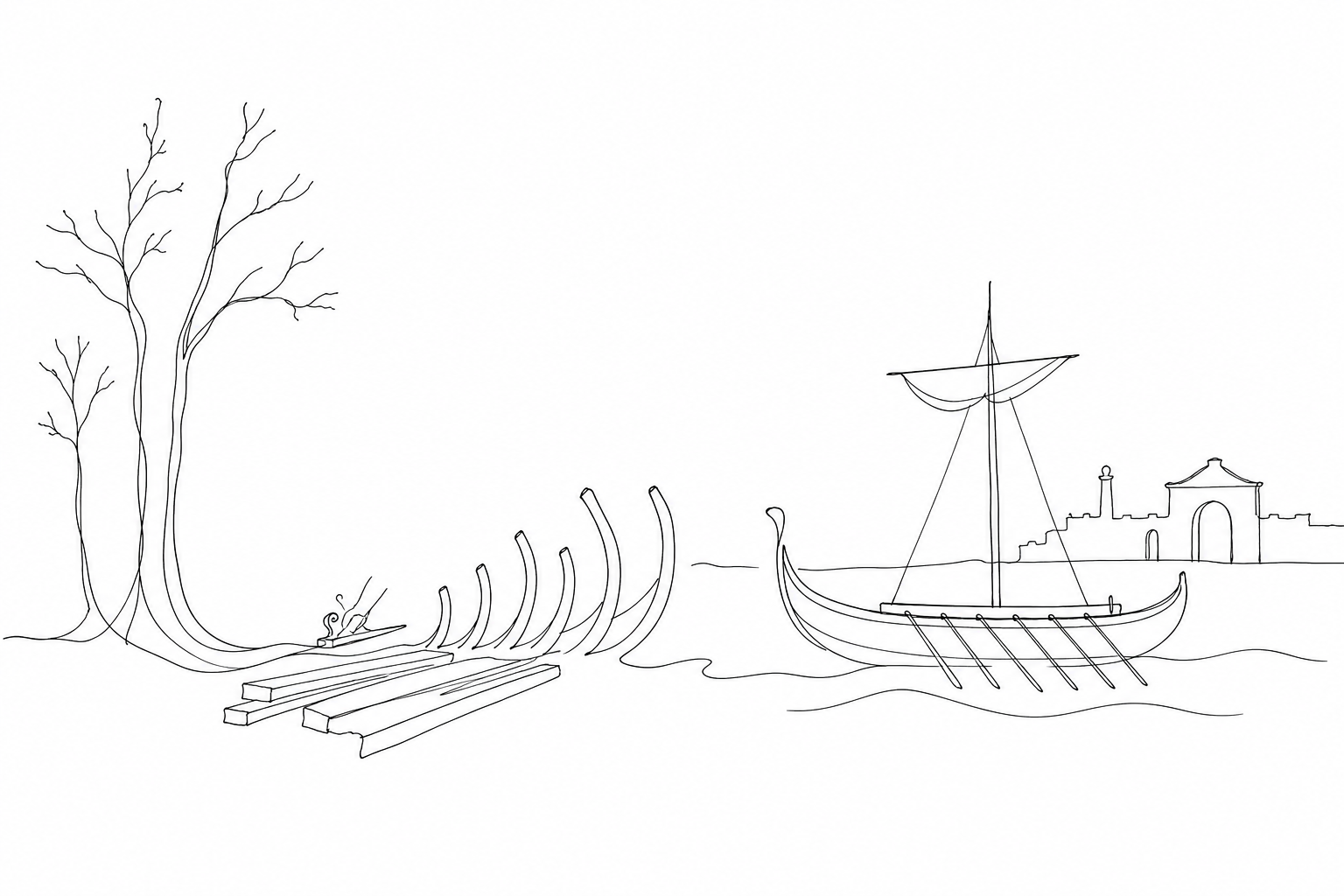
In the great Venetian shipyard, work did not proceed by individual intuition, but by controlled sequences. The marangoni intervened after the selection and seasoning of the pieces: they read grain, knots and natural curves, then adapted each element to the intended function in the hull.
The day was made up of gestures repeated with precision: squaring beams, shaping floor timbers and frames, preparing joints, drilling, finishing surfaces intended to fit together. Axe, saw, auger, chisel and plane were not simple tools: they served to translate measurements, moulds and models into real parts of a ship.
Specialization was essential. Some masters worked on the load-bearing structures, others on planking, decks, masts or oars; alongside them worked caulkers, blacksmiths and ropemakers. Coordination avoided costly errors: a poorly curved plank or an undersized joint could compromise speed, watertightness and resistance.
Internal rules, technical hierarchies and control of materials protected strategic knowledge. In this environment the marangoni were not wood laborers, but specialists capable of transforming drawings, public orders and raw material into the naval strength of Venice.
What to read today between the Arsenal and Castello
To understand the marangoni, it is not enough to look for a surviving workshop: one must read the district as a productive machine. The Porta Magna marked the ceremonial entrance, but behind that solemn face stretched closed, controlled spaces, where work on wood became a resource of the State. The high walls along the rio are not only a boundary: they recall the separation between the everyday city and the public shipyard, between technical secrecy and the life of the calli.
In Castello some clues still help interpretation. Campo de la Tana refers to the hemp used for ropes and naval equipment; the nearby parish of San Martino was linked to the community of the arsenalotti; the rii allowed the movement of heavy materials without crossing the streets. Observing these places means imagining a supply chain: selected trunks, shaped pieces, assembled hulls, but also controls, warehouses, records and specialized workers. Before visiting interiors or monumental areas, it is always advisable to verify the updated access conditions.
Reading the Arsenal through the marangoni means shifting one’s gaze from great naval enterprises to the gestures that made them possible. Every beam, joint and curve of the hull tells of a city capable of organizing manual knowledge as a public resource. Today, walking among the walls of the Arsenal, the calli of Castello and the signs remaining in names, buildings and water perspectives, one can sense a Venice that is less scenic and more concrete: that of trades, raw materials, work hierarchies and the technical intelligence that sustained the power of the Serenissima.
Related Posts
The Venice Arsenal: the place where the Serenissima built its power
History, spaces and meaning of the Arsenal, the productive and military heart of maritime Venice.The Arsenale ropewalks: where the ropes that held Venetian naval power together were born
History, function, and interpretation of the Arsenale ropewalks, the long space where Venice produced the ropes for its fleet.
The Venetian remèr: oars and forcole, the craftsmanship without which the gondola does not move
Who the Venetian remèr is, how oars and forcole are made, and why the movement of the gondola depends on these pieces.Questions Answered
Who were the marangoni in the Arsenal?
They were specialized wood artisans essential for ship construction.Why was wood considered a strategic material at the Arsenal?
Different woods served specific functions to improve ship durability and performance.How was work organized among the marangoni and other artisans?
Work proceeded by controlled sequences with specialized roles and strict rules.What can be learned by exploring the Arsenal and Castello district today?
The area reflects a productive machine shaped by technical knowledge and work hierarchies.Inside the Venice of the Arsenal
Want to follow the thread linking shipyards, craftsmen, vessels and maritime power?
 The Venice Arsenal: the place where the Serenissima built its powerHistory, spaces and meaning of the Arsenal, the productive and military heart of maritime Venice.
 The Porta Magna of the Arsenale: lions, symbols and propaganda carved at the entrance to Venetian naval powerHistory and interpretation of the Porta Magna of the Arsenale, amid Renaissance architecture, marble lions and Venetian political messages.
 The Arsenale ropewalks: where the ropes that held Venetian naval power together were bornHistory, function, and interpretation of the Arsenale ropewalks, the long space where Venice produced the ropes for its fleet.
 The Ships Pavilion: seeing Venice from the side of boats, not postcardsA route through the Ships Pavilion, among the Arsenale, historic boats and Venice seen from the water.