
The Arsenale ropewalks tell an essential, and often invisible, part of Venetian power. Before the battles, the trade routes, and the great ships, there were fibers to select, trained hands, spaces calibrated to the length of the ropes. The Corderia della Tana was not a simple workplace: it was an architectural machine serving navigation, where hemp became resistance, control, safety. Reading it today means entering a place where technology, daily toil, and political ambition were intertwined with an almost silent precision.
Why ropes were a strategic technology
In maritime Venice, a ship was not held together only by the wood of the hull or the iron of the anchors: it depended on a dense network of ropes. Shrouds, stays, halyards, sheets, and hawsers regulated masts and sails, made maneuvers possible, secured the cargo, and enabled mooring. Without strong cables, a galley or a transport ship could not face the Adriatic, the Levant, or the longer trade routes.
The Arsenale ropewalks responded to this need with internal, controlled, and continuous production. The Republic needed reliable materials in enormous quantities: every vessel consumed ropes during navigation, repairs, and fitting out. The quality of the fiber, the regular twist, and the length of the cables were therefore military and economic matters, not mere artisanal details.
In this sense, the ropewalks were a strategic factory within the Venetian naval factory: they transformed hemp and specialized labor into one of the tools that allowed the fleet to move, fight, and trade.
The Corderia della Tana: a long space for long fibers
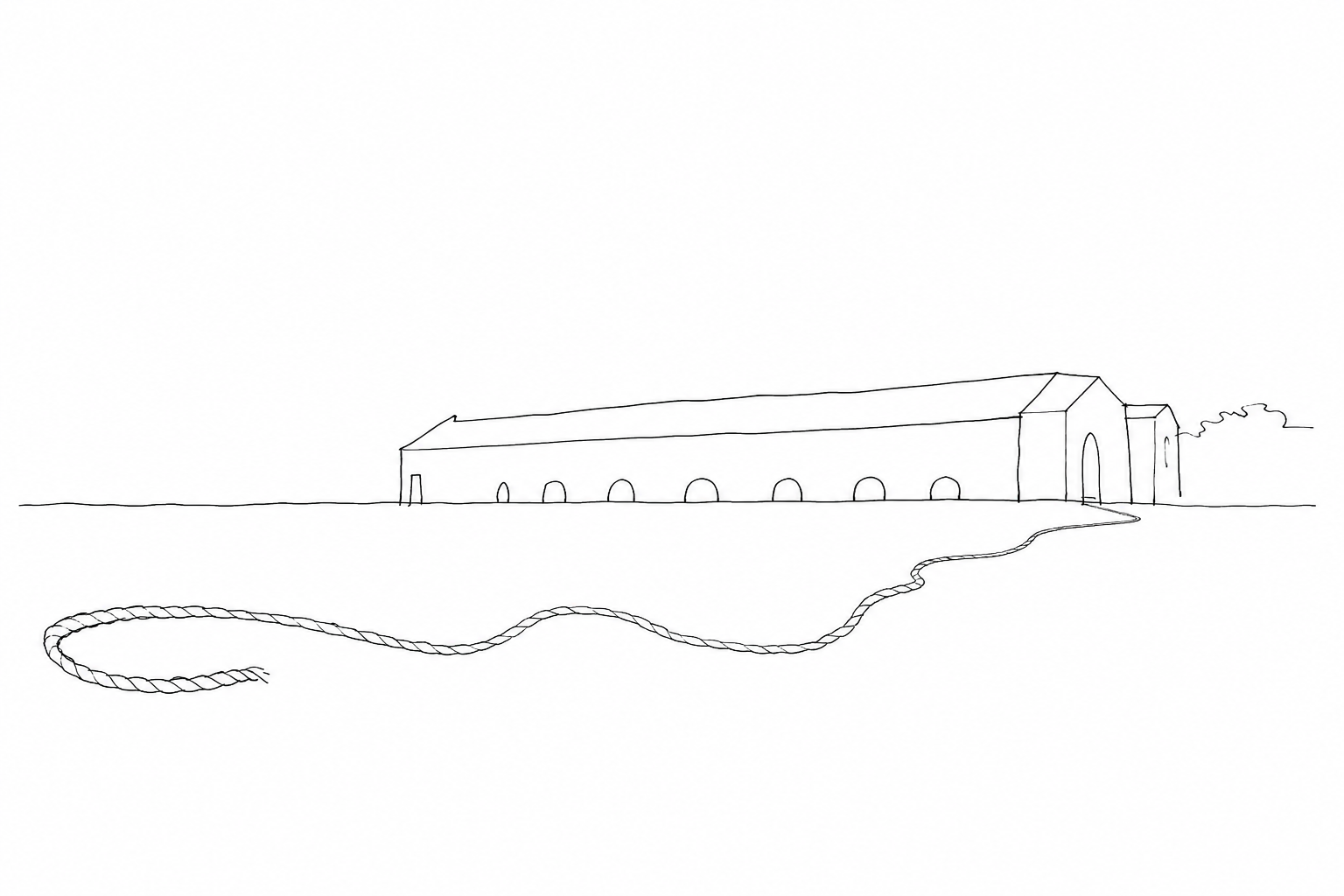
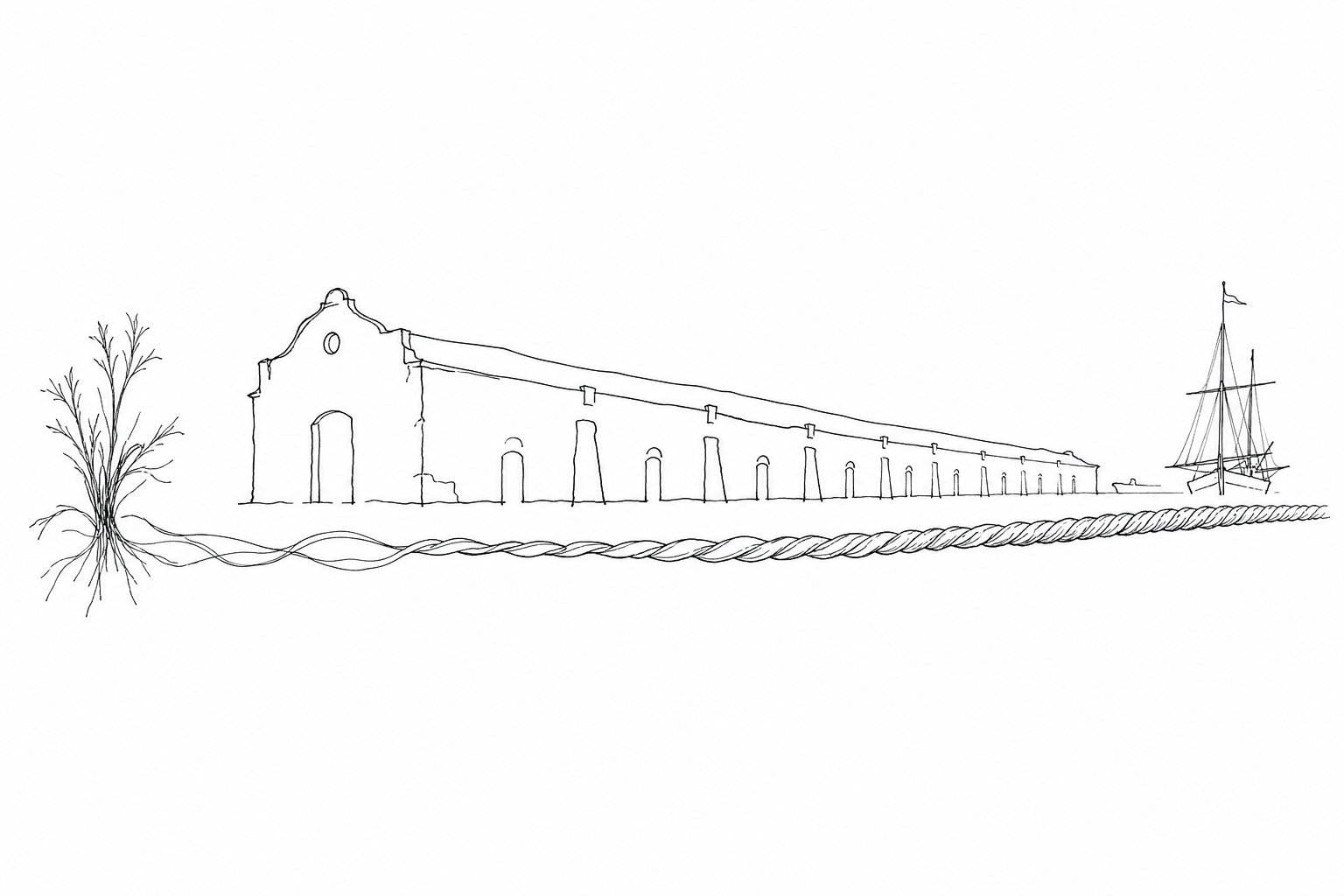
The Corderia della Tana is read first of all as an architectural machine. Its elongated form does not respond to a scenographic taste, but to a practical need: to obtain strong cables, the hemp had to be stretched out, combed, gathered into strands, and twisted along a continuous lane. The longer and sturdier the final product had to be, the more linear space was needed to control tension, thickness, and regularity.
The name “Tana” traditionally refers to Tanais, an area of the Black Sea linked to hemp supplies: a detail that connects the Venetian building to distant trade routes. Inside the Arsenale, however, that raw material became naval technology. The vast naves, marked by pillars and repeated openings, offered shade, ventilation, and operational rhythm; the length allowed aligned teams of workers, with coordinated gestures and tools capable of imparting progressive twist.
Seen this way, the Corderia is not a simple warehouse. It is a masonry production line, designed to transform plant fibers into hawsers, shrouds, and running rigging: elements invisible in the rhetoric of battle, but indispensable to the functioning of every Venetian ship.
Hemp, arsenalotti, and repeated gestures
Inside the spaces of the Arsenale, the work began long before a ship touched the water. The fiber arrived in bundles, already selected for strength and regularity; then it was combed, divided, spun, and twisted according to precise measurements. It was not enough to obtain a rope: different cables were needed for masts, sails, anchors, cargoes, and maneuvers, each with diameter, elasticity, and holding power suited to its use.
The arsenalotti should not be imagined as picturesque extras, but as specialized laborers of the Venetian State. They knew the weight of the materials, the right tension, the point at which a twist could weaken the product instead of strengthening it. Their knowledge was made of arms, eye, and technical memory, repeated every day in an environment marked by plant dust, strong smells, humidity, and noise.
In this routine, a concrete part of Venetian naval power was measured: without reliable rigging, even the best-built hull remained incomplete. The great decisions of the Republic also passed through slow, controlled, and often tiring gestures.
How to read them today during a visit
To understand the Corderie, it is not enough to look at the spectacular size of the spaces: it is worth looking for the clues left by their function. The first key is the perspective depth. A building so extended served to stretch out yarns, twist them, and control their tension without interruptions; for this reason the gaze must run from one end to the other, ideally following the path of the strands.
- Measure and rhythm: observe the regular succession of columns, trusses, and bays. It is not only monumentality: it is a grid useful for organizing repeated processes.
- Light: note how the lateral lighting makes the volume legible. In a rope workshop, seeing defects, knots, and irregularities was essential.
- Central void: interpret the free space as an operational area, not as an exhibition hall born as such.
- Material: where rough surfaces, bricks, and wood appear, imagine dust, controlled humidity, and the smell of fiber.
If the visit depends on exhibitions or special openings, always check the updated conditions.
Visiting the Arsenale ropewalks means observing Venice from a concrete perspective: not only a city of water and stone, but a production system capable of organizing materials, timing, and skills on an impressive scale. The long naves, the memory of the arsenalotti, the repeated rhythm of hemp processing help to understand how much Venetian maritime greatness depended on practical and continuous gestures. In these spaces, history does not appear as decoration, but as infrastructure: a weave of ropes, work, and urban intelligence that held together ships, trade, and power.
Related Posts
The Venice Arsenal: the place where the Serenissima built its power
History, spaces and meaning of the Arsenal, the productive and military heart of maritime Venice.The marangoni of the Arsenal: the wood artisans who built the strength of the Serenissima
History of the marangoni of the Arsenal, ship carpenters who transformed wood into galleys, hulls and Venetian maritime power.Naval History Museum: gondolas, models and ships to understand Venice as a maritime city
A route through the Naval History Museum to interpret Venice through gondolas, ship models, the Arsenal and maritime culture.Questions Answered
Why were ropes considered a strategic technology in Venice?
Because they enabled ships to maneuver, secure cargo, and withstand long trade routes.What is the significance of the Corderia della Tana’s architecture?
Its elongated form supported continuous rope production by controlling tension and length.Who were the arsenalotti and what was their role?
Specialized laborers who expertly produced ropes ensuring reliability and strength.How should visitors interpret the Arsenale ropewalks today?
By observing architectural features and imagining the production environment and its function.
Keep exploring the Arsenal
Which places and trades reveal the Serenissima’s naval machine most clearly?
 The Porta Magna of the Arsenale: lions, symbols and propaganda carved at the entrance to Venetian naval powerHistory and interpretation of the Porta Magna of the Arsenale, amid Renaissance architecture, marble lions and Venetian political messages.
 The Venice Arsenal: the place where the Serenissima built its powerHistory, spaces and meaning of the Arsenal, the productive and military heart of maritime Venice.
 The marangoni of the Arsenal: the wood artisans who built the strength of the SerenissimaHistory of the marangoni of the Arsenal, ship carpenters who transformed wood into galleys, hulls and Venetian maritime power.
 The Ships Pavilion: seeing Venice from the side of boats, not postcardsA route through the Ships Pavilion, among the Arsenale, historic boats and Venice seen from the water.