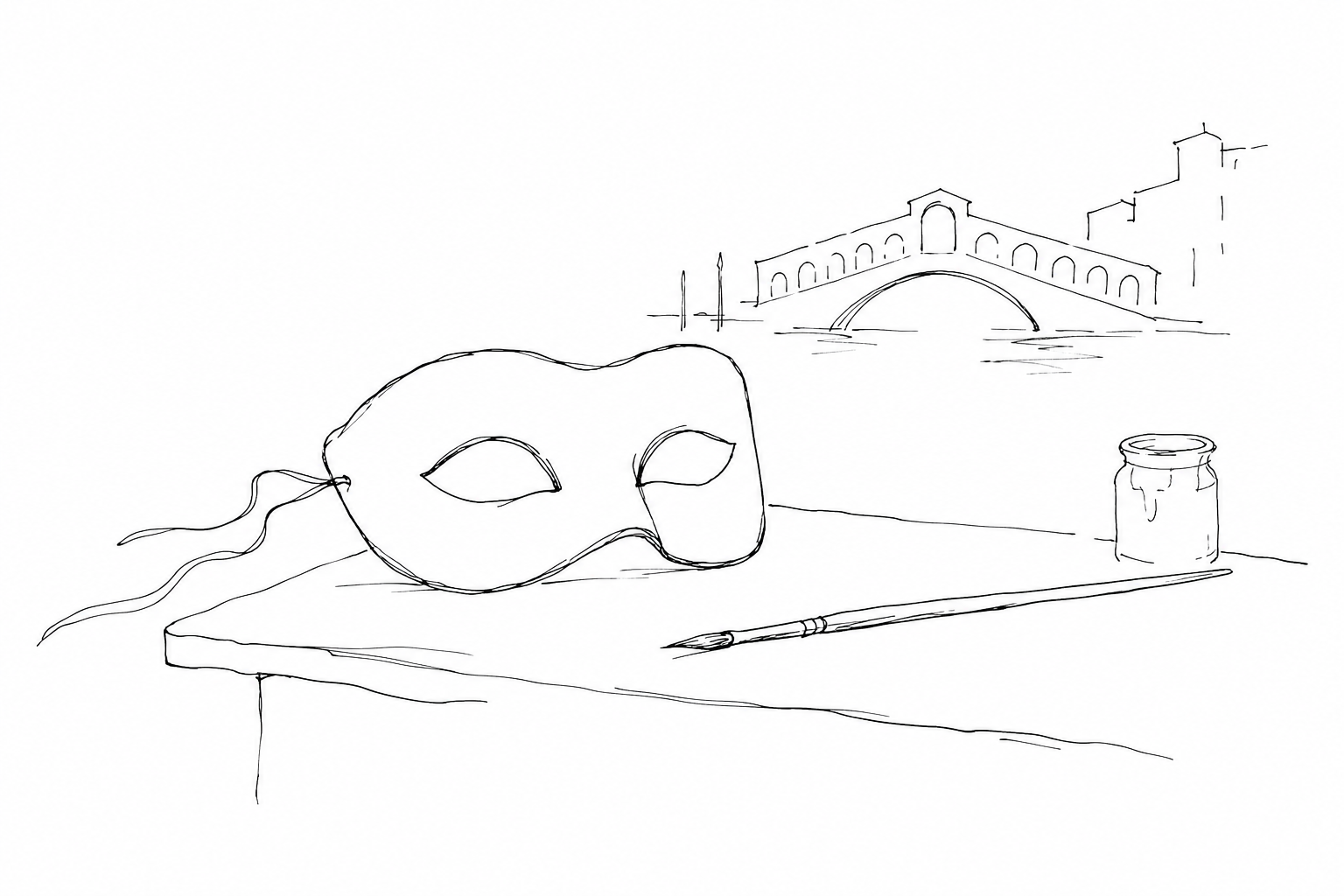

Among Venetian shop windows, one mask may seem similar to another. Yet the distance between a papier-mâché object born in a workshop and a mass-produced souvenir can be read in the details: in the irregular thickness, in the lightness, in the patience of the layers, in the way the color follows the face. Understanding this difference means looking at Venice beyond the decorative surface, entering a craft that brings together theater, Carnival, manual skill and everyday life. It is not only a matter of buying better, but of recognizing when an object truly preserves the time and the hand of the person who made it.
Why papier-mâché still matters in Venice
Papier-mâché is not a folkloric detail: it is one of the materials that best explains the authentic Venetian mask. In Venice, the masked face had to be light, wearable for hours, adaptable to the face and strong enough to accompany festivities, theater and street life. Papier-mâché met these needs better than more rigid or heavier materials.
In a real workshop, value comes from layering: paper, glue, gesso or primer, sanding, decoration. Each step leaves small readable traces, such as an irregular thickness on the edge or a surface that is not perfectly industrial. These controlled imperfections distinguish a handmade object from a mass-produced printed souvenir.
Tradition also dialogues with the Commedia dell’Arte and with Venetian figures such as the bauta and the moretta, but it is not limited to copying them. Papier-mâché allows variations, restorations, gilding, craquelure and hand painting: for this reason, even today, it tells not only an image of Venice, but a material and recognizable craft.
Inside a real workshop: shapes, layers and time
In an authentic workshop the mask is not born from a closed industrial mold, but from a positive form, often in plaster, which preserves traditional volumes: the pronounced nose of the bauta, the smooth forehead of the moretta, the marked cheeks of the zanni. The difference can already be seen here: the edges are not all identical, because each piece is adapted by hand.
The layers of papier-mâché are applied with controlled glues and pressure, following curves and hollows without erasing the details. After drying, the piece is removed from the form, trimmed, sanded and corrected. An ordinary souvenir tends to show uniform thicknesses, plastic surfaces or printed decorations; handwork, instead, preserves small variations, slight asymmetries and a different tension along the profile.
Time is also a clue. Drying, filling, base coat, painting, gilding or aging cannot be compressed without leaving traces. In a real workshop, successive steps can be recognized: the base that prepares the color, the burnished or worn metal leaf, the brush that follows the relief. The finished mask is not only decorated: it is built in layers, and each layer tells of a technical choice.
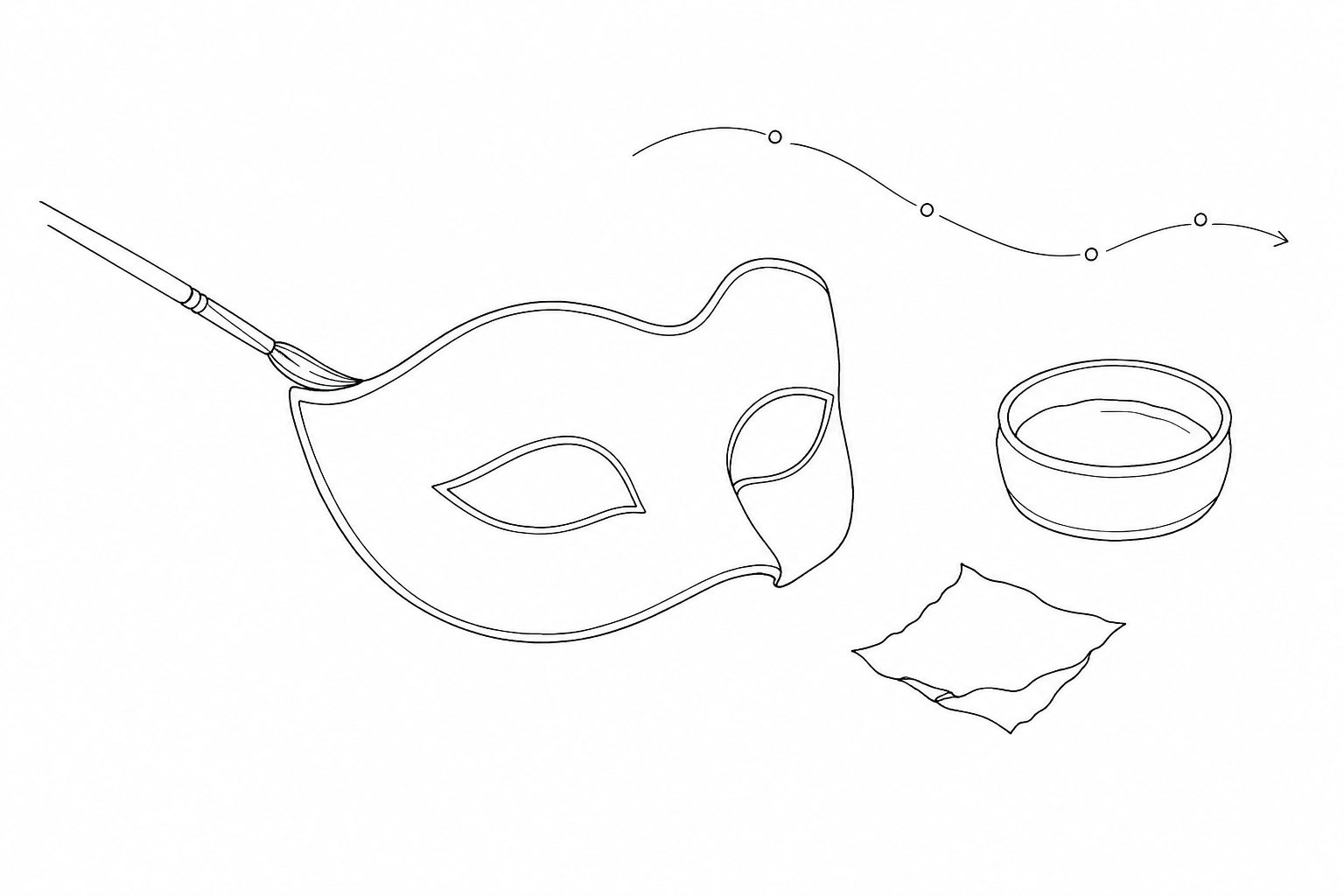
How to read a mask before buying it
Before the price, observe the piece as you would a small object of applied art. In Venetian papier-mâché masks, quality is recognized by physical clues, not by a generic label saying “handmade”.
- Weight and rigidity: a well-made artifact is light but not floppy. If it looks like thin plastic, or if it sounds too “hollow”, it probably does not come from traditional processing with pressed paper and glue.
- Edges and back: look inside. Small irregularities, hand finishing and controlled traces of sanding are better signs than an anonymous and perfectly industrial surface.
- Decoration: the color should follow noses, cheekbones and eyebrows. Brushstrokes, glazes, painted craquelure, gilding applied or worn with judgment indicate human intervention; uniform glitter and printed motifs often betray serial production.
- Origin: ask who made it and where. A serious workshop knows how to explain form, technique and materials without vague answers.
- Historical coherence: Colombina, Bauta, Plague Doctor or Volto have recognizable proportions. Imaginative versions exist, but a random deformation is different from a conscious choice.
A good purchase comes from this slow gaze: do not look for absolute perfection, look for a readable hand.
Where the souvenir betrays mass production
The industrial piece can often be recognized even before touching it: rows of identical faces, the same eyebrow angle, the same painted crack, the same repeated “antiqued” patina without variations. In an artisan workshop two similar Colombinas will never be clones; the line changes, the pressure of the brush, the way the gold follows the relief.
Also observe the back. In cheap souvenirs there may appear a plasticized surface, too smooth or with edges cut sharply, closer to a molded shell than to papier-mâché worked on a form. Decorations glued all in the same place, uniform glitter and the acrid smell of synthetic paint are other clues.
Finally, the context matters: a stall that sells magnets, fans, miniature gondolas and “Venetian masks” without explanations about the technique is communicating seriality, not craft.
Choosing a Venetian papier-mâché mask requires a few extra minutes: observing it up close, asking about how it was made, accepting small asymmetries, distinguishing a living finish from repeated decoration. In a city where the boundary between craftsmanship and tourist merchandise is often thin, this gaze changes the travel experience. A real workshop offers not only a memory to take home, but a concrete trace of Venice: made of hands, slow time, poor materials transformed with precision and a tradition that remains credible precisely because it continues to be practiced, not merely displayed.
Related Posts
Marbled paper in Venice: colors on water and workshops that seem like alchemy laboratories
A short journey through the history, technique and Venetian workshops of marbled paper, where pigments, water and slow gestures become objects of use and memory.Glass beads in Venice: a small global object born between Murano and city workshops
History, places and meanings of Venetian glass beads, between Murano furnaces, urban work and global routes.
Decorated Paper in Venice: Marbling, Bindings and the Tactile Side of Printing
A journey through Venetian decorated paper, among marbling, bindings, workshops and books to be observed with eyes and hands.Questions Answered
Why does papier-mâché still matter in Venice?
It combines lightness, adaptability, and strength for masks used in festivals and theater.What distinguishes a handmade mask from a souvenir?
Irregular thickness, layering details, hand-decorated surfaces, and slight asymmetries.How can one evaluate the quality of a Venetian mask?
By checking weight, edges, decoration, origin, and historical accuracy.What are the signs that a mask is mass-produced?
Identical features, plastic backs, glued decoration, and artificial finishes.
Follow another thread of Venetian art
Which places help you see artists, architecture and history as parts of the same city?
 Marbled paper in Venice: colors on water and workshops that seem like alchemy laboratoriesA short journey through the history, technique and Venetian workshops of marbled paper, where pigments, water and slow gestures become objects of...
 Venetian impiraresse: the women who strung beads and kept an invisible trade aliveHistory and memory of the Venetian impiraresse, workers in the conterie trade who strung beads between home, calli and workshops.
 Decorated Paper in Venice: Marbling, Bindings and the Tactile Side of PrintingA journey through Venetian decorated paper, among marbling, bindings, workshops and books to be observed with eyes and hands.
 Glass beads in Venice: a small global object born between Murano and city workshopsHistory, places and meanings of Venetian glass beads, between Murano furnaces, urban work and global routes.