
Giorgione’s The Tempest is one of those paintings that seem to hold back more than they show. At the Gallerie dell’Accademia, its modest dimensions contrast with the enormous weight of the questions it continues to raise: who are the nursing woman, the standing man, the city in the background? And why does that flash of lightning change the air of the entire scene? Looking at it means entering a Venetian enigma of the early sixteenth century, where landscape, figures and silence cannot be reduced to a single explanation.
A small painting in a large room of history
At the Gallerie dell’Accademia, The Tempest does not impress with monumental dimensions: it is a relatively small canvas, about 82 by 73 centimetres. Precisely this compact size accentuates the paradox. One of the broadest debates in European painting has formed in front of such a modest work.
The painting belongs to Venice in the early years of the sixteenth century, when Venetian painting was shifting its centre of interest from line to colour, from declared allegory to atmosphere. Giorgione, born in Castelfranco Veneto and active in the Serenissima, died young in 1510; he left few certain works and many debated attributions. This makes every detail of The Tempest even weightier.
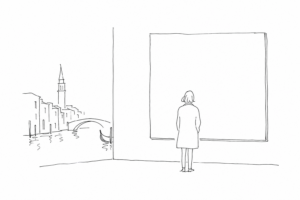
The first known description, in 1530, comes from the patrician and connoisseur Marcantonio Michiel, who saw it in the collection of Gabriele Vendramin and remembered it as a “little landscape” with storm, gypsy woman and soldier. Even there the subject was not explained: it was named, not interpreted.
Woman, armed young man, city, lightning
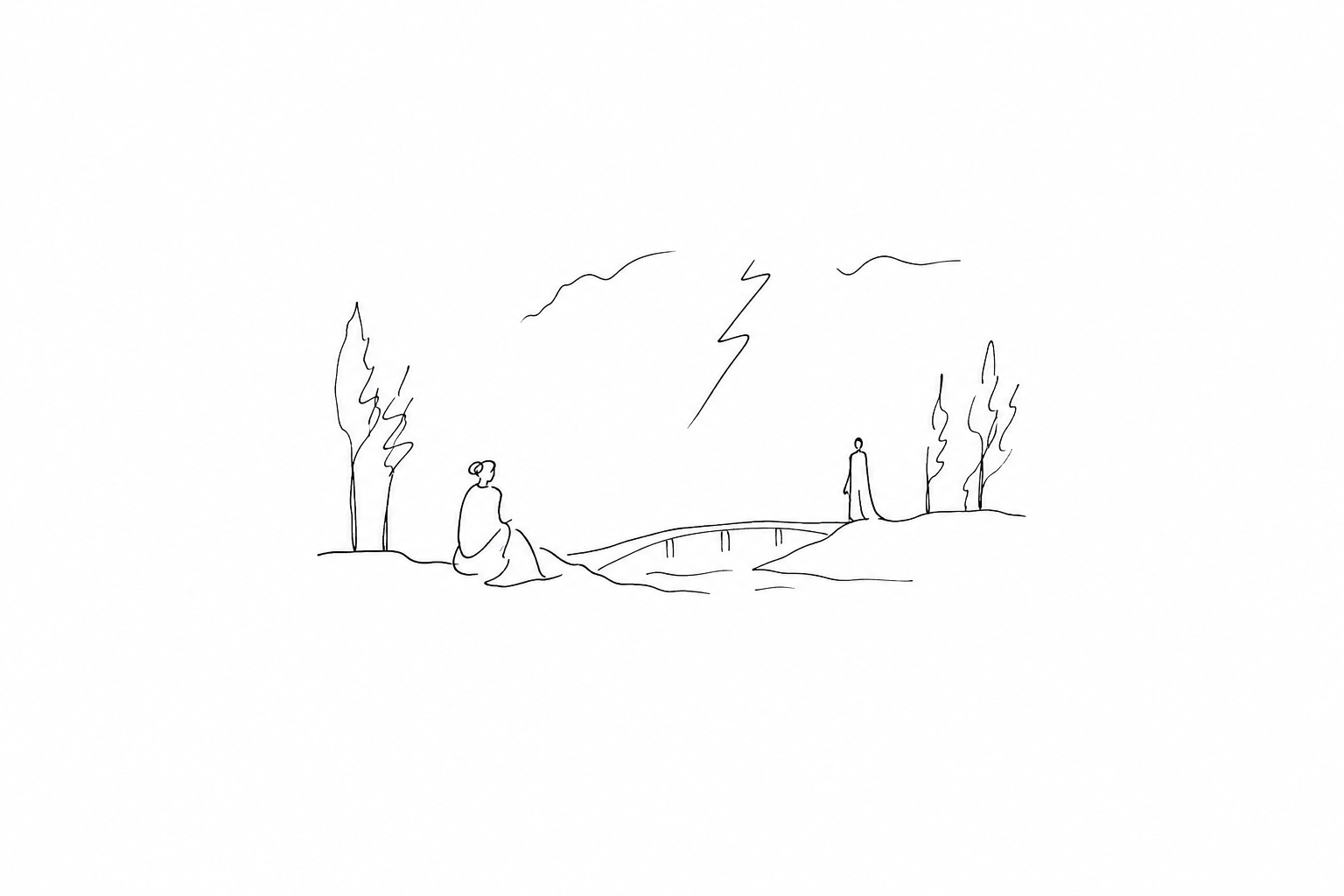
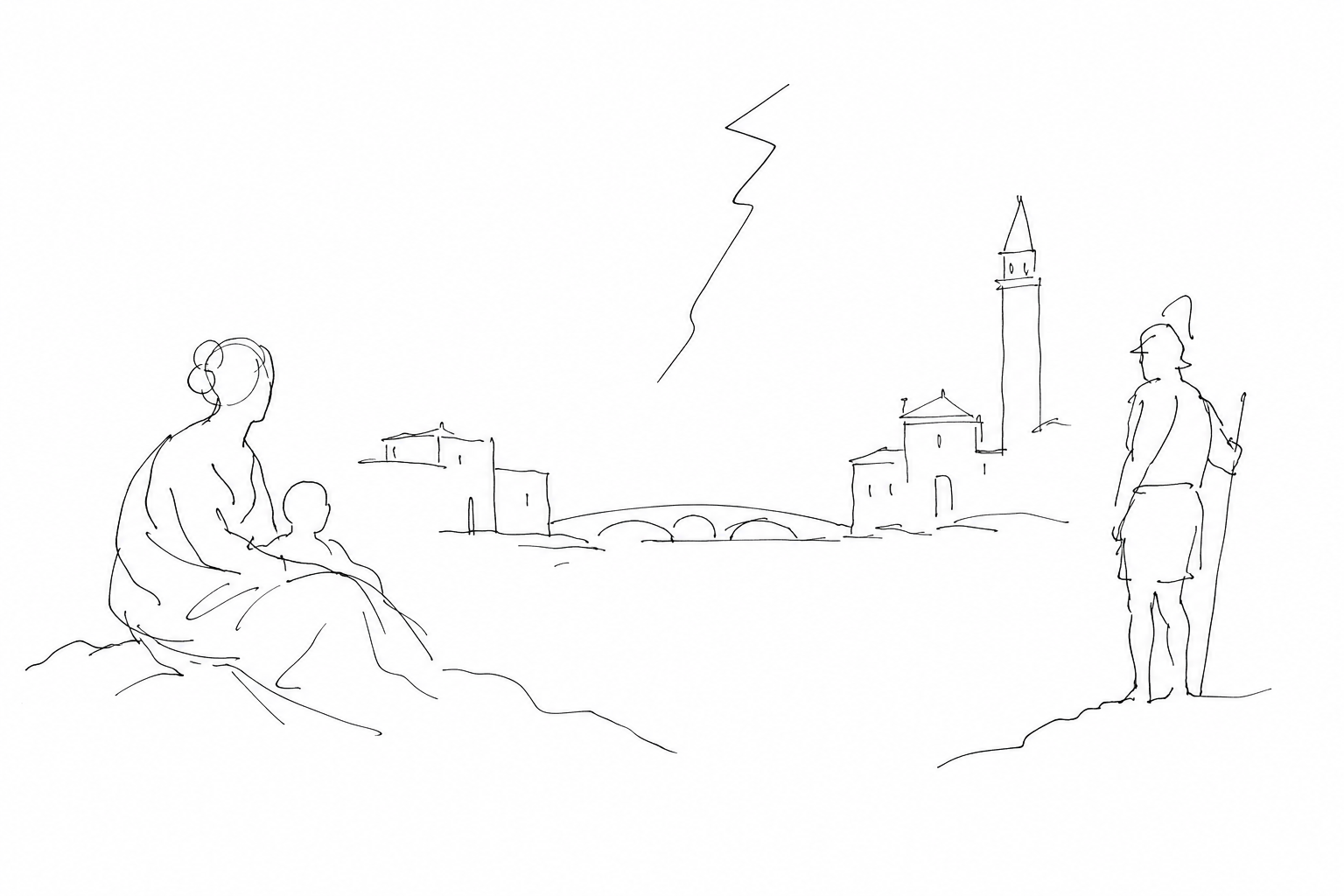
Before looking for a story, it is worth remaining in front of the elements. On the right, an almost naked woman sits on the grass and nurses a child. Her body is exposed, but the gesture is domestic; her gaze, directed toward the viewer, makes the scene less private and more uneasy.
On the left stands a clothed young man, with a long staff or pole. Tradition has called him a soldier, but he wears no obvious armour: he seems rather a guardian, a wayfarer, a presence waiting. Between him and the woman there is no visible dialogue. Are they looking at each other? Perhaps not. They inhabit the same space without explaining themselves.
Behind them, the landscape is constructed with precision: water, bridge, houses, towers, trees, ruins and two broken columns in the foreground. The lightning opens the sky above the city, while the green remains still, almost damp and silent. The decisive point is this: Giorgione distributes concrete clues, but does not arrange them into a closed story. The painting shows a great deal; it clarifies very little.
Why it cannot be fully explained
The crux already arises from the first known words about The Tempest. In 1530 Marcantonio Michiel records it in Gabriele Vendramin’s house as el paesetto in tela cum la cingana et soldato, attributed to Zorzi da Castelfranco. He does not speak of heroes, saints or famous episodes: he sees above all a landscape, a gypsy woman and a soldier. This ancient note helps, but it does not resolve the matter: it describes, it does not interpret.
Very different readings derive from this. One line seeks a biblical subject: Moses saved from the waters, Hagar and Ishmael, or Adam and Eve after the expulsion. The limit is evident: certain attributes are missing, and the armed young man does not fit naturally into those stories.
Others have proposed ancient myths or romances, such as Paris and Oenone, or episodes linked to loves, births and abandonments. Here too, however, the painting resists: no decisive gesture, no scene recognizable according to the usual iconography.
The allegorical hypothesis remains: city and countryside, motherhood and defence, nature and civilization, calm and threat. It is perhaps the most suited to the suspended tone of the work now at the Gallerie dell’Accademia, but it risks becoming too elastic. It can explain everything precisely because it proves nothing. For this reason the painting continues to function as an enigma: not because of an absence of clues, but because of an excess of clues that are not hierarchically ordered.
At the Gallerie dell’Accademia, The Tempest first surprises with its modest dimensions: about 82 by 73 centimetres. It does not impose a reading from afar; instead it asks you to come closer, stop, go back. A good way to look at it is to start with the landscape, not with the figures: the bridge, the houses, the broken columns, the dark water, the greenish sky cut by lightning.
Only afterward is it worth moving to the foreground: the nursing mother, the young man standing with the pole, the empty space between them. It is precisely that void that makes every explanation unstable. It does not seem like an episode narrated at its decisive moment, but a suspended scene, as if the meaning had been left just outside the visible surface.
Seeing it in person also helps one grasp Giorgione’s subtle painting: soft transitions, contours that are not rigid, an atmosphere that unites people, ruins and nature in a single unease.
Perhaps the fascination of The Tempest lies precisely in its resistance. It is not an image to be “solved” quickly, but a painting to inhabit with the gaze, accepting areas of shadow, hypotheses and minimal details. At the Accademia it invites you to slow down, to stay a few minutes longer in front of a fragile and suspended scene, so different from the rapid rhythm of a museum visit. Venice, here, is not a decorative background: it is a mental climate, made of water, stone, waiting and uncertainty.
Related Posts
Titian’s Pietà at the Accademia: the last light of a painter before death
Titian’s Pietà at the Gallerie dell’Accademia read as a pictorial testament, prayer, and ultimate confrontation with death.Carpaccio’s Stories of Saint Ursula: a painted tale to follow like a Venetian novel
Narrative guide to Carpaccio’s Stories of Saint Ursula: origin, episodes, Venetian details and keys to interpretation at the Gallerie dell’Accademia.
The Frari Triptych: how to look at Bellini without stopping only at the great basilica
A brief guide to reading Giovanni Bellini’s Frari Triptych, beyond the scale of the basilica.Questions Answered
Who are the figures depicted in The Tempest?
Identities are unclear; a nursing woman and a young man with a staff are shown.Why does The Tempest resist full explanation?
It presents many clues without arranging them into a clear narrative.What is the significance of the painting's small size?
Its compact dimensions contrast with the profound questions it raises.How does the landscape contribute to the painting's meaning?
The precise landscape elements create atmosphere and unify the scene’s mood.
Dorsoduro between art and walking
Which nearby stops are worth connecting without turning the district into a checklist?
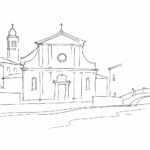 San Sebastiano in Dorsoduro: the church where Veronese transformed the walls into theaterA slow guide to San Sebastiano, the church in Dorsoduro marked by Paolo Veronese’s long work.
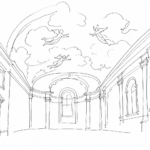 The Scuola Grande dei Carmini: clouds, angels and Venetian painting above a hidden hallA brief guide to the upper hall of the Carmini, among Tiepolo, Carmelite devotion and Dorsoduro.
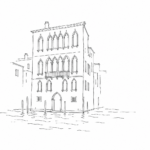 Ca’ Dario: beauty, superstition and dark legends on the Grand Canal’s most unsettling façadeHistory, façade and dark fame of Ca’ Dario, a Renaissance palace on the Grand Canal among art, famous names and dark tales.
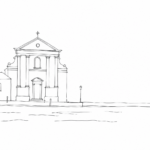 The Gesuati at the Zattere: Tiepolo, light and white façades in front of the Giudecca CanalA brief guide to the Gesuati at the Zattere: history, façade, light of the Giudecca Canal and Tiepolo’s ceilings.