
Vittore Carpaccio’s Stories of Saint Ursula are best viewed without haste, like an episodic tale in which each canvas adds a clue, a change of scene, an urban detail. Painted for a Venetian confraternity between the late fifteenth and early sixteenth centuries, they transform a medieval legend into a recognizable world: ambassadors, rooms, landing stages, ships, architecture and everyday gestures. At the Accademia they are not only masterpieces to admire, but a narrative to follow carefully, entering the visual rhythm of a cultured, mercantile and theatrical Venice.
Why they seem like a painted novel
Vittore Carpaccio’s Stories of Saint Ursula work like a serialized story: they do not simply ask to be looked at, but to be followed scene after scene. Painted in the 1490s for the Scuola di Sant’Orsola in Venice, they were large teleri, that is, narrative canvases intended to cover the walls of a confraternity, transforming the space into a kind of monumental illustrated book.
The story comes from the medieval legend of Ursula, a Christian princess betrothed to a pagan prince, a pilgrim on her way to Rome and finally a martyr in Cologne. Carpaccio, however, does not tell it like a distant fairy tale: he stages it with ambassadors, courtyards, loggias, boats, clothing and ceremonies that speak the language of the Venice of his time.
This is where the “Venetian novel” effect arises: each canvas contains a main episode, but also secondary characters, minimal gestures, credible architecture and urban details that invite the eye to linger. Sanctity becomes narrative, and narrative becomes a painted city.
The story, episode after episode
To find one’s way through Carpaccio’s cycle, it is best to read it as a sequence, not as isolated images. The story begins at the court of the Christian king of Brittany: the ambassadors of the pagan prince Ereo arrive, having come to ask for Ursula’s hand. The answer already introduces the crux of the story: the marriage will be possible only after the groom’s conversion and a pilgrimage to Rome.
There follow the envoys’ departure, their return to Ereo and the start of the journey. Carpaccio transforms these diplomatic passages into solemn episodes, full of loggias, stairways, landing stages and groups in discussion. The politics of the marriage almost becomes a Venetian chronicle, legible in gestures and spaces.
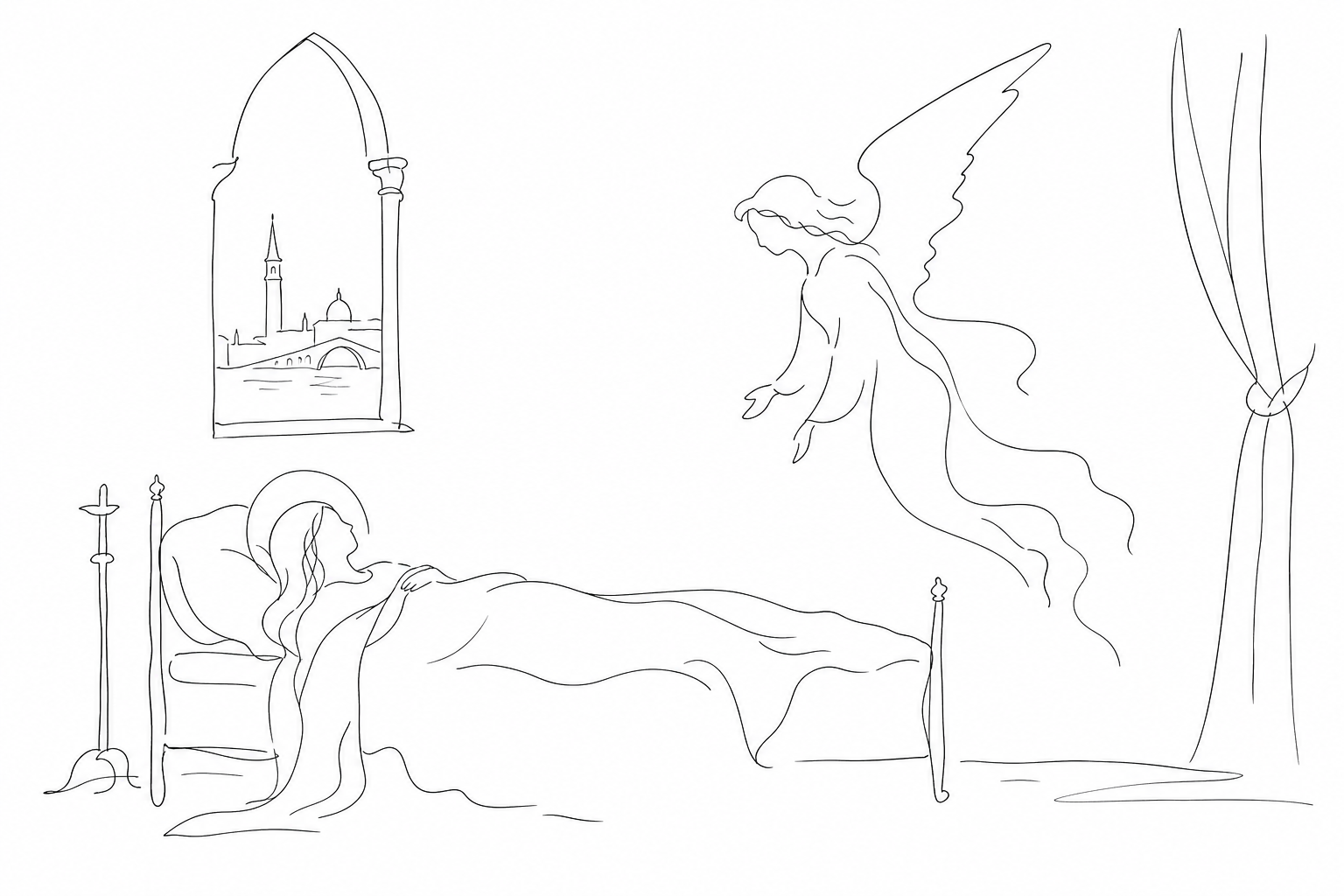
The emotional center is the Dream of Saint Ursula: an angel announces the imminent martyrdom in a silent room, far from the public clamor of the other canvases. Then the group reaches Rome, meets Pope Cyriacus and sets off again. In Cologne, occupied by the Huns, the journey turns into tragedy: killing, funeral and finally apotheosis close the story, carrying the princess from earthly history to heavenly glory.
Venice within the legend
The fascination of the cycle also lies in a silent shift: the medieval legend is clothed in the garments, spaces and gestures of late fifteenth-century Venice. Carpaccio does not seek an archaeological reconstruction of Brittany, Rome or Cologne; he constructs a world recognizable to the confreres of the Scuola di Sant’Orsola, then active in the area of Santi Giovanni e Paolo.
For this reason the embassies have the rhythm of Venetian diplomacy: secretaries, pages, dignitaries, red hats, precious fabrics and court protocols transform the sacred story into a civic chronicle. The architecture also speaks the language of the lagoon: loggias, porticoes, stairways, polychrome façades and ordered squares recall an ideal city born from the daily experience of the Serenissima.
The sea is not a neutral backdrop. Ships, masts, landings and piers give the story the geography of a mercantile power, where traveling means negotiating, waiting, embarking, exposing oneself to risk. Thus the princess appears not only as a martyr: she becomes a public figure, read through Venetian codes of marriage, embassy, devotion and family prestige.
How to view them today at the Accademia
At the Gallerie dell’Accademia the cycle should be approached at a slow pace: these are not paintings to be “summarized,” but large teleri created to cover a confraternal hall, the Scuola di Sant’Orsola. Size matters: it is worth alternating distance, to follow the overall structure, and closeness, to read gestures, clothing, inscriptions, coats of arms, ships and urban details.
A useful reading is to look first for the main narrative passages, then return to the margins. Often the secondary figures clarify the tone of the episode: ambassadors negotiating, spectators leaning out, servants, sailors, dignitaries. The painted city is not a neutral backdrop, but a visual machine that directs the gaze.
- Before: identify the displayed sequence, which may depend on the museum layout.
- During: observe the Venetian architecture and ceremonies.
- After: check the museum website for any practical updates before the visit.
Arriving at the Stories of Saint Ursula with a few coordinates changes the gaze: one does not look only for the beauty of the painting, but for the way Carpaccio constructs time, space and expectation. Each scene holds something of the Venice that surrounded him, even when it tells of a distant and legendary event. This is why the cycle remains so alive: it combines devotion, storytelling, urban observation and narrative precision. Viewing it today at the Accademia means allowing oneself a slow pause, following a painted plot that continues to speak through rooms, faces, fabrics, silences and apparently secondary details.