
At the Gallerie dell’Accademia, Titian’s Pietà is not encountered as a simple concluding masterpiece, but as a work left on the threshold. Conceived by the painter for his own burial and left unfinished at his death in 1576, it gathers bodies, shadows, stone and light in a scene that seems to burn itself out slowly before the viewer. There is no rhetoric of farewell: there is restless, almost physical pictorial matter, in which the artist’s old age becomes language. To look at it in Venice means entering into a silent dialogue with Titian’s final season, when color no longer merely describes, but resists.
A work conceived before the end
The Pietà preserved at the Gallerie dell’Accademia in Venice was not born as a simple devotional commission: it is the painting with which Titian looks toward his own death. The artist painted it in his final years, when he was already very old, and intended it for his burial in the basilica of the Frari. The canvas, however, remained in his studio at his death, which occurred in 1576 during the plague that struck Venice.
The personal character of the work is evident in the figure of Nicodemus, often read as a self-portrait of the painter: an old man supporting the body of Christ and seeming to ask for mercy. It is not only a sacred scene, but an extreme meditation on salvation, pain, and the fate of the body.
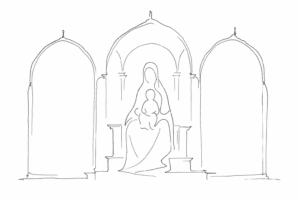
After Titian’s death, Palma il Giovane intervened to complete some parts of the canvas, leaving a record of his own intervention. It is precisely this tension between unfinished state and completion that makes the Pietà a testament-work, traversed by a dark, broken, final light.
Where to look: bodies, stone and silence
To read the Pietà, it is best to begin with the weight of Christ’s body: it is not an idealized body, but a lifeless, oblique mass gathered on the Virgin’s knees. The livid skin emerges with difficulty from the brown of the background; hands, feet and torso seem to consume the painting’s last light.
The gaze then rises to Mary’s face, closed in a firm, non-theatrical sorrow. Beside her, the kneeling old man, often identified with Nicodemus and with a self-portrait of Titian, introduces a personal intensity: he does not observe from afar, he enters the scene as a supplicant.
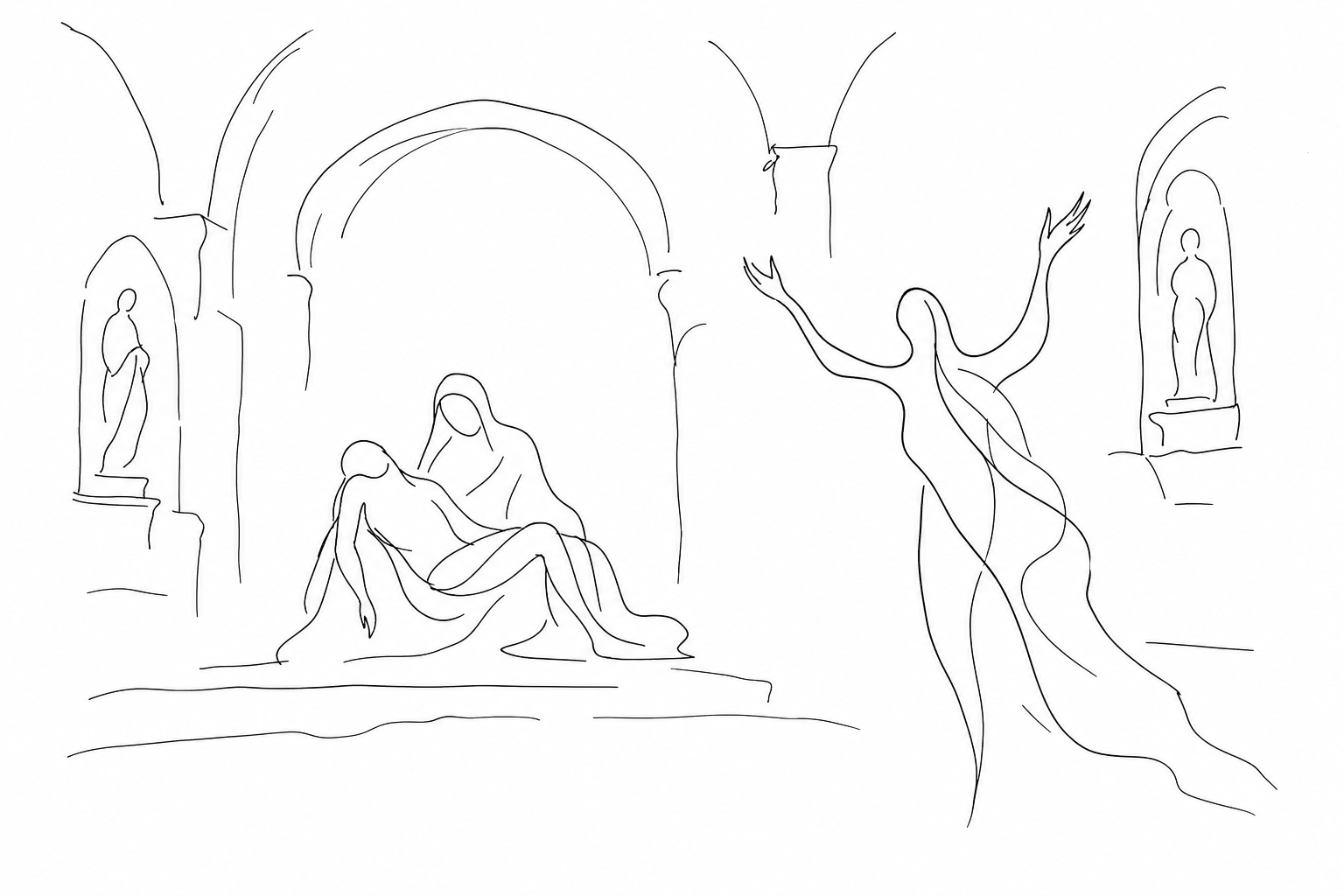
On the right, the Magdalene breaks the silence with an open gesture, almost a restrained cry. Behind the figures, the stone architecture does not serve as a simple backdrop: it is a sepulchral chapel, dark, inhabited by statues and reliefs, where the sacred takes on the tone of a tomb. The surfaces are rough, scratched, built with broad brushstrokes; up close, many forms seem to come apart. It is precisely there that the canvas speaks of the end: not with an orderly narrative, but with matter, shadow and residual flashes of light.
Late light, undone color, living matter
In this extreme canvas, now in the Gallerie dell’Accademia, painting renounces the polished finish that had made the Venetian master famous. The surface is harsh: the contours do not close the figures, the color seems scratched, driven into depth by browns, dark greens, muted reds and sudden pale flashes. It is not carelessness, but a late, physical, almost feverish language.
Seen up close, the pictorial matter becomes the protagonist. The brushstrokes remain visible, dense or dragged, and make the stone, the draperies, the flesh now devoid of strength vibrate. From a distance the image recomposes itself; from a few steps away, instead, it seems to be consumed before one’s eyes. It is this gap that makes it modern: it does not offer a pacified beauty, but shows the process, the effort, the trembling of the hand.
Tradition recalls that the painting was intended for the artist’s burial and remained unfinished; Palma il Giovane intervened after his death. For this reason too, the light does not truly illuminate: it resists, like one last residue within the shadow.
Within the Gallerie’s route, this painting asks for a different rhythm from the one reserved for the more narrative masterpieces. It is best to stop first at a distance: the whole appears almost like a broken altar, with the great stone niche enclosing the figures in a funerary space. Only afterward does it make sense to come closer, following the passages from Christ’s body to the Virgin’s face, to the kneeling old man, often read as a self-portrait of the painter.
The context of Dorsoduro helps one understand its weight. Once you leave the rooms, Venice here is not the ceremonial city of San Marco, but a district of scuole, churches and ancient places of devotion. The thought runs to the Frari, where the master wished to be buried and for which the canvas was conceived.
Looking at it without haste also means seeking out the small ex voto at the bottom: there appear two praying figures, linked to the request for salvation during the plague. Always check the museum website for any practical visit details.
Leaving the room after the Pietà calls for a slower step. The work does not offer a pacified closure: it remains open, rough, crossed by a light that seems to arrive late but not to go out. At the Accademia, among more famous paintings and often rapid routes, stopping before this canvas means listening to the moment when Titian transforms the end into living painting. It is a visit to make without haste, letting the details emerge one at a time: Nicodemus’s gesture, the cold stone, the gathered bodies, the color that flakes away and continues to speak.