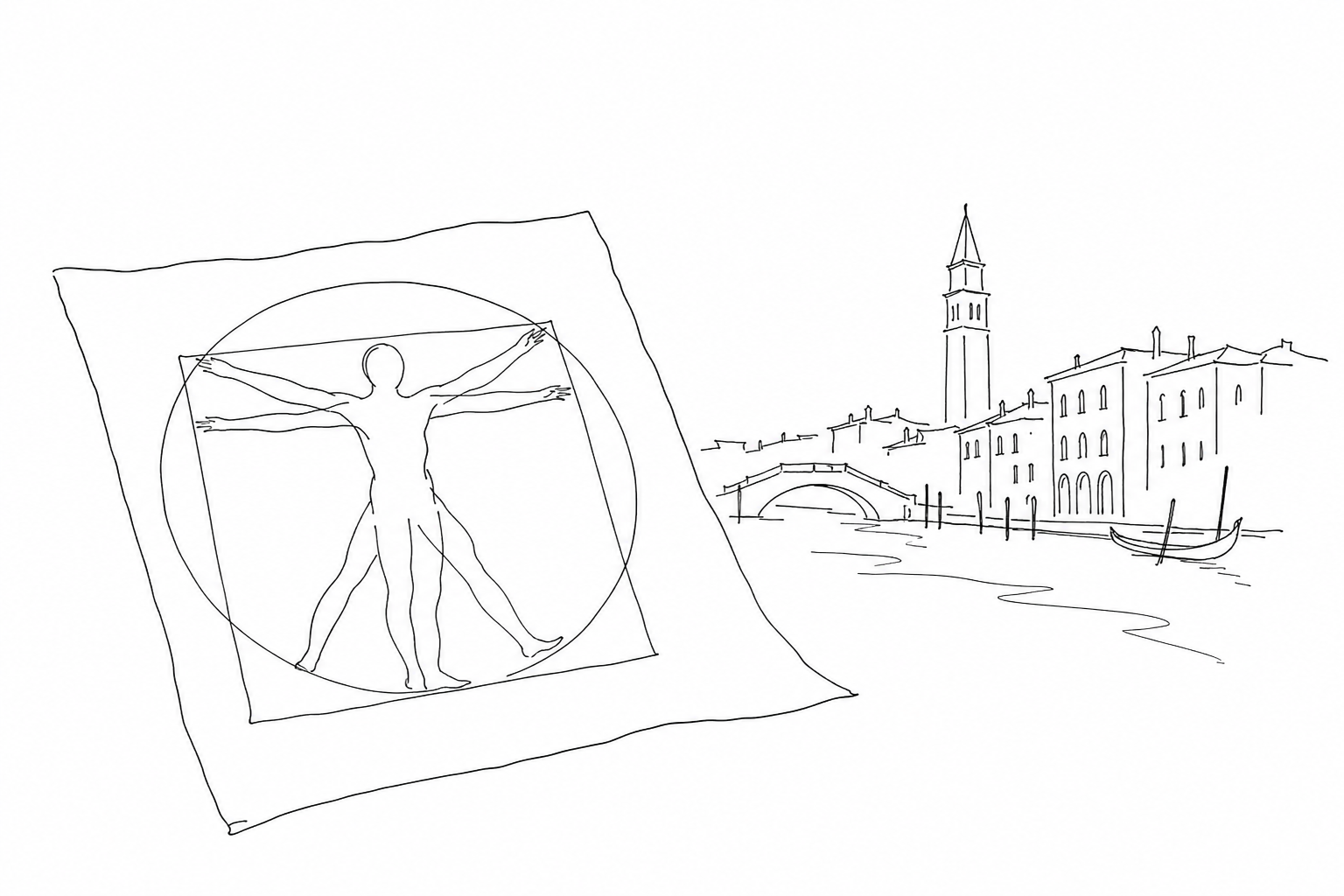

The Vitruvian Man is one of Leonardo’s most recognizable images, but in Venice it is not encountered like a painting permanently hung on display. The drawing is kept at the Gallerie dell’Accademia, in a fragile and controlled context, where protection weighs more than public availability. Understanding why it is not always visible means reading the work for what it truly is: a sheet on paper, precious and vulnerable, born from the study of proportions, the body, and architecture. Before looking for it in the galleries, it is worth knowing its history and the rules that condition its exhibition.
Where the Vitruvian Man really is
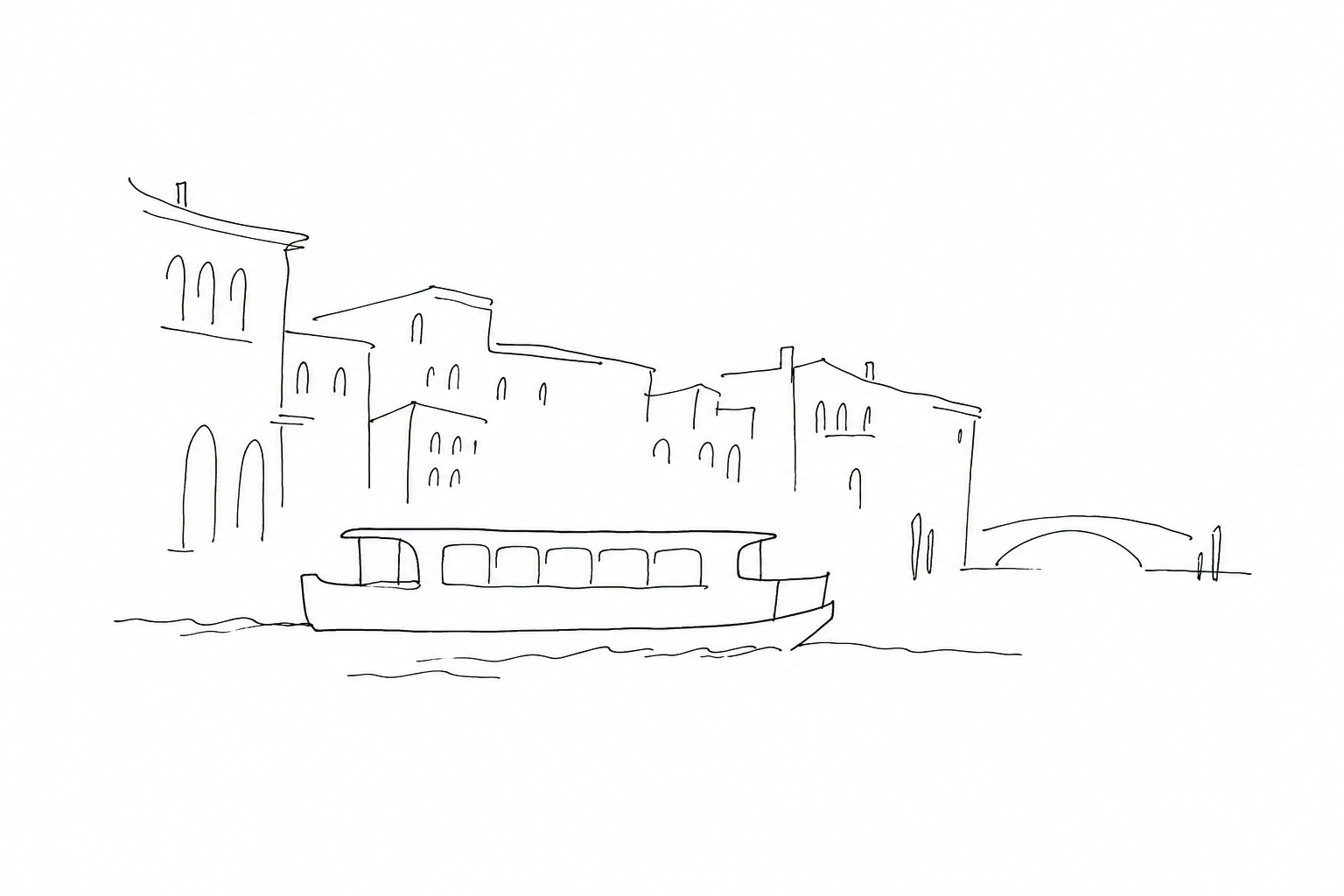
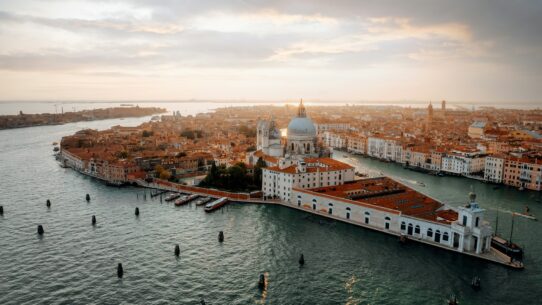
The Vitruvian Man is located in Venice, but not in the sense in which many visitors imagine a masterpiece “on display” in a gallery. Leonardo da Vinci’s drawing belongs to the Gallerie dell’Accademia, the state museum overlooking the Grand Canal, in the Dorsoduro district. It is therefore part of a Venetian public collection, not of a church, the Doge’s Palace, or a private collection.
Its nature is decisive for understanding why it is not always visible: it is not a painting on panel or canvas, but a drawing on paper, made around 1490 with pen and ink, accompanied by Leonardo’s notes in mirror writing. The work relates the human body to the circle and the square, taking up the proportions described by the Roman architect Vitruvius.
At the Gallerie dell’Accademia, the sheet is preserved as a graphic work of exceptional fragility. For this reason, a distinction must be made between “it is in Venice” and “it can be seen at any time”: the museum location is stable, its public exhibition is not.
Why it is not always visible
The main reason is material: the Vitruvian Man is not a painting on panel or canvas, but a drawing on paper, made by Leonardo around 1490 with ink and extremely fine graphic lines. Paper is an organic support: it absorbs humidity, reacts to changes in temperature and, above all, suffers progressive damage when exposed to light.
For an ancient sheet, light is not only an aesthetic problem. It can weaken the fibers, alter the color of the paper, and compromise the legibility of the marks. Even low light levels, if prolonged over time, produce a cumulative effect. For this reason, a graphic work of such importance cannot remain permanently on the wall as many paintings do.
Conservation therefore requires periods of rest in controlled environments, in the dark or with minimal exposure, and public appearances only on limited occasions, when conditions allow. This is not a choice designed to create rarity, but a necessary measure to slow the deterioration of the sheet.
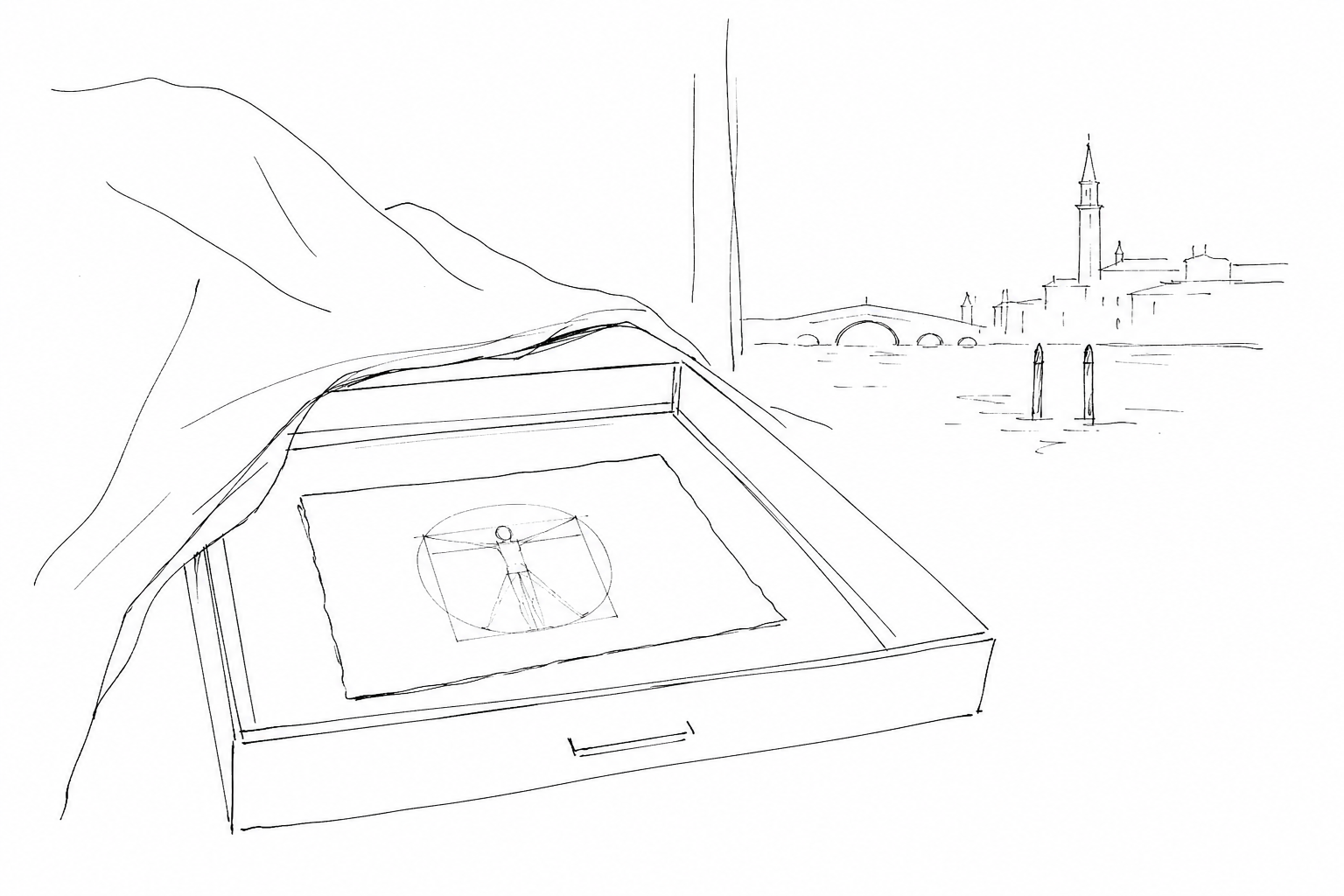
Anyone wishing to see it must therefore distinguish between the presence of the work in the Venetian collections and its actual visibility. Before planning a visit, it is always advisable to check whether the drawing is scheduled to be on display.
The famous figure preserved in Venice is not only an image of ideal harmony. It is a graphic reading of a passage from Vitruvius’s De architectura, the Roman architect of the 1st century BC, who described the human body as a model of proportion for sacred architecture. In the Renaissance, that text became central again: measuring the body meant seeking a rational order valid for art, science, and construction.
Leonardo translates this idea with a precise visual solution: a male figure inscribed in both a square and a circle. The circle has its center at the navel, while the square follows a different balance of the body; the arms and legs in double position make it possible to align two geometric systems that are not identical. Around the figure, the handwritten notes record proportional relationships, such as the span of the arms being equal to the height.
For this reason, the work is so important in the Gallerie dell’Accademia: it shows not only graphic skill, but the moment when anatomical observation, ancient mathematics, and humanistic culture become a single image.
How to prepare before the visit
Before planning a visit to the Gallerie dell’Accademia, it is useful to consider the Vitruvian Man as a work preserved under special conditions, not as a painting displayed continuously. The paper support and the ink require strict limits on light, humidity, and handling; for this reason, its presence in the gallery may depend on conservation rotations or specific exhibition occasions.
- Check the updated information on the museum’s official website or through institutional channels, avoiding reliance on outdated guides.
- Do not build the entire itinerary around a single work: the collection still makes it possible to understand the Venetian and Renaissance context in which the sheet is kept.
- Prepare beforehand by reading the reference to Vitruvius and observing a reliable reproduction: it helps to recognize the proportions, the double position of the limbs, and the relationship between circle and square.
Seeing the Vitruvian Man in Venice is not a certainty to be mechanically included in an itinerary, but a possibility linked to conservation choices, temporary exhibitions, and very precise conditions. This frequent absence itself helps us look at it with greater attention: not as an icon reproduced everywhere, but as an ancient drawing that requires darkness, rest, and care. Before the visit, it is useful to check the official communications of the Gallerie dell’Accademia and to consider the museum in any case for what it offers: a rich itinerary, capable of telling the story of Venice and the Renaissance even beyond Leonardo’s sheet.