
At the Frari, the eye easily runs toward the height of the basilica, toward Titian, toward the Gothic vastness of the nave. Yet Giovanni Bellini’s triptych asks for a different kind of time: it does not dominate the space, it gathers it. Created in 1488 for a side chapel, it builds a silent presence in which painted architecture, light and sacred figures seem to belong to the same breath. Looking at it well means shifting attention from the grandeur of the place to the precision of an equilibrium: the Madonna, the saints, the color and that sense of calm that makes Bellini still surprisingly close.
Where Bellini’s gaze truly lies
At the Frari, the first risk is to let oneself be absorbed by the scale of the basilica: the very high naves, the wooden choir, the funerary monuments and the great altarpiece tend to push the gaze toward the center and upward. Giovanni Bellini’s triptych, however, asks for a different movement: it is not understood by remaining only on the monumental axis of the church, but by seeking the sacristy, the more intimate space in which the work is preserved.
This shift is already a key to interpretation. Bellini does not compete with the Gothic vastness of the Frari; instead, he builds a calibrated presence, made of silence, light and measure. In the triptych, the Madonna and Child and the saints are not conceived as figures to be dominated from afar, but as presences to be encountered at close range, within a frame that organizes the space like a small sacred architecture.
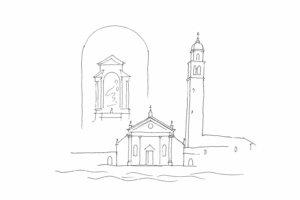
To look at it well, then, it is best to slow down: first orient yourself in the basilica, then change your mental scale. Bellini is found where the visual noise of the Frari subsides.
A 1488 triptych between devotion and unified space
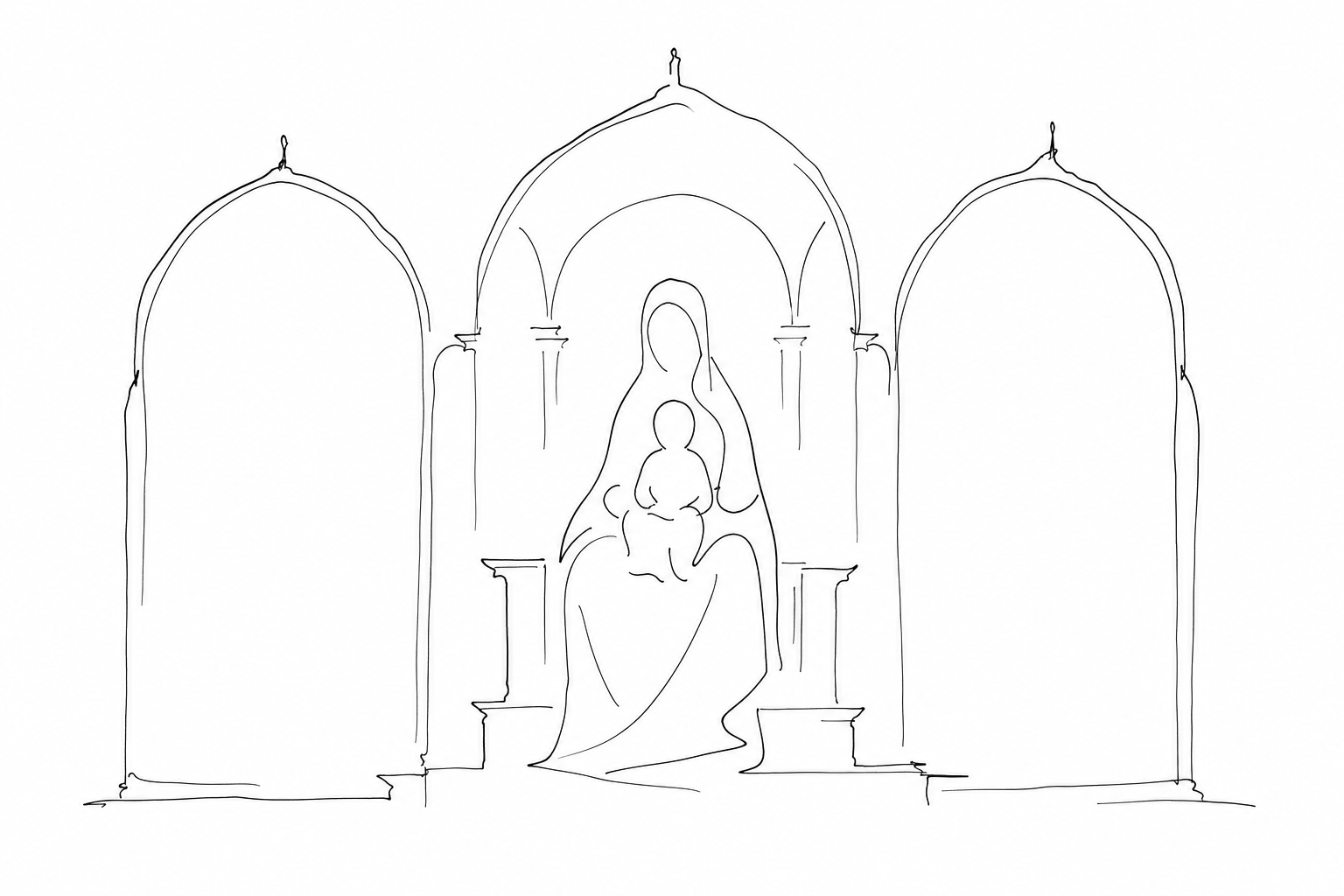
The core to recognize is an altarpiece signed and dated 1488 by Giovanni Bellini, intended for the sacristy of the Frari basilica. The form is that of the triptych: at the center, the Virgin and Child enthroned beneath a small gilded vault; at the sides, within compartments separated by the frame, four saints appear, including Peter and Mark, decisive figures for reading the Venetian connection of the work.
The novelty lies not only in the individual panels, but in the way the artist makes them breathe together. The gilded wooden frame divides, but perspective stitches back together: floor, light and architecture suggest a single environment, a painted chapel that ideally continues into the real space of the sacristy. For this reason, the triptych should be observed without treating it as a fragmented image: the side figures are not simple attendants; they participate in the same silent presence as the Madonna.
In 1488 this solution translated traditional devotion into a more unified and measured vision, where the gold remains sacred but the light makes the figures close, solid, almost present.
To read the work without letting oneself be absorbed only by the monumental setting, it is best to start from the center: the Madonna is not isolated against an abstract background, but sits on an architectural throne that seems to continue beyond the frame. The Child, firm and frontal, introduces a human note into a very controlled composition.
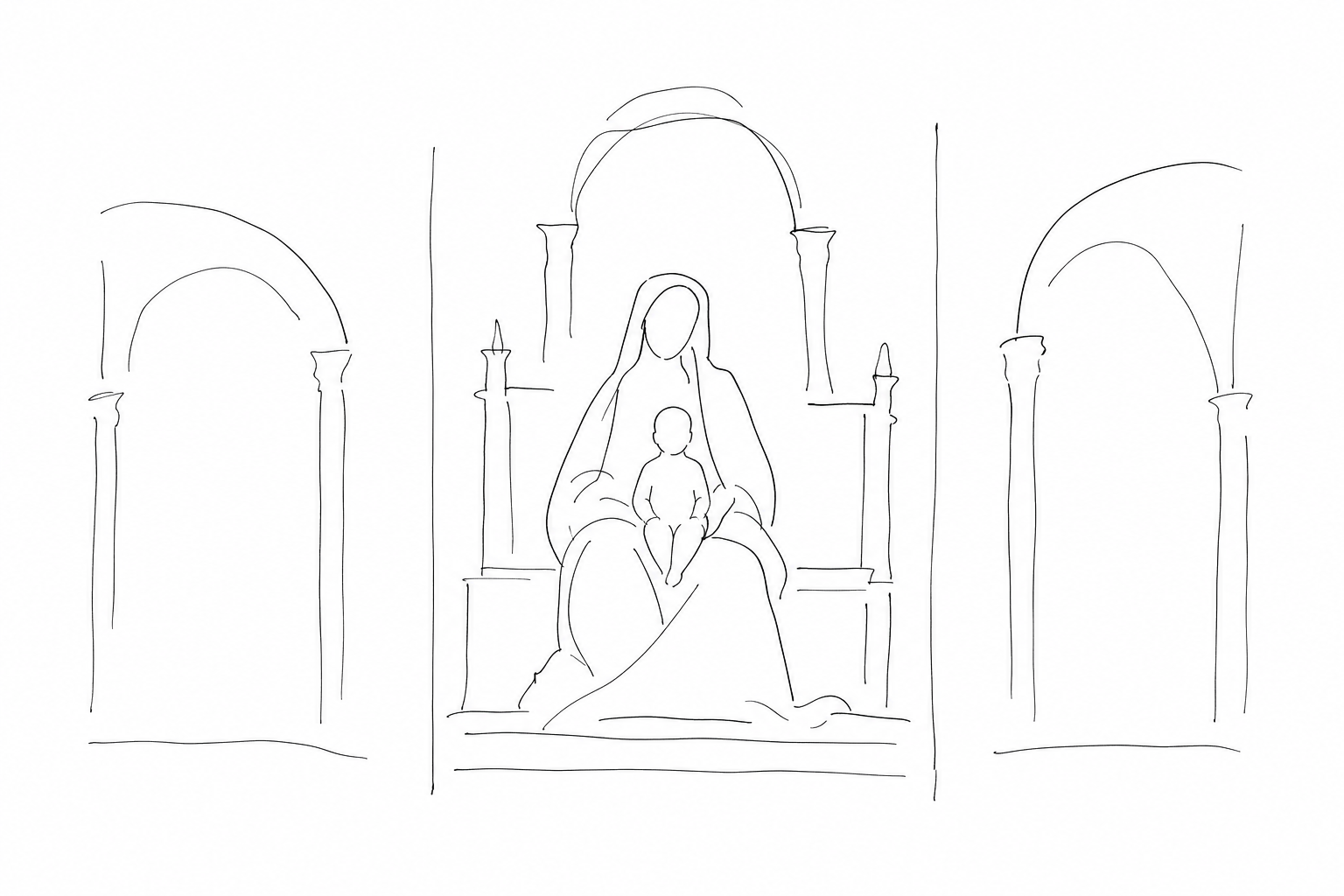
At the sides, the saints should not be looked at as simple decorative presences. Saint Nicholas and Saint Peter, on one side, Saint Mark and Saint Benedict, on the other, form an ordered community around the Virgin. The books, the episcopal vestments, the keys, the bearded face, the habit and the attributes help to distinguish them, but the decisive point is their composure: no one forces the scene; all inhabit the same silence.
Light is the true connecting thread. It does not erase the gold; it makes it less distant: it slips over the marbles, softens the faces, builds the volumes of the hands and draperies. Looking calmly, one notices that solemnity arises from small balances: the vertical axis of the throne, the heads arranged with measure, the colors alternating red, blue, green and dark browns.
The best way to approach it is to linger on the passages between figure and architecture: there, painting transforms devotion into concrete presence.
Why not stop at the great basilica
The visit changes if the work is not treated only as a minor stop after the monumental nave. The painting is in a more intimate setting, the sacristy: this reduced scale helps to read more clearly the calm of the figures, the relationship with the altar and the devotional function for which it was conceived.
Then, going out into the campo, the meaning broadens: the Franciscan complex is not an island, but an urban node close to calli, bridges, workshops and the Scuola Grande di San Rocco. Looking at the central panel and the side saints after having perceived this everyday rhythm makes it possible to understand why the painting does not speak only of religious magnificence: it brings order, silence and measure into a very dense Venice.
The ideal route therefore alternates three moments: the great nave, the close stop before the work, and finally the return to the district.
Stopping at the Frari triptych is not a minor detour, but a more attentive way of moving through the basilica. Bellini does not compete with the monumentality of the building: he interprets it on an intimate scale, transforming a chapel into a space of visual listening. After seeing the great works, it is worth allowing yourself a few minutes in front of this measured composition, where every detail works without clamor. It is often in these side encounters that Venice stops being only a setting and once again shows itself as a city made of works, places and gazes layered over time.
Related Posts
The mosaics of San Marco: how to look at the gold without being dazzled only by its beauty
A brief guide to reading the mosaics of San Marco: gold, light, scenes, spaces and details to observe calmly.San Zaccaria beyond San Marco: crypt, water and the suspended calm of Giovanni Bellini
A slow guide to San Zaccaria: the church between San Marco and Castello, the flooded crypt and the altarpiece by Giovanni Bellini.
San Cassiano: Tintoretto, market and silence a few minutes from the chaos of Rialto
A short route between Rialto and San Cassiano: market, quiet calli, church and canvases by Tintoretto.Questions Answered
How does Bellini’s triptych differ from the basilica's scale?
It creates an intimate, balanced presence instead of competing with monumental vastness.What is unique about the triptych’s composition?
The panels are unified through perspective and light into a single painted sacred space.Who are the figures depicted in the triptych?
The central Madonna and Child are accompanied by four saints including Peter and Mark.Why should visitors look beyond the basilica when viewing the triptych?
Understanding the surrounding urban context enriches the triptych’s meaning and devotional function.
From the artwork to its Venetian setting
Want to move from this detail to spaces that explain the city’s art more fully?
 Italic type was also born here: Venice, publishing and typefaces that changed the way people readHow Venice, Aldus Manutius and Aldine typefaces changed books, reading and the printed page.
 Palazzo Pisani Moretta: why Venetian Gothic seems embroidered in stoneA reading of Palazzo Pisani Moretta, where Venetian Gothic becomes a subtle weave on the façade of the Grand Canal.
 Marbled paper in Venice: colors on water and workshops that seem like alchemy laboratoriesA short journey through the history, technique and Venetian workshops of marbled paper, where pigments, water and slow gestures become objects of...
 Palazzo dei Camerlenghi: money, public offices and economic power next to RialtoHistory and interpretation of the Palazzo dei Camerlenghi, the financial seat of public Venice next to Rialto.