
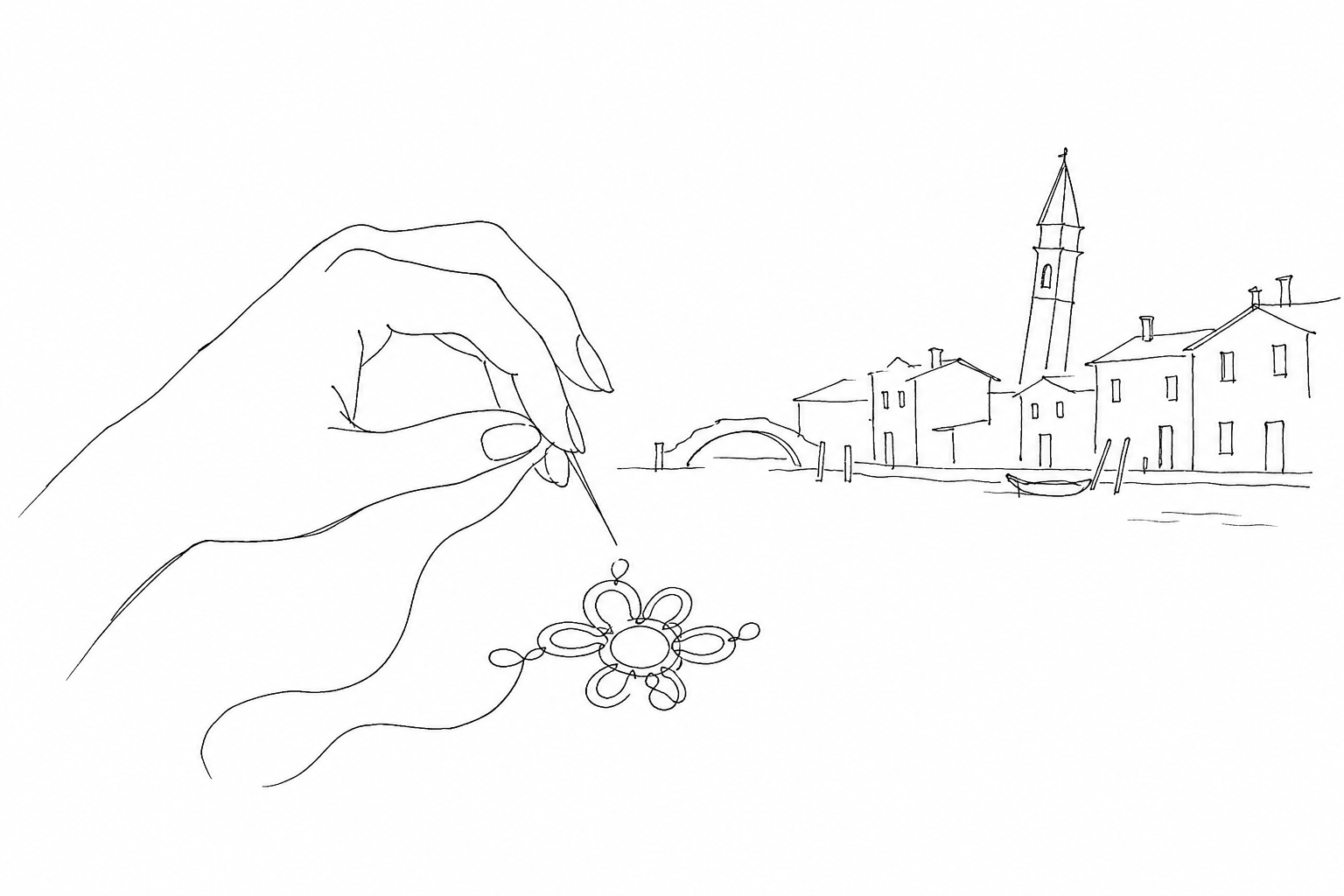

In Burano, the eye almost always runs to the painted facades, to the reflections in the canals, to the easy photographs. The Lace Museum instead asks for a slower step: entering the history of a domestic and at the same time highly refined art, made of hands, patience, drawings and female transmissions. Housed in the former Lace School, the museum tells of a less immediate but deeper island, where daily work produced beauty, economy and identity. When visiting it, the colorful houses remain outside the window, but they become part of a broader context.
Beyond the colorful houses: why enter the museum
In Burano, the eye immediately runs to the lively facades, to the reflections in the canals, to the images that already seem ready for a postcard. The Lace Museum, instead, asks for a different kind of attention: slower, closer, almost silent. Entering its rooms means moving from the island’s colorful surface to the minute precision of an art built thread after thread.
The museum is located in the historic headquarters of the Burano Lace School, established in 1872 to revive a tradition that had made the island famous in previous centuries. Here lace does not appear as a simple ornament, but as a document of work, patience and female knowledge handed down through hands, drawings, stitches and samples.
The visit helps to understand what photographs of the colorful houses do not tell: behind Burano’s cheerful image there exists a material culture made of time, trained eyesight, technical memory and precious fragilities.
The Lace School and the rebirth of a form of knowledge
The roots of the Lace Museum lie in the Lace School, founded in 1872 to save a technique that was at risk of disappearing. After centuries of European fame, Venetian needle lace had gone through a long crisis: changes in taste, competition from less expensive productions and local poverty had interrupted the transmission of the craft.
The school was born as a cultural and social project. Figures from the Venetian aristocracy, including Andriana Marcello, supported the revival of teaching, recovering ancient stitches and organizing specialized female work. The pupils did not only learn to “embroider”: they studied drawings, technical steps, thread tension, the order of solids and voids. Each piece became a test of visual and manual discipline.
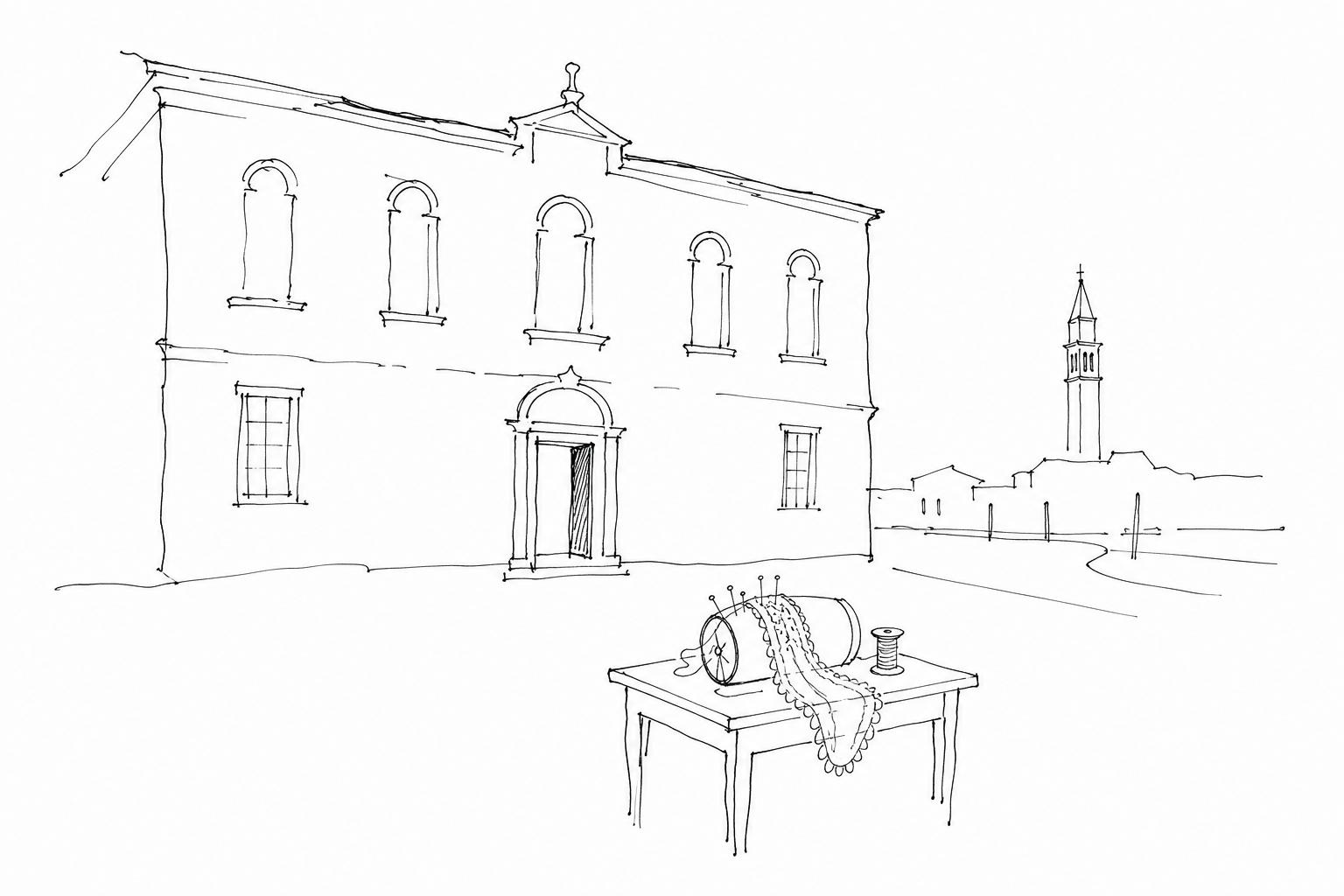
The museum occupies the very historic building of the school, overlooking Piazza Galuppi. This continuity is essential: one does not enter a simple collection of artifacts, but the place where a body of knowledge was reconstructed, taught and made readable again. For this reason the rooms tell of a rebirth, not only a tradition: lace as memory saved from oblivion.
What to observe in the rooms: stitches, hands, time
In front of the display cases, it is worth slowing the gaze. The first thing to look for is not the overall design, but the way in which the void is built: thin bars, tiny picots, reliefs just raised from the ground. In Venetian needlework, the thread does not simply fill a fabric; it often creates an independent structure, born on a temporary support and then freed.
Observe the passages from reticello, still tied to the weave of linen, to punto in aria, where the decoration seems suspended. Flowers, scrolls, animals and small geometric elements become a test of control: every curve requires constant tension, every knot must disappear within the order of the whole.
- The edges: reveal the precision of the visual cut and the regularity of the rhythm.
- The solid areas: show padding, reliefs and different densities of thread.
- The preparatory drawings: help to understand how much planning precedes the apparent lightness.
Thus the rooms tell what the colorful facades do not show: steady hands, trained eyesight, invisible hours transformed into a luminous surface.
How to include the visit in a day in Burano
To give meaning to the stop, it is worth placing it not as an “indoor” parenthesis, but as the center of the day on the island. Arriving from the landing stage, you can calmly cross the busiest street and reach Piazza Galuppi: there the historic exhibition building, connected to the former headquarters of specialized training, helps shift attention from the facades to the minute work.
A good order is to visit the rooms before the photographic walk: after seeing preparatory cartoons, samples and weaves, even a window, a curtain or a workshop appear less decorative and more connected to a history of hands and apprenticeship. Alternatively, entering in the afternoon creates a silent pause after alleys, waterfronts and lunch.
- Always check updated opening hours and entry procedures.
- Leave time to read the captions, not only to “see everything”.
- Connect the visit to the church of San Martino and to the side streets, where the island’s rhythm slows down.
Including the Lace Museum in a day in Burano means giving balance to the visit: not only strolling among alleys and banks, but understanding what held together for centuries artisan gesture, island life and European taste. The rooms do not require haste; they invite you to observe minimal differences, subtle weaves, long times. It is a quiet stop, useful for looking at Burano beyond its best-known image and for leaving with a different perception: less decorative, more concrete, tied to the people who transformed a thread into cultural heritage.
Related Posts
The Murano Glass Museum: reading the island’s history beyond demonstrations for tourists
An editorial guide to the Murano Glass Museum: rooms, techniques, objects and context for understanding the island beyond demonstration furnaces.Fortuny Museum: fabrics, light and inventions in a Gothic palace off the most obvious route
Editorial guide to the Fortuny Museum: Palazzo Pesaro degli Orfei, textiles, light, inventions and a slow reading of the spaces.
Murano beyond the furnaces: the lighthouse, the fondamenta and the real life of the glass island
A portrait of Murano beyond glass: lighthouse, fondamenta, canals and daily life on the island.Questions Answered
Why was the Burano Lace School founded?
To revive and preserve the at-risk lace-making tradition.What makes the Lace Museum experience unique compared to just viewing the colorful houses?
It reveals the intricate craft, history, and cultural significance behind the lace.What technical aspects of lace-making are highlighted in the museum?
Thread tension, stitch techniques, and the creation of independent lace structures.How can visitors best integrate the Lace Museum visit into a day in Burano?
By visiting before or after outdoor walks to connect craft with the island's broader atmosphere.
Another piece of island Venice
Want to follow the journey through water, crafts and communities that shaped the lagoon islands?
 Bussolai and buranelli: the sweet side of Burano beyond the colorful housesHistory, shapes and flavors of Burano’s biscuits, among bakeries, the lagoon and slow pauses.
 Murano, Burano or Torcello: Which Venice Island Should You Choose?At some point while planning a trip to Venice, the same question almost always appears: is it worth visiting the islands too?...
 The Murano Glass Museum: reading the island’s history beyond demonstrations for touristsAn editorial guide to the Murano Glass Museum: rooms, techniques, objects and context for understanding the island beyond demonstration furnaces.
 The Ships Pavilion: seeing Venice from the side of boats, not postcardsA route through the Ships Pavilion, among the Arsenale, historic boats and Venice seen from the water.