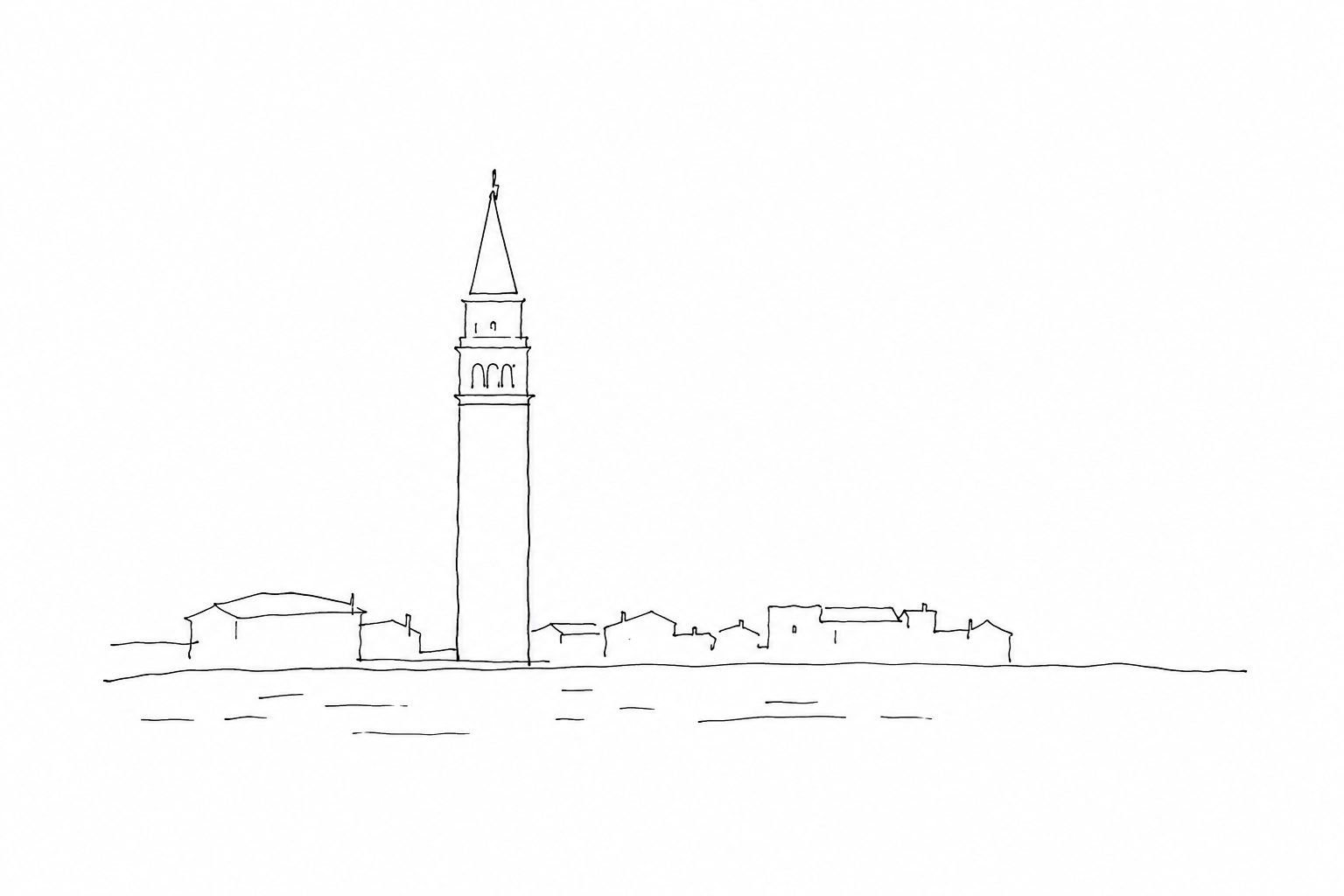

Climbing St Mark’s Campanile means looking at Venice from one of its most recognizable viewpoints, but also accepting a small complication: the tower we see today is not the medieval one, but the faithful reconstruction after the collapse of 1902. It is precisely this rupture that makes the visit more interesting. The campanile is not only a belvedere above St Mark’s Square: it has been a lighthouse, an urban signal, a civic landmark and the symbol of a city capable of rebuilding its own image without pretending that nothing had happened.
Why climb it knowing that it is not the original
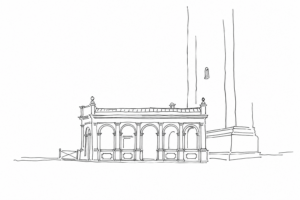
Climbing St Mark’s Campanile means looking at Venice from one of its most recognizable viewpoints, but also accepting a small rupture in the city’s memory. The tower that dominates the Square is not the medieval one: on 14 July 1902 the campanile suddenly collapsed, almost entirely sparing the Basilica and damaging Sansovino’s Loggetta at its foot. The reconstruction followed the famous principle as it was, where it was, with reopening in 1912.
This awareness does not diminish the experience; it makes it more precise. From above you can read the geometry of the Square, St Mark’s Basin, the Giudecca, the domes and the roofs that remain separate from ground level. But the panorama is also that of a Venice that chose to rebuild a symbol instead of replacing it with a new sign.
The campanile, also born as a watchtower and a reference point for navigation, today shows a constructed continuity: not a fake to be ignored, but a historical copy that recounts the way in which the city preserves itself.
From lighthouse to civic tower: what the tower of St Mark tells
Before becoming above all a panoramic viewpoint, St Mark’s Campanile was an urban machine. Its position, beside the basilica and in front of the square of Venetian power, was not merely scenic: it served to orient, warn, call.
In its earliest phases the tower also had a function linked to lagoon navigation. Its height made it a signal visible from afar, useful to those entering the city from the water. In a Venice built on maritime routes, seeing that profile meant recognizing the political and religious center of the Republic.
The bells, then, gave rhythm to public life. They did not announce only celebrations: they marked work, the meetings of the Great Council, capital executions, emergencies. The Marangona, for example, called the craftsmen of the Arsenal and marked the beginning and end of the working day.
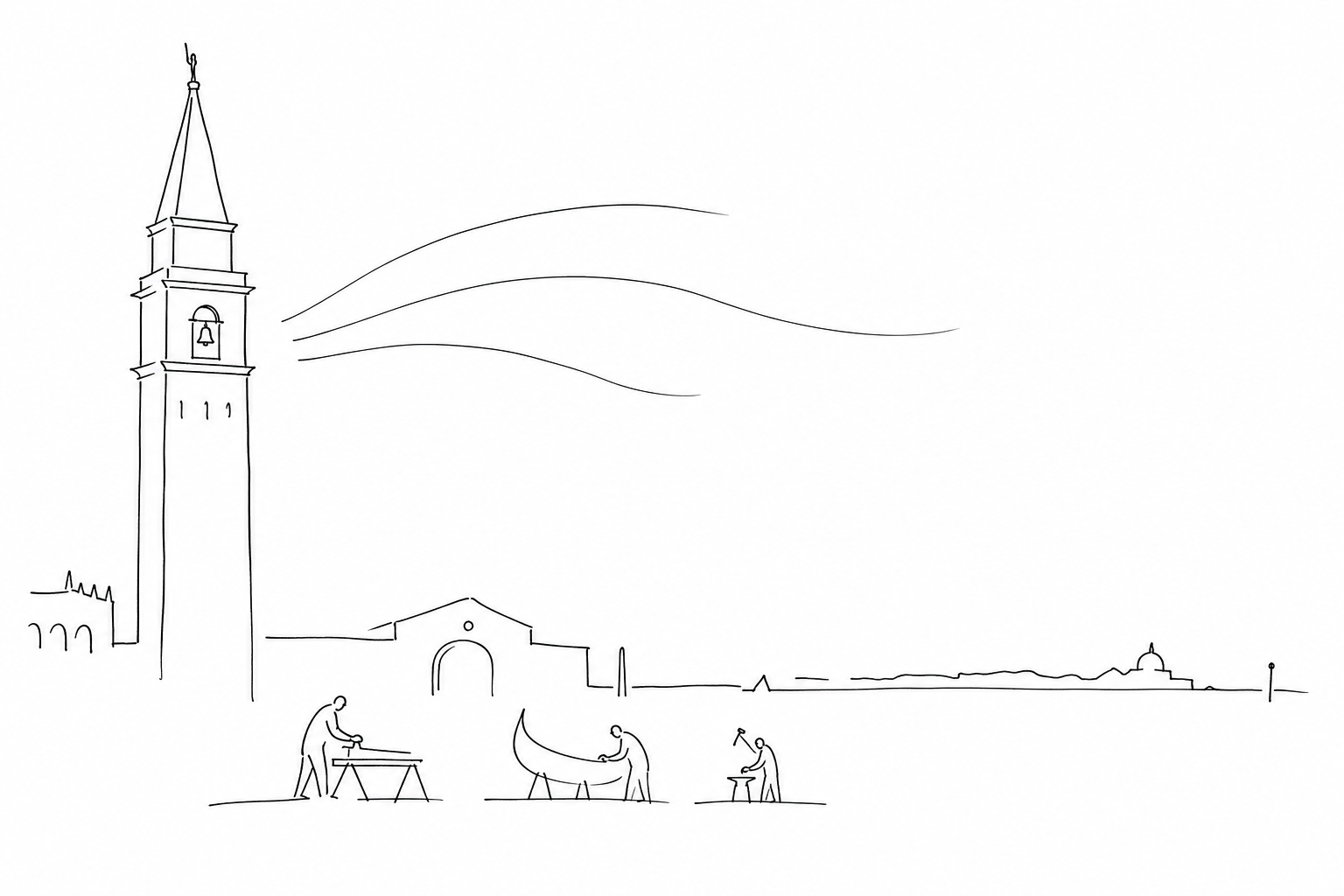
Looking at it today knowing that the campanile was rebuilt after the collapse of 1902 changes the reading: it is not only a lookout over the city, but the sign of civic functions that Venice wanted to put back on its feet “where it was and as it was”.
The collapse of 1902 and the motto “as it was, where it was”
On 14 July 1902 the great brick mass suddenly gave way, after days of cracks observed with growing alarm. The collapse was vertical, almost onto itself: it swept away the Loggetta by Jacopo Sansovino at its foot, but spared St Mark’s Basilica and caused a surprisingly limited number of injuries to people. This very image, dramatic and at the same time “orderly”, immediately entered the city’s memory.
The response was not to invent a new architectural sign, but to return to the city what it had lost. The motto “as it was, where it was” summarized a precise cultural choice: to reconstruct the form, position and profile of the ancient building, while using safer technical criteria. The first stone was laid in 1903 and the inauguration took place in 1912, on 25 April, the day of the patron saint.
Looking at the lagoon from above therefore also means observing a paradox: what seems medieval is in reality a very faithful twentieth-century rebirth. The value of the monument lies not only in its material authenticity, but in the collective will to stitch the skyline, civic memory and the symbolic role of the urban center back together.
The view from above: reading the panorama, not just photographing it
Climbing up to the belfry means finding yourself before a three-dimensional map. The first orientation is the water: St Mark’s Basin opens the view toward San Giorgio Maggiore and the Giudecca, while farther on you can make out the line of the Lido, a thin barrier between the lagoon and the Adriatic. Looking north, you recognize the network of roofs, the hidden canals and, on clear days, the distant outline of the Prealps.
The most interesting reading, however, comes from the comparison between nearby monuments. The domes of the basilica, the Procuratie and the Doge’s Palace appear as parts of a civic, religious and commercial system built over the centuries around the same public space. From here you also understand the meaning of the twentieth-century reconstruction: that mass is not a simple panoramic viewpoint, but a sign repositioned to restore proportions, visual hierarchies and memory to the urban skyline.
The view from above remains memorable, but the meaning of St Mark’s Campanile is not exhausted by the photograph of the lagoon. Observing roofs, domes, islands and calli from that height helps you understand Venice as a compact and fragile organism, built through visual relationships and daily practices. Knowing that the tower is a reconstruction does not diminish its value: it shifts it. It invites you to look not only at what is ancient, but also at the way in which a city decides to preserve, remake and hand itself down.
Related Posts
The bell tower of San Giorgio Maggiore: the cleanest perspective on St Mark’s Basin
A reading of the bell tower of San Giorgio Maggiore as a clear viewpoint over San Marco, the lagoon and the urban profile of Venice.Sansovino’s Loggetta: the small precious building at the foot of the Campanile
History, architecture and sculptures of Sansovino’s Loggetta, at the foot of St. Mark’s Campanile.
The Clock Tower: Moors, gears and Venetian time above St. Mark’s Square
History and interpretation of St. Mark’s Clock Tower: Moors, dial, automata and Venetian public time.Questions Answered
Why was St Mark’s Campanile rebuilt after 1902?
Because the original tower collapsed, and the city chose to reconstruct it faithfully.What roles did the campanile historically serve?
It was a lighthouse, navigation signal, bell tower marking civic life events.How does the reconstructed tower affect the perception of Venice?
It symbolizes continuity and the city’s will to preserve its identity.What can visitors see from the top of the campanile?
A panoramic view showing Venice's layout, monuments, and surrounding lagoon.
St Mark’s seen through its details
Want to connect architecture, ceremony and power without stopping at the postcard view?
 The Clock Tower: Moors, gears and Venetian time above St. Mark’s SquareHistory and interpretation of St. Mark’s Clock Tower: Moors, dial, automata and Venetian public time.
 The Procuratie up close: how St. Mark’s Square became a perfect urban machineThe Procuratie read up close: architecture, power, porticoes and the urban rhythm of St. Mark’s Square.
 The floor of St. Mark’s: marble waves, geometries and the feeling of walking on waterA journey across the floor of St. Mark’s Basilica: marbles, waves, geometric mosaics and a slow reading of a Venetian detail.
 The Treasury of St. Mark’s: relics, spoils and precious objects that arrived from the EastOrigins, objects and meanings of the Treasury of St. Mark’s, among relics, Byzantine enamels and spoils that reached Venice from the East.