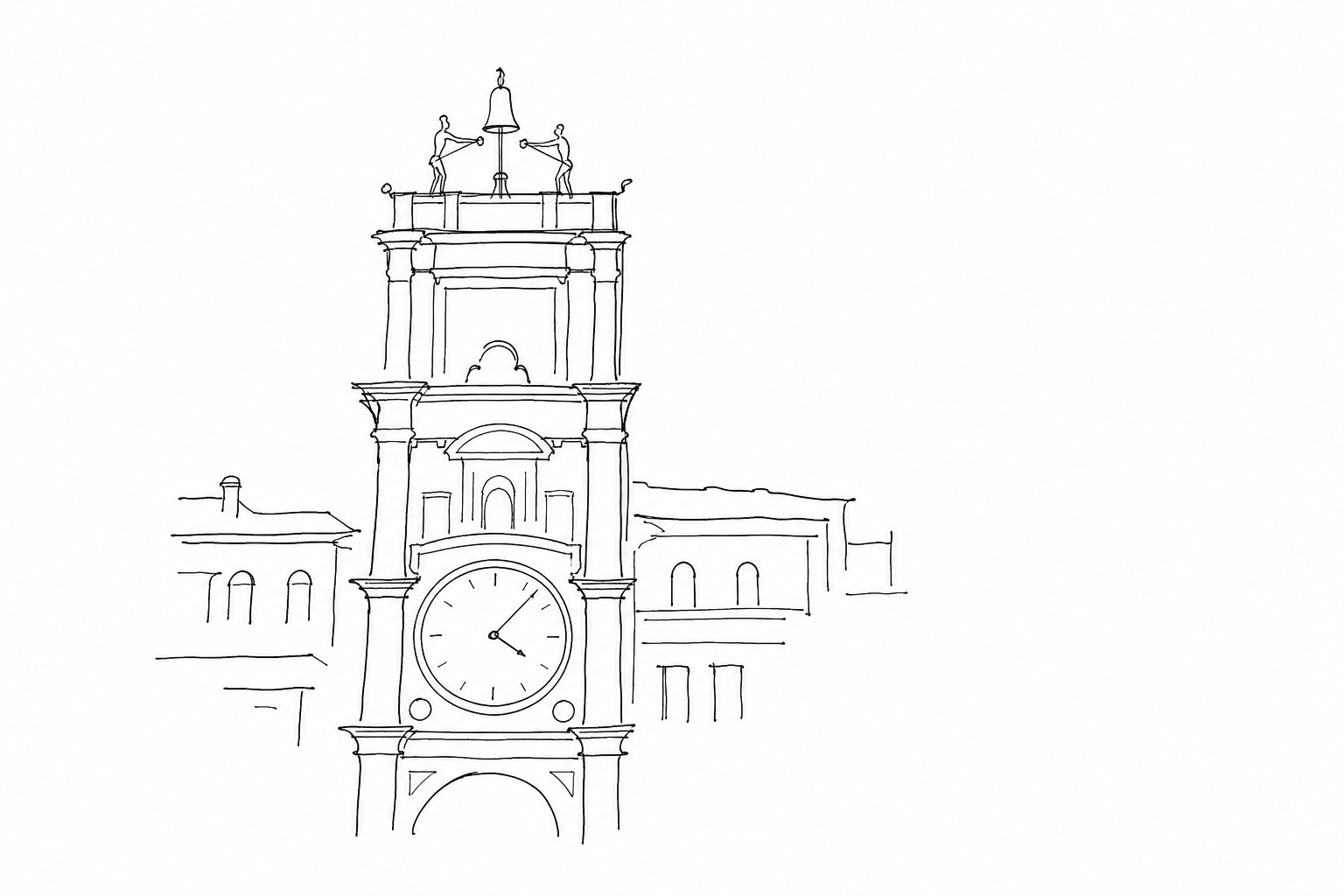

The Clock Tower is not merely an elegant backdrop to St. Mark’s Square: it is an urban machine designed to measure, display and almost stage the time of the Serenissima. Between the astronomical dial, the zodiac signs, the bronze Moors and the passage of the automata, the façade tells of a Venice that governed trade, tides, daily work and political representation also through gears. Looking at it carefully means shifting one’s gaze from the simple “monument” to a complex device, suspended above the most visible point of the city.
A clock above the political heart of Venice
The Clock Tower was not placed there by chance: it dominates the north side of St. Mark’s Square, above the entrance to the Mercerie, the commercial axis that connected the city’s ceremonial center with Rialto. At that point, public time became visible both to those entering the square and to those crossing it for business, government or devotion.
Built at the end of the fifteenth century, when Venice wanted to present itself as an orderly, wealthy power capable of controlling the rhythms of urban life, the tower ideally stood alongside the Basilica, the Doge’s Palace and the Procuratie. It was not merely a technical building: it was a political sign. The astronomical clock, with hours, lunar phases and zodiac, declared that the Serenissima knew how to measure not only daily time, but also cosmic time.
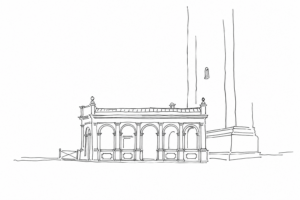
The position above the square transformed every chime into a collective message. The Moors on the summit, striking the bell, made audible what the dial made visible: a shared, regulated and scenic Venetian time.
The dial: hours, zodiac signs and sky on the façade
The most surprising part of the Tower is the large dial, designed not only to indicate the hours but to translate the order of the sky into an image. The blue surface, dotted with gold, recalls a celestial vault: at the center the astronomical motions can be read, while the outer rings organize the information according to a logic that is both technical and symbolic.
The band of the hours uses a twenty-four-hour division, different from the modern habit of twelve repeated hours. This detail recalls an urban culture in which public measurement was tied to the life of the Serenissima: trade, liturgies, navigation and government needed a common and clearly visible reference.
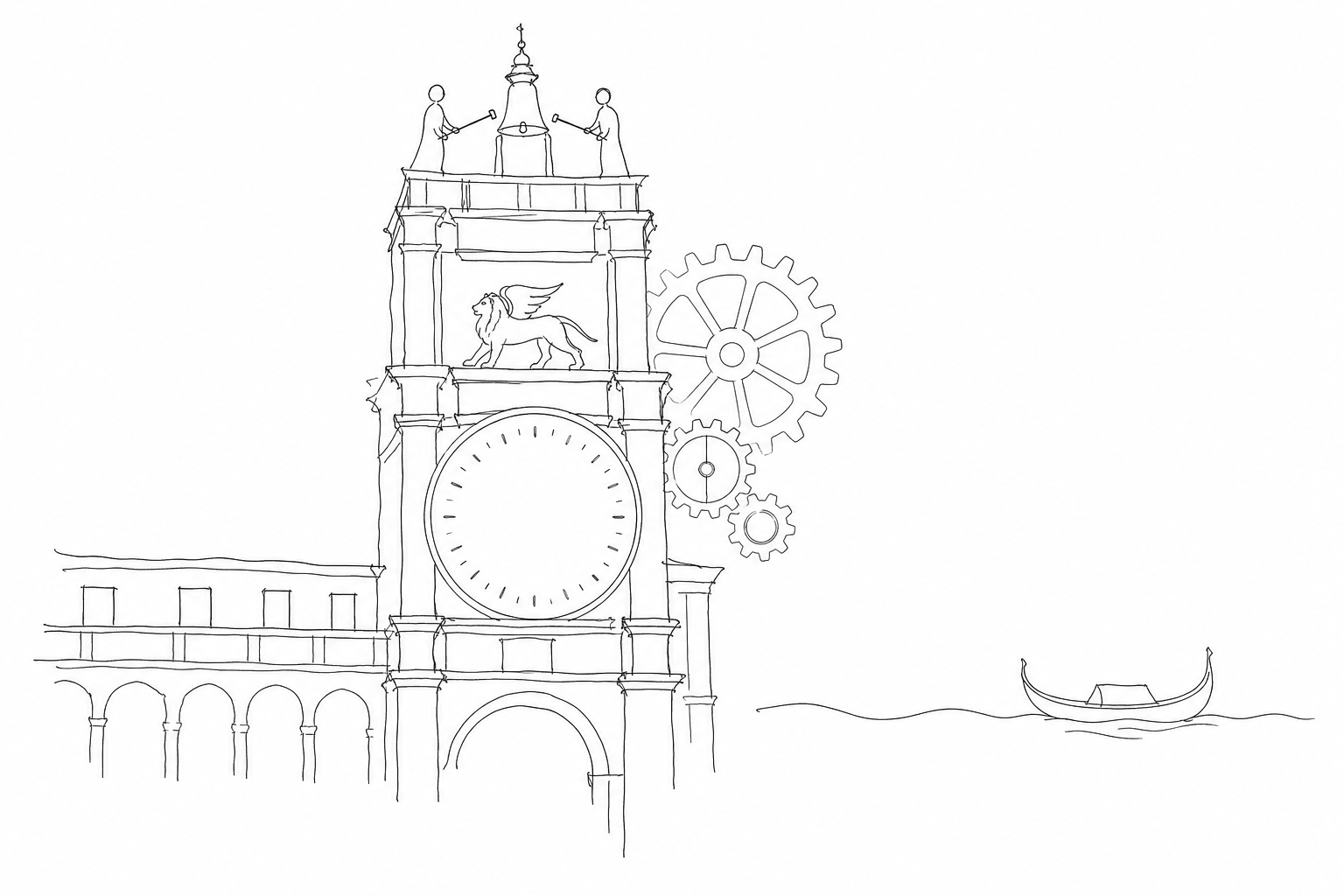
Around it appear the zodiac signs, not as simple decoration. In Renaissance language they connected the human calendar to cosmic cycles: months, seasons, the position of the sun and astral influences entered into an ordered representation. Those observing the façade therefore saw much more than a mechanism: they saw Venice inserted into a regulated, legible and magnificently displayed universe.
At the top of the Marcian structure, the two bronze figures known as the Moors transform the indication of the hours into a theatrical gesture. The name does not indicate a precise geographical origin: it arises above all from the dark patina of the metal, which made the bodies appear almost black to Venetian eyes. Armed with a hammer, the two automata strike the great bell: one is traditionally read as the old man, the other as the young man, an image of the passage between what ends and what arrives.
The scene is not merely decorative. The sound makes the measure of the day public, while the movement of the arms shows the mechanical skill hidden in the structure. On the lower level, the niche with the Virgin and Child introduces another animated episode: on solemn occasions, the angel and the Magi make their ceremonial passage before the Madonna. Thus the façade unites technique, devotion and civic spectacle: not a simple sound signal, but a small urban performance offered to those crossing St. Mark’s Square.
Observing it from below: three readings in a few steps
To understand it in person, it is best not to remain still in the center of St. Mark’s. The first point is the axis of the Mercerie: from there the façade functions as a monumental threshold between ceremonial space and commercial street, and its urban function, not only its decorative one, can be perceived.
- Look up. The Moors should be sought on the crowning element, not on the dial: their gesture belongs to the sound city, designed to be heard even by those who did not read the astronomical indications.
- Lower your gaze. The Lion of St. Mark, the Madonna and Child and the openings of the automata form a vertical sequence: Venetian power, public devotion, mechanical wonder.
- Approach the arch. From below, the role of passage toward the Mercerie is more noticeable. The construction does not close the small square: it frames it and puts it in communication with the commercial fabric.
For any internal routes or guided access, it is prudent to always check the updated information, because procedures and availability may change.
Observing the Clock Tower takes only a few minutes, but it is worth giving it more time: following the movement of the Moors, reading the dial, noticing the position above the Merceria and the continuous dialogue with the Basilica and the Square. It is one of those Venetian places where art, technique and daily life overlap without clamor. Even amid the crowd, stopping to look at it methodically allows one to better understand how Venice constructed its own public time, transforming a clock into a sign of order, power and mechanical wonder.
Related Posts
The Moors of St. Mark’s: why two statues strike the hours above the city
Who the Moors of the Clock Tower are, why they strike the bell, and what they tell about Venice’s public time.Sansovino’s Loggetta: the small precious building at the foot of the Campanile
History, architecture and sculptures of Sansovino’s Loggetta, at the foot of St. Mark’s Campanile.The bell tower of San Giorgio Maggiore: the cleanest perspective on St Mark’s Basin
A reading of the bell tower of San Giorgio Maggiore as a clear viewpoint over San Marco, the lagoon and the urban profile of Venice.Questions Answered
Why was the Clock Tower placed above the Mercerie in St. Mark’s Square?
It connects ceremonial space with commercial activity and makes public time visible.What makes the Clock Tower’s dial unique compared to modern clocks?
It uses a 24-hour division and includes zodiac signs reflecting cosmic cycles.What role do the Moors automata play in the Clock Tower’s function?
They strike the bell to audibly mark the hours and symbolize the passage of time.How does observing the Clock Tower enhance understanding of Venetian public time?
It reveals the blend of political power, mechanical skill, and civic spectacle.
From the square to the rooms of power
Would you like to follow other places showing how Venice represented itself at the heart of St Mark’s?
 The Procuratie up close: how St. Mark’s Square became a perfect urban machineThe Procuratie read up close: architecture, power, porticoes and the urban rhythm of St. Mark’s Square.
 St Mark’s Campanile: looking at Venice from above without forgetting that it is a reconstructionClimbing St Mark’s Campanile means reading Venice from above and remembering the collapse of 1902, the reconstruction and the urban meaning of...
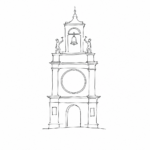 The Moors of St. Mark’s: why two statues strike the hours above the cityWho the Moors of the Clock Tower are, why they strike the bell, and what they tell about Venice’s public time.
 The floor of St. Mark’s: marble waves, geometries and the feeling of walking on waterA journey across the floor of St. Mark’s Basilica: marbles, waves, geometric mosaics and a slow reading of a Venetian detail.