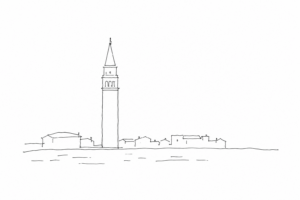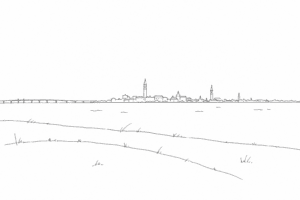

From the bell tower of San Giorgio Maggiore, Venice does not present itself as a crowded postcard, but as a readable drawing. The short distance from the island of San Marco is enough to change everything: the basin opens up, the façades find proportion, the routes of the boats become orderly lines on the water. Climbing here means observing the city from a lateral and precise point, where the Palladian basilica, the lagoon and the urban profile converse without overlapping. It is a perspective that is silent only in appearance: it tells of power, scenography, orientation and daily life.
Why the basin appears more orderly from here
From the bell tower of San Giorgio Maggiore, St Mark’s Basin loses much of its visual noise. The reason is first and foremost geographical: the island stands slightly apart from Venice’s monumental front, just enough to turn the Doge’s Palace, the Piazzetta, St Mark’s domes and the Riva degli Schiavoni into a readable sequence, not an overlapping whole.
The height of the bell tower helps distinguish the layers. Below remains the water, wide and continuous; in the middle the city of representation is aligned, with its façades facing the basin; farther back emerge roofs, towers and smaller bell towers. This frontal distance avoids the oblique effect one has when walking along the waterfronts and makes it possible to understand the scenographic role of the basin as Venice’s great public space.
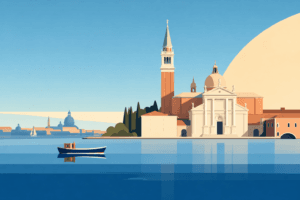
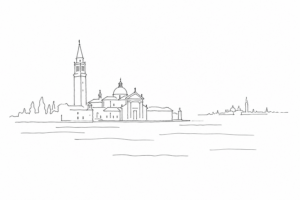
The Palladian architecture of the church, at the foot of the tower, also contributes to the clarity: San Giorgio Maggiore is not only a panoramic viewpoint, but a designed counter-view. From here Venice is observed as a composition, with the water acting as pause and measure.
The bell tower and the island: a backdrop in front of Venice
San Giorgio Maggiore functions as a scenic backdrop because it is not a simple landing place in front of San Marco: it is a monastic island built, over time, as an architectural front. The Benedictine presence has been documented since the 10th century, when the area was entrusted to a religious community; in the following centuries the complex grew until it became one of the visual cornerstones of the central lagoon.
The decisive point is the church designed by Andrea Palladio starting in 1566. The white façade, conceived as a classical temple superimposed on a Christian basilica, orders the waterfront with clear geometry: pediments, columns and proportions transform the island into a measured backdrop. The bell tower, rebuilt at the end of the eighteenth century after the collapse of the previous tower, completes this verticality without competing with San Marco.
Climbing here therefore means looking at Venice from a place that belongs to its history, but remains separate from it. This short distance, crossed by water, makes profiles, domes and waterfronts more readable.
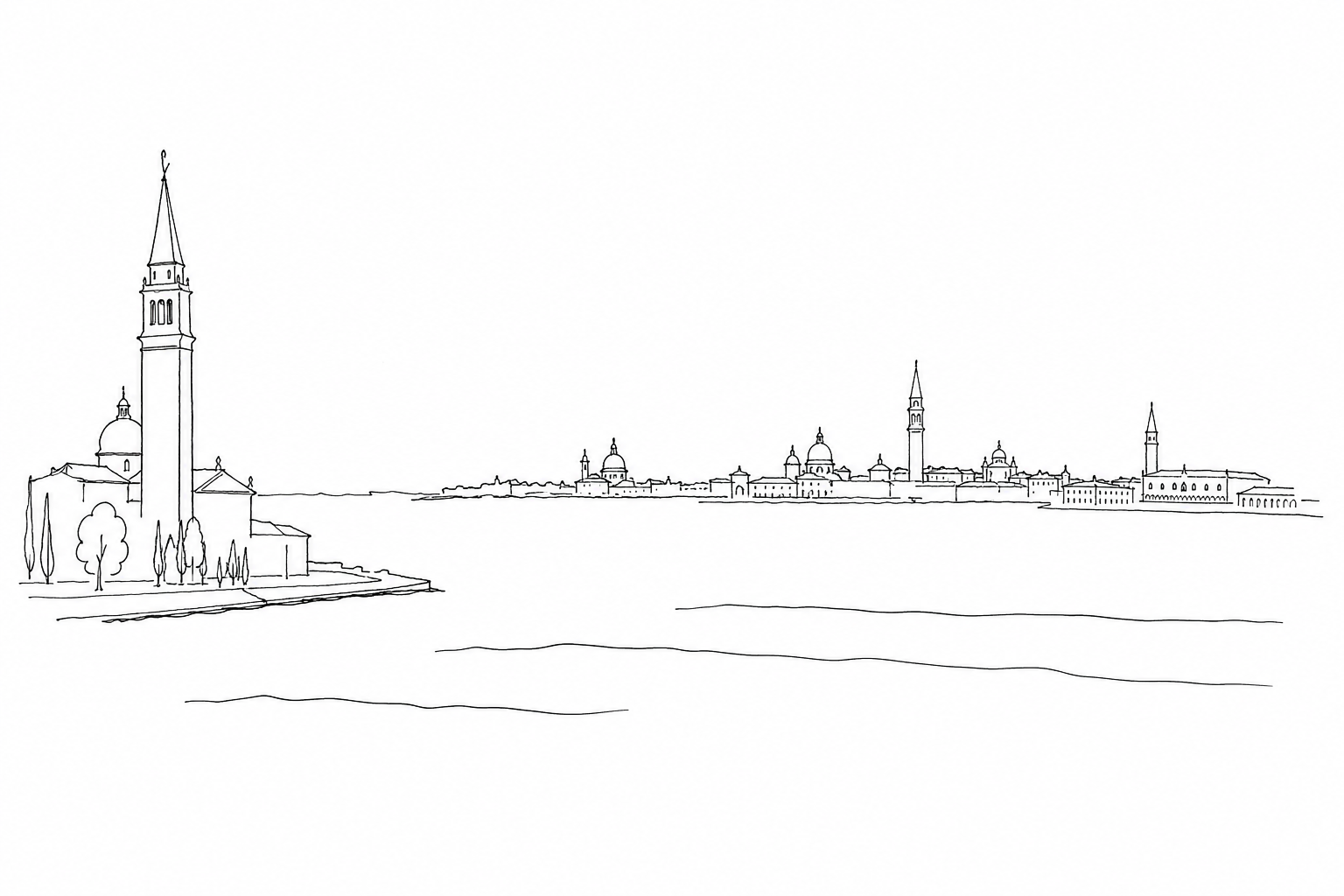
From the viewing chamber, the reading proceeds by layers. The first is the monumental one: opposite, one can distinguish the mass of the Doge’s Palace, the profile of St Mark’s Basilica with its domes, the Piazzetta and the two columns facing the water. From this height, decorative detail does not prevail, but the relationship between the buildings: civil power, religious space and the ceremonial landing place appear aligned in a single readable scene.
To the west, the gaze catches Punta della Dogana and the dome of the Salute, which mark the entrance to the Grand Canal. Just below, Giudecca does not appear merely as a parallel waterfront: it becomes an inhabited threshold, with long fronts, boatyards, quays and expanses of water that separate without isolating. This distance helps one understand how much the historic city is made of margins, not of a compact center.
The distant layer is the lagoon. Depending on the clarity, one can make out the low line of the Lido, the smaller islands and the opening toward the Adriatic. It is here that the perspective becomes particularly clean: the architectural landmarks remain recognizable, while the liquid horizon shows the real measure of the settlement, fragile and precise, suspended between built waterfronts and open waters.
On a short visit, the climb to the tower works best if treated not as a hurried “extra,” but as a pause for orientation. It is worth placing it after seeing the San Marco area: crossing the stretch of water immediately afterward makes it possible to recognize from above what has just been covered on the ground, from the Piazzetta to the Riva degli Schiavoni.
The allowance to plan for does not concern only the ascent, but also the arrival on the island, any possible wait and the time needed to read the panorama without merely taking a photograph. Ten minutes of calm observation are worth a great deal: first the monumental front, then the boats in motion, and finally the islands and the lagoon line.
To avoid unnecessary rushing, it is better not to place it between two fixed appointments. Hours, access and visiting procedures may change: before leaving, it is prudent to check the updated information through official channels.
Including the bell tower of San Giorgio Maggiore in a short visit is not for “taking in one more panorama,” but for better understanding Venice before returning to its labyrinth. From this height, St Mark’s Basin recomposes itself: axes, margins, islands, passages and architectural masses can be distinguished. The ferry, an unhurried climb and a few minutes of observation are enough to take away a cleaner view of the city. It does not replace the walk through calli and campi; it makes it more conscious.