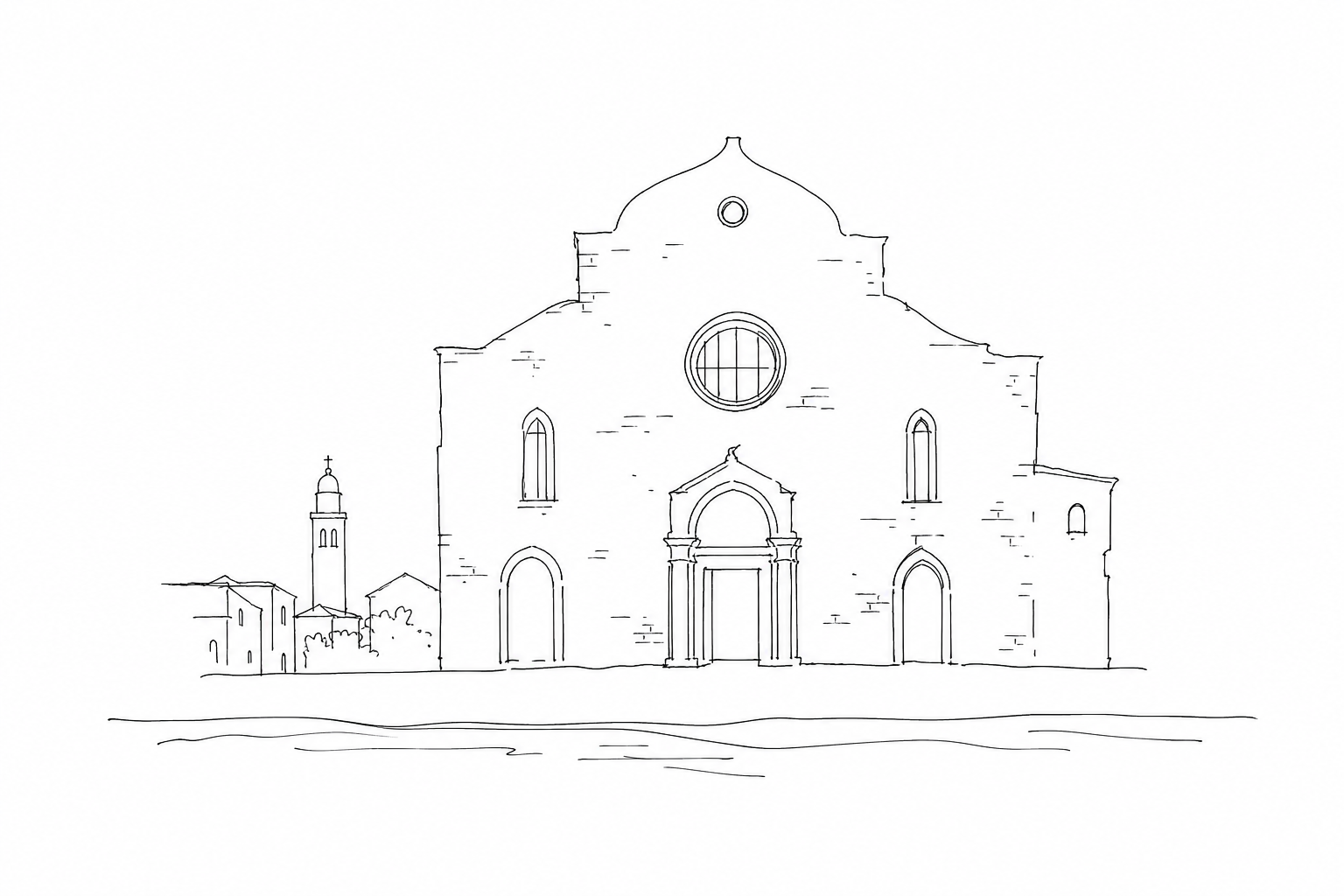

At San Marcuola, on the Grand Canal, Venice shows one of its most eloquent truths: a façade left bare, unfinished, without the need to mask the interruption. The church of Saints Ermagora and Fortunato does not impress through a scenic effect, but through that rough front that forces the gaze to slow down. Here absence becomes part of the architecture: it tells of projects, resources, urban priorities, and the concrete relationship between a neighborhood church and its view onto the water.
A façade that does not pretend to be finished
Arriving at San Marcuola from the Grand Canal, the first surprise is what is not there: no final marble, no polished frontage to close the discourse, but a wall that has remained bare, with its provisional character having by now become definitive. The church of Saints Ermagora and Fortunato, commonly called San Marcuola, stands in the sestiere of Cannaregio and shows without disguises one of the most Venetian truths: even the unfinished can become part of the landscape.
Here the lack is not a defect to be corrected with the imagination. It is the point to observe. The eighteenth-century building, linked to the reconstruction attributed to Giorgio Massari, faces the water with a façade never clad according to the monumental ambition one might expect in a city accustomed to the stage. Precisely for this reason, San Marcuola teaches us to look at Venice without pretense: not as a perfect backdrop, but as an organism made of interrupted projects, limited resources, decisions left suspended, and untamed beauties.
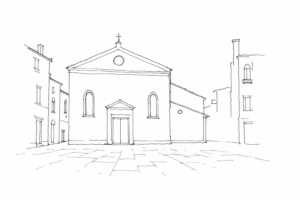
The everyday name, San Marcuola, is actually a Venetian contraction of Saints Ermagora and Fortunato. This fact is not an erudite detail: it shifts the gaze from the unfinished façade to the long religious and urban memory of the place. Ermagora, linked to the Aquileian tradition and to the cult of Saint Mark, and Fortunato, his deacon, evoke an upper-Adriatic horizon, earlier than the monumental Venice we often imagine as already complete.
The church stands in Cannaregio, overlooking the Grand Canal but set within a fabric of calli, landings, and neighborhood routes. Its history passes through refoundations and reconstructions: the medieval building gave way, in the eighteenth century, to a renewed project attributed to Giorgio Massari’s circle. It is precisely here that the missing façade becomes legible: not a random void, but the visible trace of a building site and an ambition left unfulfilled.
Massari, the Grand Canal, and the suspended project
In the eighteenth century Giorgio Massari worked on the building, giving it the layout that can still be read from the water today: a compact, proportioned church, with its entrance facing the Grand Canal. The position is decisive. Here the frontage was not an urban rear, but a public threshold, seen from boats, ferries, and palaces overlooking the opposite bank.
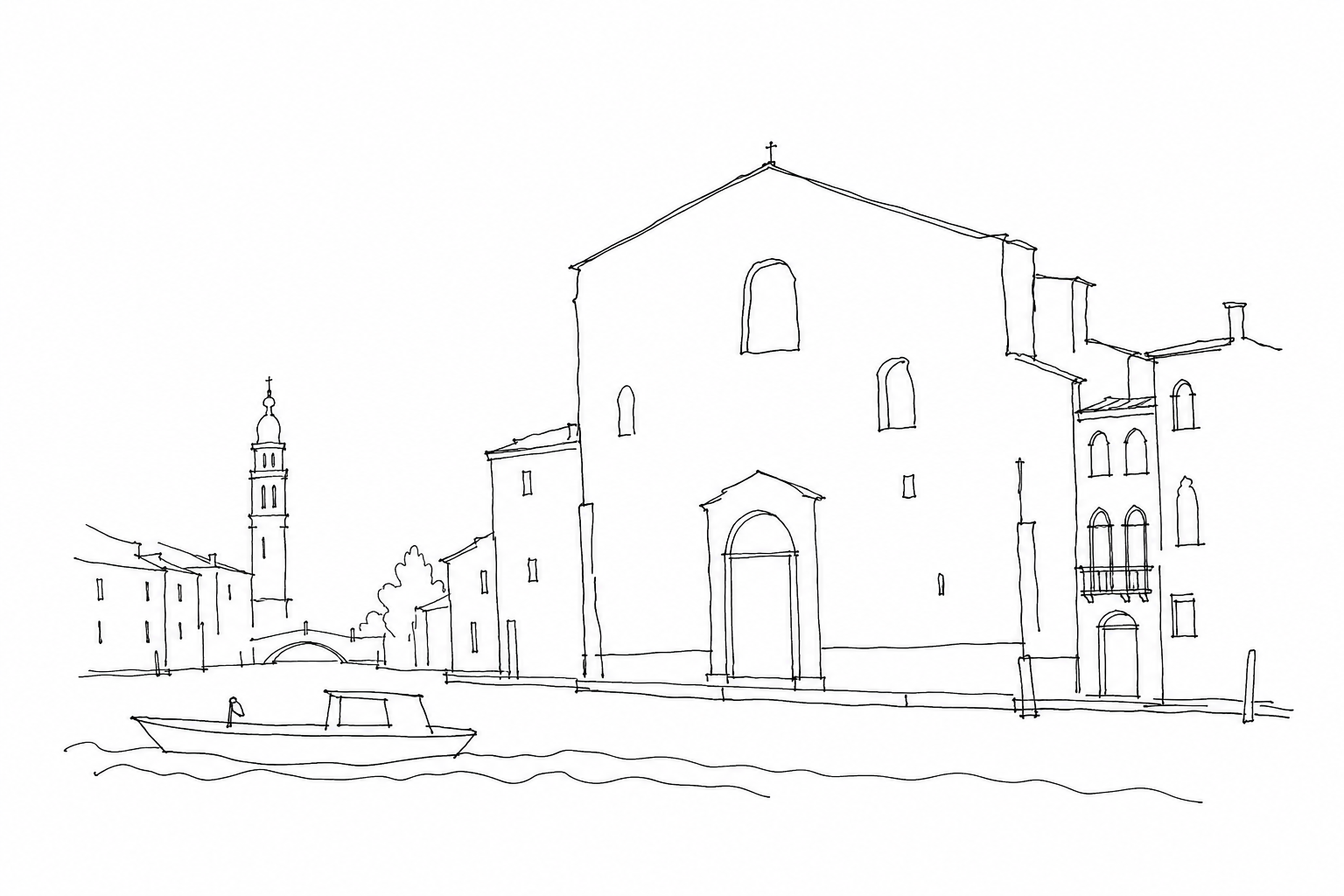
Precisely for this reason, the unfinished strikes the eye. The entrance wall remains a surface of bare brick, where the stone cladding, the architectural order, the crowning cornices, and that design of solids and voids that would have transformed the front into a completed composition are missing. One senses a structure prepared for monumentality, but deprived of its final layer: not a ruin, but a building site stopped before its official mask.
Massari, an architect attentive to classical clarity, would probably have sought balance between the central axis, openings, and vertical divisions. The absence of completion instead makes visible what in Venice often remains hidden: the wall as a constructive body, the difference between project and financing, between representative ambition and material reality. Looking at it from the Grand Canal means reading an architectural promise left suspended.
Entering after looking at the bare wall
The visit changes if the unfinished frontage is not considered a simple lack. Before crossing the threshold, it is worth pausing for a few minutes in front of the exposed bricks: there one understands that the building does not hide its own path, but leaves it exposed. The interior should be read with the same criterion, seeking continuity rather than contrast.
The church appears compact, with an ordered space and altars that guide the gaze toward the works. Among these, Tintoretto’s Last Supper is a decisive point: it does not serve to “fill” what outside has remained suspended, but shows how the artistic strength of the place does not depend on the decorative completeness of the shell. The painting introduces movement, shadow, and spiritual tension into an essential architectural organism.
Looking first at the rough wall and then at the nave means accepting a less scenic reading: project, economic limit, devotion, and daily use coexist in the same building. For access and any visiting conditions, it is always prudent to check updated information before going.
Looking at San Marcuola means accepting a less polished Venice, where even what is missing has weight. The unfinished façade is not a defect to overcome, but a key to reading the city without pretense: its suspended building sites, its transformations, its everyday layers. Entering after observing that bare wall changes the visit, because it prepares you to seek not only the completed work, but the traces of what Venice has chosen, postponed, or simply left visible.
Related Posts
Santa Maria Formosa: one campo, two façades, and a Venice that changes sides with every step
A narrative guide to Santa Maria Formosa: the campo, the two façades, the bell tower, and the details that change the way you look.San Zulian: the small church near St. Mark’s where Sansovino left his mark
A brief guide to San Zulian, a church between St. Mark's and the Mercerie, with the facade linked to Sansovino and the physician Tommaso Rangone.
San Francesco della Vigna: vineyards, proportions and silence at the far end of Castello
Outline on the history, vineyards, architecture and urban quiet of San Francesco della Vigna.Questions Answered
What makes San Marcuola’s façade unique in Venice?
It is left bare and unfinished, becoming part of the authentic urban landscape.Who are Saints Ermagora and Fortunato and why are they significant?
They relate to early Adriatic tradition and Venice’s religious origins.What was Giorgio Massari’s role in San Marcuola’s architecture?
He designed the 18th-century reconstruction but the façade remained incomplete.How does the interior of San Marcuola contrast with its façade?
The interior is ordered and includes Tintoretto’s Last Supper, showing artistic depth.
Inside the less obvious Cannaregio
Would you like to follow nearby details that give the district its distinctive character?
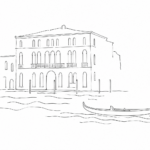 Ca’ Vendramin Calergi: Wagner’s palace and the elegant Venice of the Grand CanalHistory, architecture and Wagnerian memory of Ca’ Vendramin Calergi, a Renaissance palace overlooking the Grand Canal.
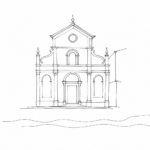 Santa Maria dei Miracoli: why this small church looks like a marble casketHistory, marbles and proportions of Santa Maria dei Miracoli, the small church in Cannaregio that concentrates Venice in an intimate space.
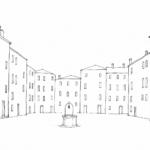 The Ghetto Novo: why the houses are so tall and what they tell us about Venetian Jewish historyIn Cannaregio’s Ghetto Novo, the height of the houses tells of imposed space, housing density and Jewish life in Venice.
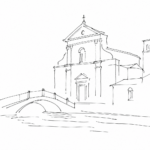 San Giobbe in Cannaregio: the hidden Venetian Renaissance near the stationGuide to San Giobbe, a Renaissance church in Cannaregio just a short walk from Santa Lucia.