
A few steps from St. Mark’s Square, San Zulian is one of those Venetian churches that you pass almost out of the corner of your eye, absorbed by the flow of the calli and the shop windows. Yet its facade tells a great deal: the ambition of a patron, the hand of Jacopo Sansovino, the relationship between urban space, personal memory and public representation. Looking at it calmly means shifting attention from the famous monument to the detail that endures, from the most exposed Venice to the one that continues to speak in a low voice.
Where San Zulian is located and why it passes almost unnoticed
San Zulian, or San Giuliano, is located in the dense urban fabric that connects St. Mark’s Square to the Mercerie, along one of the routes most traveled by those crossing Venice among shop windows, narrow calli and continuous flows of passers-by. This very central position contributes to its paradox: it is very close to the monumental heart of the city, but it easily remains in the background compared with the Basilica, the Campanile and the great fronts of St. Mark’s.
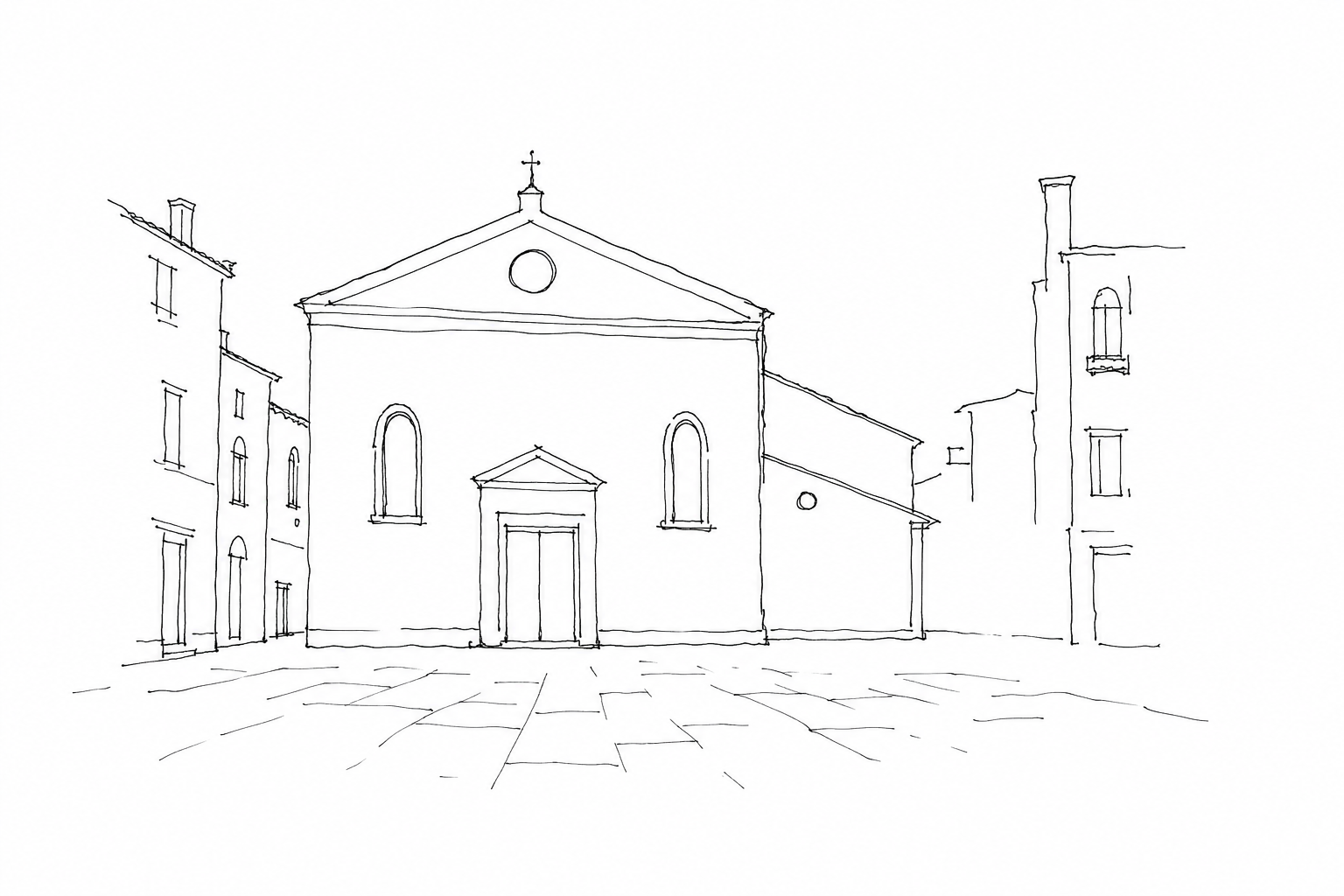
The church overlooks a small campo that functions almost like a pause in the commercial flow of the Mercerie. It does not introduce the visitor with a grand scenic perspective: instead, it appears suddenly, set among buildings and everyday routes. For this reason San Zulian should be read as a typical Venetian presence, linked to neighborhood life and urban passage more than to isolated monumentality.
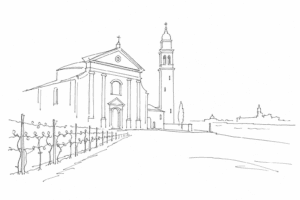
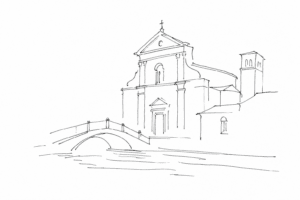
It is on this intimate scale that the trace of Jacopo Sansovino becomes significant, capable of giving architectural dignity to a space that many pass through without stopping.
The presence of Jacopo Sansovino at San Zulian can be read above all in the facade, where the small church takes on a surprisingly authoritative language. The architect, a leading figure in the sixteenth-century renewal of the St. Mark’s area, sets the front like a classical page: order, proportion, rhythm of the architectural members and a clear vertical articulation transform a compressed space into a monumental episode.
The most significant aspect is the role of the patron Tommaso Rangone, a physician and humanist, who financed the work and wanted to link his own name to the building. The facade therefore does not merely present the sacred entrance: it also becomes a personal manifesto, with inscriptions and with the statue of the patron placed in a dominant position. In a city accustomed to celebrating families, scuole and institutions, this very explicit display of the individual is particularly eloquent.
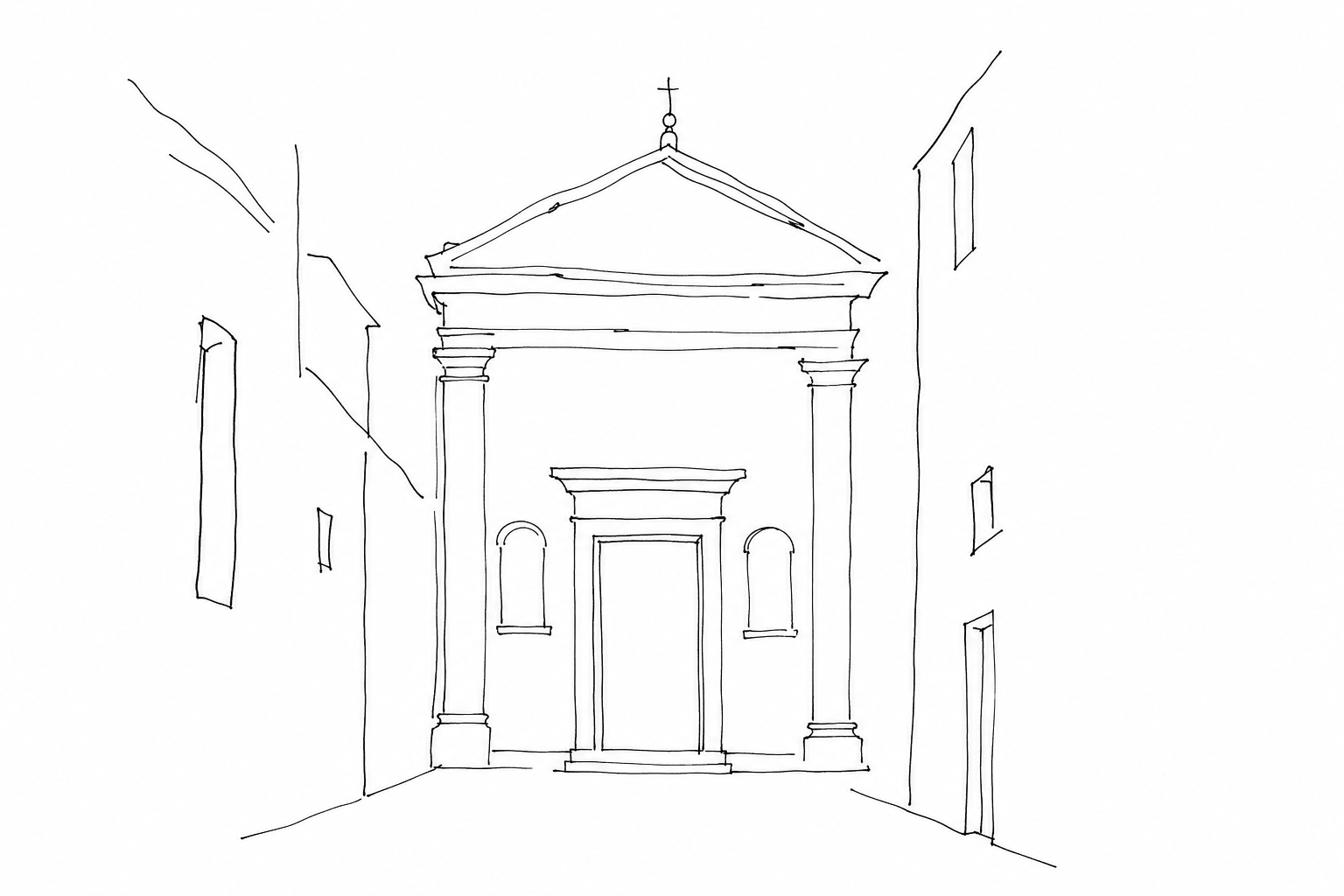
Sansovino translates this ambition into architecture without breaking the Venetian measure. Pillars, niches and entablature construct an orderly front, legible even to those arriving from the Mercerie. This is precisely where his trace lies: giving the church a public, cultured and recognizable voice, even within a crowded calle lacking broad scenic breadth.
Tommaso Rangone, the patron who wanted to be seen
The facade of San Zulian does not speak only through orders, columns and proportions: at its center it places a man. Tommaso Rangone, a physician, astrologer and humanist of Ravenna origin, financed the work and obtained a monumental presence unusual for a layman on a Venetian sacred building. His statue, placed above the portal, transforms the entrance into a declaration of personal memory.
To read it properly, one must also observe the inscriptions. Rangone wanted to associate texts in several languages with his own portrait, according to an erudite taste that referred to classical, biblical and scientific culture. It is not a simple donor’s signature: it is a public self-portrait, constructed to present him as a man of learning, benefactor and figure worthy of being remembered in the heart of the city.
This choice explains why the facade appears so singular. Alongside its religious function, the small church also becomes the place of a strategy of prestige. Rangone uses stone, image and word to fix his name along the most frequented urban route toward St. Mark’s.
Entering without haste: a close reading
After the marble front, the interior of San Zulian should be observed by changing pace: it is not a space to cross in a few seconds on the way to St. Mark’s, but a compact environment in which decoration, altars and painting construct a precise hierarchy. Sansovino’s trace is better understood if one looks at the passage between exterior and nave: outside, architectural order dominates; inside, a warmer devotional language prevails, linked to the late sixteenth- and seventeenth-century Venetian period.
- Look up: the ceiling and upper apparatus help to read the verticality of a small place, conceived to visually enlarge the space.
- Pause at the side altars: altarpieces, frames and marbles tell of different patrons, less conspicuous but decisive for the history of the building.
- Observe the light: the space does not aim at a monumental effect, but at controlled reflections, gilding and surfaces that gradually emerge.
A careful visit therefore makes it possible to grasp the most interesting contrast: a very strong urban presence on the outside and, inside, a gathered, layered and surprisingly dense artistic narrative.
San Zulian does not require a long detour, but a change of rhythm. Stopping in front of the facade, reading the insistent presence of Tommaso Rangone, entering and observing the interior without haste makes it possible to grasp a less immediate and more layered Venice. Here history does not present itself as a grand scene, but as an interweaving of art, vanity, devotion and urban life. Precisely for this reason the small church near St. Mark’s remains a valuable stop for those who want to look beyond the most obvious route.