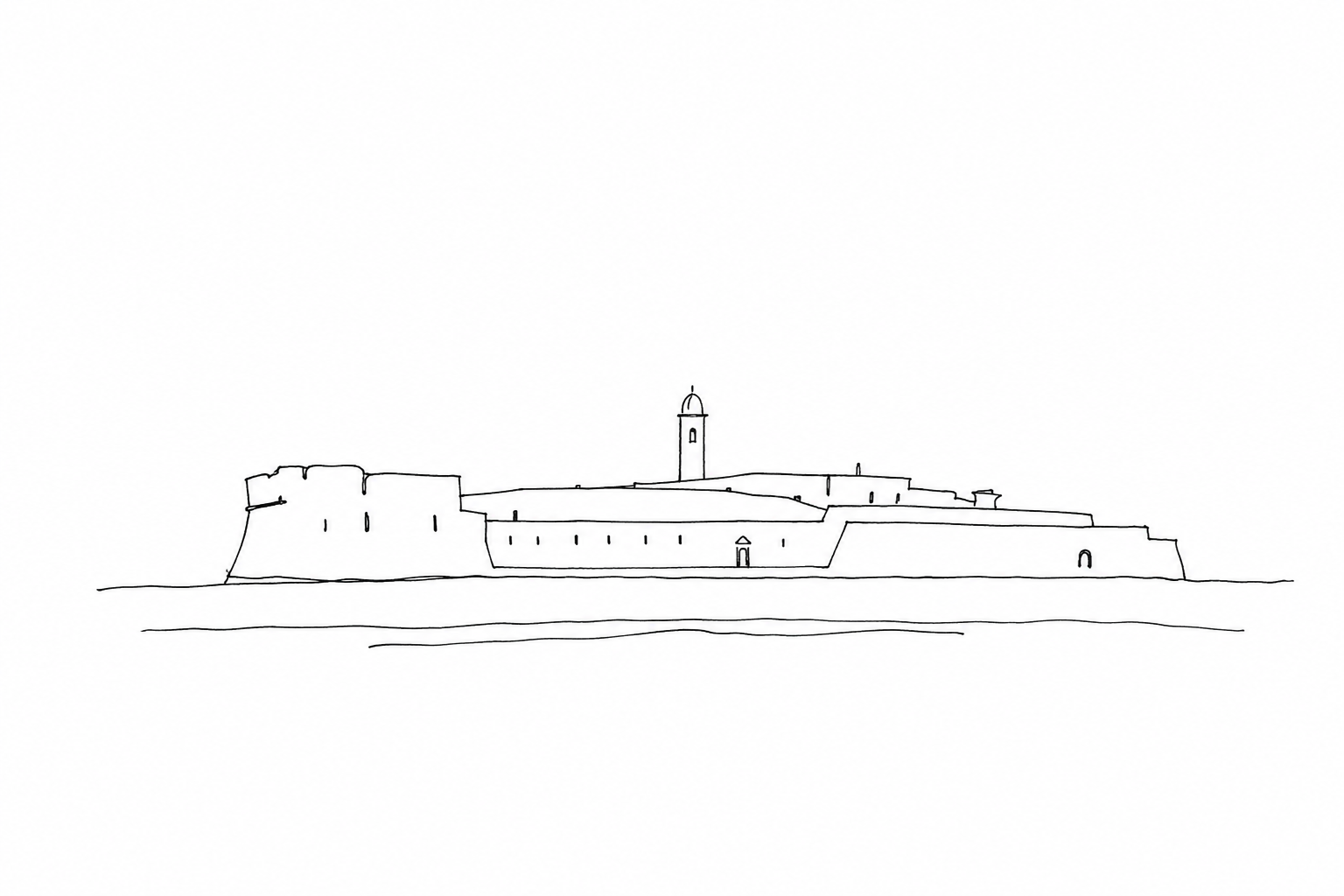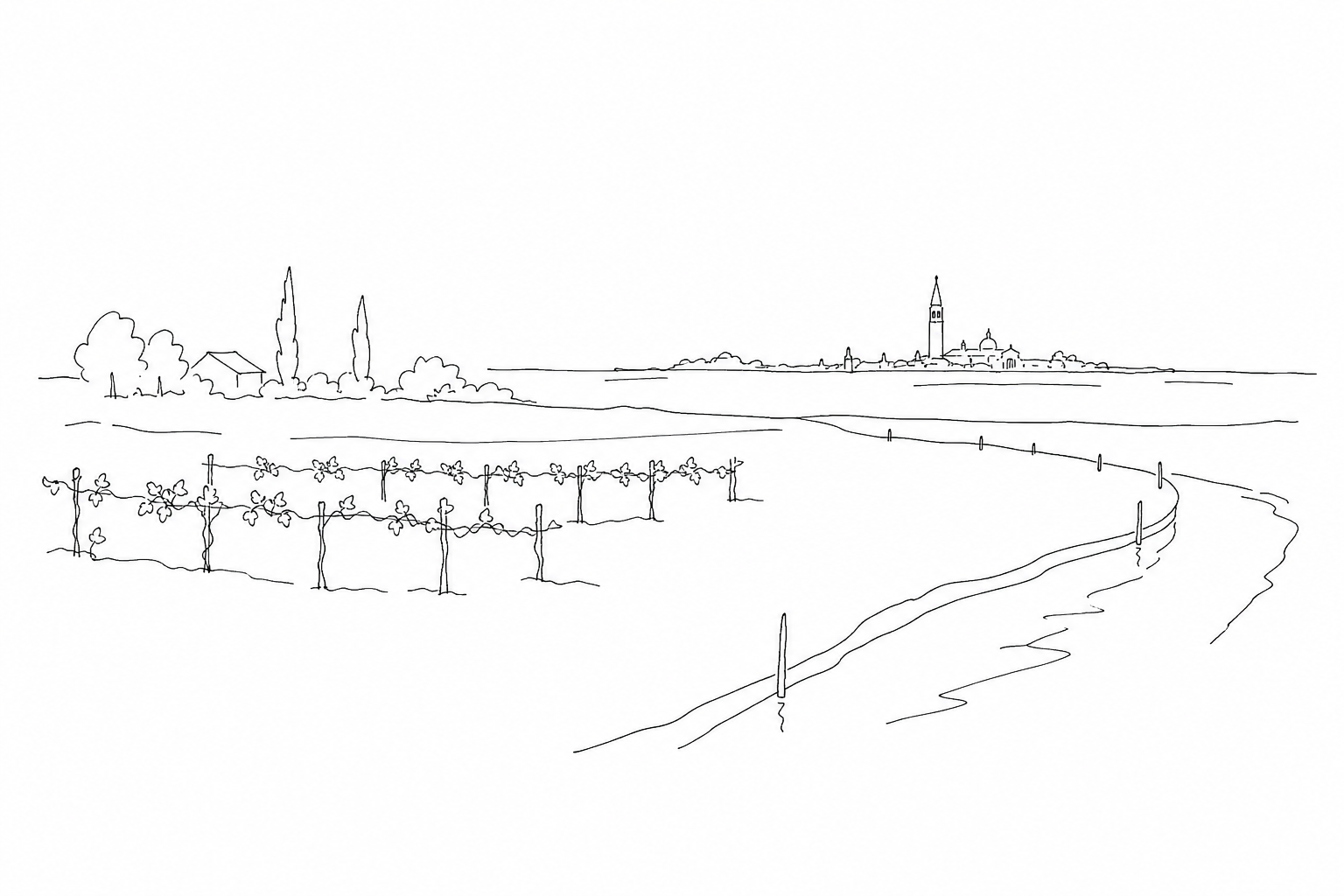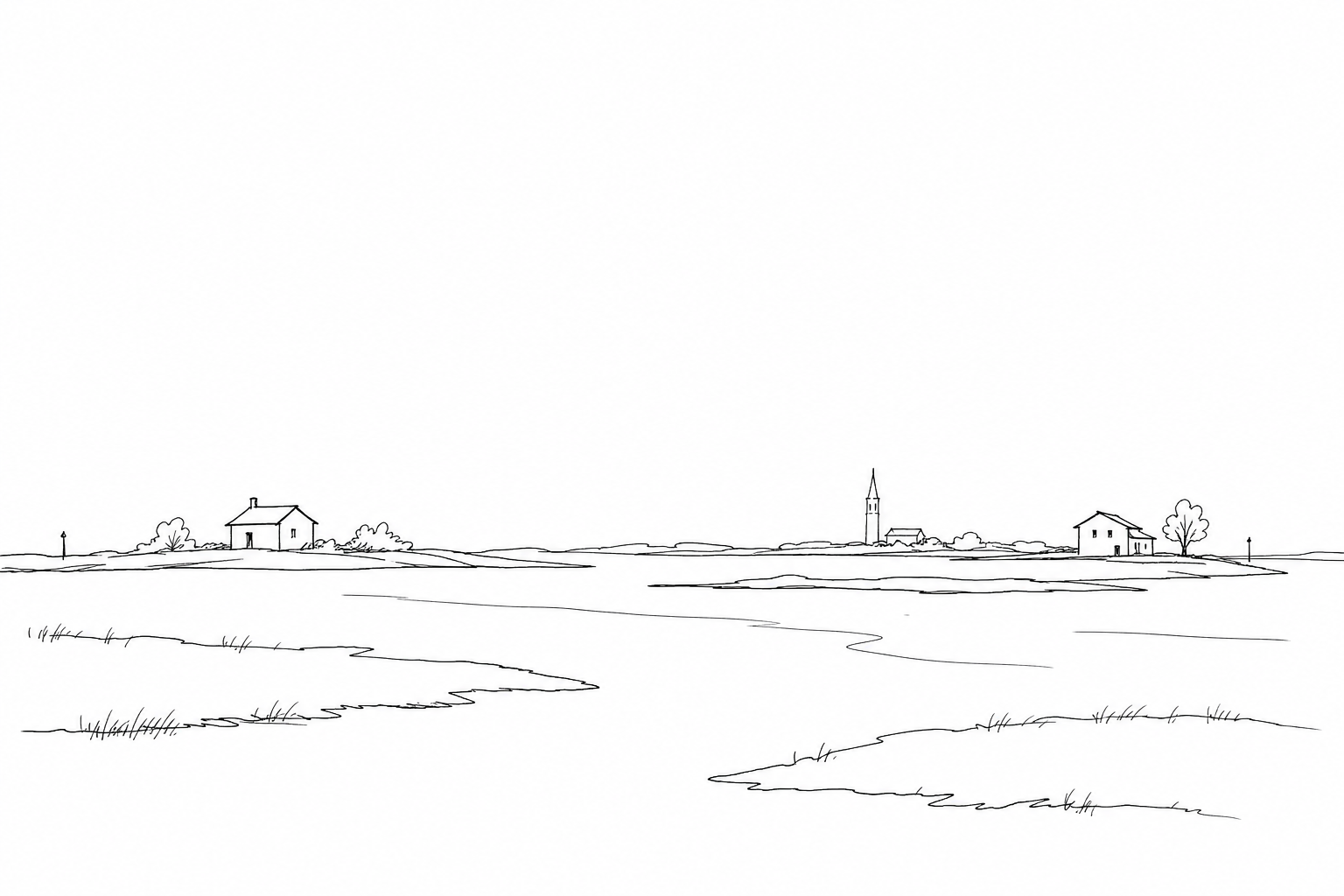
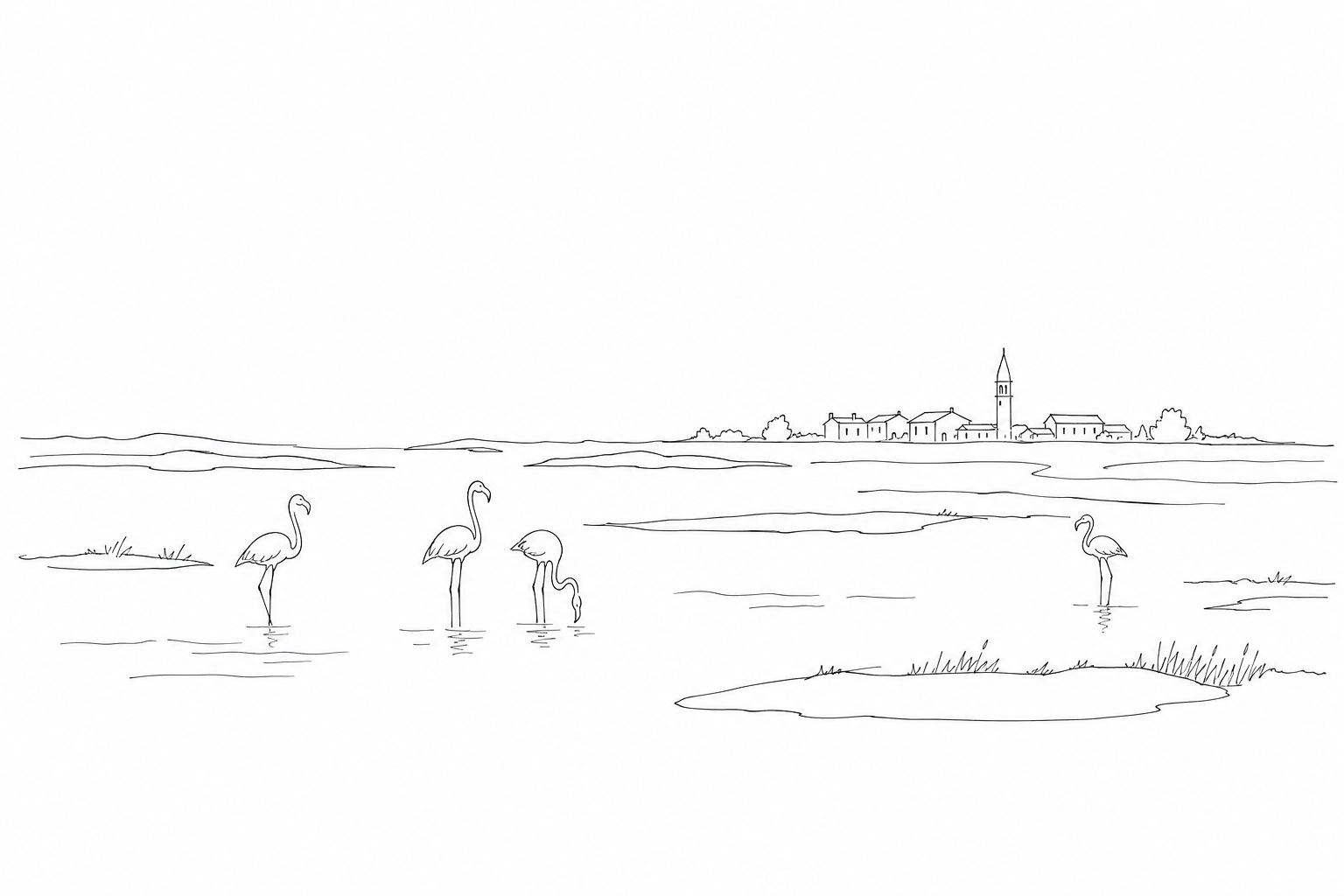
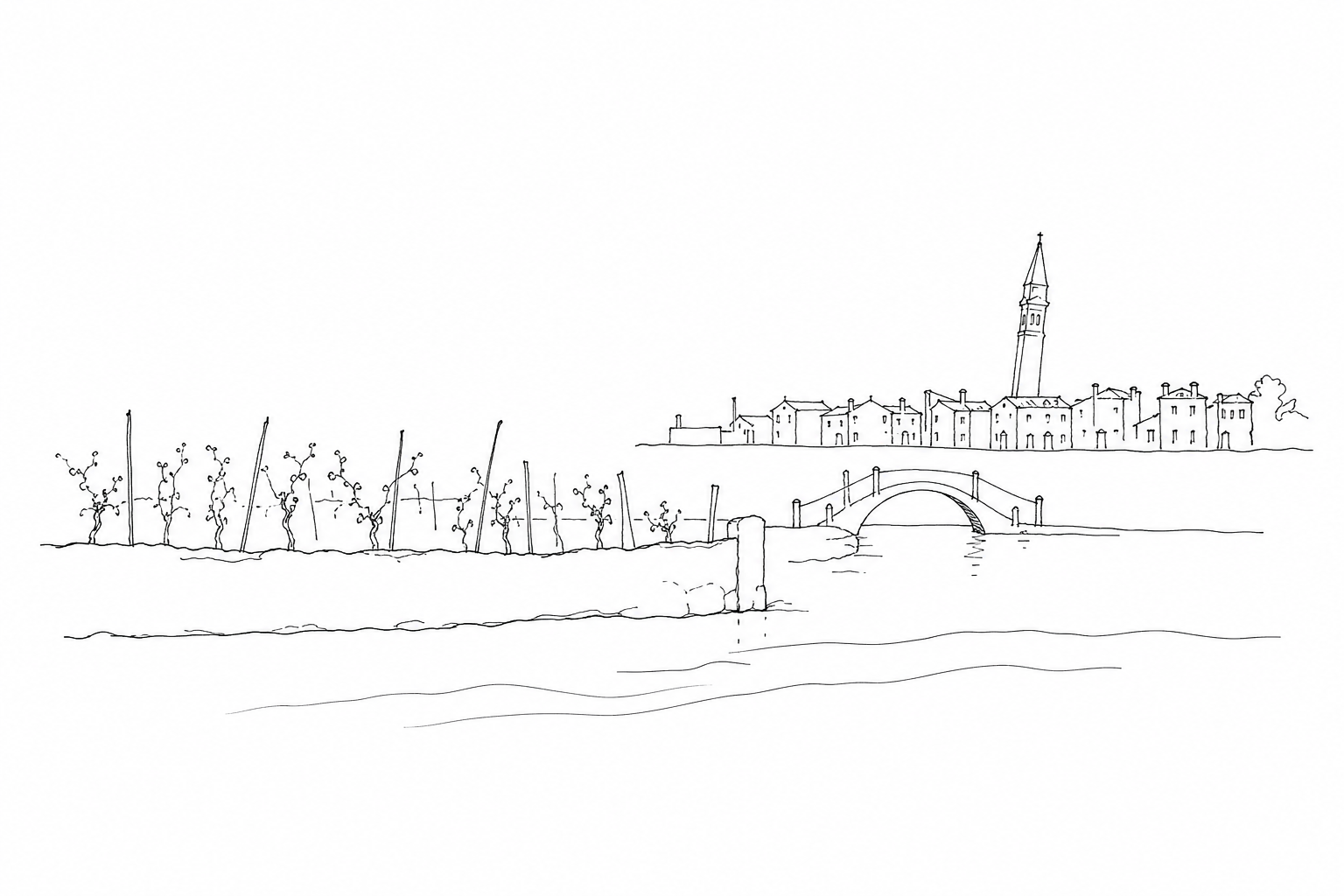
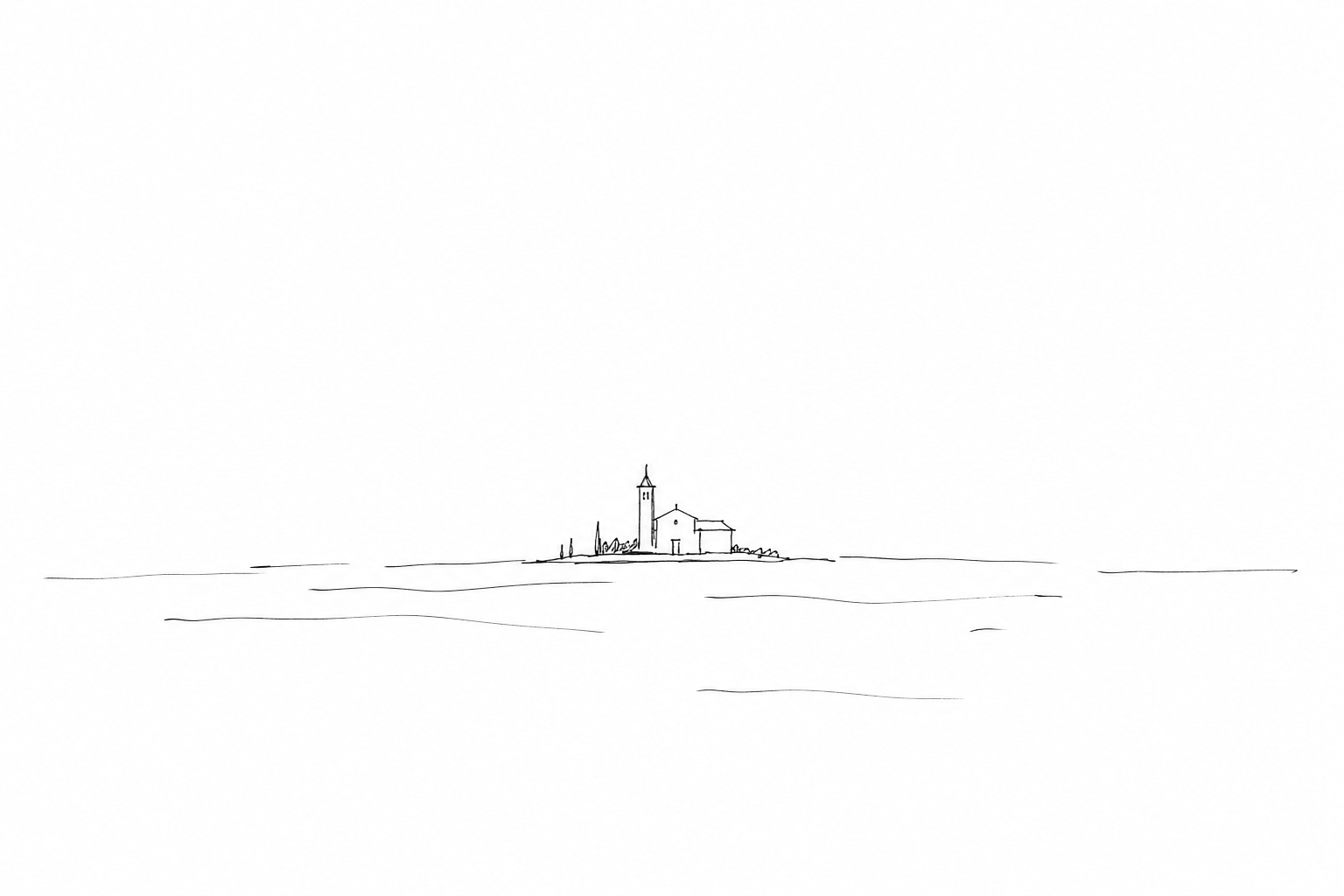

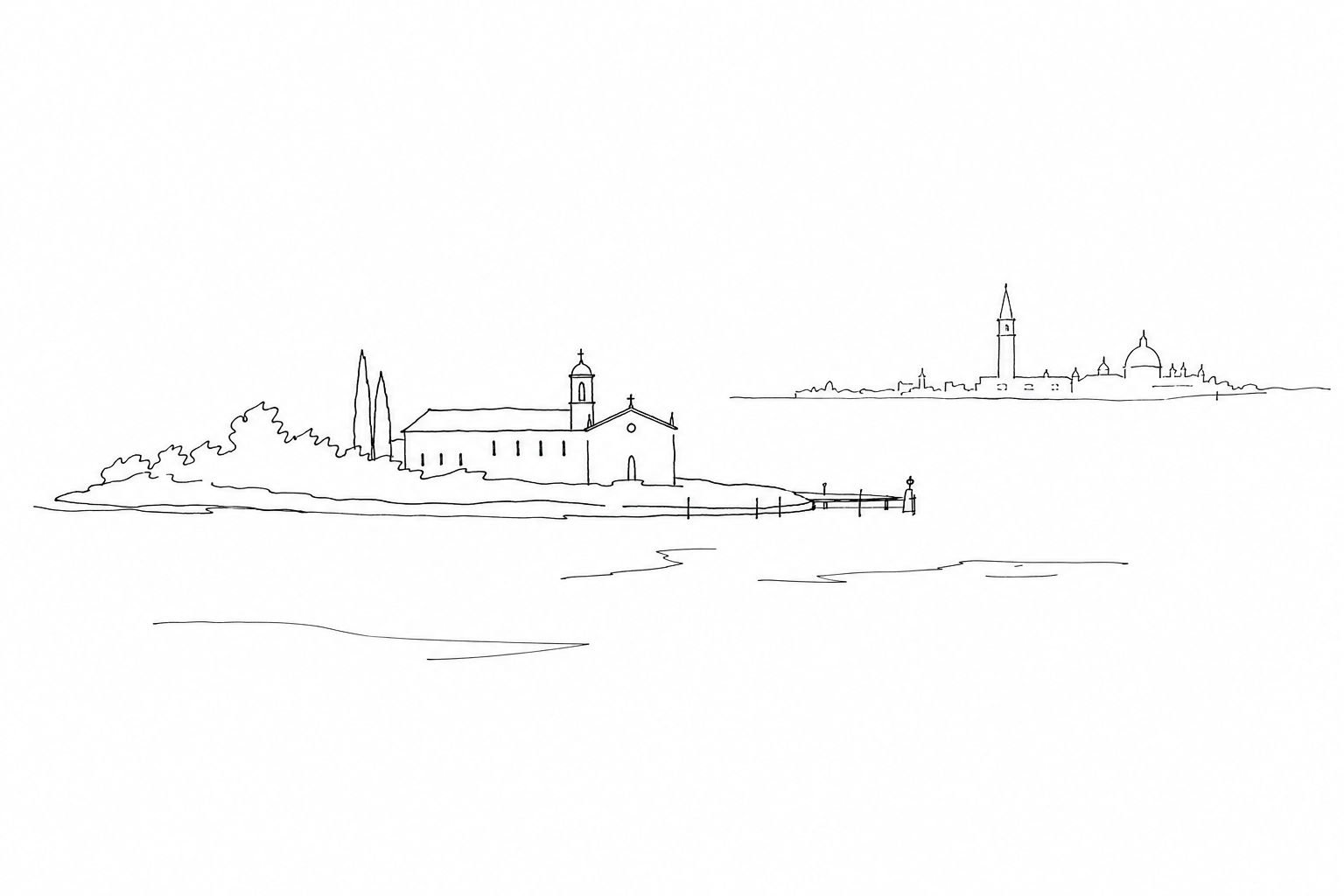
San Clemente is one of the Venetian islands that is best understood by observing its distance. It has never truly been outside the city, but neither fully inside it: a threshold of water between welcome, control, prayer, and care. Its history passes through monasteries, pilgrims bound for the Holy Land, female cloisters, and healthcare institutions, showing how Venice has often used the lagoon to separate without erasing. To read San Clemente means following a discreet geography, made of landing places, walls, gardens, and silences, where the function of the buildings says as much as their beauty.
An island conceived as a threshold
San Clemente is understood first of all by looking at its position: not inside Venice, but not really outside either. Located in the southern lagoon, along the routes between the city and the sea, the island functioned for centuries as a controlled threshold, a place to welcome, isolate, and wait.
Its history begins in the Middle Ages with a religious and welfare function. Tradition links the foundation of the complex to Pietro Gattilesso, a Venetian merchant of the 12th century, and to a hospice intended for pilgrims and crusaders in transit toward the Holy Land. Even then, the distance was not accidental: it made it possible to offer shelter without immediately bringing bodies, diseases, and tensions into the urban heart.
This logic remained recognizable in later transitions as well: monastery, place of care, then women’s psychiatric hospital. San Clemente tells of a Venice capable of including by separating, entrusting to the islands what was necessary but inconvenient, close to the city and at the same time kept at a measure of safety.
Monastic origins and hospitality for pilgrims
The medieval phase of San Clemente should not be read as a legend of contemplative isolation, but as a small religious infrastructure linked to mobility. According to the most accredited documentary tradition, in 1131 the merchant Pietro Gattilesso had a church dedicated to Saint Clement and a hospice intended for pilgrims and men traveling toward the East and the Holy Land built on the island.
In that context, hospitality did not mean healthcare in the modern sense. It was regulated welcome: a place where one could pray, rest, wait for a ship, and receive protection before re-entering the Venetian routes. The religious presence guaranteed order, liturgical memory, and moral control over a temporary population, often made up of travelers, veterans, devotees, and people without stable ties in the city.
San Clemente was therefore born as a service space: close enough to Venice to depend on its maritime economy, but separate enough to manage passages, waits, and fragilities. This is where the island’s long vocation begins: to welcome what the city did not want to place in its own center.
From cloister to separate care
The decisive transition occurred when the religious function lost its public weight. After the suppression of the orders between the Napoleonic era and Austrian rule, many lagoon complexes were converted: San Clemente followed this path, passing from a place of monastic discipline to a space intended for the institutional management of fragility.
In the nineteenth century, the distance from the inhabited area was no longer merely a geographical fact. It became an administrative tool: the water made it possible to separate without moving away completely, to control access and transfers, to keep the sick within a perimeter that could be supervised. From 1873 the complex housed a women’s asylum, included in the lagoon healthcare system together with other facilities dedicated to psychiatric care and custody.
The transformation also changed the meaning of the buildings. Cells, corridors, courtyards, and common spaces no longer referred to chosen cloister, but to an imposed therapeutic confinement. The history of the place thus tells of an uncomfortable continuity: Venice used that margin of water to accommodate presences considered necessary, but difficult to keep in the urban heart.
Reading San Clemente today
Observed from the southern basin, San Clemente should not be read only for what it preserves, but for the position it occupies: close enough to the historic center to remain within the Venetian political and healthcare horizon, separate enough to function as a filter. It is this margin of water, between Giudecca, the Lido, and San Servolo, that explains the long transformation from religious landing place to psychiatric facility.
To understand it today, it is useful to distinguish three visible or documentable layers:
- the monastic matrix, recalled by the church and by the layout gathered around the community spaces;
- the welfare phase, when physical isolation became part of healthcare organization and social control;
- contemporary reuse, which transformed the historic buildings for hospitality use without completely erasing the memory of the place.
The most useful reading, therefore, is not nostalgic: San Clemente shows how much the lagoon was also an urban device, capable of including while keeping at a distance. For any visits or access, the updated conditions must always be checked.
Today San Clemente cannot be reduced to a simple lagoon curiosity. Its story invites us to look at Venice through its smaller islands, places where the city has deposited fragilities, practical necessities, and symbolic choices. From monastery to hospital, every transformation speaks of a distance constructed with precision: close enough to remain part of the urban system, far enough to safeguard what the center did not want to show. For those who visit Venice attentively, San Clemente is a key to interpretation: less spectacular, perhaps, but more revealing.
Related Posts
San Servolo: the island of the asylum and the uncomfortable memory of psychiatric care
History and visit to San Servolo, an island in the lagoon marked by the Venetian asylum and the Museum of the Asylum.San Nicolò del Lido: monks, departures by sea and the ceremonial side of the lagoon
History and interpretation of San Nicolò del Lido: monastery, church, harbor entrance, naval departures and public rituals of lagoon Venice.
San Michele: the cemetery island where Venice learned to separate the living from the dead
History, spaces and memory of San Michele, the lagoon cemetery born when Venice moved the dead outside the inhabited city.Questions Answered
What role did San Clemente originally serve for Venice?
It was a hospice for pilgrims and crusaders traveling to the Holy Land.How did the island's function change after the suppression of religious orders?
It transformed into a women’s psychiatric hospital maintaining separation through water.Why was San Clemente positioned as a threshold rather than fully inside Venice?
To control access, isolate fragilities, and separate without removing from the civic system.How is San Clemente understood today in relation to Venice’s urban and social history?
As a symbol of Venice’s strategy to include difficult populations by keeping them at a measured distance.
Keep reading the lagoon
Want to understand Venice from the side of water, islands and the landscapes surrounding it?
 San Michele: the cemetery island where Venice learned to separate the living from the deadHistory, spaces and memory of San Michele, the lagoon cemetery born when Venice moved the dead outside the inhabited city.
 The Lazzaretto Nuovo: the quarantine island before the word became globalHistory and interpretation of the Lazzaretto Nuovo, the lagoon island where Venice organized health controls, goods and quarantine.
 San Lazzaro degli Armeni: a small island, a library and a piece of the East in the lagoonHistory, library, monastery and atmosphere of San Lazzaro degli Armeni, the Armenian island in the Venice lagoon.
 San Nicolò del Lido: monks, departures by sea and the ceremonial side of the lagoonHistory and interpretation of San Nicolò del Lido: monastery, church, harbor entrance, naval departures and public rituals of lagoon Venice.