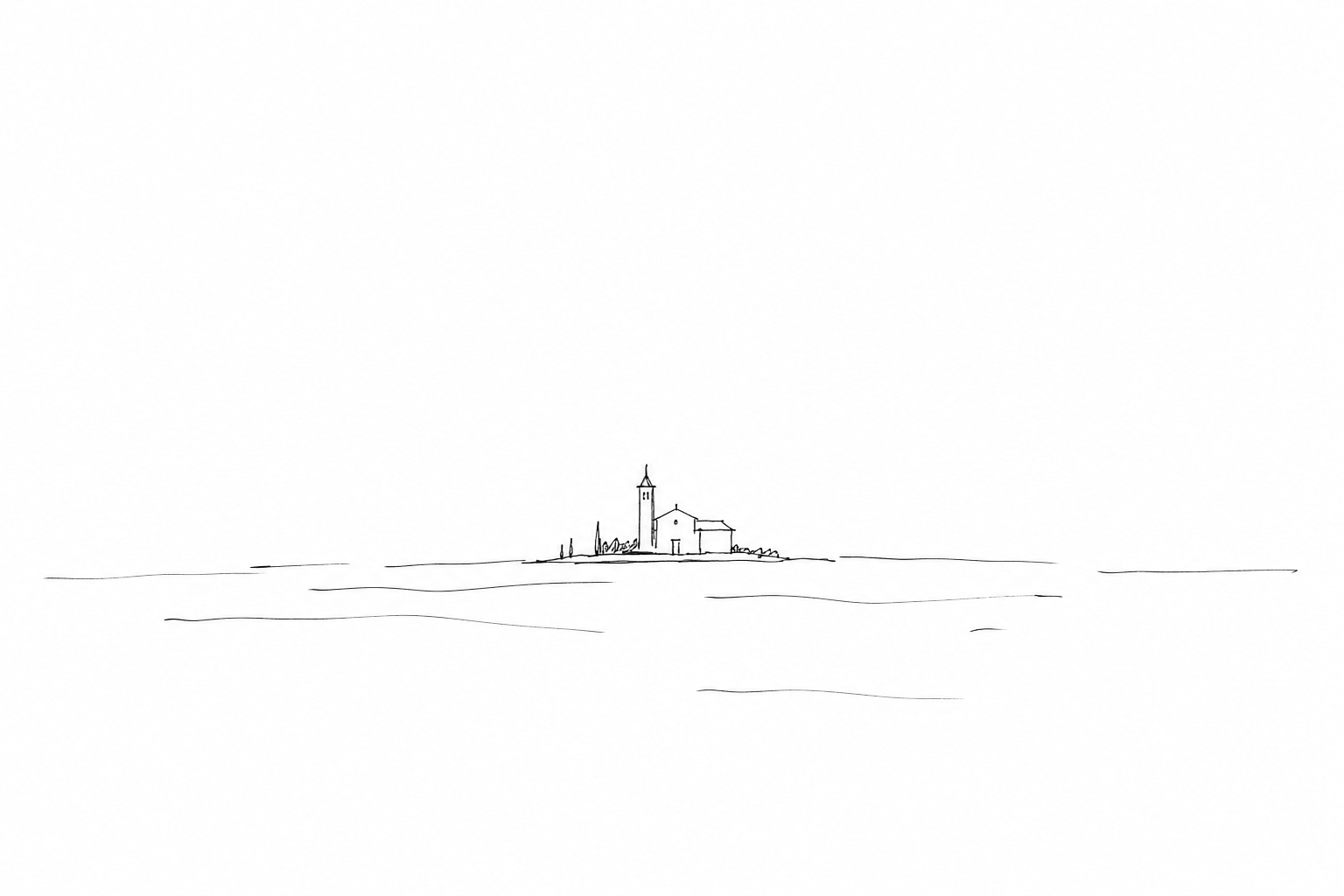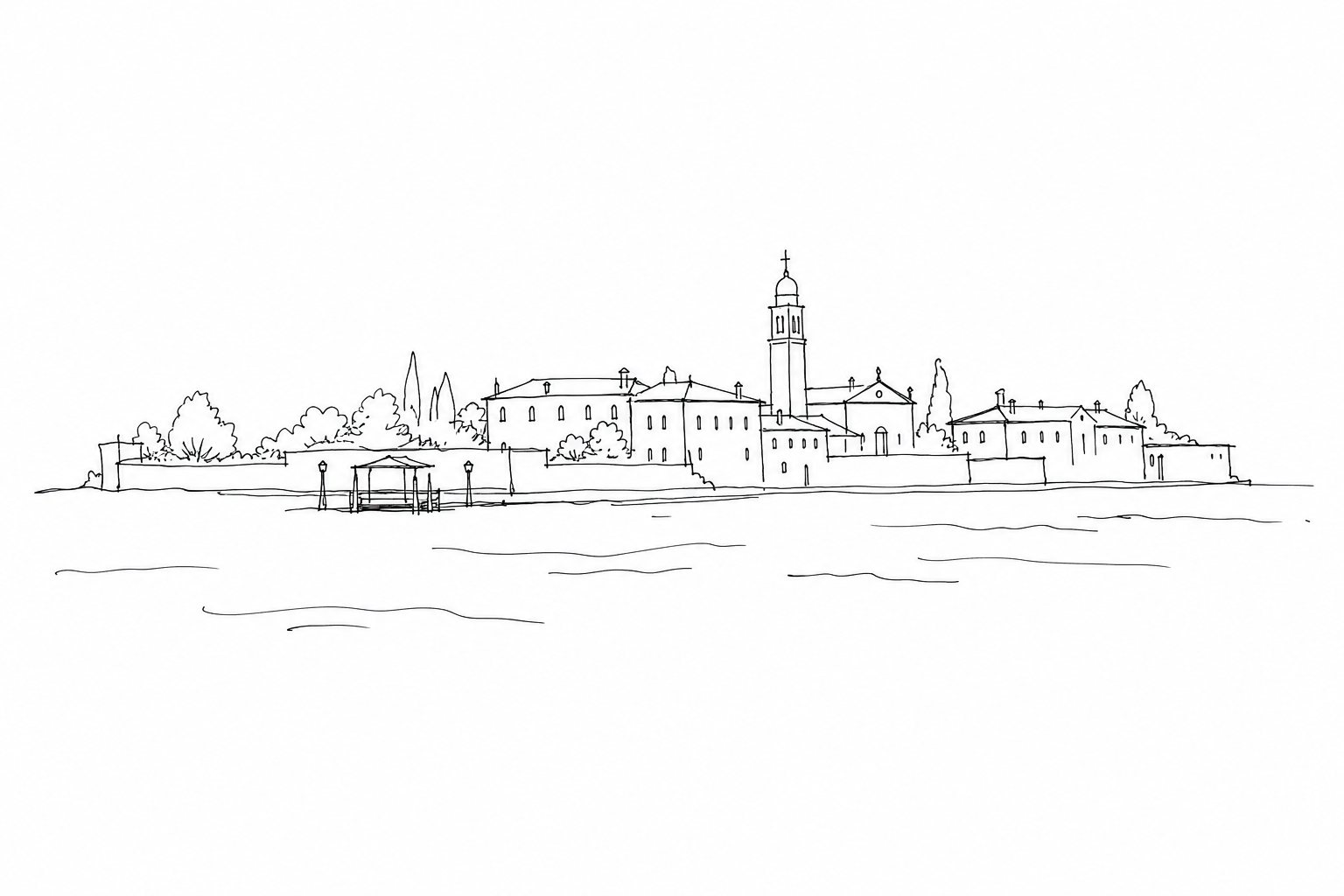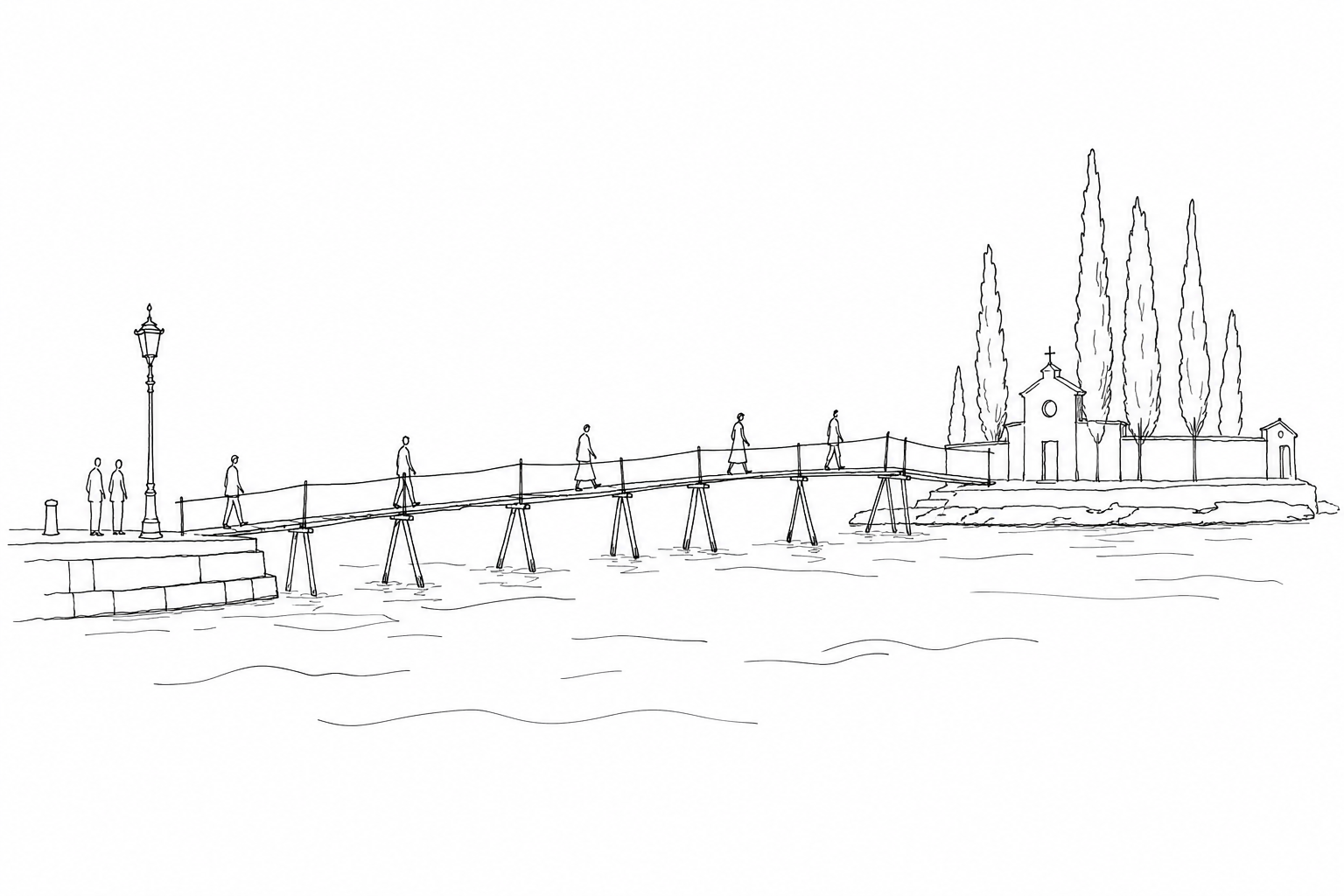

San Michele is not only Venice’s cemetery: it is the place where the city, forced for centuries to live with water, density and sanitary fragility, gave an urban form to the distance between the living and the dead. A few minutes from the Fondamente Nove, the island appears compact and silent, enclosed by brick walls and cypresses. But behind this orderly image one can read Napoleonic decisions, architectural transformations, illustrious memories and the daily gestures of Venetians who continue to reach it by vaporetto, with flowers and a slow step.
Why Venice moved the dead to the lagoon
San Michele was born from a concrete decision: to move burials away from the inhabited body of Venice. For centuries the dead had been laid in churches, cloisters and small parish campos, that is, within the daily fabric of the city. This closeness was religious and familial, but it became increasingly problematic in a dense, humid city, built on islands, where space was rare and public health an urgent issue.
The turning point came in the Napoleonic era, when the new regulations required cemeteries to be placed outside inhabited centers. In Venice the choice fell on the island of San Cristoforo della Pace, later joined to nearby San Michele: two strips of lagoon progressively transformed into a separate burial place, reachable by boat but distinct from urban life.
The solution was both sanitary and urban-planning. Separating the living from the dead meant freeing the parishes from burials, reducing hygienic fears linked to internal burials and ordering collective memory in a dedicated space. San Michele thus became a threshold: not an indistinct periphery, but a specialized island, visible from Venice and yet secluded.
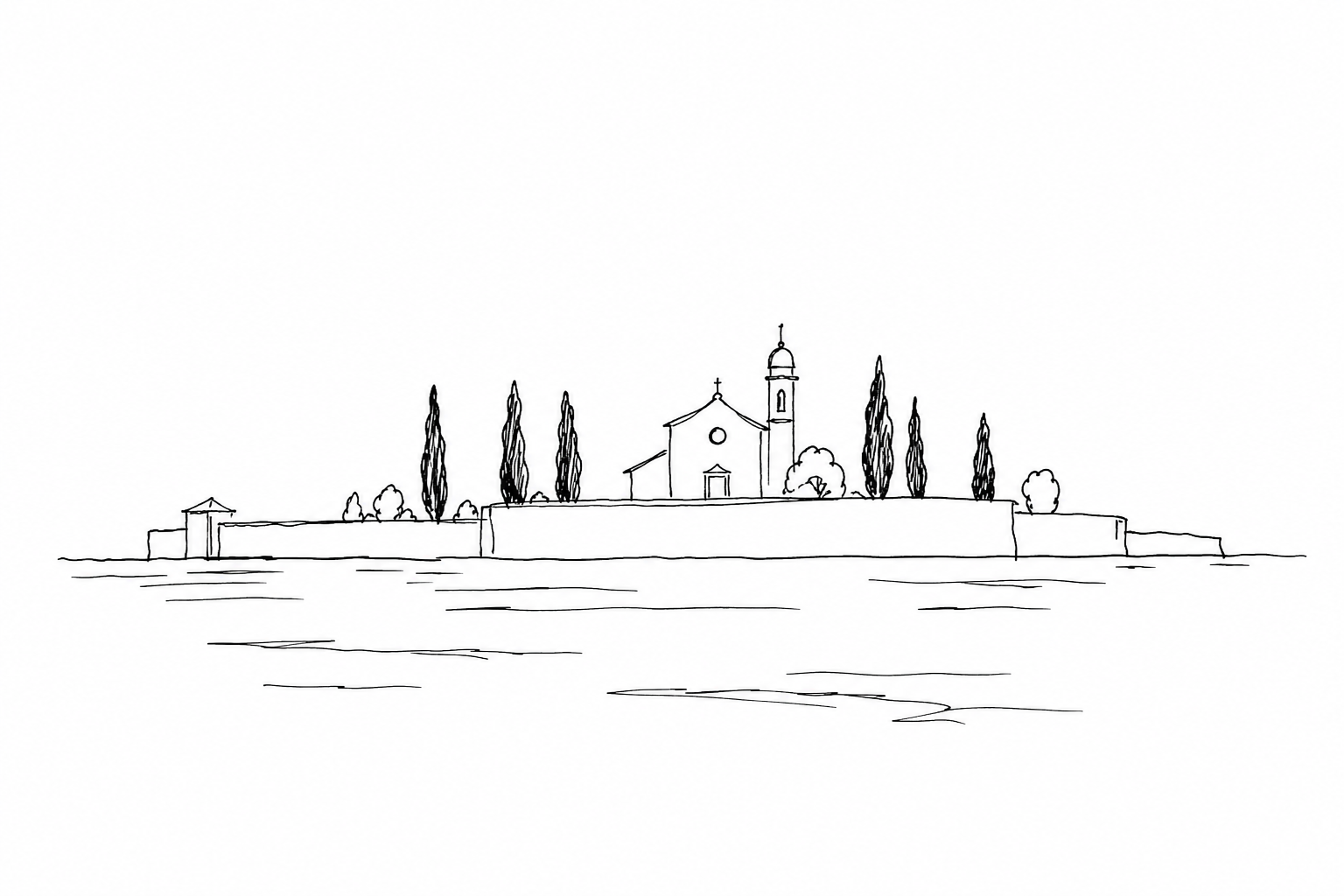
San Michele is read first of all as an enclosure. Those arriving from the water do not encounter an open square, but a perimeter of bricks and gates: the city of the dead is also visually separated, protected by low, continuous walls that turn the lagoon into a threshold.
Access is from the landing stage, along the routes that connect the historic center to Murano; for timetables and stops it is always best to check the updated information. Once inside, the sound of the water remains behind. The paths are regular, almost urban: tree-lined avenues, burial fields, chapels, columbaria and distinct sectors order the space like a specialized district.
The church of San Michele in Isola, with its Renaissance façade in Istrian stone designed by Mauro Codussi, introduces a monumental but sober note. It does not dominate with theatricality: it accompanies the character of the place, made of measured proportions, shade, cypresses and pauses. Here silence is not natural: it is built, designed, maintained.
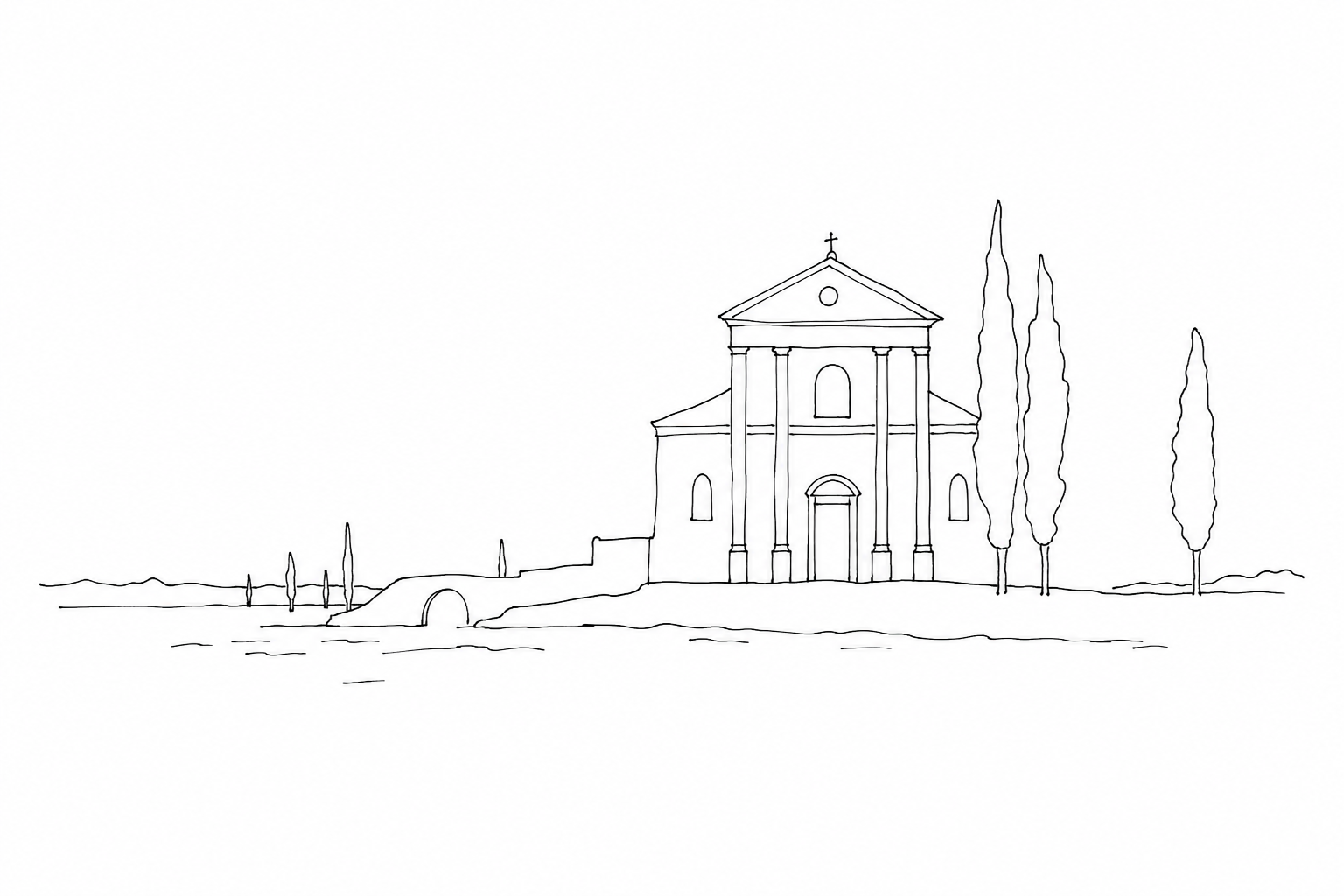
Church, cloister and architectures of memory
The oldest core did not originate as a cemetery, but as a Camaldolese monastic complex. The church of San Michele in Isola, begun in the fifteenth century and linked to the name of Mauro Codussi, is one of the decisive passages of the lagoon Renaissance: Istrian stone façade, clear proportions, arches and pilasters order the space with a severity that anticipates the funerary destiny of the place.
Next to the church, the cloister introduces another measure of time. It is not a simple courtyard: it is a machine for contemplation, where the rhythm of the arches transforms walking into pause. Memory here is not shouted, but framed; the path forces one to slow down even before reaching the burial fields.
One element to observe is the Emiliana Chapel, a Renaissance addition with a central plan, attributed to Guglielmo dei Grigi. Its more compact, almost autonomous form shows how religious architecture and private commemoration were intertwined before the Napoleonic reform. When the cemetery was imposed outside the inhabited fabric, it therefore found a language already ready: cloister, pale stone, enclosure, order.
How to read the funerary enclosure during the visit
To understand San Michele it is best to proceed slowly, as in an open-air archive. Do not look only for the famous tombs: the meaning of the place arises above all from its organization. The straight avenues, the dividing walls and the distinct fields show the nineteenth-century desire to make burial orderly, controllable, hygienic, far from the parishes of the inhabited center.
A useful key is to observe the differences between the Catholic, Evangelical and Orthodox areas: epitaphs in different languages, crosses, icons, sobriety or decorations tell of a lagoon community more international than it seems. The tombs of Igor Stravinsky, Ezra Pound or Sergei Diaghilev attract attention, but they should be read within this geography of belonging, not as simple “attractions”.
Behavior matters: low voice, discreet photographs, no passage between the graves. If you want to verify access, routes or any limitations, it is better to check the updated information before the visit.
Visiting San Michele means observing Venice from an essential margin, far from the monumental scene but close to its most concrete history. The island tells how a city built on water had to rethink the space of death, transforming it into a landscape of enclosure, memory and care. Among church, cloisters, enclosures and tombs, the visit requires attention more than haste: reading the names, noticing the architectures, listening to the silence. It is a short route, but capable of returning a less obvious and deeper Venice.
Related Posts
The votive bridge for San Michele: when Venice walks on water to remember the dead
The votive bridge for San Michele tells of the bond between Venice, the lagoon and the memory of the dead.The Jewish cemetery on the Lido: gravestones, sand and silence near San Nicolò
History and reading of the Jewish cemetery on the Lido, among ancient gravestones, sand and quiet near San Nicolò.
San Zanipolo: doges, funerary monuments and a basilica that seems to tell of power after death
A reading of San Zanipolo as Venice’s political pantheon, among doges’ tombs, funerary art and Dominican architecture.Questions Answered
Why was San Michele chosen as Venice's cemetery island?
To separate burials from the inhabited city for health and planning.What architectural style influences San Michele's church?
It features Renaissance design by Mauro Codussi.How is the cemetery organized to reflect Venice’s community?
It has distinct Catholic, Evangelical, and Orthodox burial areas.What should visitors know about behavior at San Michele?
Visitors should maintain silence and avoid crossing graves.
Explore the Venice beyond stone
Would you like to connect this stop with islands, boats and environments that tell the city’s other half?
 The votive bridge for San Michele: when Venice walks on water to remember the deadThe votive bridge for San Michele tells of the bond between Venice, the lagoon and the memory of the dead.
 San Clemente: from monastery to hospital, the island Venice has always kept at a distanceHistory of San Clemente, a lagoon island used for worship, care, and separation.
 The Lazzaretto Nuovo: the quarantine island before the word became globalHistory and interpretation of the Lazzaretto Nuovo, the lagoon island where Venice organized health controls, goods and quarantine.
 Malamocco on the Lido: the ancient village that recalls a Venice before VeniceHistory, places and urban reading of Malamocco, the village on the Lido linked to the oldest Venice.