
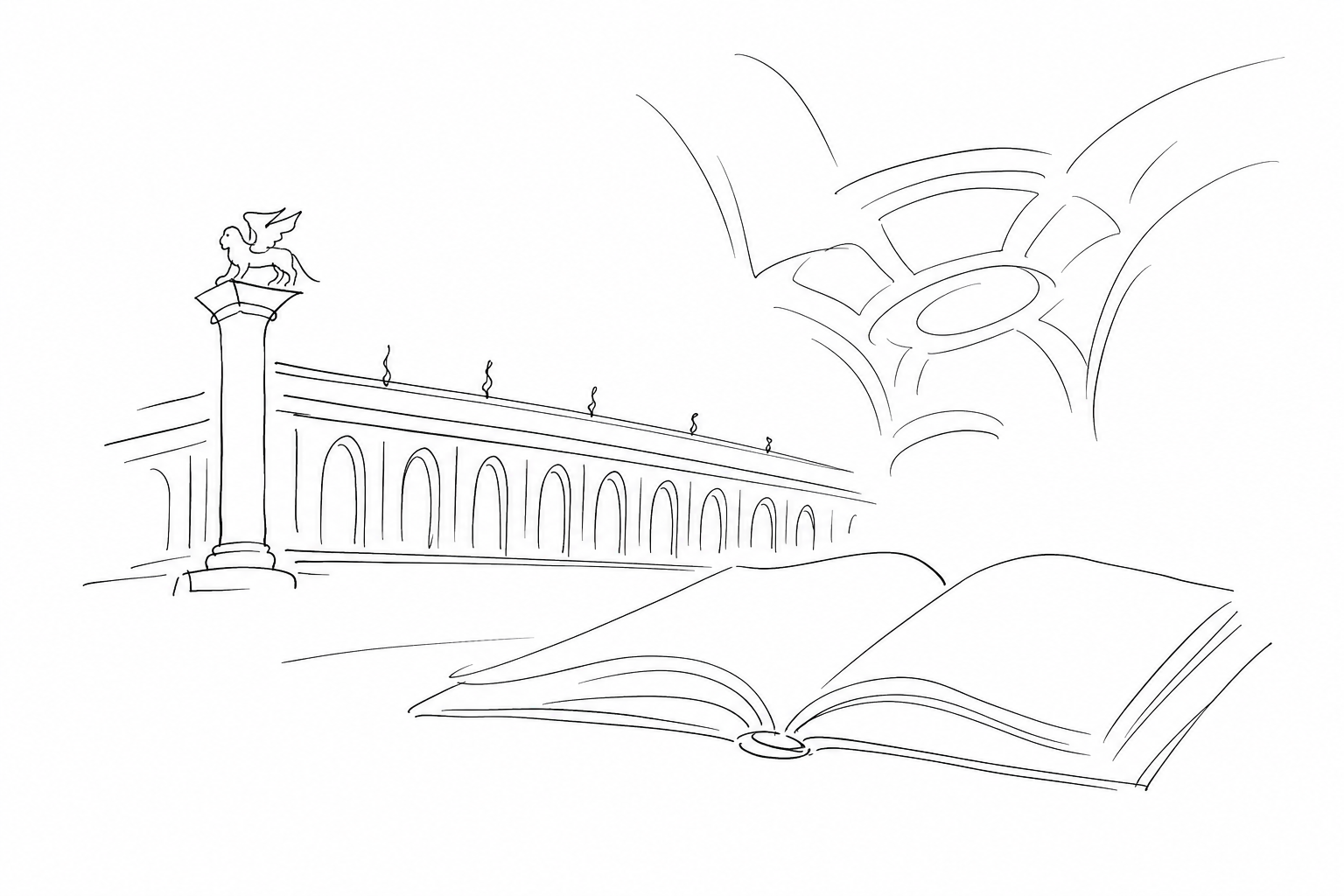

Next to San Marco, where the city shows itself in its most ceremonial face, the Marciana Library tells of another idea of Venice: not only power and representation, but knowledge preserved in a public space. Born from the donation of Greek and Latin codices and grown in the political heart of the Serenissima, the Marciana brings together books, architecture and painting in a rare balance. Entering it means reading the square from a different perspective, following the relationship between humanistic culture, civic ambition and urban life.
Next to San Marco, a library born for the city
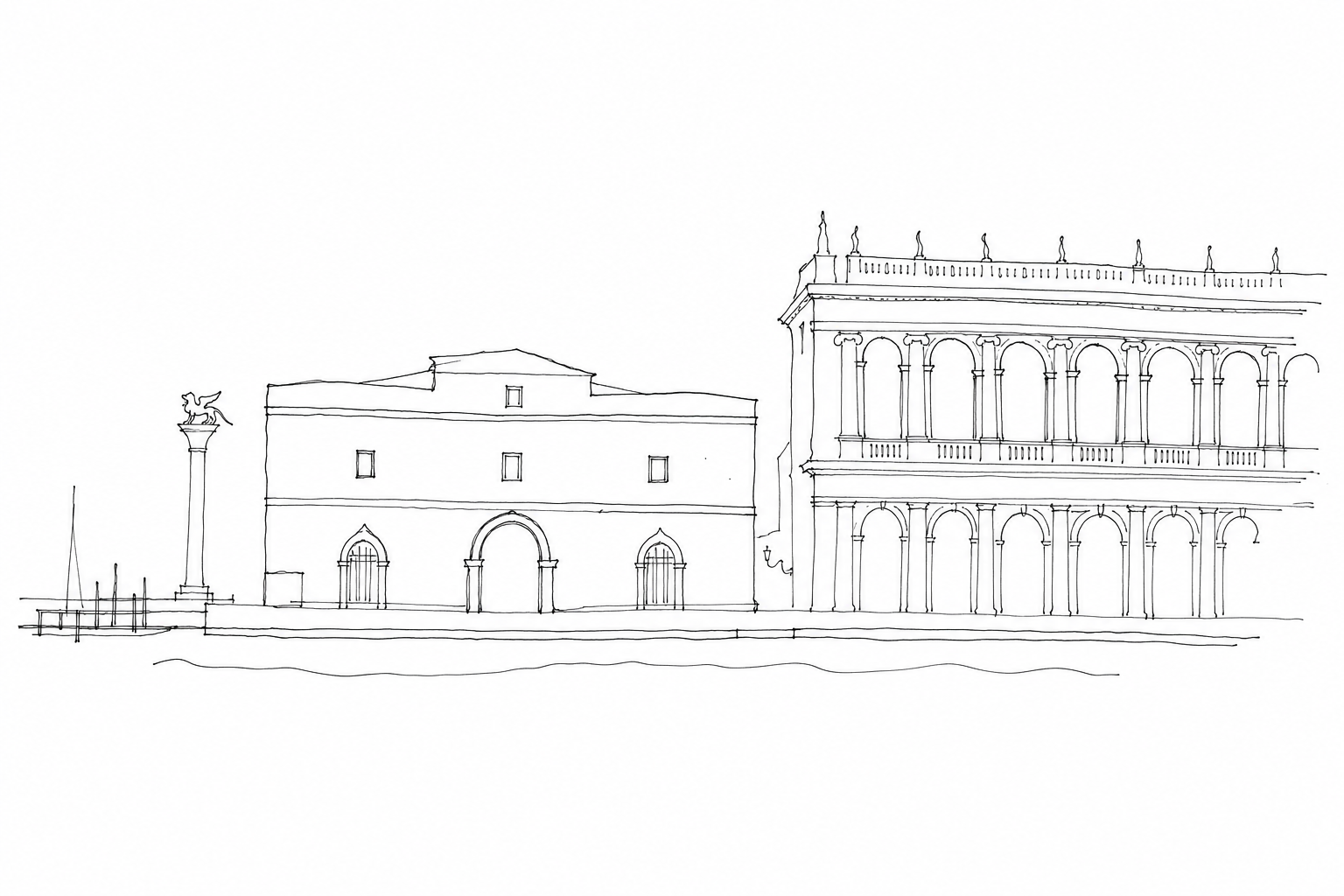
The Marciana Library occupies one of the most eloquent points in Venice: the Piazzetta next to San Marco, opposite the Doge’s Palace and a few steps from the Basin. Here written knowledge was placed in the political heart of the Republic, not in a secluded place. The choice says a great deal: books, manuscripts and study were to belong to the city’s public life, alongside the magistracies, ceremonies and arrivals by sea.
The most famous core dates back to 1468, when Cardinal Bessarion donated to the Serenissima an extraordinary collection of Greek and Latin codices. To house it, Venice built in the sixteenth century the Library designed by Jacopo Sansovino, a building that transformed the façade of the Piazzetta with columns, loggias and sculptures.
The Marciana is therefore not only a historic library: it is an urban idea. Its books, painted ceilings and architecture declare that knowledge was part of Venetian civic representation.
Sansovino’s building: knowledge on the façade
The monumental seat of the Marciana was born in the sixteenth century with the project by Jacopo Sansovino, called to give stable form to the legacy of Greek and Latin codices donated by Cardinal Bessarion to the Republic. It was not conceived as a secluded repository: the Library stands along the side of the Piazzetta and dialogues with the Procuratie, the Mint and the Doge’s Palace, turning the custody of books into a public presence.
The two-tier façade, with arches on the ground floor and superimposed columns, translates into stone a classical language legible to those who crossed the political space of the city. Sansovino uses proportion, rhythm and sculptural decoration to suggest authority, but also openness: the lower portico belongs to urban life, while the upper rooms preserve study, manuscripts and memory.
For this reason too, the building is part of the cultural message: Venice displayed knowledge not behind closed walls, but in its most representative setting.
Painted ceilings, allegories and Venetian painting
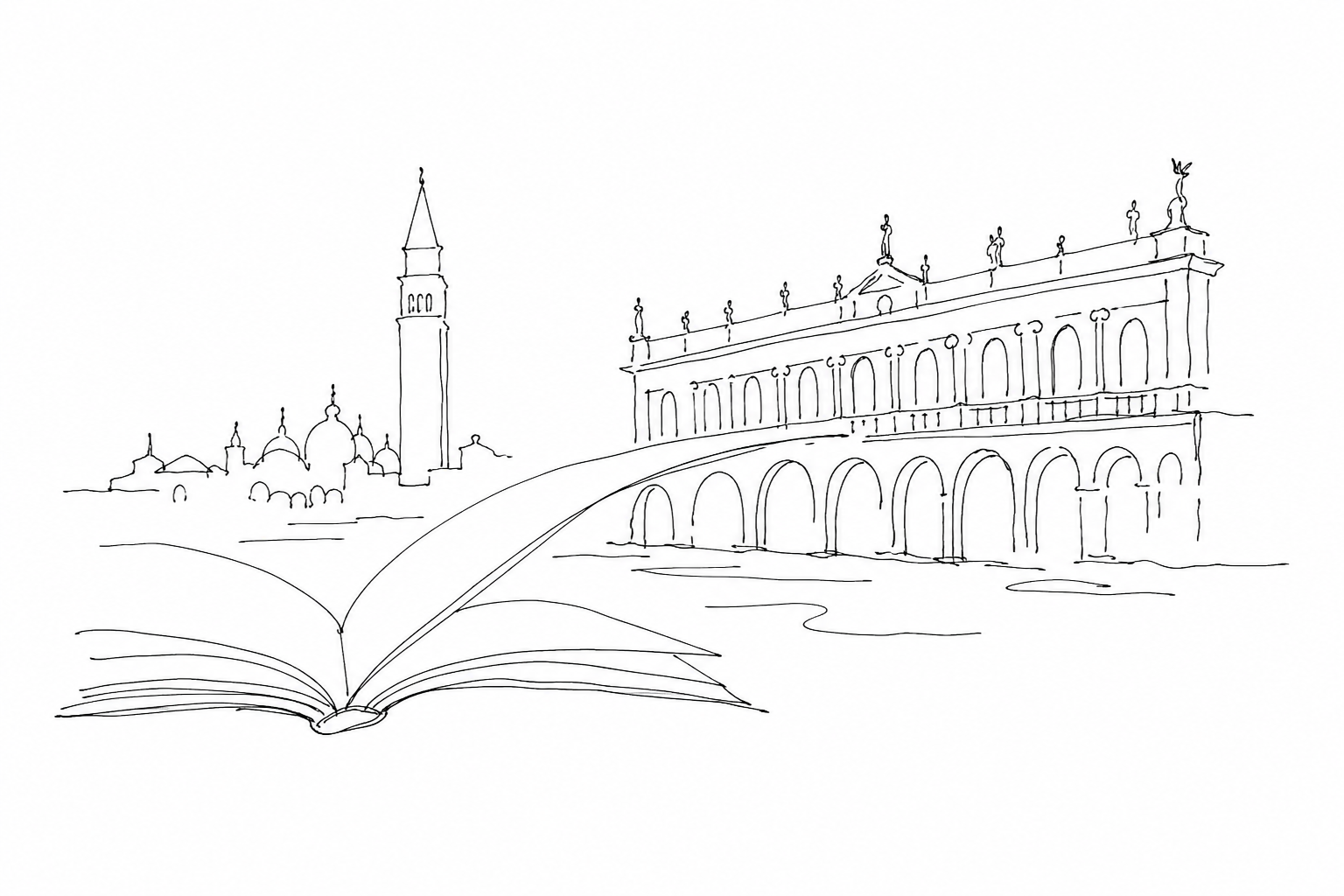
Entering the monumental rooms, the gaze is guided upward: the ceilings are not simple ornament, but a true figurative program. In the Library Hall and in the connected spaces, Venetian painting of the sixteenth century transforms study, eloquence and civic virtues into images legible to those who frequented that public place of the Serenissima.
The canvases set into the gilded coffers call upon masters such as Titian, Paolo Veronese, Tintoretto, Andrea Schiavone and other painters active in the lagoon’s artistic climate. The allegorical figures celebrate disciplines, moral qualities and faculties of the mind: memory, prudence, fame, the harmony between liberal arts and good government. They do not tell a single story, but build a constellation of meanings.
The key to interpretation is political as well as cultural. Above the shelves and consultation desks, the images declared that knowledge had to serve the city, justice and the formation of the ruling elite. Gold, color and perspective were not aimed only at wonder: they made visible the idea that possession of ancient and modern texts was a public responsibility.
Manuscripts, maps and a mindful visit today
The most famous core of the Marciana comes from the donation of Cardinal Bessarion, who in 1468 entrusted an extraordinary set of Greek and Latin codices for public use. That legacy explains why the rooms should not be read only as an artistic setting: they preserved a civic promise, to make rare texts, philosophy, philology and the memory of antiquity accessible.
The holdings also include incunabula, Aldine editions, portolan charts, island books and nautical charts: precious materials for understanding a city built on trade, travel and diplomacy. Maps were not simple illustrations; they translated routes, borders, exchanges, the risks of the sea and political ambitions into consultable visual forms.
For an attentive visit it is worth distinguishing two levels: the monumental route, where architecture and painting tell of the humanistic ideal, and the conservation of the collections, subject to specific rules for study. Before planning entry or any consultations, it is prudent always to verify updated information through the official channels.
The Marciana is not only a historic library nor a monumental interior to be observed in haste. It is a place where Venice organized its knowledge, staged it and made it part of the city. The painted ceilings, Sansovino’s rooms, the manuscripts and the maps call for a slow gaze, capable of connecting artistic details and public function. Visited attentively, next to the continuous movement of San Marco, it gives back a more cultured, concrete and less predictable Venice.
Related Posts
Sansovino’s Loggetta: the small precious building at the foot of the Campanile
History, architecture and sculptures of Sansovino’s Loggetta, at the foot of St. Mark’s Campanile.The Scuola Grande di San Marco: the most elegant façade in front of the civil hospital
A reading of the Scuola Grande di San Marco, from its confraternal history to the Renaissance façade that today stands in front of the Civil…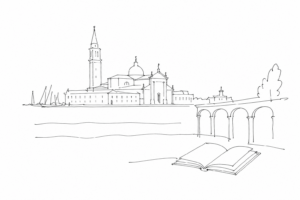
Fondazione Giorgio Cini: cloisters, libraries and culture on the island opposite San Marco
Editorial guide to the Fondazione Giorgio Cini, among cloisters, libraries, archives and cultural life on San Giorgio Maggiore.Questions Answered
What is the historical significance of the Marciana Library’s location?
It situates knowledge within Venice’s political and public life near San Marco.Who contributed the core collection to the Marciana Library?
Cardinal Bessarion donated a collection of Greek and Latin codices in 1468.How does the architecture reflect Venice’s values about knowledge?
Sansovino’s design makes the library a public and authoritative presence in the city.What kinds of materials are preserved in the Marciana’s holdings?
Manuscripts, incunabula, Aldine editions, portolan charts, and nautical maps.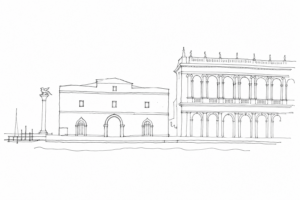
Read St Mark’s beyond the square
Want to move from the famous monuments to details that explain power, art and public life?
 Museo Correr: why starting here helps you understand San Marco before the basilicaTo read San Marco more calmly, the Museo Correr offers the civic, political and urban key to the square before the basilica.
 The Venice Mint: Coins, Metal, and Public Trust Beside the Marciana LibraryHistory and urban reading of the Venice Mint, between coinage, solid architecture, and public role on the Molo of San Marco.
 The Tetrarchs of San Marco: four embraced figures and the missing fragment in IstanbulHistory, interpretation and location of the Tetrarchs of San Marco, a porphyry group linked to Constantinople and to a fragment preserved in...
 San Zaccaria beyond San Marco: crypt, water and the suspended calm of Giovanni BelliniA slow guide to San Zaccaria: the church between San Marco and Castello, the flooded crypt and the altarpiece by Giovanni Bellini.