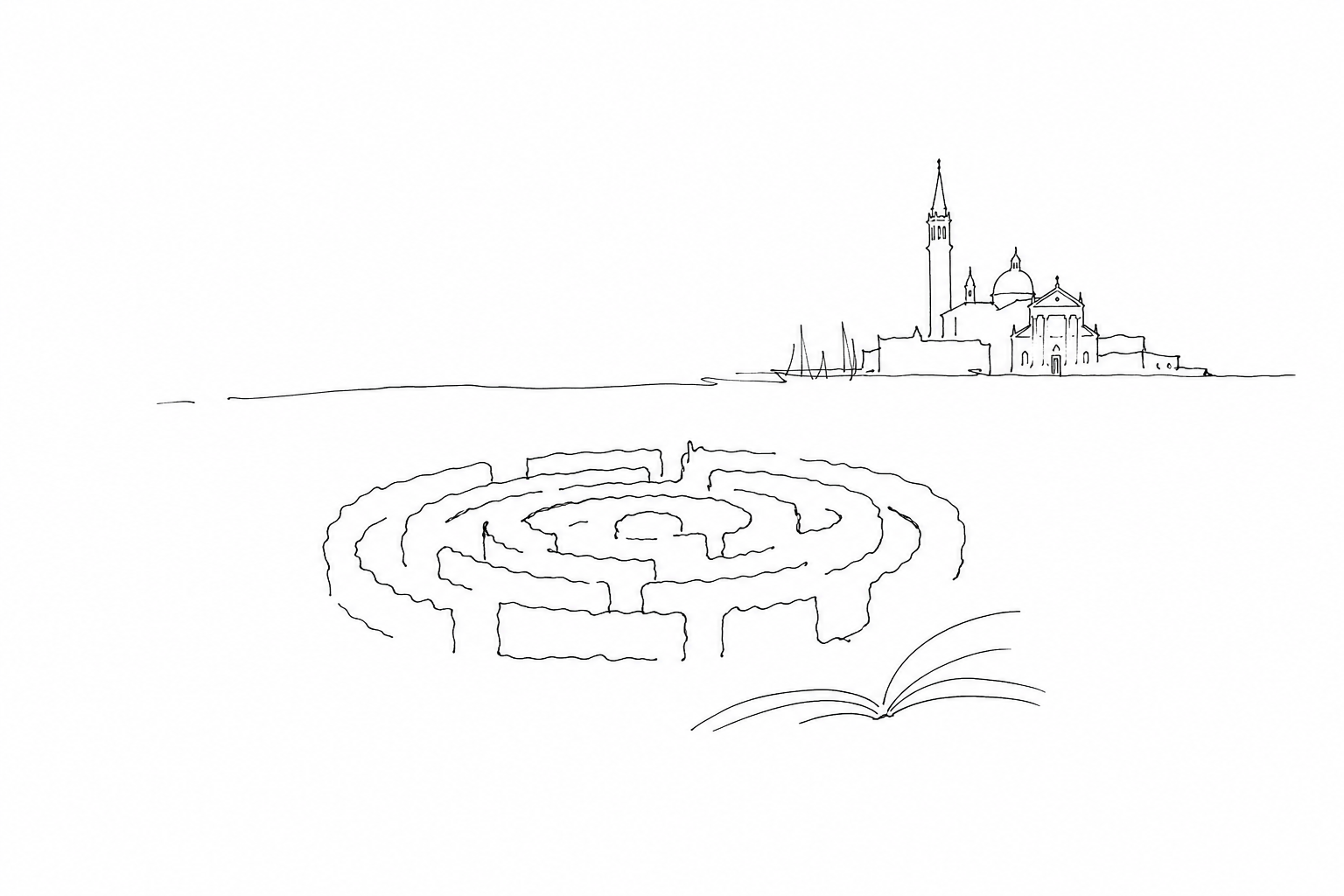

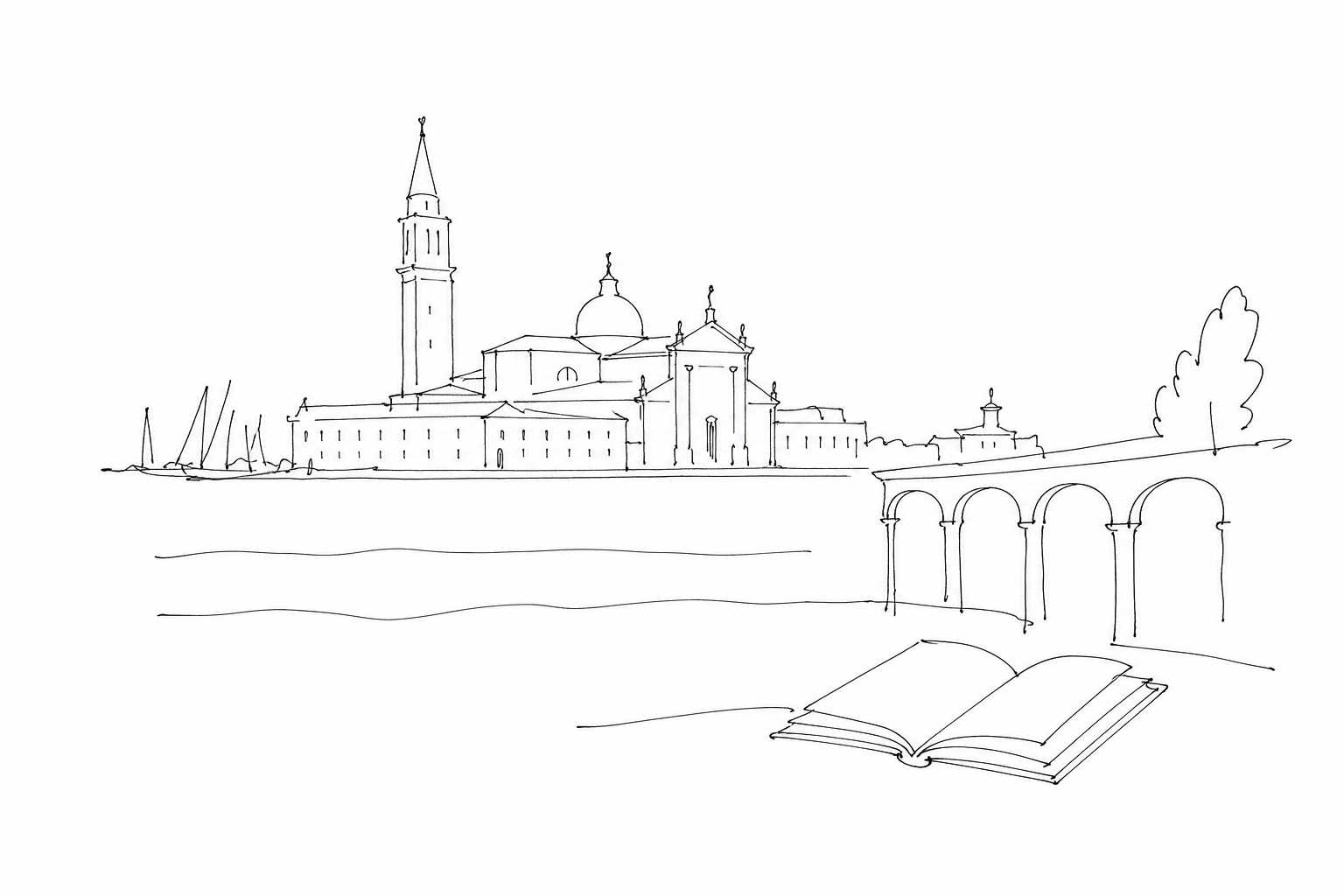

The Fondazione Giorgio Cini occupies the island of San Giorgio Maggiore, a few minutes from San Marco but already beyond its noise. Here Venice changes scale: no longer only façades on the water and crowded routes, but silent cloisters, specialized libraries, study rooms, archives and spaces born from a long monastic history. Founded in the twentieth century by Vittorio Cini in memory of his son Giorgio, the Foundation transformed the ancient Benedictine complex into one of the city’s most important cultural places, where art, music, theatre, history and research engage in dialogue with the architecture of the island.
A cultural island in front of San Marco
The Fondazione Giorgio Cini occupies the island of San Giorgio Maggiore, directly opposite the San Marco basin: a position that makes it part of Venice’s most recognizable landscape, but also slightly set apart from the flows of the Piazza. This difference is essential for understanding its character: not a simple monument to pass through, but a complex for study, conservation and research.
The Foundation was established in 1951 on the initiative of Vittorio Cini, in memory of his son Giorgio. The project transformed the ancient Benedictine monastery, marked by suppressions and military uses, into a center dedicated to the arts, music, theatre, Venetian history and comparative civilizations. Alongside the Palladian basilica of San Giorgio Maggiore, the internal route connects cloisters, monumental halls, libraries and archives.


The place thus preserves a dual identity: on the one hand the island’s long monastic history, on the other the twentieth-century vocation of an international cultural institution, built on the recovery of spaces and on the collection of specialized documentary holdings.
Cloisters, architecture and monastic spaces
The visit takes shape within the large Benedictine complex of San Giorgio Maggiore, where the order of the spaces preserves a clear reading: cloisters, corridors, refectory, grand staircases and ancient convent wings connect religious recollection and contemporary cultural use.
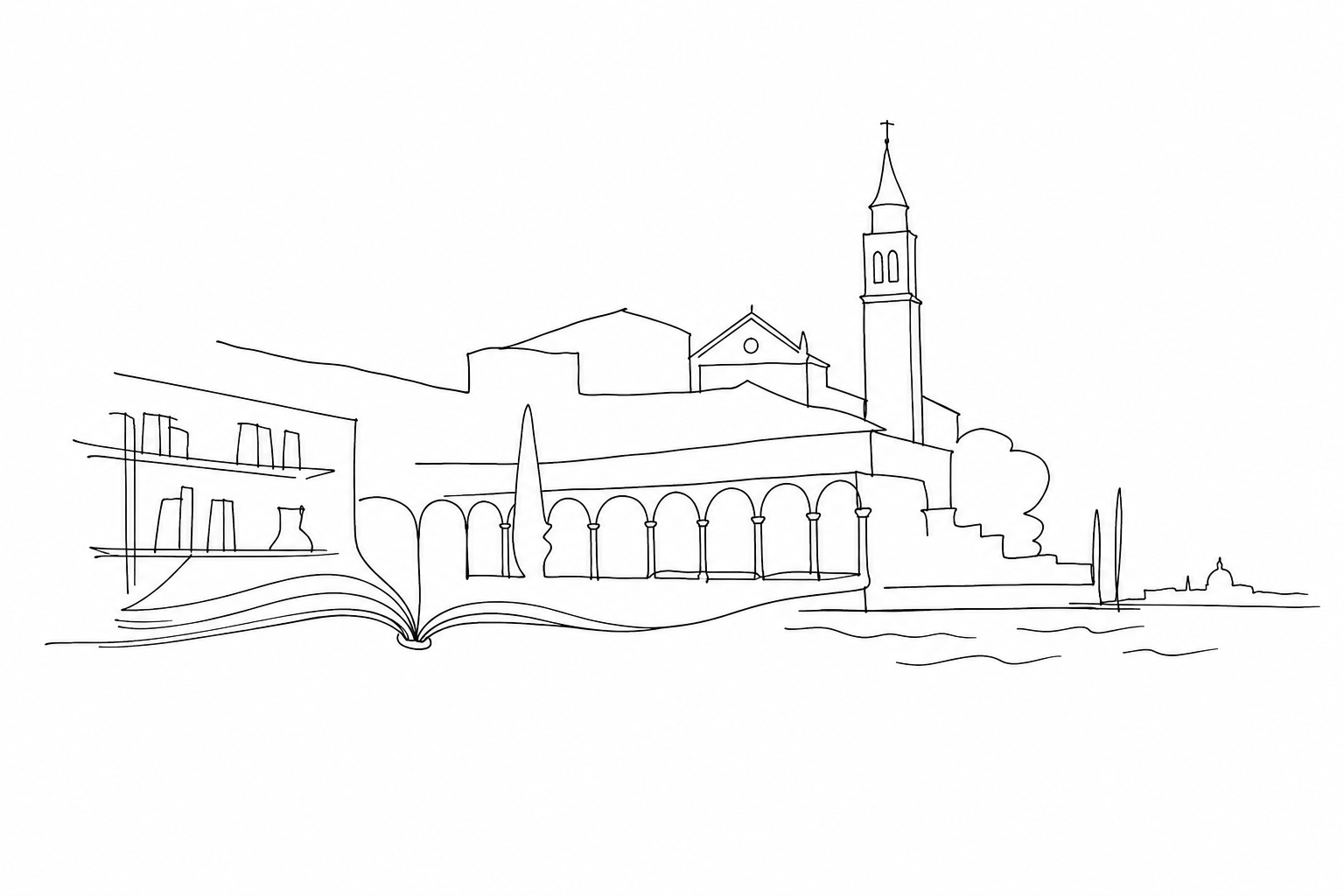
Among the most recognizable spaces are the Chiostro dei Cipressi, attributed to the Palladian project, with regular arches and measured proportions, and the larger cloister linked to the Renaissance renewal of the monastery. Here Istrian stone, brick and the internal greenery create a silent rhythm, different from the open monumentality of the San Marco basin.
A central role also belongs to the study spaces: the Manica Lunga, the monks’ ancient dormitory, has been transformed into a library while maintaining the perception of the long nave, marked by shelving, tables and natural light. The Scala del Longhena, theatrical and solemn, instead recalls the Baroque phase of the complex, when the monastery updated its image without erasing the previous layout.
These spaces are not simple containers: they orient the route, explain the architectural stratification and make the Foundation’s vocation as a place of conservation, research and memory legible.
Libraries, archives and Venetian studies
Alongside the monumental dimension, the complex of San Giorgio Maggiore houses one of the most important research centers for those studying Venice, the arts and twentieth-century music. The Nuova Manica Lunga, the ancient Benedictine dormitory reimagined as a library, is one of the most significant spaces: shelving, consultation tables and natural light transform a historic volume into a contemporary workspace.
The Fondazione Giorgio Cini preserves specialist libraries, photo libraries and archives linked to the history of art, theatre, music, Venetian civilization and cultural relations between Italy and the world. Among the best-known holdings are materials useful for the study of composers, artists, critics, collectors and institutions that shaped the city’s intellectual life.
The value of the place lies not only in the quantity of documents, but in their dialogue: a drawing, a score, a photograph or a letter can reconstruct relationships, commissions, journeys and contexts. For consultations and access to the archives, it is always advisable to check the updated procedures through the official channels.
How to read it during a stay in Venice
To include it in a Venetian trip, it is worth considering San Giorgio Maggiore not as a simple panoramic detour, but as a reverse shot of Piazza San Marco. From the basin, the dialogue between the Palladian façade of the basilica, the profile of the bell tower and the Marcian waterfront can be clearly read: a short distance that changes the point of view on the city of power.
A visit makes sense if approached in layers. The first is monastic: internal courtyards, secluded routes, Renaissance proportions and Benedictine memory. The second is twentieth-century: the recovery promoted by Vittorio Cini after the decline that followed the Napoleonic suppressions. The third is one of study: rooms, documentary collections, music, theatre, art history and Venetian civilization.
Those with little time can focus on one detail for each layer: the visual relationship with San Marco, the architectural order of the internal spaces, the role of the archives. For exhibitions, visits and access to specialist rooms, it is prudent always to check the updated information on the official channels.
Visiting, or even just approaching, the Fondazione Giorgio Cini means reading Venice from a lateral and privileged position: in front of San Marco, but free from its scenic immediacy. The island’s cloisters, libraries and archives tell of a city made of study, conservation and international relationships, not only tourist passage. Including it in a Venetian stay makes it possible to slow down, observe more closely the relationship between water, stone and memory, and understand how much the city’s culture continues to live even in its more secluded places, beyond the most predictable routes.