
At the corner of St. Mark’s Basilica, almost squeezed between stone, crowds and daily passageways, the Tetrarchs seem like a detail easy to pass by. Yet those four porphyry figures, locked in a rigid and solemn embrace, tell much more than a Venetian curiosity: they speak of imperial power, of Constantinople, of medieval spoliations and of the way Venice built its own image using fragments of the Byzantine world.
Where the Tetrarchs of San Marco are located
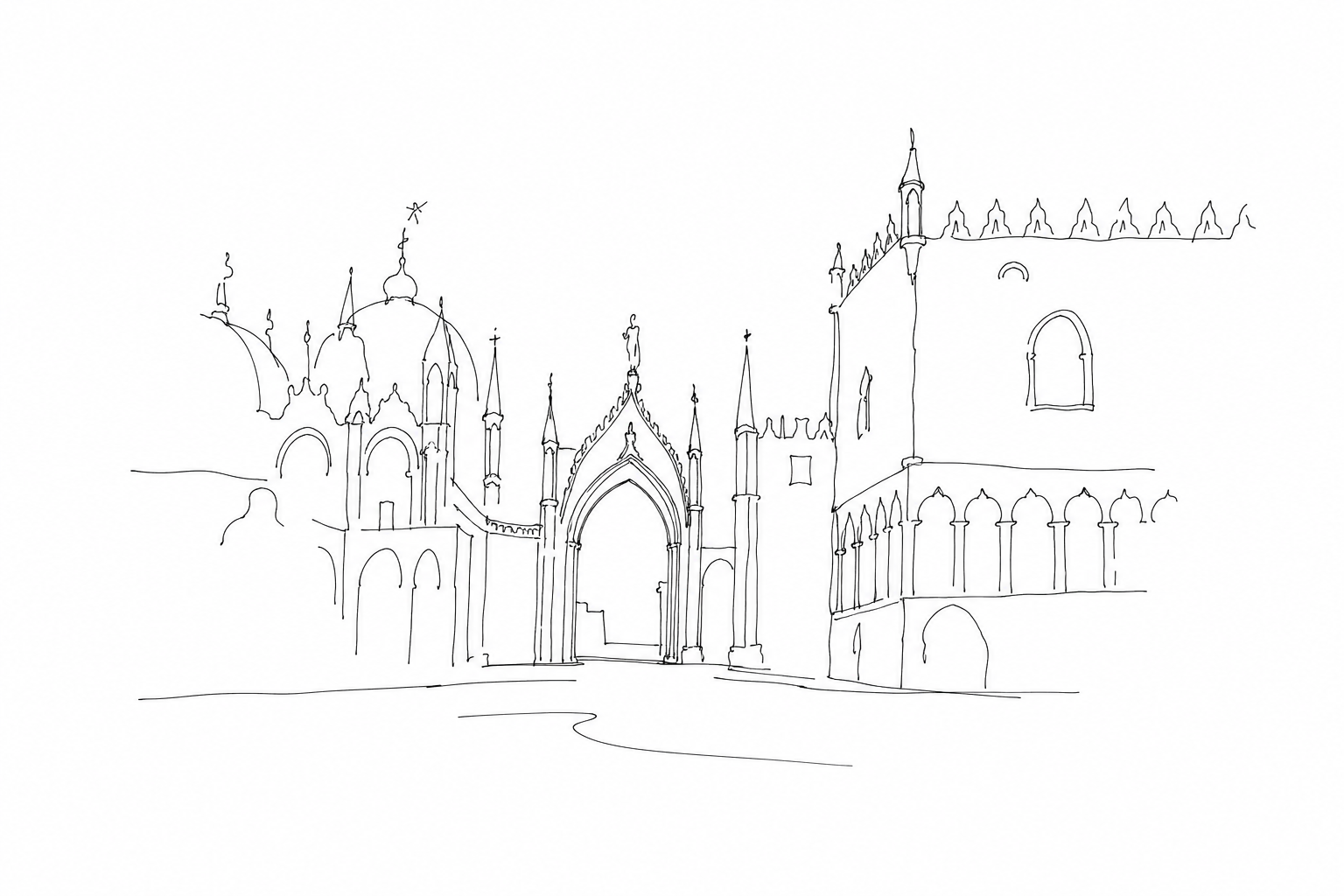
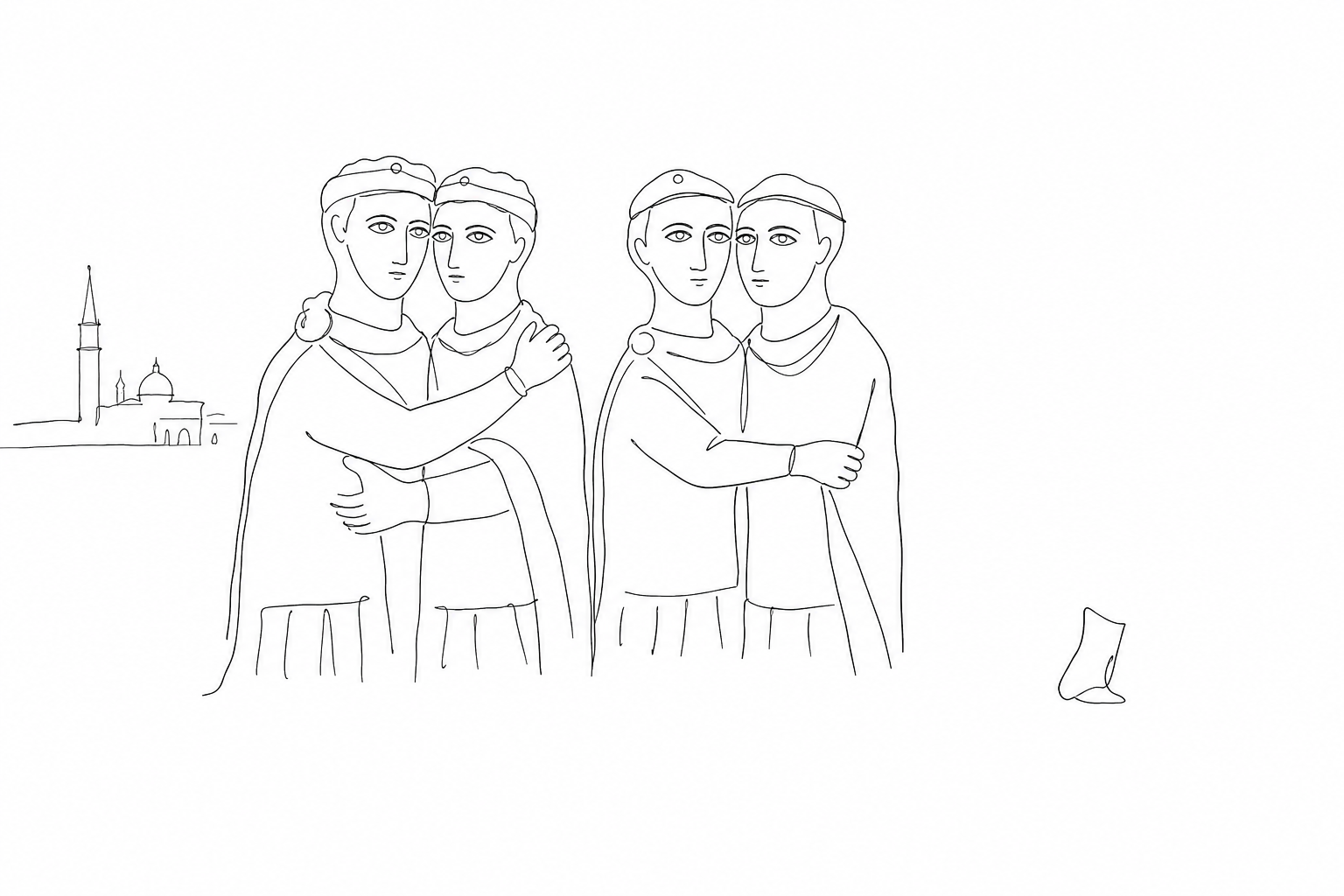
The Tetrarchs are outside St. Mark’s Basilica, not inside the church: to find them, you need to move toward the south-western corner of the building, at the point where the basilica visually interacts with the Doge’s Palace and the Porta della Carta. The group is walled in at close height, on a corner projection, and appears as a small but extremely dense presence in dark red porphyry among the marbles, columns and reliefs of the façade of San Marco.
The context is essential: it is not an isolated statue in a museum, but a fragment inserted into Venice’s most monumental urban fabric, between Piazza San Marco and the Piazzetta. The four embraced figures, traditionally identified with the tetrarchs of the Roman Empire, face those passing along the route between the basilica and the palace of Venetian power.

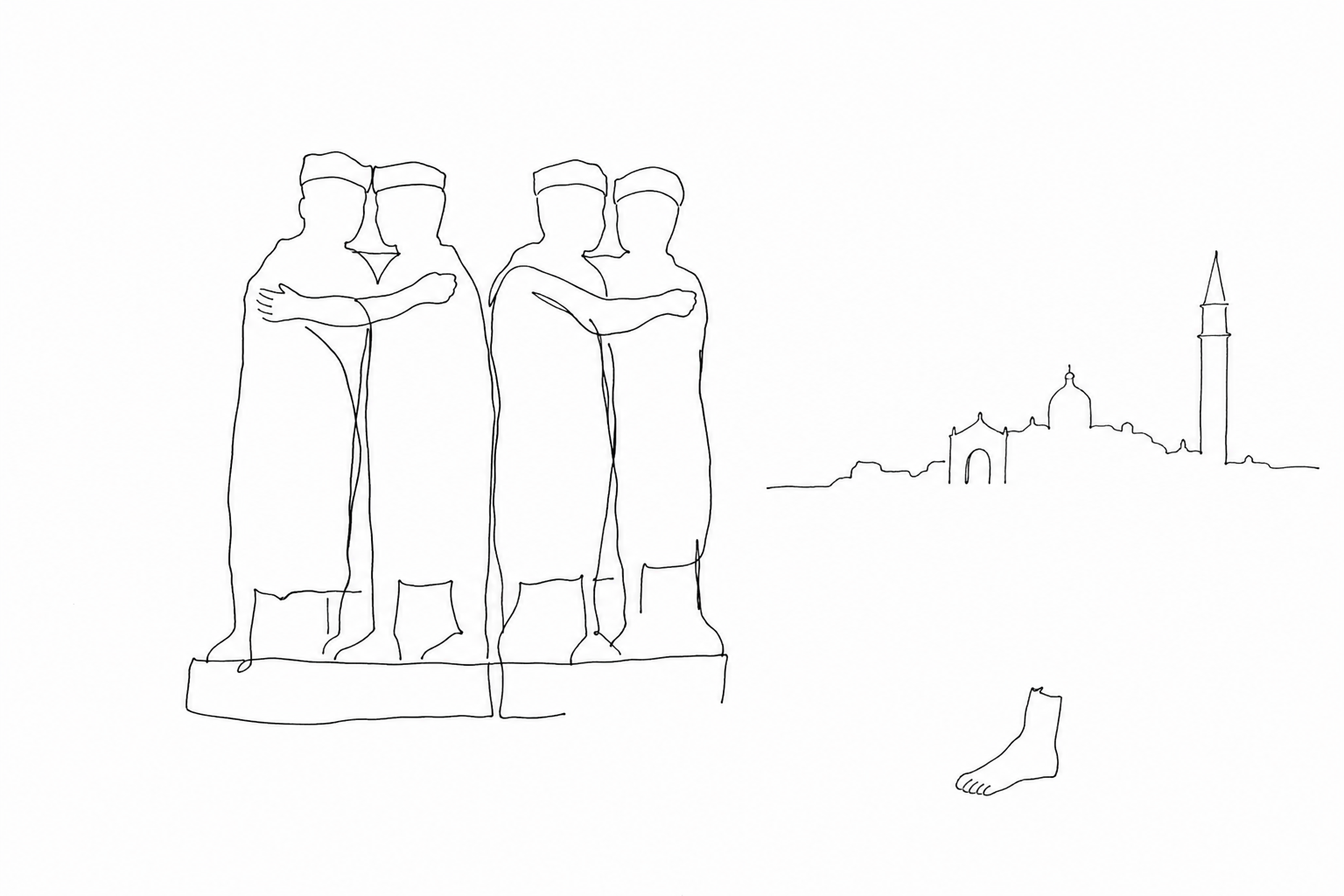
The detail of the missing foot, on the other hand, points to Istanbul: a compatible fragment is preserved in the city’s Archaeological Museums, material trace of the group’s Constantinopolitan origin.
Who the four embraced figures are
The four porphyry figures represent the system of government established by Diocletian at the end of the 3rd century: two Augusti, that is, the principal emperors, and two Caesars, destined to succeed them. They are not individual portraits in the older Roman sense: the faces are similar, almost interchangeable, because the image aims to communicate unity, discipline and continuity of power.
The embrace is the decisive detail. Each pair clasps one another in a rigid and solemn gesture, more political than affectionate: it shows the concord between the rulers and the idea that the Empire, though administratively divided between East and West, remains a single body. The hands resting on the swords also allude to the common defense of the imperial order.
The material reinforces the message. The reddish-purple porphyry was associated with imperial dignity and the sacredness of command. The compact proportions, the large eyes and the military garments transform the sovereigns into an emblem: not four biographies, but a visual formula of shared power.
Porphyry, Constantinople and the arrival in Venice
The material of the group was not chosen by chance: Egyptian red porphyry, quarried in the imperial quarries of the eastern desert, belonged to the exclusive language of the Roman court. Hard, rare and close in color to purple, it evoked authority, dynastic continuity and sacred distance from the rest of society.
Before being walled into the corner of St. Mark’s Basilica, the group most likely belonged to Constantinople. Its original location is often linked to the Philadelphion, an urban space connected to the representation of imperial concord. From there the work passed to Venice after the Crusader conquest of 1204, when many Byzantine marbles, columns and reliefs were transferred to the lagoon city as booty and as visible signs of prestige.
The decisive detail comes from Istanbul: a fragment of the missing foot, found in the twentieth century near the area of the Bodrum Mosque, the ancient Myrelaion complex, matches the Venetian group. That small piece left on the Bosphorus concretely confirms the Constantinopolitan provenance and turns the sculpture into material evidence of medieval spoliation.
The foot left in Istanbul: proof that fits
The decisive detail is not a narrative addition, but a physical element: a portion of a porphyry foot, found in Istanbul in the area of Bodrum Camii, the ancient church of the Myrelaion. Its shape matches the lost part of the sculpture today walled into the corner of the Venetian basilica, on the side toward the Doge’s Palace.
This piece, preserved in the archaeological museums of Istanbul, clarifies that the visible absence in Venice does not depend on generic wear, but on the separation that occurred before or during the medieval transfer. It is rare material evidence: it not only confirms the Constantinopolitan origin of the work, but allows the statue to be read as an object dismantled, transported and relocated after 1204.
Observing the relief today, the absent foot therefore becomes a key to interpretation. The gap is not marginal: it connects Piazza San Marco to the Bosphorus and transforms an apparent damage into a historical document, capable of indicating the provenance, route and political reuse of the imperial image.
Observing the Tetrarchs means reading Venice through a fragment, indeed through an absence: the foot found in Istanbul reminds us that this sculpture was not created for San Marco and that its history crosses cities, empires and changes of meaning. Standing before those embraced figures today is not only recognizing an ancient work, but understanding how an urban detail can preserve a complex geography, made of stone, memory and movements.
Related Posts
The Horses of Saint Mark: originals, copies and a centuries-long journey above the basilica
History and interpretation of the Horses of Saint Mark: copies on the loggia, originals in the museum, from Constantinople to Venice and Paris.The Pala d’Oro: Stones, Enamels and Byzantine Power Behind the Altar of St. Mark’s
History, materials and symbols of the Pala d’Oro, the great precious altar of St. Mark’s born between Venice and Byzantium.
Sansovino’s Loggetta: the small precious building at the foot of the Campanile
History, architecture and sculptures of Sansovino’s Loggetta, at the foot of St. Mark’s Campanile.Questions Answered
Where are the Tetrarchs of San Marco located?
On the south-western corner outside St. Mark’s Basilica near the Doge’s Palace.Who do the four figures represent?
They represent the two Augusti and two Caesars from Diocletian’s system of government.What is the origin of the Tetrarchs’ material?
They are made of rare Egyptian red porphyry, associated with imperial dignity.What does the missing foot fragment signify?
It confirms the statue’s Constantinople origin and medieval transfer to Venice.
From the square to the rooms of power
Would you like to follow other places showing how Venice represented itself at the heart of St Mark’s?
 The Marciana Library: books, painted ceilings and public knowledge next to San MarcoEditorial guide to the Marciana Library: history, rooms, books, paintings and public role in the heart of San Marco.
 The Molo of San Marco: columns, departures and the maritime power of the SerenissimaHistory and interpretation of the Molo of San Marco: the columns, the Basin, State departures and the language of Venetian power.
 The mosaics of San Marco: how to look at the gold without being dazzled only by its beautyA brief guide to reading the mosaics of San Marco: gold, light, scenes, spaces and details to observe calmly.
 San Zaccaria beyond San Marco: crypt, water and the suspended calm of Giovanni BelliniA slow guide to San Zaccaria: the church between San Marco and Castello, the flooded crypt and the altarpiece by Giovanni Bellini.