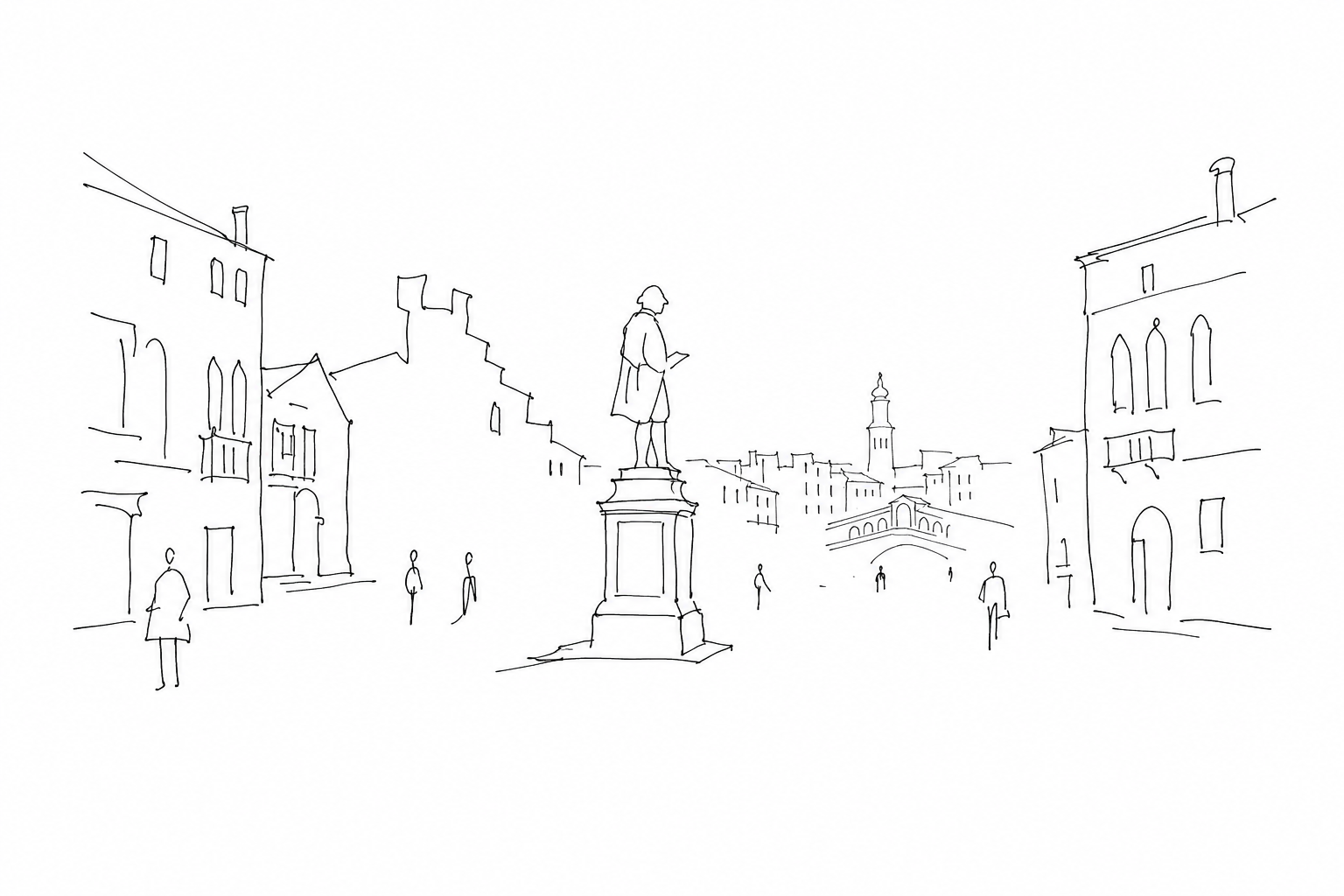

Campo San Bartolomeo is one of those places where Venice seems to accelerate. A few steps from Rialto and along the route toward San Marco, it concentrates passages, brief stops, voices, signs and trajectories that cross without almost stopping. At the center, the statue of Carlo Goldoni is not only a literary tribute: it seems to observe a continuous urban scene, made of trade, encounters and small everyday comedies. Reading this campo means understanding a less scenic and more restless Venice, where beauty does not lie in silence, but in the precision with which the city organizes movement.
Where it is and why it is a restless node
Campo San Bartolomeo opens immediately east of the Rialto Bridge, in the sestiere of San Marco, in a position that makes it less a square for stopping and more a decompression chamber of the city. From here decisive routes branch out: toward the Mercerie and therefore San Marco, toward Rialto and the Grand Canal, toward San Salvador, San Lio and the network of commercial calli that concentrates shops, narrow passages and continuous flows.
Its energy arises precisely from this hinge function. Those arriving from Rialto cross it almost naturally to continue toward the monumental center; those moving from San Marco encounter it as the first real junction before the historic mercantile area. It is not a secluded campo, but a practical point of orientation, often crowded, where the Venice of commerce, tourism and everyday life overlap.
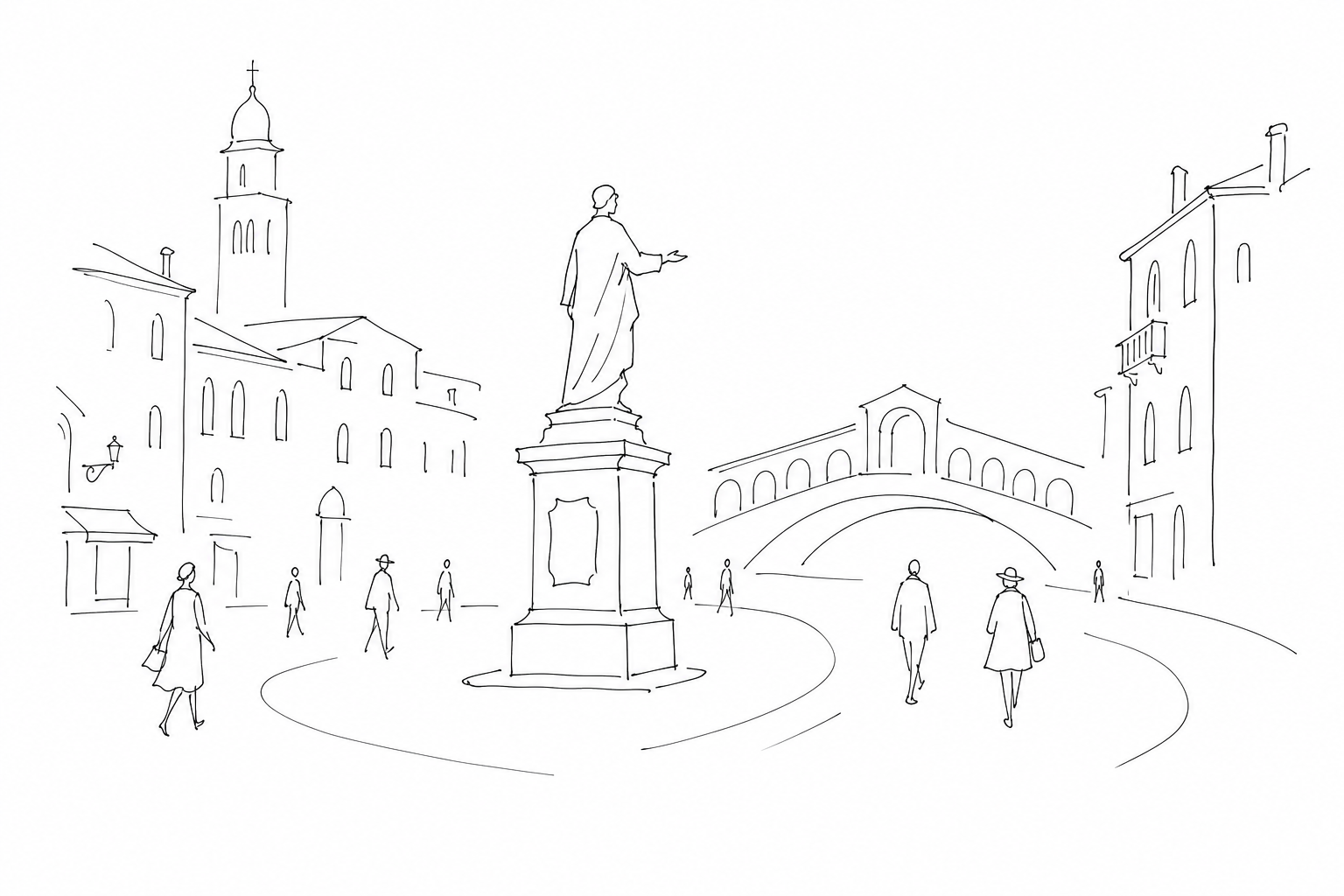
At the center, the monument to Carlo Goldoni also recalls a theatrical dimension: San Bartolomeo is an urban stage, crossed more than contemplated.
Goldoni at the center: a statue that observes the city
The monument to Carlo Goldoni gives the campo a precise key to interpretation: it does not celebrate a military victory or institutional power, but the art of observing people. The bronze statue, the work of the Venetian sculptor Antonio Dal Zotto, was inaugurated in 1883, when the city wanted to pay homage to the playwright born in 1707 and who died in Paris in 1793.
Goldoni is represented as a civic presence, almost ready to recognize in passers-by the human types of his comedies: merchants, servants, travelers, the curious, hurried Venetians. It is a choice consistent with his theatrical reform, which brought more realistic characters and dialogues close to the living language onto the stage, overcoming many rigid masks of the commedia dell’arte.
At the most crowded point of the campo, the statue functions as a small silent director. Around him there is no orderly audience, but a continuous flow: precisely this confusion makes the monument effective, because it transforms the space into an urban scene always in motion.
Between Rialto and San Marco: how to read the space
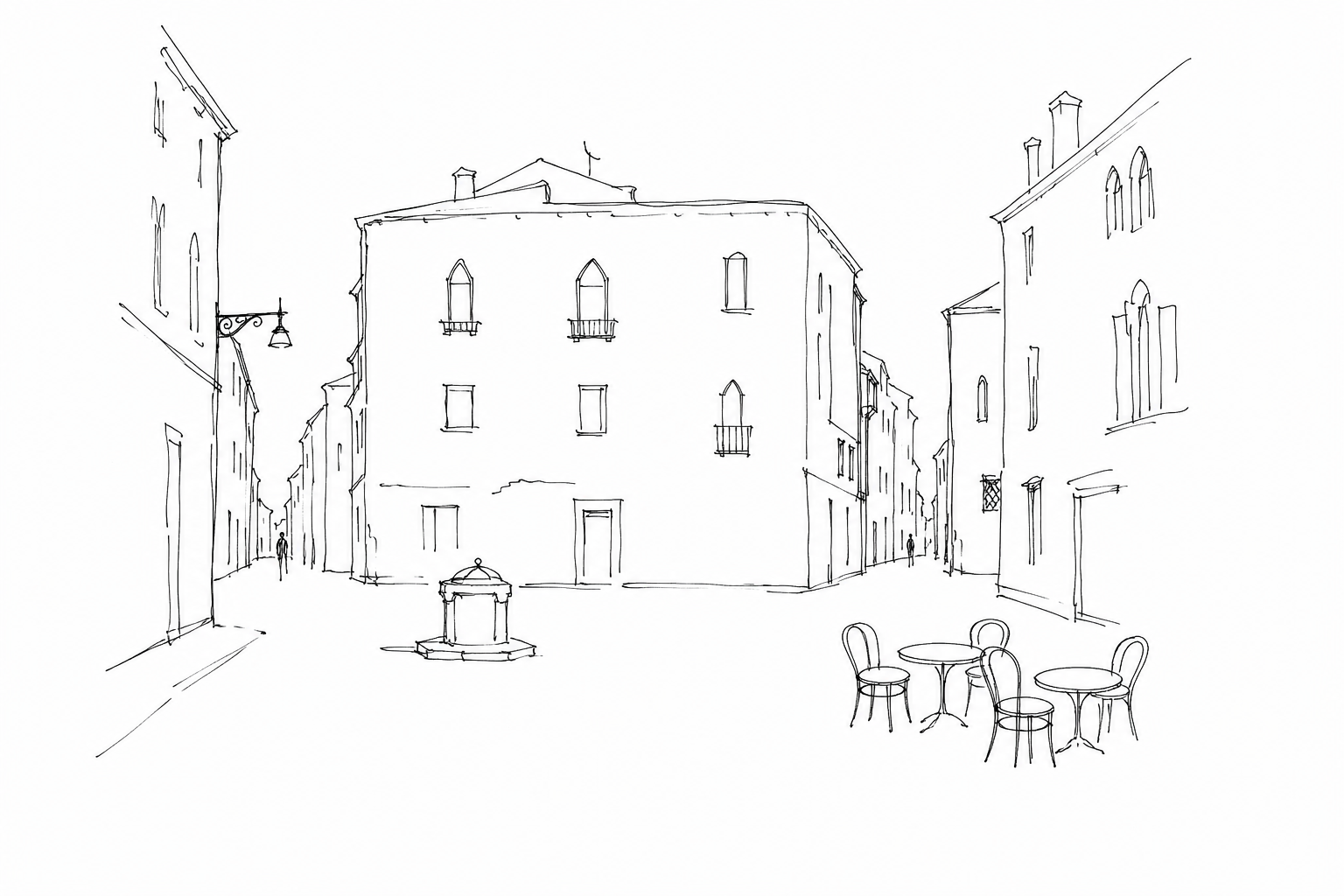
This open space functions less like a square to contemplate and more like a crossing node. You understand this by looking at the entrances: on one side come the footsteps from the bridge and the historic commercial area; on the other opens the sequence of the Mercerie, a minute and crowded route toward San Marco. The calli do not enter symmetrically: they emerge at an angle, compress the view, then release it into the open space.
The architecture helps to read this tension. The ground floors are almost entirely occupied by commercial fronts, while above remain windows, plasterwork, cornices and different heights that recall the Venetian residential stratification. The bell tower of San Bartolomeo acts as a vertical reference: it does not dominate with isolated monumentality, but orients those arriving from narrow and often curved routes.
To observe the place well, it is better to stop at the edges, not in the center of the flow. From there the trajectories can be distinguished: those who cut straight across, those who wait, those looking for a meeting, those who use the statue as a point of reference. The urban form arises precisely from this continuous pressure.
The best moment to understand this node is a brief stop, not a long stay: stand at the edges, never in the middle of the trajectories, and let a few minutes of crowd pass. The statue of Carlo Goldoni, a nineteenth-century work by Antonio Dal Zotto, still functions as a practical reference: observe how many people use it to orient themselves or arrange to meet.
Up close it is worth looking at the base, the theatrical gesture of the figure and the relationship with the commercial facades around it: here the monument does not isolate the space, it makes it recognizable. Then raise your gaze toward signs, windows and side entrances: the scene changes as soon as you leave the main flow.
- Stop on an edge, not in front of the access points.
- Follow the directions of passers-by before choosing yours.
- For interiors and nearby visits, always check updated details.
Stopping at Campo San Bartolomeo requires a simple gesture: stepping out of the current for a few minutes. Only in this way do the strategic position, the dialogue with Rialto, Goldoni’s watchful presence, the details of the facades and the concrete rhythm of those who cross the campo every day emerge. It is not a place to consume in a photograph, but to read as a threshold: between market and promenade, between theatrical history and urban life, between monumental Venice and functional Venice. Precisely for this reason it remains one of the city’s most revealing points.
Related Posts
Campo San Luca: the Venice of quick passage, among cafés, offices and intersecting calli
A central, everyday campo, between Rialto and San Marco, read as an urban junction of passages, short stops, offices and calli.San Vidal and Campo Santo Stefano: music, crooked bridges and an elegant piece of Venice
A short route through San Vidal, Campo Santo Stefano, music, architecture and oblique bridges.
Campo Santa Margherita: how to read a Venetian square that is still a space of daily life
A concrete reading of Campo Santa Margherita: history, urban edges, daily uses and details that help understand a lively square in Dorsoduro.Questions Answered
What makes Campo San Bartolomeo a restless meeting point?
Its role as a busy junction connecting key Venetian routes and commercial areas.Who is commemorated by the statue in the campo and why?
Carlo Goldoni, honored for his realistic theatrical reform and observation of Venetian life.How does the architecture contribute to understanding the campo?
Commercial fronts and varied residential elements create a dynamic urban tension.What is the best way to experience Campo San Bartolomeo?
Pause briefly at the edges to observe pedestrian flow and the statue’s role as a landmark.
St Mark’s seen through its details
Want to connect architecture, ceremony and power without stopping at the postcard view?
 Campo San Luca: the Venice of quick passage, among cafés, offices and intersecting calliA central, everyday campo, between Rialto and San Marco, read as an urban junction of passages, short stops, offices and calli.
 Le Mercerie: the commercial route between Rialto and San Marco that was not created for modern shoppingHistory and urban reading of the Mercerie, a dense axis of calli between Rialto and San Marco born from civic, artisan and...
 Fondaco dei Tedeschi: from warehouse of Northern merchants to terrace over the cityHistory, architecture and urban interpretation of the Fondaco dei Tedeschi, between Rialto, northern trade and a view over the rooftops of Venice.
 Why in Venice They Say “ombra”: history and legend of the most Venetian glass of wineOrigin, legend and everyday use of the ombra, the glass of wine linked to Venetian bacari.