
The Golden Staircase of the Doge’s Palace was not a simple passage toward the halls of power. With its gilded stucco, filtered light and controlled route, it marked a precise threshold: those who climbed it entered a reserved space, regulated by the hierarchy of the Venetian Republic. Observing it today means reading together architecture, political representation and the daily use of the palace, where every detail helped define distances, privileges and authority.
A staircase that is not only decorative
The Golden Staircase of the Doge’s Palace should not be read only as a masterpiece of gilded stucco. In the political heart of the Republic of Venice, climbing those steps meant crossing a threshold: from the public and representative courtyard one moved toward the rooms where power was exercised, controlled and staged.
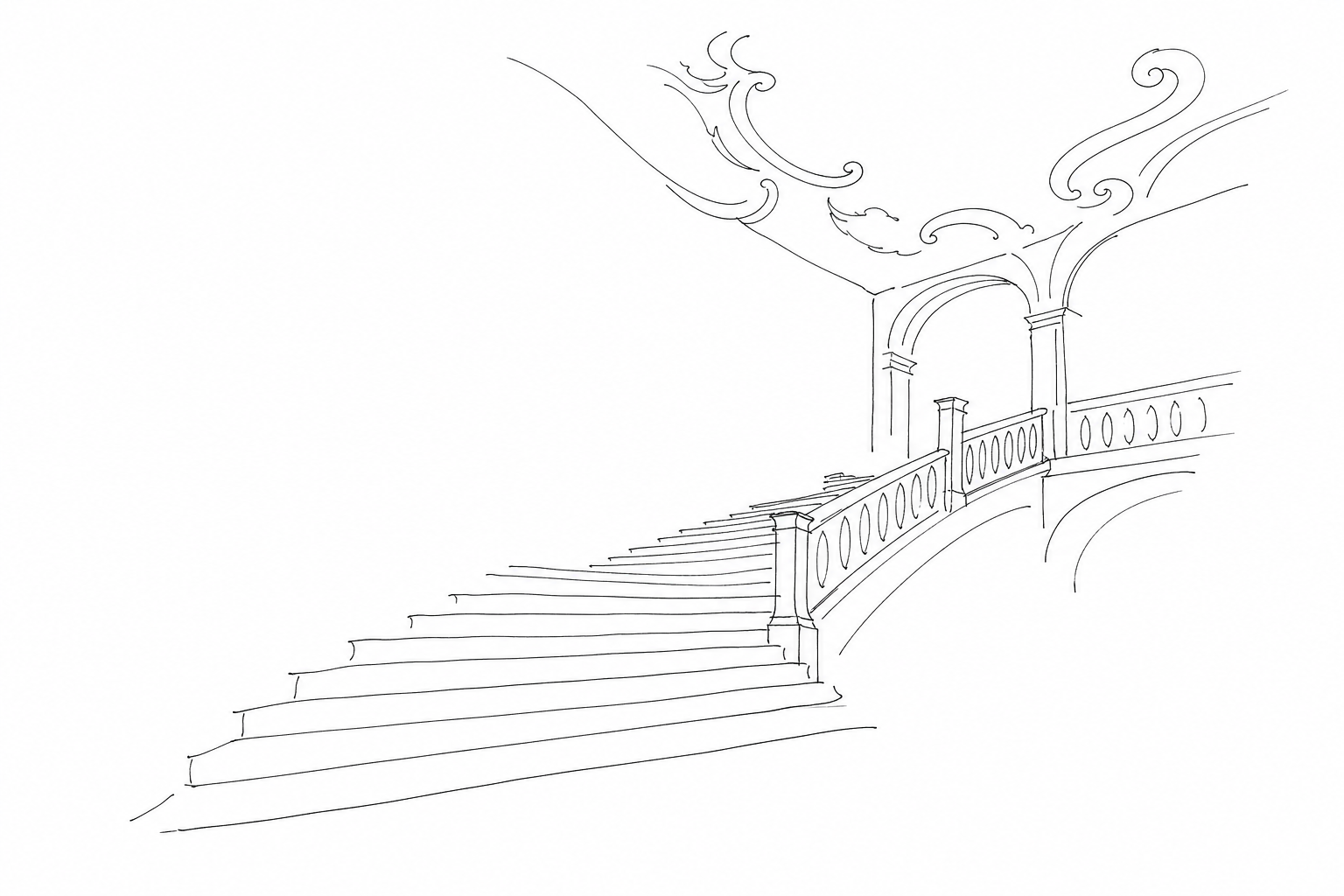
Designed as part of the sixteenth-century renewal of the palace, traditionally linked to Jacopo Sansovino, the staircase led to the upper floors, toward the dogal apartments and the institutional halls. The lavish decoration, with vaults adorned with reliefs, allegorical figures and gilding, was therefore not a simple embellishment: it built a path of visual legitimation, reminding those who climbed it of the greatness and order of the Serenissima.
Its name also evokes the idea of selection. Access was not intended for everyone, but for magistrates, patricians and guests admitted to the proximity of the government. The beauty of the staircase thus became a political device: it celebrated Venice while separating those who could enter the decision-making rooms from those who remained outside.
Patronage, design and construction site
The origin of the Golden Staircase lies in the full Renaissance renewal of the Doge’s Palace, when Venice wanted to update the language of its government spaces without giving up institutional continuity. The impulse is linked to the dogeship of Andrea Gritti, protagonist of a season of strong public representation of the Republic. The project was entrusted to Jacopo Sansovino, the Florentine architect and sculptor called to Venice as proto of St. Mark’s, capable of translating Venetian authority into classical, orderly and solemn forms.
The construction site began in 1538 and was completed, in its main parts, around 1559. The structure was not conceived as a simple internal connection: it had to introduce the upper rooms of power with ceremonial measure. Specialized workers in gilded stucco contributed to the decoration; among the names associated with the ornamental apparatus, Alessandro Vittoria stands out, while the figurative program involved painters active in the Venetian Mannerist climate, including Giambattista Franco.
Gilded stucco and symbolic program
The gilded stucco covering should not be read only as a display of wealth. In the ceremonial route that led to the rooms of government, frames, reliefs and paintings built a political message: those who climbed were immersed in an ordered representation of the authority of the Serenissima.
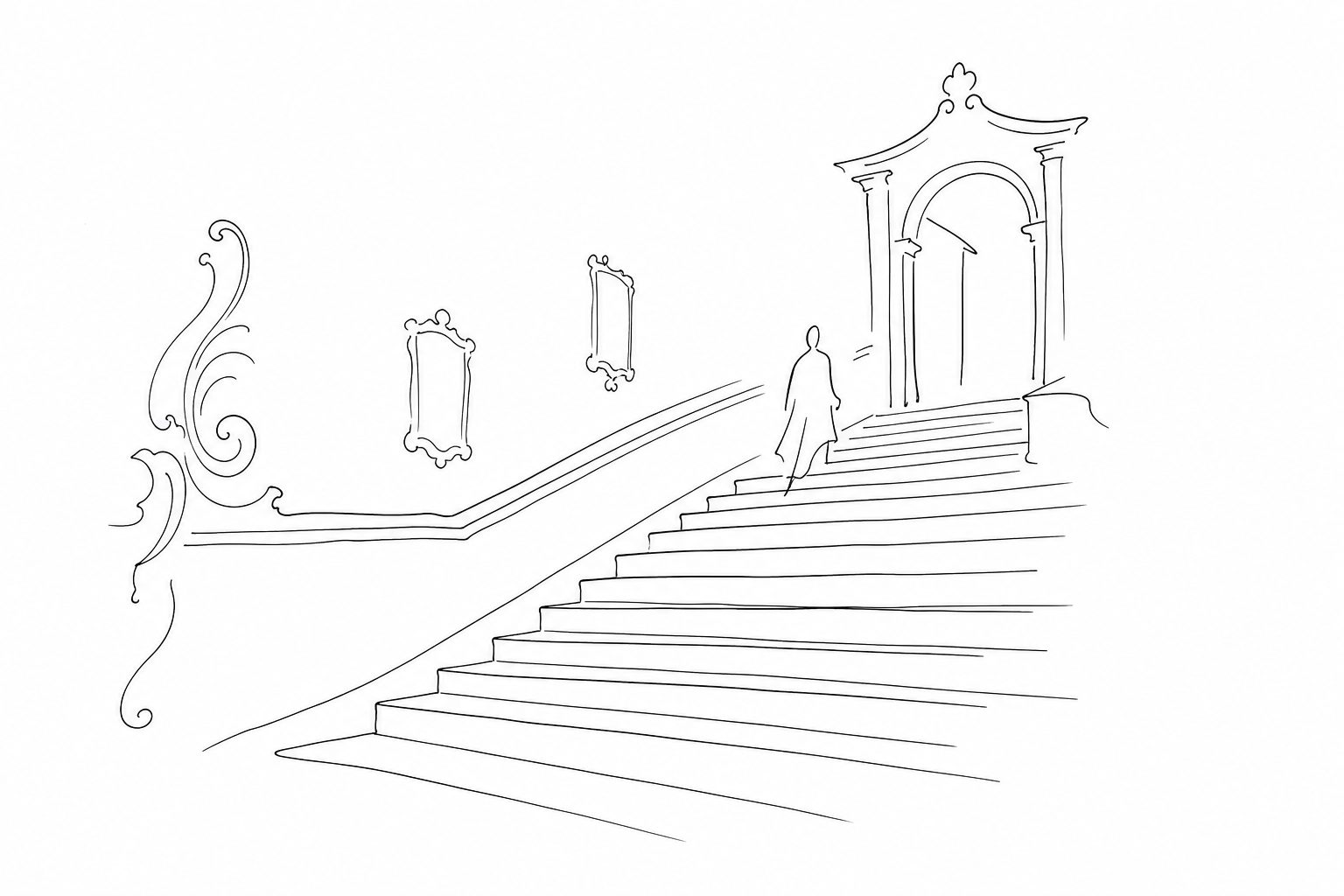
The decorations alternate vegetal motifs, grotesques, allegorical figures and painted panels. The gold captures the light and guides the gaze, but above all it separates each image within a hierarchical frame. Public virtues, allusions to justice, prudence and the strength of the State transform the ascent into a visual lesson: ducal power does not appear personal, but rather watched over by values and institutions.
In this sense, the ornamental apparatus acts as a filter. Ambassadors, magistrates and authorized guests did not pass through a simple internal connection, but through a device of selection and representation. The beauty of the stucco softens the rigidity of control, while the repetition of emblems and figures recalls that access to the upper halls depended on rank, function and permission.
The decoration, therefore, speaks the language of the Republic: measured splendor, collective authority, institutional vigilance.
Observing it during the visit
To read it on site, it is best to proceed slowly and distinguish three levels: the movement of the body, the decoration overhead and the lateral control points. From the courtyard one immediately perceives that the ascent is not free: the steps direct, the turns select the gaze, the landings function as ceremonial pauses.
Raising your eyes, observe the coffered vault and the gilded reliefs not as simple ornament, but as a continuous surface that accompanies the entrance to the reserved rooms of the government. The allegorical figures, frames and medallions build a visual path parallel to the physical one: those who climbed were immersed in a language of public legitimation.
It is also useful to note the relationship with light and access points. The openings toward loggias and courtyard interrupt the half-light and make the contrast between open space and administered threshold more evident. Before the visit, check only the updated information on the museum route, because permitted methods and passages may vary.
The Golden Staircase remains one of the points where the Doge’s Palace best shows the Venetian relationship between beauty and government. It is striking not only for the gold or for the decorative richness, but for the way it accompanies movement, selects access and transforms an ascent into an experience of power. During the visit it is worth slowing down: looking at the surfaces, the sequence of spaces, the relationship with the upper halls. It is there that decoration becomes political language.
Related Posts
The Giants’ Staircase: where the doge became doge before the city
History, ritual and details of the Giants’ Staircase in the courtyard of the Doge’s Palace.The Porta della Carta: entering the Doge’s Palace by reading stone, power and propaganda
A close reading of the Porta della Carta: ceremonial threshold, Gothic sculpture and political manifesto between St. Mark's and the Doge's Palace.
The Scala Contarini del Bovolo: why a spiral staircase became one of Venice’s strangest details
History, form and urban context of the Scala Contarini del Bovolo, a Venetian spiral between family prestige, architecture and views over the rooftops.Questions Answered
What is the significance of the Golden Staircase in the Doge’s Palace?
It marks a ceremonial threshold reflecting Venetian political hierarchy and power.Who designed the Golden Staircase and when?
Jacopo Sansovino designed it during the Doge Andrea Gritti’s 16th-century renewal.What role does the gilded stucco decoration play?
It symbolizes public virtues and state authority beyond mere decoration.How does the staircase shape visitor experience?
It directs movement, controls access, and visually represents power and privilege.
Read St Mark’s beyond the square
Want to move from the famous monuments to details that explain power, art and public life?
 The Giants’ Staircase: where the doge became doge before the cityHistory, ritual and details of the Giants’ Staircase in the courtyard of the Doge’s Palace.
 The Piombi and Pozzi: the prisons of the Doge’s Palace beyond the legend of CasanovaHistory, spaces and meaning of the prisons of the Doge’s Palace, from the Piombi to the Pozzi, beyond the myth of Casanova’s...
 The Porta della Carta: entering the Doge’s Palace by reading stone, power and propagandaA close reading of the Porta della Carta: ceremonial threshold, Gothic sculpture and political manifesto between St. Mark's and the Doge's Palace.
 The Bridge of Sighs from the inside: what those passing toward the New Prisons really sawA precise look at the internal passage of the Bridge of Sighs: route, light, windows and the true view of detainees toward...