
In the Venice Carnival the mask takes the stage, but the fritola tells of another city: more domestic, older, closer to the calli than to the stages. A street and shop sweet, born among boiling oil, raisins, pine nuts and expert hands, it crosses centuries of festivals, trades and everyday habits. Looking at Carnival from a fritter means shifting attention from costume to appetite, from pose to substance: a simple, and very Venetian, way to read the festival through what is prepared, bought and eaten while the city continues to live.
A fritter at the center of Carnival
Looking at the Venice Carnival from a fritola means shifting attention from the mask to the hot counter, from embroidered fabric to frying oil. For centuries, even before becoming a homemade or pastry-shop sweet, the Venetian fritter was an urban sign: it was eaten in the street, in the calli, near the campi and the busiest passageways, when the city filled with voices, disguises and appetites.
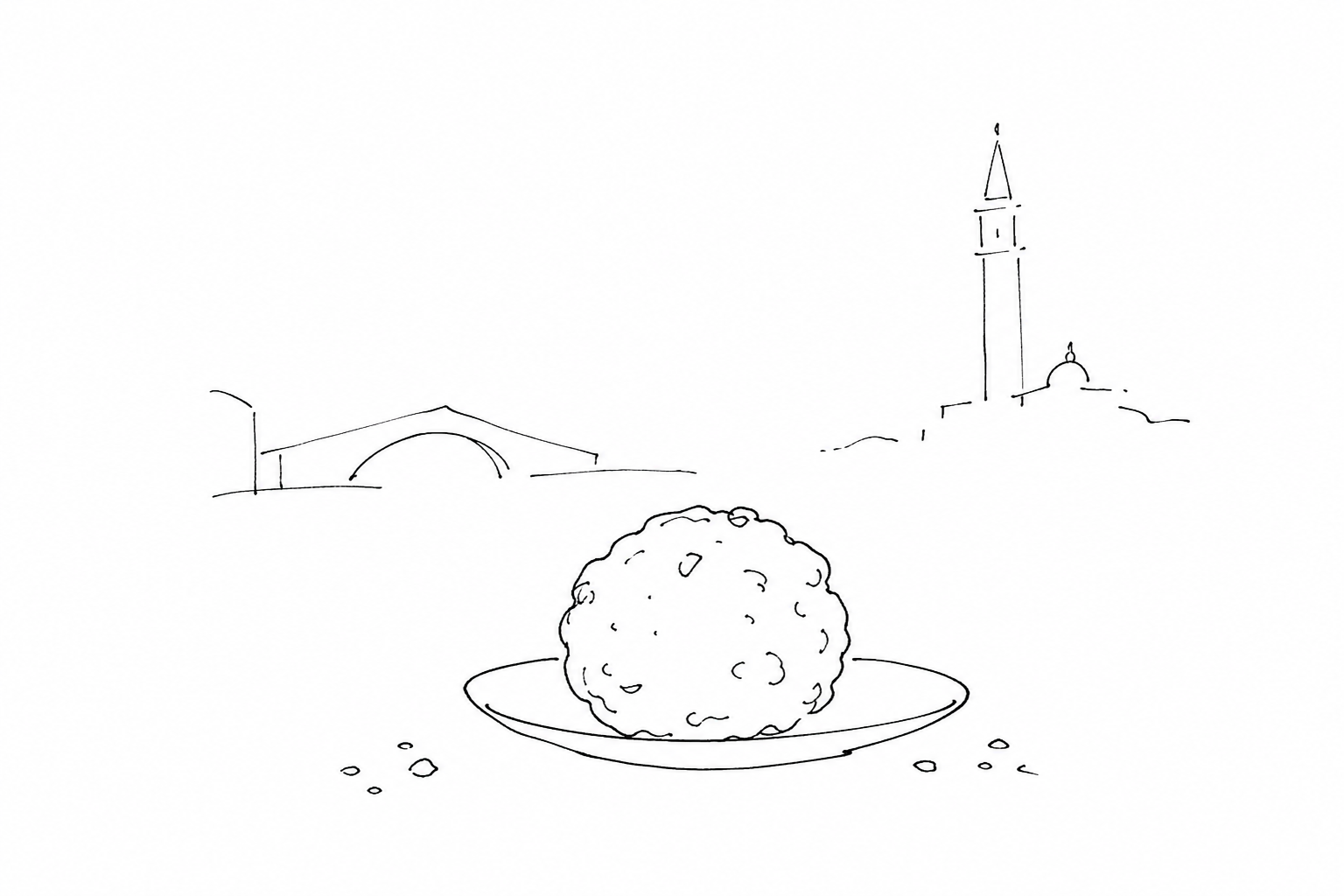
Its round, simple and irregular shape tells of a Carnival that is less scenic but more concrete. Flour, eggs, sugar, raisins and pine nuts do not build a character: they build a pause. It is a sweet for fingers, for absorbent paper, for sugar that stays on the coat. From this perspective, the festival is not only theater: it is also smell, warmth, waiting in front of the frying.
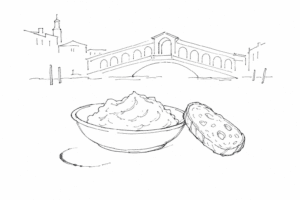
The Venetian fritola thus becomes a small historical lens: it does not hide the face, but reveals how Venice transformed popular food into a collective ritual.
From the fritoleri to the Serenissima: a fried history
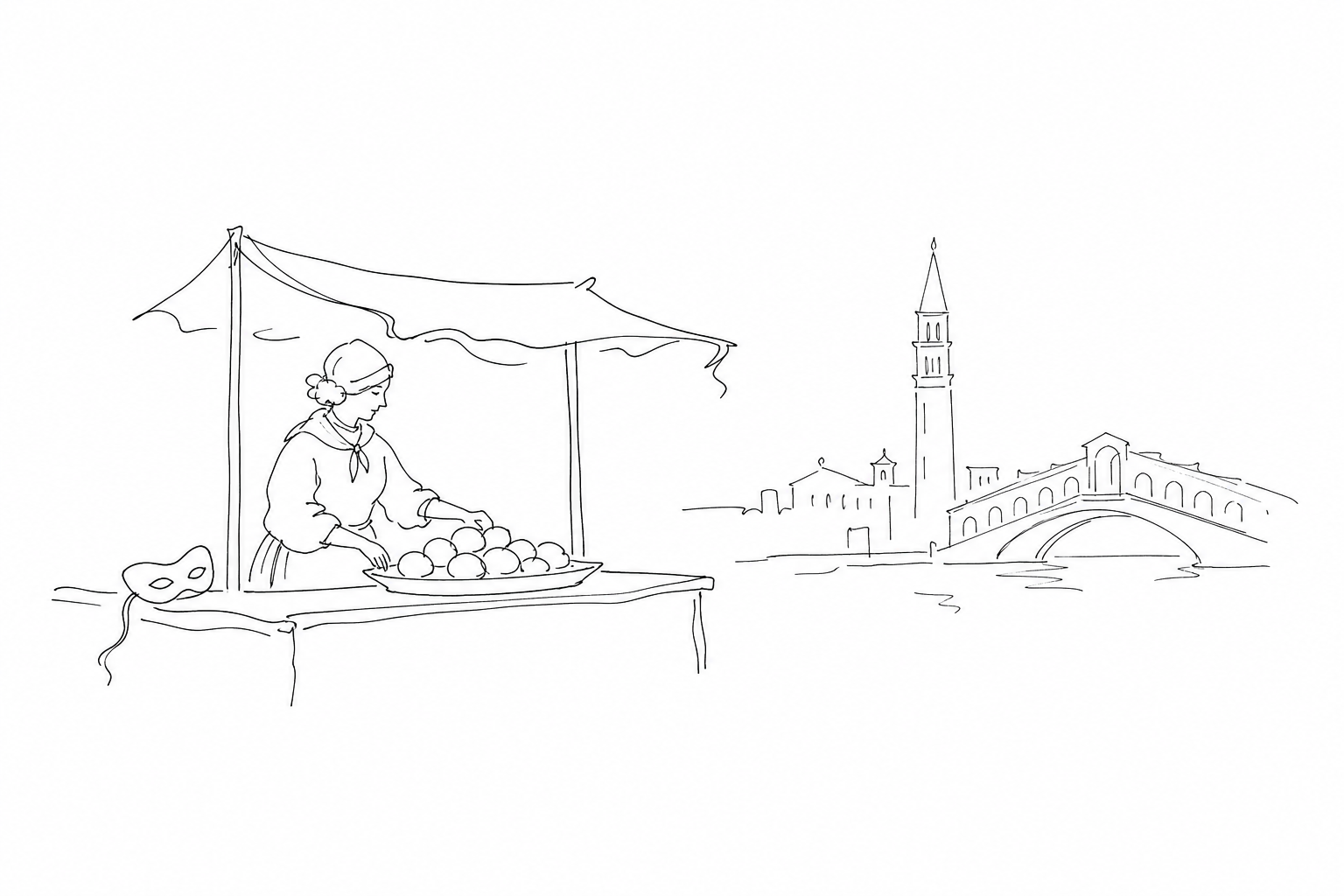
The history of Venetian fritole does not belong only to home cooking: it passes above all through the fritoleri, specialized vendors who, between the early modern period and the full Serenissima, transformed fried dough into a recognizable urban sign. They were not simple street improvisers: in Venice the trade came to organize itself with rules, sales areas and handed-down knowledge, as happened for many city arts.
The classic fritola was born from accessible but not ordinary ingredients: flour, eggs, milk or water, sugar, raisins and often pine nuts, with frying providing fragrance and consistency. This very combination tells Venice well: popular in form, but crossed by the trade that brought spices, sugars and dried fruit to the lagoon.
In the eighteenth century its presence was so familiar that it also entered the artistic imagination. Pietro Longhi, a painter very attentive to Venetian everyday life, depicted vendors and minute gestures of the city; frying was not background, but a social scene. The fritola, more than the mask, shows Carnival as a shared practice: a warm sweetness, bought in public, eaten standing up, capable of uniting calli, campi and palaces under the same smell of oil.
How a fritola is made: dough, bite, variations
Seen up close, the fritola is not a simple sugared bite. The dough is made from flour, eggs, sugar, milk or water, yeast and a light citrus fragrance; soaked raisins, pine nuts and sometimes a drop of grappa or rum often go in, more to dry the aroma than to stand out. It is portioned by the spoonful: for this reason it remains rounded but irregular, with small golden points.
The correct result plays on a precise contrast: a thin crust, dark honey in color, and a soft, moist interior, with tiny air pockets. It must be neither a compact doughnut nor an oil sponge. The final sugar adheres when the sweet is still warm, forming a grainy surface.
The most recognizable versions are three: the “empty” one, with raisins and pine nuts in the dough; the one filled with pastry cream; the one with zabaglione, richer. The gastronomic reading changes little: it is always a handheld sweet, hot, quick, made to be eaten in the street.
To find a good fritola it is better to look less at the stages and more at the low display windows, those of pastry shops, bakeries and small frying shops that work for daily foot traffic. The useful map does not coincide with the crowd: it starts from the inhabited and crossed sestieri, where the sweet remains a brief stop, not a souvenir.
In San Polo and Santa Croce, between Rialto and the side calli, the search makes sense because the relationship with the counter is ancient: market, shops, quick breaks. In Cannaregio, away from the most compact flows, it is easier to read it as a neighborhood snack. In Dorsoduro, especially in the university and artisan areas, it works as food for walking. Castello also deserves attention when moving toward the less scenic calli.
- Observe the turnover: a tray that empties often promises more recent frying.
- Ask for the version of the day: plain, with raisins, cream or zabaglione.
- Always check on the spot: availability and production change with season and shop.
The Venetian fritola is not only a seasonal sweet: it is a small edible trace of urban history, made of guilds, handed-down recipes, neighborhood pastry shops and gestures repeated every winter. Seeking it without haste, even outside the busiest routes, allows you to enter Carnival through a side door, less scenic but more concrete. Between a shop and a calle, a good fritola says a lot about Venice: about its ability to transform simple ingredients into memory, ritual and everyday pleasure.
Related Posts
Bussolai and buranelli: the sweet side of Burano beyond the colorful houses
History, shapes and flavors of Burano’s biscuits, among bakeries, the lagoon and slow pauses.Baccalà mantecato: why a fish from the North became one of the most Venetian flavors
History, technique and places of baccalà mantecato, from Nordic cod to Venetian tables.
Sarde in saor: the sweet-and-sour dish that tells of sailors, preservation and the lagoon
History, taste and everyday use of sarde in saor, a Venetian dish born among fishing, onions, vinegar and long preservation.Questions Answered
What role does the Venetian fritola play in Carnival?
It shifts focus from masks to shared culinary tradition and city life.Who were the fritoleri and what was their importance?
They were specialized vendors organizing fritole trade with rules and locations.What ingredients and variations define a Venetian fritola?
Basic dough with raisins, pine nuts, and optional creams or zabaglione.Where in Venice can you find authentic fritole during Carnival?
In neighborhood pastry shops throughout sestieri like San Polo, Cannaregio, and Dorsoduro.
More flavours for understanding Venice
Want to move from this recipe to the stories still eaten in bacari and Venetian homes?
 Baccalà mantecato: why a fish from the North became one of the most Venetian flavorsHistory, technique and places of baccalà mantecato, from Nordic cod to Venetian tables.
 Bigoli in salsa: the humble Venetian pasta that smells of onion and anchovyHistory, ingredients and gestures of bigoli in salsa, a Venetian dish of rough pasta, slow-cooked onion and anchovies.
 The Venetian tramezzino: how a simple food became a counter habitHistory, form and daily ritual of the Venetian tramezzino, among bars, bacari and stops at the counter.
 Bussolai and buranelli: the sweet side of Burano beyond the colorful housesHistory, shapes and flavors of Burano’s biscuits, among bakeries, the lagoon and slow pauses.