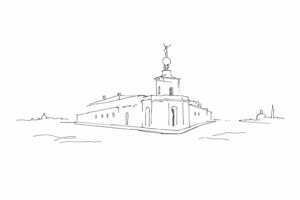

At the top of the Dogana da Mar, between the Grand Canal and St. Mark’s Basin, a golden ball seems suspended rather than resting. It is held up by two bronze Atlantes, while above it Fortune turns, a mobile and light figure exposed to the wind. It is a detail that many notice from afar, perhaps from Punta della Dogana, from the Zattere or from a vaporetto, without stopping to read it. Yet that gilded globe tells of Venice’s commercial role, its relationship with the sea and the city’s ability to transform a functional building into a precise urban sign.
Where to look for the golden ball
To find the golden ball of the Dogana da Mar, one should ideally place oneself at the far tip of Dorsoduro, where the Grand Canal opens into St. Mark’s Basin and meets the Giudecca Canal. The gaze should go to the roof of the long triangular building of the old customs house: not to the low façade toward the water, but to the crowning of the corner turret, right on the edge that seems to act as the city’s prow.
There the sculptural group can be distinguished: two bronze Atlantes support a gilded globe, above which stands Fortune, a mobile figure connected to the wind and to navigation. Its position is not accidental: it dominates the point where goods, ships and duties arrived, in front of the Doge’s Palace, the domes of St. Mark’s and the island of San Giorgio Maggiore. Looking at it from the Basin means reading Venice as port, power and urban theater all at once.
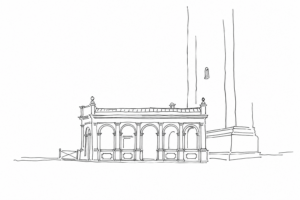
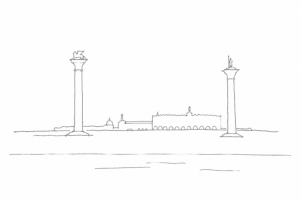
At the top of the Dogana da Mar, the sculptural group functions as a visual signal even before being an ornament. Two male figures, the Atlantes, support a large globe covered in gold: it is not a simple decorative element, but a concentrated image of weight, commerce and maritime dominion.
The contrast between the dark bodies of the bearers and the luminous sphere makes the scene legible even from afar, from the Basin or from San Giorgio. The Atlantes evoke the material effort on which Venetian traffic rested: ships, cargoes, registers, duties. The globe, instead, broadens the discourse beyond the lagoon and refers to routes, markets and geographies reached by sea.
Above the sphere appears Fortune, a mobile and unstable figure by definition. With the sail unfurled to the wind, she recalls navigation and the variability of trade. Placed on that very high point, she transforms an administrative building into an emblem: Venice looks toward the Basin knowing that wealth and risk arrive from the same water.
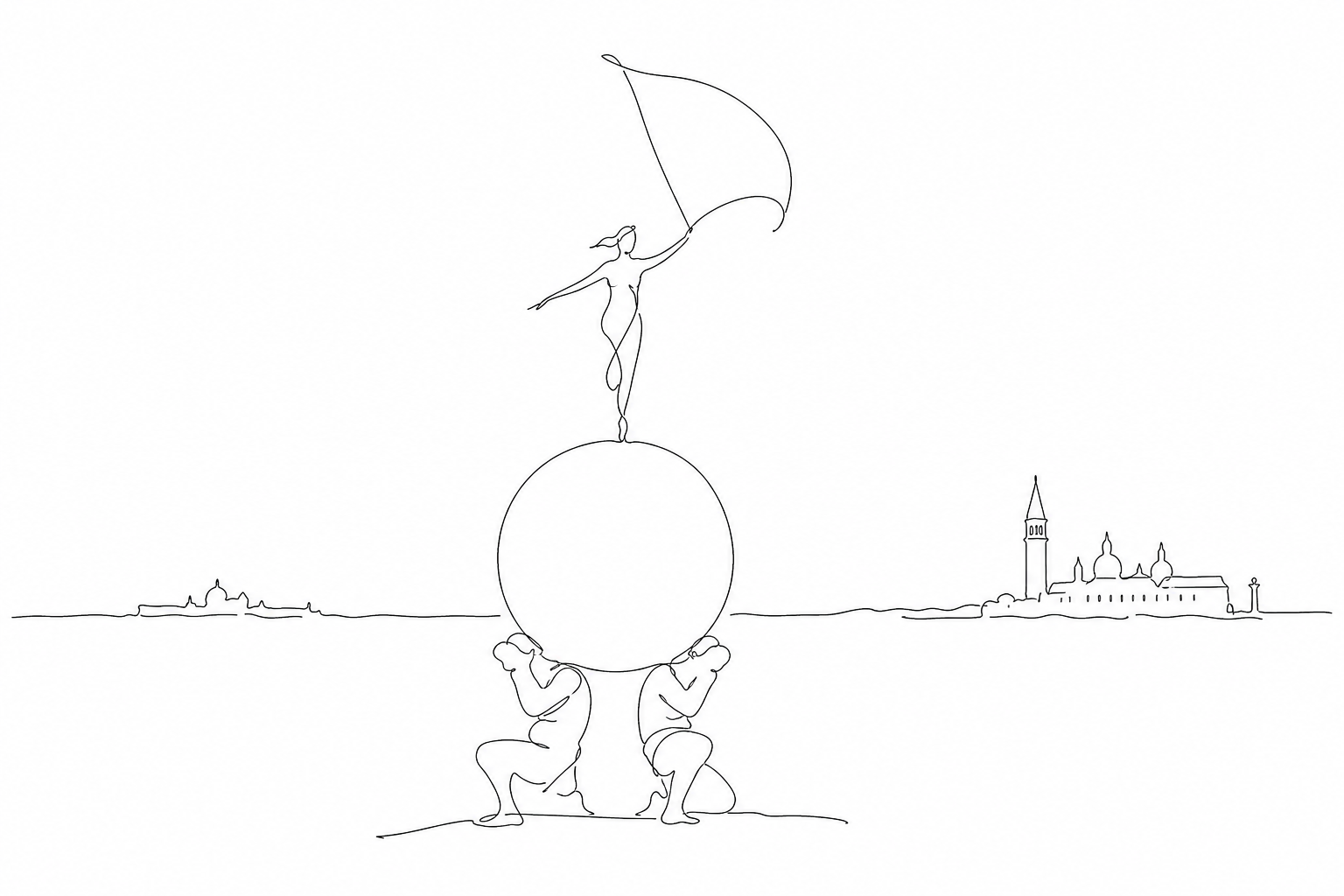
The female figure placed on top of the golden ball is Fortune, not a simple celebratory statue. The body is mounted on a pivot: it can rotate when pushed by the wind and indicate the direction of the air to sailors. For this reason the image combines allegory and practical use. The goddess who governs chance also becomes a nautical instrument, visible to those entering or leaving the lagoon port.
The decisive detail is the sail that the figure holds raised. It is not only a decorative attribute: it recalls navigation, maritime trade and the instability on which much Venetian wealth was founded. If the wind changes, Fortune’s orientation changes as well; the gold beneath her feet remains luminous, but her position is never fixed. In this reading, Venice recognizes a very concrete truth: commerce, duties, ships and landings depend on political calculation and technical skill, but also on currents, tides and favorable opportunities.
Why this detail matters
The crowning is not an isolated ornament: it functions as a key to reading the whole Punta. At that point, between the Grand Canal and the Giudecca Canal, Venice placed its most visible fiscal device, where goods entered the city and the view opened toward St. Mark’s, San Giorgio Maggiore and the Basin.
The gilded sphere supported by the two male figures translates a precise idea into an image: maritime wealth requires weight, balance and control. Above, Fortune instead recalls the unstable element of wind and chance. The group, linked to the seventeenth-century rebuilding designed by Giuseppe Benoni and to the sculpture of Bernardo Falconi, brings together administration, navigation and political allegory.
Seen from afar, the profile signals the symbolic entrance to the commercial city. Seen up close, it reveals a subtler message: the Serenissima represents itself as capable of supporting the world of trade, but lucid enough to know that every route also depends on changing conditions.
Observing the golden ball of the Dogana da Mar means changing scale: not looking only at the famous profile of Venice, but at a point where sculpture, architecture and economic history meet. The two Atlantes, the globe and Fortune are not isolated ornaments: they construct an image of the mercantile city, open to trade and aware of the instability of the wind and of fate. The next time the Basin opens before you, look for that gleam high above: it is small compared with the scene, but it helps to understand it better.