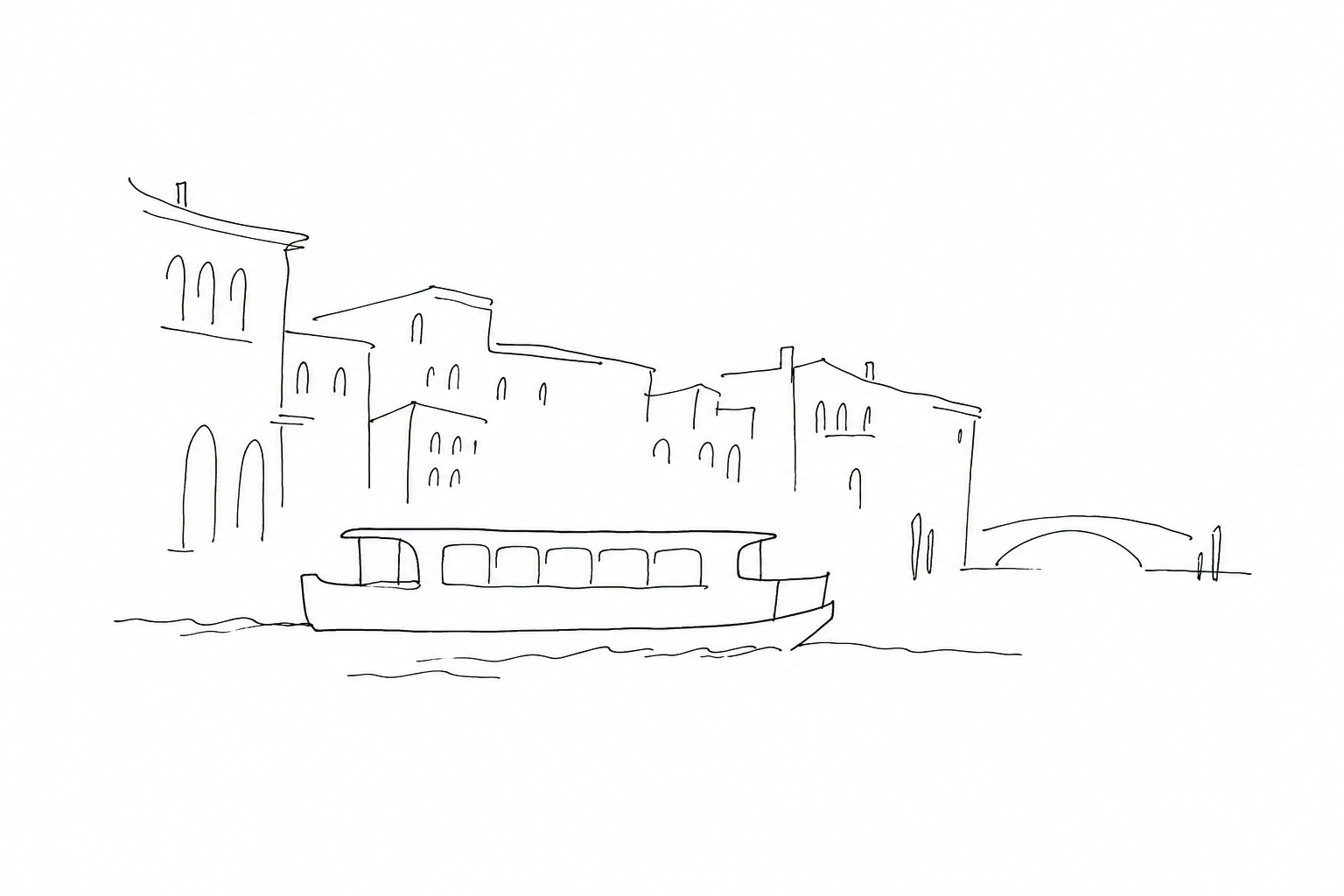

Vaporetto line 1 is not the fastest way to cross Venice, and that is precisely its value. Following almost the entire Grand Canal, it forces the gaze to slow down: the façades of the palaces, the landings, the jetties, the reflections and the minute traffic of the water become a legible sequence. More than a simple means of public transport, it is a mobile observatory on the city built to be seen also from the canal. Boarding it with attention means understanding how Venice presents itself, moves and continues to live along its main waterway.
Why line 1 changes the way you look at the Grand Canal
Vaporetto line 1 is not just a means of getting around: along the Grand Canal it becomes a different way of reading Venice. Its relative slowness, due to the closely spaced stops and navigation through the heart of the city, obliges the gaze to proceed in sequences, almost as if in front of the rooms of a museum.
From the deck of the boat the façades do not appear as indistinct backdrops, but as successive pages: Gothic palaces with four-light windows, Renaissance residences overlooking the water, portals worn by the tides, private landings, coats of arms, balconies and windows designed to be seen from the canal even before the street.
This is the point: line 1 restores the Grand Canal to its historical perspective. For centuries the main entrance of patrician houses was on the water, and the vaporetto still allows you to approach that urban logic. It does not simply cross Venice: it shows how Venice was built to be looked at while navigating.
From the window: palaces, fondaci and façades on the water
From the vaporetto window, the sequence of façades should not be read only for beauty, but for function. On the Grand Canal many buildings still show their origin as house-warehouses: at water level wide doors opened for goods and boats, above ran the portego, the large through hall that distributed light, air and representation. The façade was at once entrance, family sign and declaration of wealth.
Moving forward slowly, the styles overlap without the need for a rigid guide. The Gothic multi-light windows of Ca’ d’Oro lighten the stone with lacework and openwork arches; farther on, Renaissance palaces seek order and symmetry through columns, tympanums and cornices; Ca’ Pesaro instead introduces a more massive, almost theatrical Baroque presence, designed to impose itself on the water scene.
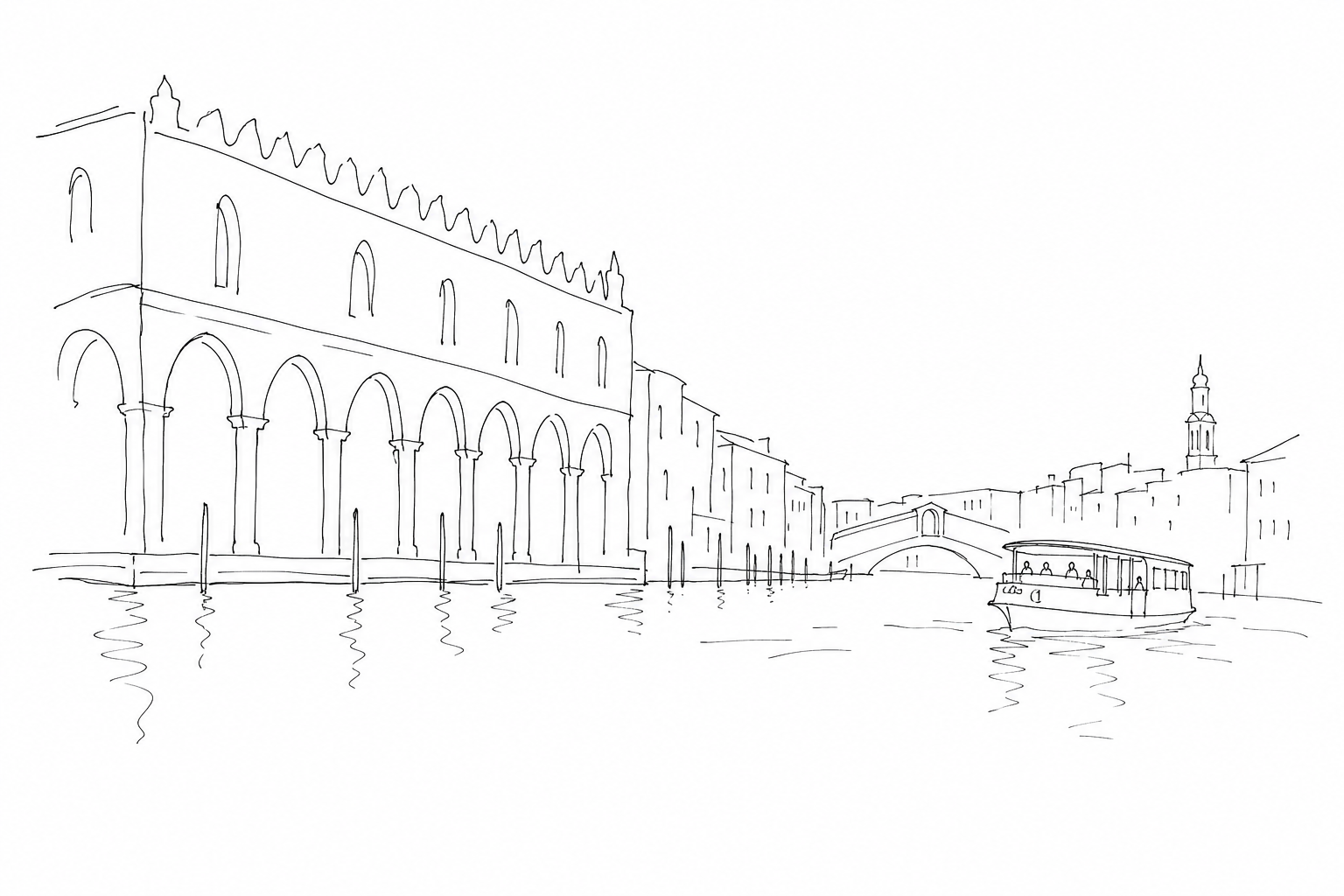
The fondaci recall the city’s mercantile dimension: the Fondaco dei Turchi, with its long arcaded façade, evokes exchanges, foreign communities and warehouses; near Rialto, the area of the Fondaco dei Tedeschi points back to the economic heart of the Serenissima. Looking at these buildings from below, at wave level, makes it possible to understand an essential detail: the main façade was not toward a square, but toward the traffic of boats.
The stops as chapters: Ferrovia, Rialto, Accademia, San Marco
To orient yourself during the crossing, the main stops can be read as successive chapters. Ferrovia is the modern entrance: behind remain tracks and mainland, ahead begins the city built to be approached from below, among banks, jetties and the first mercantile palaces.
Toward Rialto the rhythm changes. Here the reading becomes economic and political: the bridge, the crowded calli, the ancient market areas recall that the Venetian heart was not only scenery, but a place of contracts, spices, counters and warehouses. Looking at the curves of the route helps to understand why that node was so strategic.
The Accademia stop instead opens a more pictorial chapter. The profile of the wooden bridge and the proximity to the Galleries recall a Venice observed by artists: oblique perspectives, reflections, pale façades, bell towers that enter and disappear from the field of vision.
Finally San Marco is not only a monumental arrival. It is the passage toward the basin, where the space widens and the city shows its diplomatic image: public palaces, ceremonial landings, lagoon horizon.
To truly enjoy the ride, the seat matters less than attention. If you find space outdoors, choose a stable position and do not invade gangways or access points: the landing stages require quick movements, especially at the central stops. Avoid turning the journey into a sequence of photographs; it is better to follow one façade at a time, observing water portals, mooring poles, coats of arms, Byzantine paterae, altane and chimneys.
Do not calculate this passage only as a transfer. Allow a wide margin, because crowding, maneuvers and lagoon traffic can change the experience. If you want to interrupt the reading, get off at an intermediate point and resume later: Rialto helps you understand the mercantile city, Accademia that of the palaces and collections, San Marco the ceremonial opening. For up-to-date details on services, tickets and travel conditions, always check the official information before setting off.
Taking line 1 calmly allows you to transform an ordinary journey into a close reading of Venice. Each stop opens a change of rhythm, each stretch of the Grand Canal shows a different detail: a portal on the water, a Gothic window, a worn façade, a work boat passing alongside the palaces. There is no need to seek the spectacular effect: it is enough to choose the moment well, find a place from which to observe and let the route bring out the city in layers, like a slow, everyday museum on the water.