
In Venice, it is natural to look up at a bell tower, stop in front of a palazzo or search for the perfect view of the Grand Canal. The city seems almost designed to draw your attention towards whatever appears most spectacular.
And yet, a significant part of Venice lies in the details you may walk past without noticing. A name painted on a wall, A stone wellhead in the middle of a square, A wooden terrace perched above the rooftops, A doorway opening not onto a street, but directly onto the water, A shadowy passage that shortens your route and suddenly changes the sound of the city.
Discovering an unusual Venice does not necessarily mean moving away from its famous landmarks. Sometimes it simply means walking differently: slowing down, paying attention, and allowing yourself to wander away from a route you had already planned.
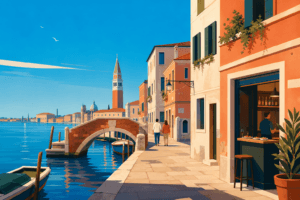
Here are twelve details to look out for during a walk through Venice, even just a few minutes from its best-known sights.
The nizioleti: street names painted on the walls
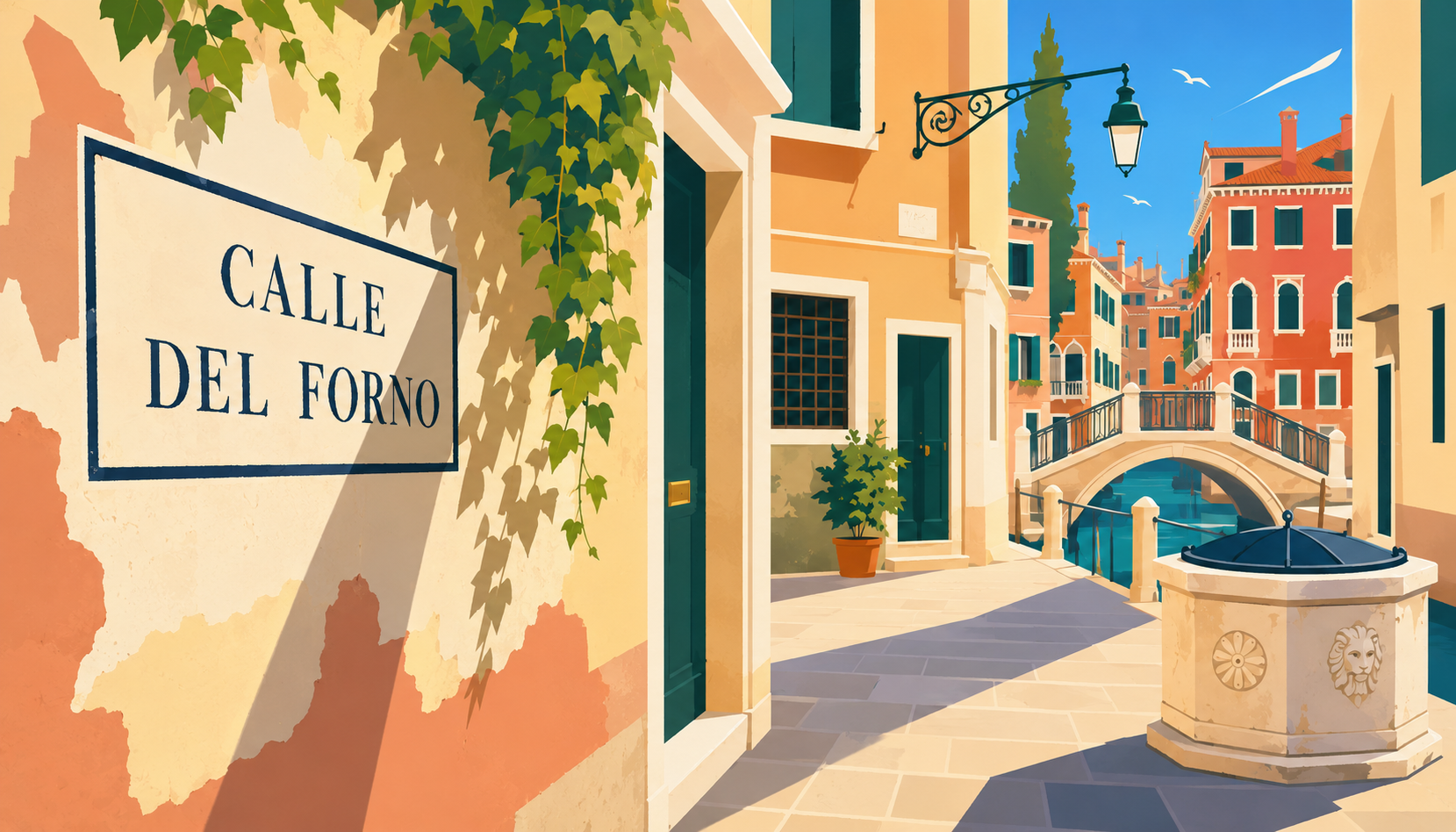
In Venice, street signs do not really look like ordinary street signs. Many names of calli, campi, bridges and fondamenta are painted directly onto the plaster, inside a white rectangle outlined in black. These are the nizioleti, a Venetian word associated with the idea of small white sheets hanging on a wall.
At first, you look at them simply to find your way. Then you begin to realise that they are much more than directions: they are small fragments of Venetian identity. They say Calle, Campo, Rio Terà, Fondamenta, Sotoportego: words that describe a city organised according to a completely different logic from that of ordinary urban streets.
Some names sound almost like the beginning of a story: a vanished trade, an old family, a workshop, an episode that has remained attached to that particular corner of the city. Even when you do not yet know their origin, a nizioleto can make you wonder: why is this place called exactly that?
Narrow calli that make you change your pace
Not every Venetian street invites you to walk in the same way. Some routes are wide and airy, while others pass through calli so narrow that you instinctively slow down when someone approaches from the opposite direction.
These passages are not merely picturesque. They allow you to feel the density of Venice: the way its buildings adapted to precious, limited space, shaped by water and by the need to connect homes, squares, churches, canalsides and bridges.
In a narrow calle, the sky becomes a vertical strip between the façades. Voices echo differently. You may smell the water before you can even see a canal. Walking here makes you understand that Venice does not always reveal itself through broad views: often it appears through sudden compressions, unexpected openings and subtle changes in light.
The sottoporteghi: crossing the city beneath its buildings
A sotoportego, also commonly written sottoportego in Italian, is one of those places that immediately reveals how different Venice is from other cities. It is a public passage running beneath a building: you enter under a house, walk for a few steps in the shade and emerge into a small square, in front of a bridge or beside a canal.
Some are short and bright; others are lower, darker and quieter. In summer, they offer a moment of cool relief. On rainy days, they feel like small sheltered pauses during a walk.
Their real charm, however, lies in the sense of transition. In only a few steps, Venice changes scene. A busy route may open into a quiet courtyard; a path that seemed closed may continue underneath a building; the sound of footsteps may turn into an echo, then disappear again as soon as you return outdoors.
Whenever you encounter one, do not cross it too hastily. Stop for a moment before stepping out: the view framed by its arch is often already a natural photograph.
Wellheads in the campi: when fresh water was precious
In many Venetian campi, you will come across a stone structure, often carved and closed at the top, At first glance it may appear to be a decorative feature but It is actually a vera da pozzo, the visible part of a system that was essential to the city’s survival.
Venice is surrounded by water, but the water of the lagoon is brackish. For centuries, access to fresh water was therefore a fundamental concern. Venetian “wells” did not simply draw water from an underground source: they were systems designed to collect and filter rainwater beneath the surface of squares and courtyards.
The wellhead was the visible element, the point around which everyday gestures once took place: waiting, drawing water, meeting other people from the neighbourhood. Looking at one means remembering that Venice’s squares were not merely beautiful settings. They were lived-in spaces, arranged around the practical needs of the community.
Carved wellheads: lions, coats of arms, leaves and worn stone
Once you have learned to recognise a vera da pozzo, it is worth stepping closer and looking at it more carefully. Many are not simple blocks of stone: they feature plant motifs, family coats of arms, carved animals, geometric patterns or marks softened by time.
Some wellheads were linked to the patronage of prominent families; others belonged to public or religious spaces. In several cases, practical purpose and artistic care coexist in a remarkable way: even an essential piece of everyday infrastructure could become an opportunity to leave a symbol, a mark of status or a recognisable image.
Among the figures you may encounter is, naturally, the lion, a recurring presence in Venetian imagery. There is no need to identify every coat of arms or period immediately. Part of the pleasure lies simply in noticing how much of the city’s memory has been entrusted to stone.
The masegni beneath your feet: paving stones that tell a story
When visiting Venice, your gaze naturally tends to rise: façades, windows, bell towers, bridges. Every now and then, however, it is worth looking down.
In many parts of the city, the paving is made from masegni, the large stone slabs that cover calli, campi and fondamenta. Shining after the rain, worn smooth where generations of footsteps have passed, slightly sloped near certain wellheads or drainage areas, they are part of the physical experience of Venice.
Walking on masegni means feeling Venice through your feet as well: the sound of footsteps, the polished surfaces shaped by time, the reflections on damp days. In some squares, by looking carefully at the paving around a wellhead, you can begin to understand the practical requirements once connected with collecting rainwater.
It is a discreet detail, but a city built on water can also be understood by observing how it learned to gather, channel and cross it.
Small bridges that do not need a famous name
Venice has bridges known throughout the world. Yet during a walk, it is often the smaller bridges that leave the most personal memory: a low arch over a quiet canal, a weathered railing, a sudden view of a boat tied to a mooring post, or a flower-filled window just beyond the water.
A minor bridge does not require a scheduled visit. You simply come across it, walk over it and perhaps stop for a few seconds. From there, the city appears from a different perspective: not monumental, but everyday.
Try not to treat every bridge simply as a way to reach the other side. Pause halfway across, without obstructing the passage, and look along the canal. You often meet a more intimate Venice precisely when you are not looking for a particular landmark.
Doors opening onto the water: entrances shaped by another kind of movement
In most cities, a door opens onto a street. In Venice, it may open directly onto a canal.
During a walk along a fondamenta or while crossing a bridge, it is easy to notice low entrances close to the waterline, damp steps, iron rings set into the stone and small landing points in front of palazzi or more modest buildings.
These details are a reminder of something obvious yet easy to forget: in Venice, water is not merely scenery. It has always been, and still is, a route for movement, work, services and access. Goods, building materials, people, maintenance work and deliveries have long had to follow the network of canals.
A water entrance changes the way you read a building. What may look like the back of a house from the calle could once have been an important entrance from the canal, where goods or visitors arrived.
The altane: small terraces suspended above the rooftops
If you look up between Venetian buildings, especially in more enclosed areas, you may spot wooden structures resting on the roofs. These are the altane, raised rooftop terraces that make it possible to find air, sunlight and a wider view above a city of narrow spaces.
They are easy to miss when you are concentrating only on shop windows or the route ahead. Yet they reveal a great deal about everyday Venetian life: when space at street level is limited and buildings overlook narrow calli, even a roof can become part of domestic living.
The altane add a vertical dimension to the city. Venice does not exist only among bridges and canals. There is also a Venice “above”: made of rooftops, bell towers, laundry drying in the sun, quiet private viewpoints and unexpectedly broad skies.
House numbers that follow a different logic
Finding your way around Venice can be confusing for a reason less obvious than its winding calli: house numbers do not work as they do in most cities.
As you walk, you may notice numbers painted beside doors, often on small pale panels, reaching surprisingly high figures. This is because Venetian civic numbering is traditionally organised by sestiere, the city’s six historic districts, rather than simply street by street.
The result is a city in which an address can feel almost like an internal coordinate within a large neighbourhood of water and stone. Visitors do not need to master the entire system, but noticing it is part of the fun: even searching for a doorway on a map can suddenly feel like a small exploration.
Above all, it shows that in Venice even the way you find an entrance follows a distinctly local logic.
Winged lions away from the most famous monuments
The winged lion of Saint Mark does not belong only to the city’s grand monumental settings. As you walk through Venice, it may appear in quieter forms: on a wellhead, above a doorway, on a façade, in a plaque, at the corner of a building or in a relief that many people pass without ever noticing.
Looking for it can almost become a game. Not every lion has the same expression, posture or state of preservation. Some are solemn and commanding; others have been reduced to a worn outline. Some dominate their surroundings, while others seem to hide on an unassuming wall.
The lion is one of the most recognisable symbols of Venetian history, but finding it away from the official landmarks creates a different impression: it is as though the city has scattered its identity throughout every neighbourhood, not only across its grandest squares.
The sudden silence of a courtyard or a small square
The final detail is not exactly an object. It is a change in atmosphere.
Venice can be extremely busy, especially along the routes connecting its best-known landmarks. Yet it may take only a side calle, a sottoportego or a small bridge to find yourself in a courtyard or a quiet campiello where the noise suddenly falls away.
There may be laundry hanging above you, a bicycle resting against a wall, a few plants outside a doorway or the faint sound of dishes from an open window. Nothing spectacular, and that is precisely what makes it valuable: the sense that Venice is not only a place to visit, but a city where people live.
In these spaces, the best thing to do is simple: pass through respectfully, speak quietly and resist the urge to turn every corner into a photographic set. The beauty of a less obvious Venice also depends on our ability to observe it without intruding.
How to discover an unusual Venice without looking for secret attractions
There is no need to chase mysterious locations or addresses to be guarded like secrets. An unusual Venice can be found even near Rialto, St Mark’s Square, Cannaregio, Dorsoduro or Castello, provided you are willing to walk without treating the city merely as a backdrop.
A good way to begin is to choose a destination while allowing yourself at least one diversion. When a side calle catches your attention, follow it. When a campo feels peaceful, stop for a moment. When a nizioleto has a curious name, read it. When you notice a wellhead in the middle of a square, walk closer and look at its carvings.
Venice rewards curiosity. Its stories are not all hidden behind an admission ticket or displayed in front of a famous façade. Many are painted on walls, carved in stone, suspended above rooftops or tucked into the cool shadow of a passage beneath a house.
A city worth looking at twice
The first Venice you encounter is the one everyone expects: the great monuments, the famous canals, the most photographed bridges, the light reflected on the water.
The second arrives a little later, once you begin to notice what had first seemed to be only background: a white-painted name on a wall, a worn paving stone, a doorway onto the water, a wooden terrace above the rooftops, a silent courtyard hidden just beyond a busy route.
It is often in this second Venice that the wish to return begins. Not because the first has disappointed you, but because you realise that the city cannot be exhausted in a single visit. It asks for time, attention and a certain pleasure in getting slightly lost.
When you walk slowly, even the smallest detail can become the most vivid memory of your day.
Related Posts
What to See in Cannaregio: A Slow Walk Through Venice’s Most Everyday District
Cannaregio reveals Venice’s quieter, more lived-in side with its historic Ghetto, vibrant fondamenta, and relaxed campi where daily life and visitors coexist without the postcard…Venice on a budget but without clichés: simple experiences worth more than many attractions
Slow and concrete ideas for experiencing Venice while spending little: calli, campi, bacari, stops and details outside the usual automatisms.
Venice in Two Days, Without Rushing: An Itinerary for Your First Visit
Experience Venice beyond popular tourist spots by pacing your two-day visit around iconic landmarks and everyday neighborhoods, balancing must-see sights with leisurely strolls through the…Questions Answered
What are nizioleti and why are they significant in Venice?
They are street names painted on walls reflecting Venetian identity and history.What is a sottoportego and what role does it play in Venetian city life?
It is a passage beneath buildings that changes the city's atmosphere and connects routes.Why were wellheads important in Venice and what do their carvings represent?
They collected fresh rainwater and often display artistic symbols of Venetian heritage.How does Venice’s house numbering system differ from typical cities?
It is organized by the six sestieri districts rather than by street sequences.
Keep noticing the less obvious Venice
Want to train your eye on names, passageways and urban details that a quick visit tends to miss?
 Venetian nizioleti: reading the names of the calli like a map written on the wallsGuide to Venetian nizioleti: origin, form, recurring words and practical use for finding your way among calli, campi, rii and sestieri.
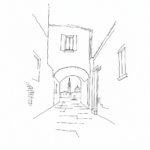 Venetian sottoporteghi: small urban tunnels where the city suddenly changes rhythmGuide to Venetian sottoporteghi: covered passages between calli, campi and rii, urban thresholds where light, sound and pace suddenly change.
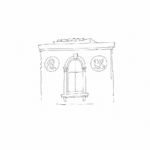 Venetian paterae: animals, symbols and Byzantine stones walled into façadesGuide to Venetian paterae: origin, forms, animals, symbols and ways to read them on façades among calli, campi and rii.
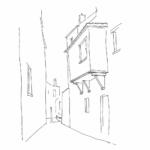 Barbacani: the wooden brackets that tell of houses wider than the calliAn urban detail of Venice: the barbacani, supports that explain space, rules and life in the calli.