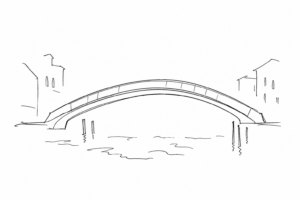
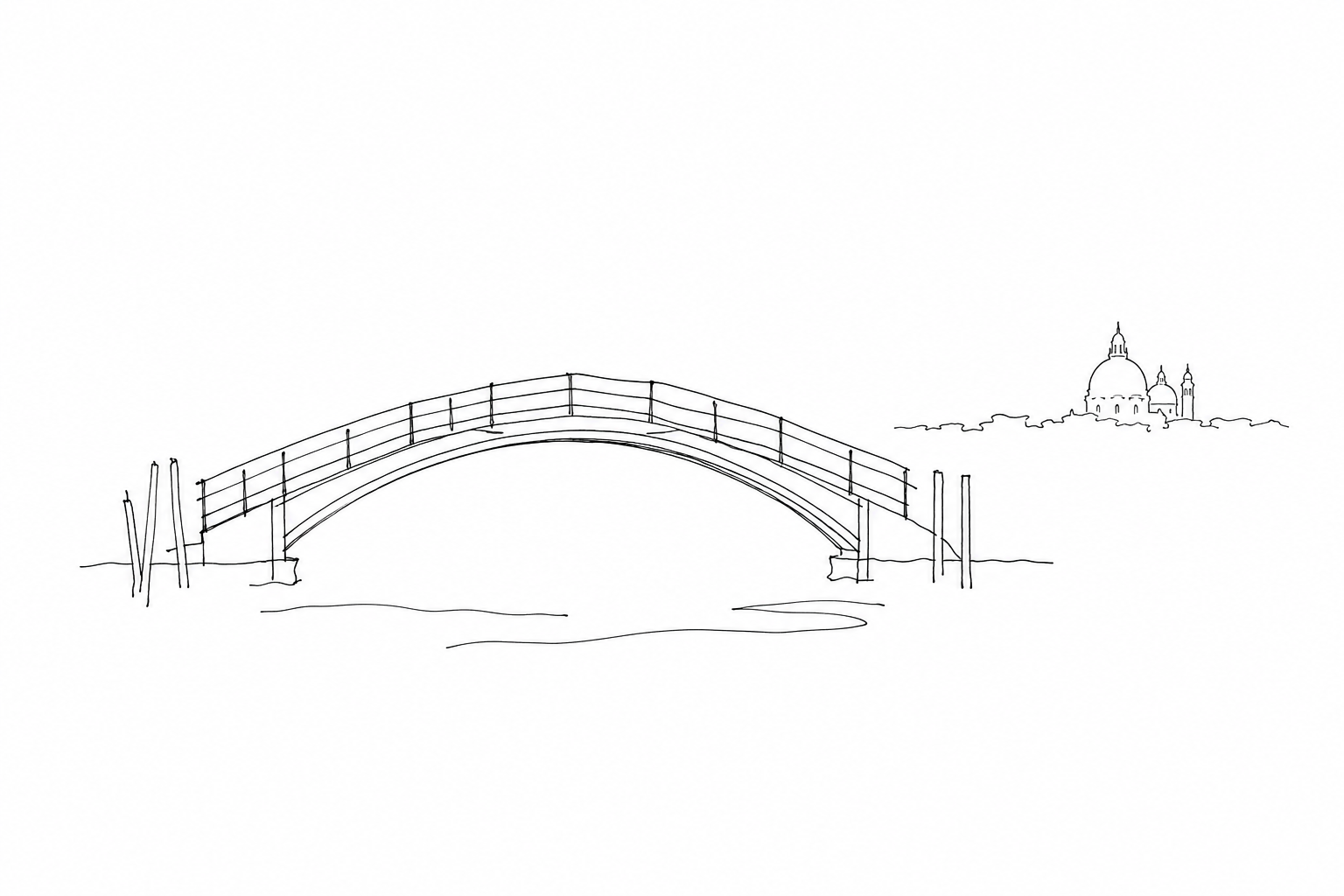

The Ponte dell’Accademia is one of the places where Venice seems to change scale: no longer only calli, campi and close-up façades, but a city that opens up in perspective along the Grand Canal. Its wooden structure, apparently simple and almost provisional, tells an urban story made of temporary solutions that became habits, of daily crossings and famous views. Crossing it means entering a particular balance: below, the water traffic; around, palaces, domes and reflections; above, the brief gesture of stopping without turning everything into a postcard.
Where it is and why it changes the way you look at Venice
The Ponte dell’Accademia crosses the Grand Canal at the point where Venice seems to open up like a stage set: on one side the area of San Vidal and Campo Santo Stefano, on the other Dorsoduro, with the Gallerie dell’Accademia just a few steps away. It is one of the few pedestrian crossings of the Grand Canal and, precisely for this reason, it is not just a passage: it is a suspended viewpoint in the heart of the city.
Its strength comes from its orientation. Looking east, the gaze glides along the water to the dome of Santa Maria della Salute and, beyond, toward the opening of the San Marco Basin. In the other direction the canal bends between palace façades, landings and reflections, showing a more intimate and domestic Venice.
The wood contributes to this perception: less monumental than stone, warmer and provisional in appearance, it invites you to stop. From here the city is not observed frontally, but along a curve of water that makes it appear built to be looked at.
From iron bridge to wooden bridge: a provisional story that remained
The Ponte dell’Accademia did not begin as the wooden bridge that today defines one of the most recognizable views of the Grand Canal. The first crossing at this point was a nineteenth-century metal bridge, built during the Austrian period and inaugurated in 1854 to a design by the engineer Alfred Neville. It was an iron structure, functional and modern for its time, intended to connect the San Vidal area more directly with Dorsoduro and with the Accademia sites.
Over time that bridge was judged poorly suited to pedestrian traffic and to the surrounding urban image. In 1933 it was replaced by a provisional wooden solution, designed by the engineer Eugenio Miozzi: an arched structure, quick to build, which was supposed to await a definitive stone bridge.
Its provisional nature, however, became its identity. The wood lightens the presence of the bridge and makes it different from the other monumental crossings of the Grand Canal. Precisely this material, warmer and less solemn, contributes to the sensation that from here Venice is both a constructed work and a scene to observe.
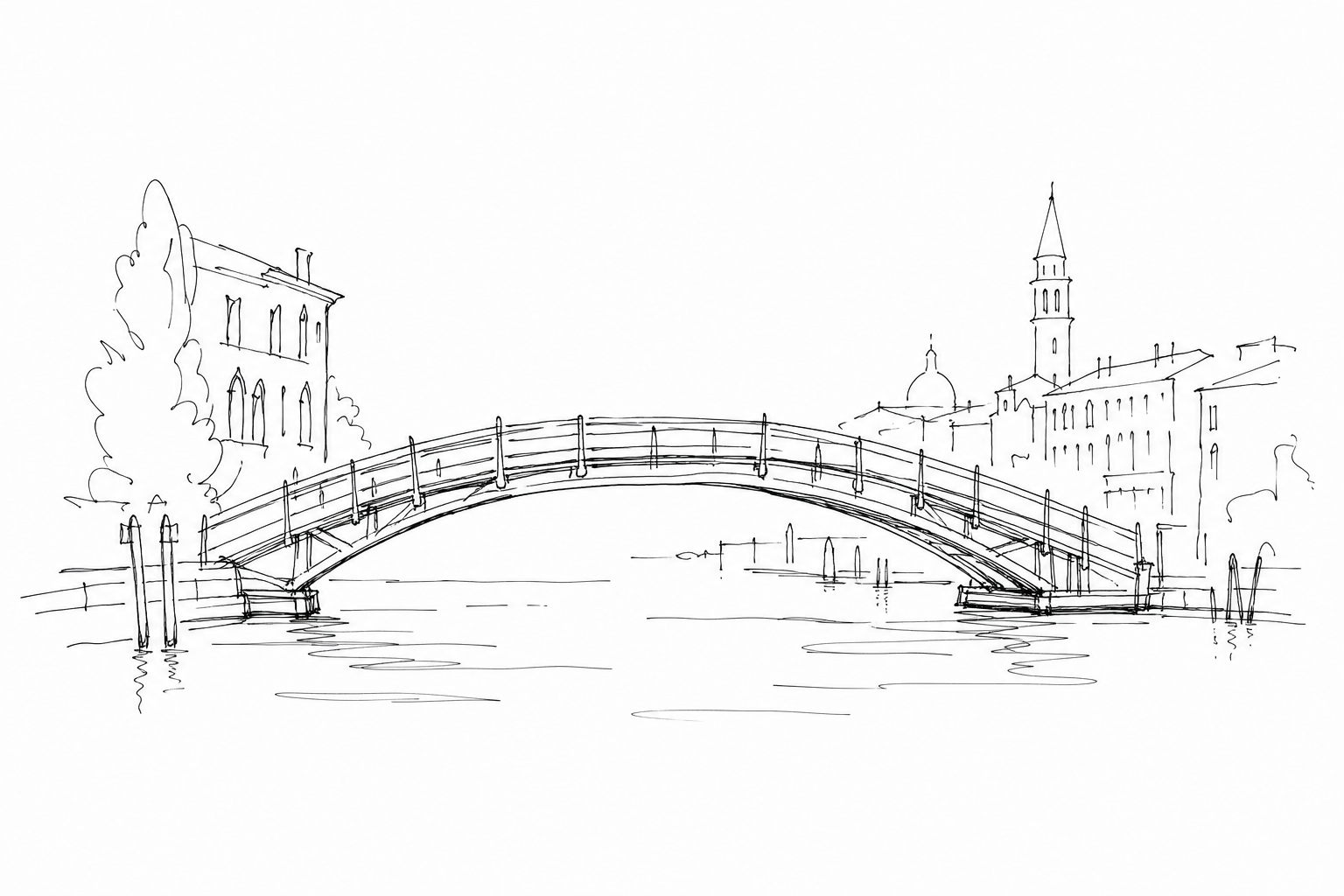
The strength of the crossing lies in its simple and very physical form: not a flat line over the water, but a stepped ascent that forces the body to change rhythm. The arched span slowly raises the gaze; first you see the planks, the parapets, the side abutments, then, once you reach the highest point, the perspective opens onto the curve of the Grand Canal and the Salute in the distance.
The material contributes as much as the geometry. The wooden surfaces absorb the light differently from the Istrian stone and marble of the nearby palaces: they appear more opaque, more everyday, almost provisional. Even the sound of footsteps, dry and close, makes the crossing less ceremonial and more immediate.
Up close, you perceive a construction made of repeated elements: steps, handrails, beams, supports. It is precisely this structural clarity that makes the Ponte dell’Accademia an observatory: as you climb, Venice appears not only as a panorama, but as a set of weights, voids, supports and perspectives.
From the highest point it is best not to look only for the famous framing toward Santa Maria della Salute. The first key is to follow the curve of the water: the route does not run straight, but bends and compresses the façades, making the palaces appear like successive wings. The basilica, with its dome, functions as a vanishing point; the Punta della Dogana closes the lower horizon, almost level with the lagoon.
A second reading comes through the nearby details. Looking under the parapet, you understand the real scale of the Grand Canal: mooring poles, landings, gondolas and motorboats reduce the distance between monumental architecture and everyday use. The water doors of the palaces remind us that many façades were not designed only to be admired, but to receive people and goods.
Finally, it is worth moving a few steps along the top and then toward the ends. At the center the broad perspective dominates; at the sides the relationships between bank, fondamenta and walls emerge. The best photograph here is not always the most symmetrical one: often it is the one that keeps together domes, reflections, boats and the difference in level of the crossing.
The Ponte dell’Accademia should not be considered only as a viewpoint, even if the view toward the Salute remains one of the most intense in Venice. It is a bridge that holds together function and image, technical history and daily use, material fragility and permanence in collective memory. Looking at it carefully allows you to read the Grand Canal, its banks and the way the city lets itself be crossed more clearly. That is why it is worth crossing it without hurry: not to search for the perfect framing, but to understand how Venice constructs its own views through apparently simple places.