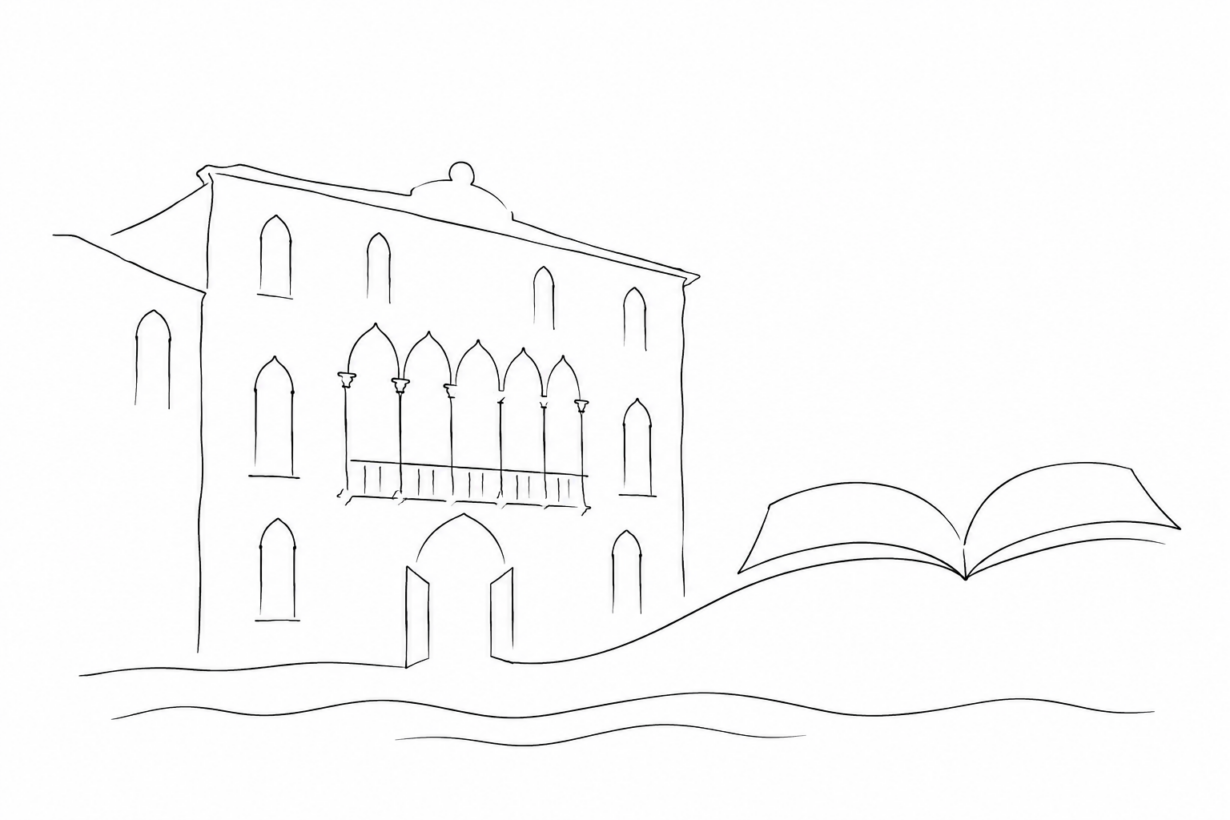

Ca’ Foscari is one of those palaces that many notice from the vaporetto, but few truly manage to read. The façade on the Grand Canal immediately catches the eye; more interesting, however, is understanding what it tells: a noble residence created to show itself, later becoming a place of study, with one of Carlo Scarpa’s most significant Venetian interventions inside it. This article is intended to help you find your bearings before the visit: where to look, which historical passages to keep in mind and how access to the spaces that can be visited works, without turning a living place into a simple postcard.
Ca’ Foscari on the Grand Canal: where it is and what you see
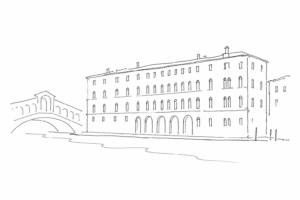
Ca’ Foscari is located at Dorsoduro 3246, in one of the most recognizable points of the Grand Canal: the so-called volta de Canal, the wide bend where the water changes direction and the gaze runs with rare depth. It is also a strategic position for orienting yourself: we are between the Rialto area and the Accademia area, with the palace directly overlooking the central stretch of the canal.
The first thing to observe is the late-Gothic Venetian façade. It is not just any elevation: it looks onto the widest curve of the Grand Canal and makes use of the light of the water, which highlights the large multi-light window and the vertical design of the building. From the outside, its historic role as a representative palace is clearly grasped; today, however, Ca’ Foscari is also a living university site, not a museumized building separated from the city.
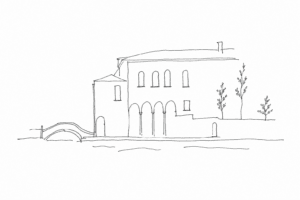
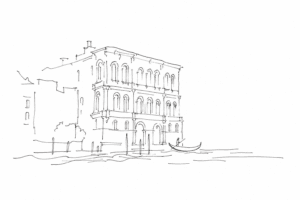
It is precisely this double register that makes it interesting: on the one hand the noble palace on the canal, on the other the spaces of the university, including the Aula Baratto, which make it possible to read Venice through architecture, public use and later transformations.
From the House of the Two Towers to the seat of the university
Before Ca’ Foscari, on this stretch of the Grand Canal there was the House of the Two Towers. The name alone is enough to make clear that the site was already important before the fifteenth-century palace: not a secondary plot, but a recognizable presence on the great bend of the canal, suited to showing itself and being seen.
The turning point came in 1453, when the current palace was built at the wish of the doge Francesco Foscari. The choice was not neutral. A private building overlooking such an exposed point of the Grand Canal also functioned as a public declaration of rank: domestic architecture, certainly, but conceived with the scale and ambition of a great Venetian family.
Over time Ca’ Foscari continued to be used as a representative palace. One significant episode is the stay, in 1574, of Henry III of Valois, king of France and Poland: a presence that confirms the ceremonial role taken on by the Foscari residence in relations between Venice and illustrious guests.
The decisive transition toward its current function happened much later. In 1868 Ca’ Foscari became the seat of the Royal Higher School of Commerce, the institution from which today’s Ca’ Foscari University of Venice would be born. It is an important change of use: the patrician palace was not frozen as a simple noble memory, but entered the modern life of the city as a place of study, economic training and international exchange.
Carlo Scarpa’s Aula Baratto: what to observe
The Aula Baratto is one of the points where Ca’ Foscari changes register: no longer only a late-Gothic palace overlooking the Grand Canal, but a historic building traversed by a highly recognizable modern intervention. The room is on the second piano nobile, right behind the large multi-light window of the façade. This detail is essential: Scarpa worked in an environment already strongly marked by the view, the light and the symmetry of the elevation.
Carlo Scarpa intervened here for the first time in 1935, when the rector Agostino Lanzillo entrusted him with the restoration of some spaces and the creation of the university’s first Aula Magna. He then returned to the room in 1955-1956, transforming it into a lecture hall. The result should not be read as simple furnishing: it is a project of balance between university use, the memory of the palace and construction precision.
The details to look at calmly
- The wooden platform of the lecturer’s desk: it is not just a functional raised surface. It orders the space, establishes a focal point and shows Scarpa’s care for proportions, edges and materials.
- The marble frame: with pedestals and Latin inscription, it introduces a more solemn measure, but without erasing the sobriety of the hall.
- The wood and glass frame of the multi-light window: it is one of the most interesting details, because it brings together the large Gothic opening, the practical need to close the room and the modern design of the detail.
The most beautiful thing to understand is that Scarpa does not “imitate” Venetian Gothic. He listens to it. He inserts new elements with great control, allowing the multi-light window to continue guiding the gaze toward the water. The Aula, named after Mario Baratto, professor of Italian literature and theatre expert, thus remains a space of study, representation and architecture all together.
Guided tours of Ca’ Foscari: access, meeting point and route
To enter the spaces that can be visited, you need to refer to Ca’ Foscari Tour. Ordinary visits are free, open to everyone and without reservation. The meeting point is the courtyard of Ca’ Foscari, Dorsoduro 3246: it is advisable to arrive at least ten minutes early, because departure takes place as a group and access follows the rules of an active university site.
The route is not always identical. When the spaces are available, the visit can pass through the palace on the Grand Canal and the Aula Baratto; in other cases the itinerary is moved to Ca’ Dolfin and the Aula Magna Silvio Trentin. This is an important detail: anyone who wants to see Scarpa must check, before showing up, the dates and spaces indicated in the official Ca’ Foscari Tour calendar.
During the visit it is worth keeping in mind that you are not passing through an isolated museum, but a university in use: corridors, grand staircases and halls tell precisely of this continuity between historic palace and contemporary university life.
Visiting Ca’ Foscari means understanding something very Venetian: the best buildings never belong to only one time. Here patrician ambition, public use, modern architecture and university life coexist, without one phase entirely erasing the other. If you manage to enter with a guided tour, it is worth looking less hastily: the façade, Scarpa’s hall, the views and even the internal passages help to read the Grand Canal as a long history of transformations, not only as a sequence of photogenic palaces.