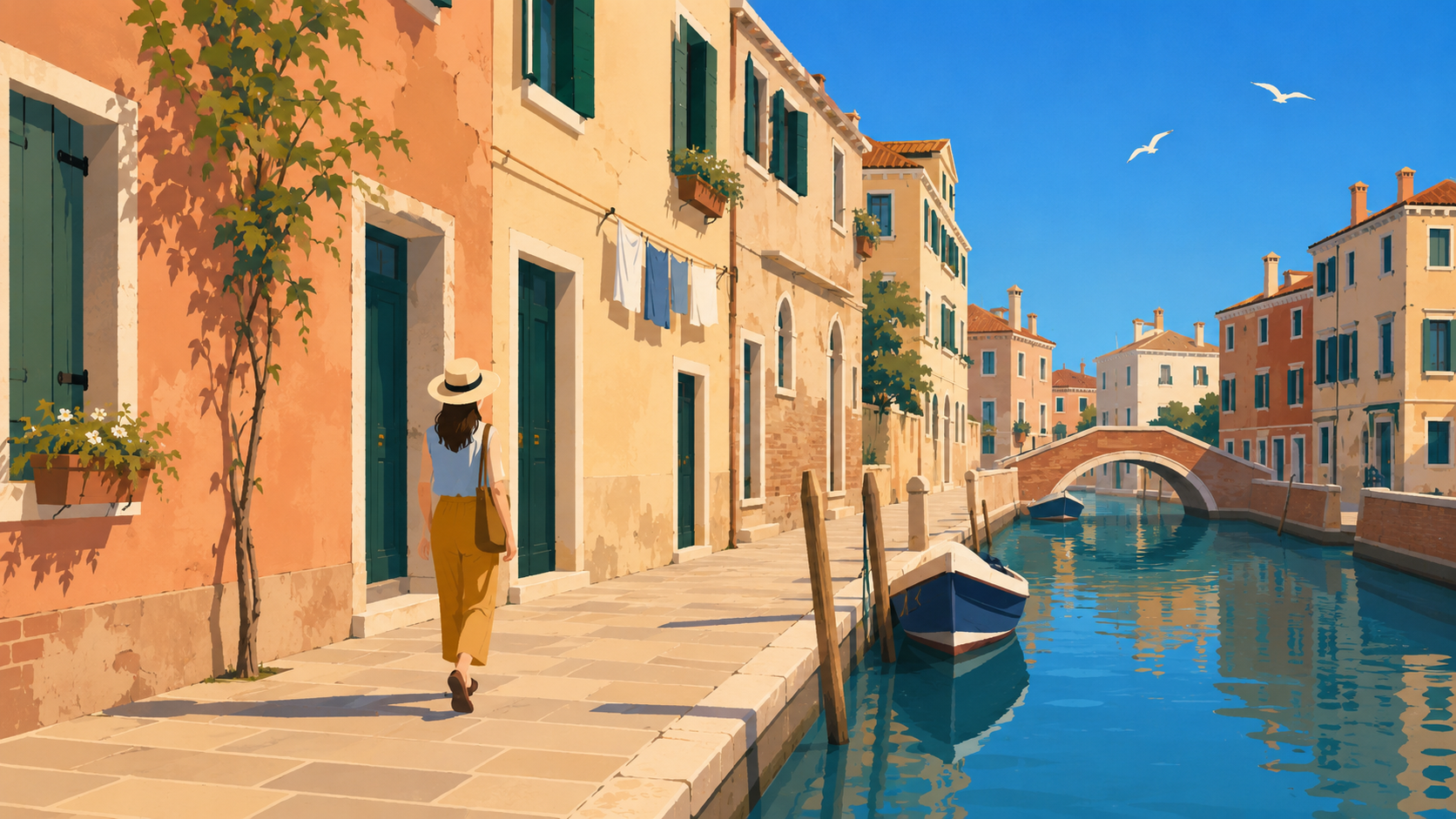

Cannaregio is one of the best places to understand that Venice does not live only through its most photographed monuments. Here, the city changes tone: it opens up along the fondamenta, gathers itself in quieter campi, and lets a more everyday rhythm appear — one that remains more hidden elsewhere.
Visitors arriving in Venice for the first time often follow a fairly predictable route: the railway station, Lista di Spagna, Rialto, St Mark’s Square. It is understandable. The city seems to pull you towards its most famous places, and to some extent it is right to follow that call.
But if you slow down before being carried along by the main flow, Cannaregio reveals a different rhythm. It is not a secret Venice, nor a district truly “off the beaten path”. It is something more interesting: a sestiere crossed by visitors, lived in by Venetians, full of important places and, at the same time, still able to preserve spaces where the city seems to breathe more freely.
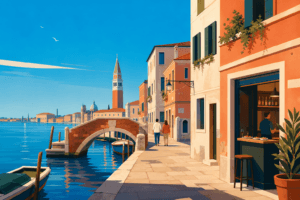
Visiting Cannaregio does not mean searching at all costs for a hidden corner. It means walking with attention, noticing how the canal banks, bridges, tall buildings of the Ghetto, long fondamenta and smaller campi compose a more everyday face of Venice.
Why Cannaregio Deserves More Than a Quick Walk
Cannaregio is often a district people pass through, but it would be a mistake to treat it merely as a corridor between the railway station and the centre. It is one of the areas where Venice best preserves its structure as an inhabited city: neighbourhood shops, houses overlooking the rii, boats moored in front of doorways, campi that seem made not just to be admired, but to be used.
The key word here is fondamenta. In Venice, it means a street running alongside a canal. In Cannaregio, the fondamenta are not simple panoramic routes: they become places of meeting, pausing, working and passing through. Walking beside the water, you understand more clearly that a canal is not just a backdrop, but an active part of the city.
There is another reason to spend time in this sestiere: Cannaregio naturally alternates between historically important places and lighter, more relaxed moments. You can visit the Ghetto and, a few minutes later, sit along a fondamenta watching the slow movement of the neighbourhood. You can encounter an imposing church and then find yourself in an almost silent side calle.
This alternation is what makes Cannaregio so suitable for anyone who wants to see Venice without feeling constantly inside a postcard.
From Ponte delle Guglie to the Ghetto: Entering Cannaregio with Care
A good starting point is the area around Ponte delle Guglie. It is close to Venice’s main access points, but it almost immediately allows you to shift perspective. From here, leaving for a moment the more crowded direction towards Rialto, you can enter the Venetian Ghetto.
The Ghetto should not be crossed as a merely picturesque stop. It is a layered, delicate place, with a history that shaped not only Venice but also the vocabulary of Europe. In 1516, the Republic of Venice decreed that the Jews living in the city had to reside within a delimited area: this was the birth of the Venetian Ghetto, often described as the first ghetto in Europe.
Today, arriving in Campo del Ghetto Novo, the first thing that strikes you is the shape of the space. The buildings are tall, taller than you might expect in many other parts of the city. This verticality speaks of a historical necessity: living within a restricted area, growing upwards because expanding freely was not possible.
It is worth stopping for a few minutes without doing anything special. Look at the façades, observe the windows, read the plaques, notice how this campo differs from other Venetian squares that may feel more open or are often crossed distractedly.
In the Ghetto, it is better to avoid the “quick photo” approach. It is a place to read slowly, ideally checking in advance whether guided visits, the Jewish Museum or the synagogues are open during the time of your visit.
Ghetto Novo, Ghetto Vecchio and the Meaning of the Names
The names of the Ghetto can be confusing at first. Ghetto Novo is not necessarily “new” in the intuitive way we might use the word today, and Ghetto Vecchio is not simply the oldest part to visit first. As often happens in Venice, place names preserve traces of former uses, transformations and layers of history.
The origin of the word “ghetto” is generally linked to the area’s old foundries, where metal was cast — gettare in Italian. Over time, that local name took on a much wider meaning, entering many languages as a historically charged term.
Walking between Ghetto Novo and Ghetto Vecchio therefore means crossing a place where toponymy is not decorative, but memorial. Every name says something about a previous use, an urban transformation, or a collective life organised within precise limits.
There is no need to turn the walk into a lecture. It is enough to carry this awareness with you: here, Venice does not show only its beauty, but also its complexity.
Fondamenta degli Ormesini: Venice Without the Need to Pose
Leaving the Ghetto and continuing towards Fondamenta degli Ormesini, Cannaregio changes again. The water opens into a more relaxed sequence, bridges mark the walk, and bars and small places to stop begin to appear without turning the landscape into an artificial scene.
This is an area often loved for having a drink or eating a few cicchetti, but its strength does not lie only in the bacari. It lies in the way daily life and visitor life coexist along the same canal bank.
Here, you can walk without a precise objective. Look at the moored boats, the reflections on the water, the open windows, the small crossings from one side of the rio to the other. Every now and then, it is worth pausing on a side bridge and looking in both directions: the perspective changes completely with only a few steps.
The best thing is not to search for the “perfect spot”. Ormesini works precisely because it does not ask to be consumed in a single glance. It is a Venice understood by walking.
Fondamenta della Misericordia: Pausing Without Leaving the Route
Continuing towards Fondamenta della Misericordia, the sestiere keeps the same relaxed character but becomes even more suited to a pause. There are stretches where the canal accompanies the walk with an almost domestic calm, and others where the presence of cafés and bars makes the atmosphere livelier.
It is one of the places where Cannaregio shows its double nature especially well: it is not untouched by tourism, but it does not seem built only for tourism either. Visitors can stop here without feeling they have left the itinerary; people who live in the city continue to move through a space that remains recognisably part of everyday life.
If you have already visited St Mark’s and Rialto, this area can be the right place to lower the pace. Sitting down, ordering something, watching people pass and letting a little time go by is, in Cannaregio, a very real form of visiting.
In Cannaregio, the beauty is not only in reaching a precise place, but in noticing how Venice changes between a fondamenta, a campo and a side bridge.
Campo dei Mori and Madonna dell’Orto: A Detour That Changes the Atmosphere
If you want to move into a more intimate part of Cannaregio, continue towards Campo dei Mori and the area around Madonna dell’Orto. Here, the city seems to change density. The passages become quieter, the façades take on a different character, and the presence of the church introduces a more severe and monumental note.
Campo dei Mori is one of those places where Venice seems to leave small clues about its commercial, family and legendary histories. The sculpted figures that give the campo its name catch the eye precisely because they appear almost like silent presences, inserted into the ordinary life of the neighbourhood.
A little further on, the Church of Madonna dell’Orto appears with unexpected force. It is not surrounded by the same visual pressure as the more central monuments; for that reason, it can strike you even more. Reaching it after walking through calli and fondamenta makes the encounter feel more natural, less programmed.
This detour is particularly suitable if you have already seen the most famous Venice and want to spend time in a sestiere that cannot be reduced to a single image.
How to Experience Cannaregio Without Turning It into a Checklist
Cannaregio can be visited in an hour or in half a day. The difference is not only in the number of stops, but in the way you choose to move through it.
If you have little time, focus on the route between Ponte delle Guglie, the Ghetto, Ormesini and Misericordia. It is compact, easy to follow and still allows you to grasp the character of the sestiere.
If you have more time, add Campo dei Mori, Madonna dell’Orto and a few side detours into the less crowded calli. There is no need to plan every turn: Cannaregio works well when it leaves space for instinctive choices.
For a short walk, follow the route from Ponte delle Guglie to the Ghetto and Fondamenta degli Ormesini.
For a slower visit, add Fondamenta della Misericordia, Campo dei Mori and Madonna dell’Orto.
For a pause, choose a fondamenta and stop without necessarily looking for the most famous place.
To observe better, look at the upper floors of the buildings, the doors opening onto the water and the small side bridges.
When to Visit Cannaregio
Cannaregio changes a great deal depending on the hour. In the morning, it has a more readable rhythm, especially between the Ghetto and the fondamenta. In the late afternoon, Ormesini and Misericordia become livelier and particularly suitable for a pause.
If you are looking for quiet and observation, it is better to start early. If you want to feel the neighbourhood at its most animated, the hours before evening are often the most interesting. In both cases, the advice is the same: do not arrive with a programme that is too rigid.
Cannaregio is at its best when it is crossed as a neighbourhood, not as a sequence of attractions.
A Less Scenic Venice, but a Closer One
After walking through Cannaregio, one thing becomes clearer: Venice is not made only of the places where everyone stops. It also exists in the intermediate routes, on the canal banks where the water accompanies the day, in the campi that do not immediately demand attention, in the tall houses of the Ghetto, and in the shadows of the side calli.
Cannaregio does not replace St Mark’s, Rialto or the Grand Canal. It completes them. It shows a less solemn and closer Venice, where beauty does not always need to announce itself.
That is why it deserves to be visited slowly. Not in search of an “authentic” Venice, as though the rest of the city were not authentic, but to allow yourself the time to see how Venice continues to live even away from its most photographed points.
Related Posts
Venice Beyond St Mark’s Square: 12 Details to Notice While Walking Slowly
Venice invites a different kind of exploration – one that uncovers its identity through painted street names, ancient wellheads, quiet bridges, and hidden courtyards, all…Venice on a budget but without clichés: simple experiences worth more than many attractions
Slow and concrete ideas for experiencing Venice while spending little: calli, campi, bacari, stops and details outside the usual automatisms.
Venice in Two Days, Without Rushing: An Itinerary for Your First Visit
Experience Venice beyond popular tourist spots by pacing your two-day visit around iconic landmarks and everyday neighborhoods, balancing must-see sights with leisurely strolls through the…Questions Answered
What makes Cannaregio different from other Venetian districts?
It is a lived neighborhood combining history with everyday Venetian life.Why is the Venetian Ghetto historically important?
It was the first designated Jewish ghetto in Europe, created in 1516.What are fondamenta and why are they significant in Cannaregio?
They are canal-side streets serving as meeting and working places.How should visitors best experience Cannaregio?
By walking slowly and observing the subtle changes in daily life.
Stay a little longer in Cannaregio
Which nearby corners reveal the more lived-in and less monumental side of this part of Venice?
 The Church of the Madonna dell’Orto: why Tintoretto is buried in one of the quietest areas of CannaregioWhy Tintoretto rests at the Madonna dell’Orto: home, parish, works and urban silence in northern Cannaregio.
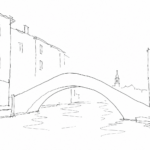 Ponte Chiodo in Cannaregio: the bridge without a parapet that Venice has almost forgottenHistory, form and context of Ponte Chiodo, a rare Venetian bridge without a parapet in Cannaregio.
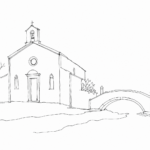 Sant’Alvise in Cannaregio: the secluded church with Tiepolo and an almost domestic VeniceA brief guide to Sant’Alvise, between the northern edge of Cannaregio, Tiepolo’s canvases and daily rhythm.
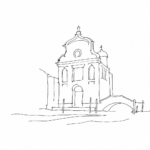 Santa Maria dei Miracoli: the marble church that looks like a reliquary in the heart of CannaregioHistory, marbles and details of Santa Maria dei Miracoli, a small Renaissance masterpiece among the canals and calli of Cannaregio.