
In 1573 Paolo Veronese delivered to the Dominicans of Santi Giovanni e Paolo an enormous canvas intended to represent the Last Supper. But that supper, rather than gathering itself in the silence of the Gospel, seemed to open up to the noise of a city: servants, soldiers, dwarfs, jesters, animals, solemn architecture and everyday gestures occupied the scene with surprising freedom. From this a case was born. The Feast in the House of Levi is not only a masterpiece of the Venetian sixteenth century: it is also the visual document of a confrontation between painting, religious control and the urban gaze.
A monumental dinner born as a Last Supper
When Paolo Caliari, known as Veronese, completed in 1573 the great painting now known as The Feast in the House of Levi, the work did not yet bear this title. It had been conceived as a Last Supper, intended for the refectory of the Dominican convent of Santi Giovanni e Paolo in Venice, one of the city’s most prestigious religious spaces. The canvas was to replace an earlier supper by Titian, lost in the fire that had struck the complex a few years before.
Its function was therefore precise: to accompany the friars’ meal with a sacred image, placed in direct dialogue with the daily ritual of the convent refectory. Veronese, however, transformed the subject into a theatrical and very vast scene, more than twelve meters long, set beneath a classicizing architecture similar to a Venetian loggia. Christ remains at the center, but around him an unexpected world crowds in: servants, soldiers, dwarfs, jesters, animals, onlookers. It was precisely this narrative abundance that made the supper problematic in the eyes of the Inquisition.
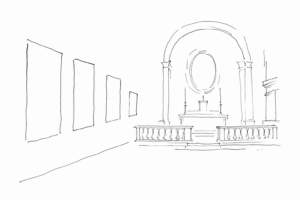
The problem was not only the presence of many figures, but the way in which Veronese transformed the sacred episode into a public, almost theatrical scene. The vast three-arched loggia, open onto stairways and balustrades, multiplies the points of observation: the gaze does not remain fixed on Christ, but is drawn to lateral groups, minute gestures and presences foreign to the Gospel account.
In the record of 18 July 1573 the inquisitors noted precisely these elements: armed men “in the German style,” servants intent on household tasks, dwarfs, jesters, animals and figures that seemed more suited to a Venetian patrician feast than to a religious subject. Some details were disturbing because they introduced noise, irony and everyday life into an image intended for the Dominican refectory.
The composition accentuates the ambiguity: Christ occupies the center, but he does not dominate the event alone. The figures at the margins demand attention with showy clothes, curious poses, objects and intersecting gazes. For the Inquisition that figurative freedom risked confusing devotion and spectacle; for Veronese, instead, it was the natural language of monumental Venetian painting.
The trial: the Inquisition’s questions to Veronese
On 18 July 1573 Paolo Caliari was called before the Holy Office of Venice. The painting, intended for the Dominican refectory of Santi Giovanni e Paolo, had been conceived to replace a lost work by Titian: precisely for this reason the scrutiny was severe. The inquisitors did not discuss the quality of the painting, but the suitability of the presences inserted around Christ.
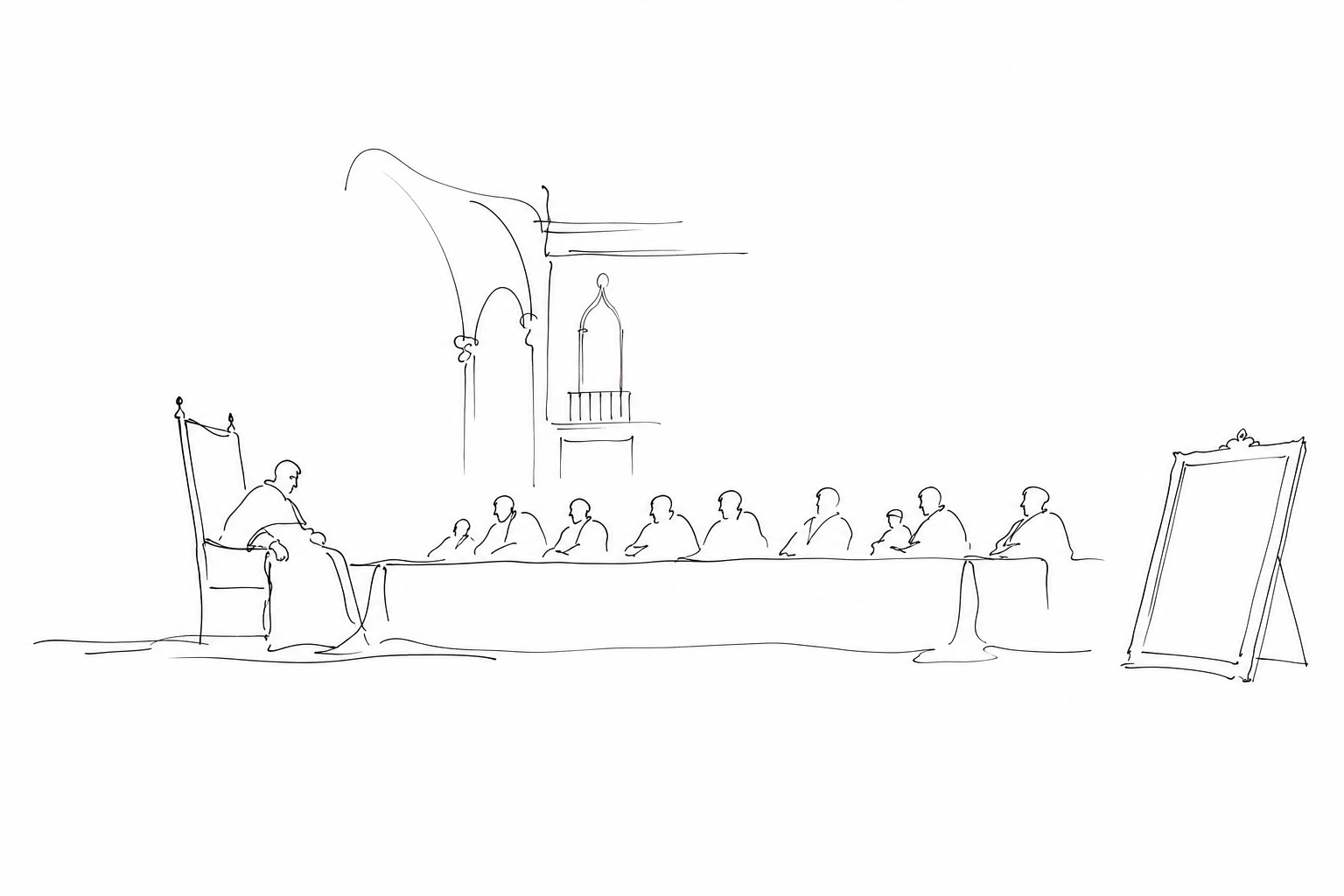
The questions were precise: why did armed soldiers appear “in the German style”? What meaning did the servant with the nosebleed have? For what reason were jesters, dwarfs, animals and figures judged foreign to the Gospel account present? The point was doctrinal: after the Council of Trent, sacred images had to be clear, decorous, free of ambiguities capable of distracting the faithful.
The painter’s defense was famous: artists, he said in essence, are entitled to a license similar to that of poets, provided the space requires it.
The sentence ordered him to correct the work within three months and at his own expense. Caliari avoided radical repainting: he changed the declared subject. No longer the Last Communion of Christ with the apostles, but Feast in the House of Levi, a Gospel episode more suited to a table crowded with publicans and questionable guests.
The new title was not a simple prudent label: it changed the theological field of the image. In the Gospel, Levi is the publican called by Christ; the banquet in his house gathers tax collectors and sinners, ambiguous presences that scandalize the Pharisees. In that context, soldiers, jesters, servants, onlookers and animals were no longer an irreverent intrusion into the Eucharistic moment, but part of a noisy world visited by mercy.
Paolo Caliari thus saved the scenic architecture, the side stairways, the monumental portico and the crowd distributed around the table, without radically transforming the canvas. The solution says a great deal even today: the work should not be read only as a document of censorship, but as a negotiation between inventive freedom and religious control. Its semantic shift, rather than erasing the conflict, makes it visible: before the painting, preserved at the Gallerie dell’Accademia, the title itself is part of the composition.
Veronese’s solution was as simple as it was intelligent: he did not modify the painting, he changed the title. The Last Supper became The Feast in the House of Levi, and that crowd that had disturbed the Inquisition found a new Gospel context in which to exist. Today the canvas preserves precisely this tension: on one side the theatrical grandeur of Venetian painting, on the other the concrete sign of an era in which every image could be discussed, questioned, corrected. To look at it means entering an overcrowded dinner, but also a cultural trial still legible in the details.