
Ponte della Paglia is one of those places in Venice that almost everyone crosses with their gaze already fixed elsewhere: toward the Bridge of Sighs, framed above the Rio di Palazzo. Yet this very bridge, crowded and apparently secondary, says a great deal about the relationship between the city, the water and the everyday use of spaces. Understanding where it is, why it has become an inevitable photo spot and where its name comes from helps to read more clearly a famous corner, often consumed in a hurry.
Where exactly Ponte della Paglia is
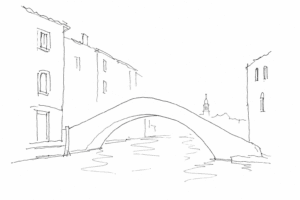
Ponte della Paglia is located at the point where the Riva degli Schiavoni meets the monumental area of San Marco, above the Rio di Palazzo. It is not the Bridge of Sighs: it is the public bridge from which, looking toward the inside of the canal, you frame the famous enclosed passage in Istrian stone that joins the Doge’s Palace to the New Prisons.
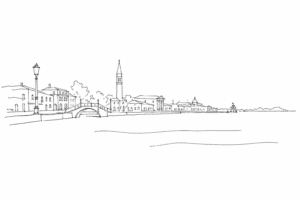
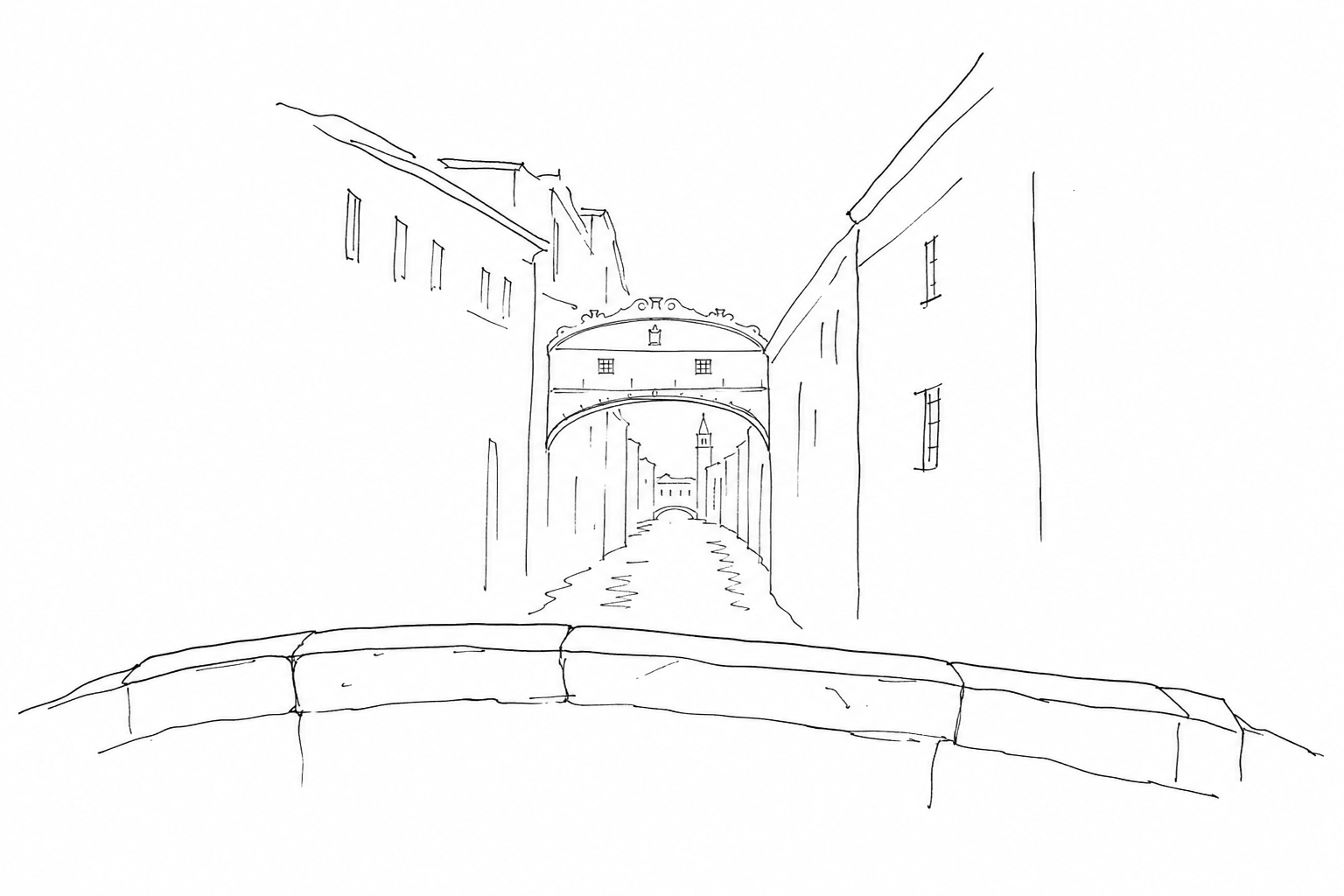
To get your bearings, just imagine the most photographed scene: behind you is the Basin of San Marco, with the island of San Giorgio Maggiore on the water; ahead, along the narrow rio, the Bridge of Sighs appears. If you look in that direction, the Doge’s Palace remains on the left and the building of the old prisons on the right.
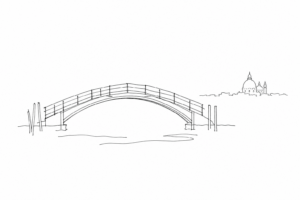
The name “della Paglia” recalls the area where straw once transported by boats was unloaded. Today, instead, the bridge functions almost like an urban terrace: those who pass from San Marco toward the Riva degli Schiavoni often stop here, without realizing that the point of the framing has a history of its own.
Why the Sighs are photographed precisely from here
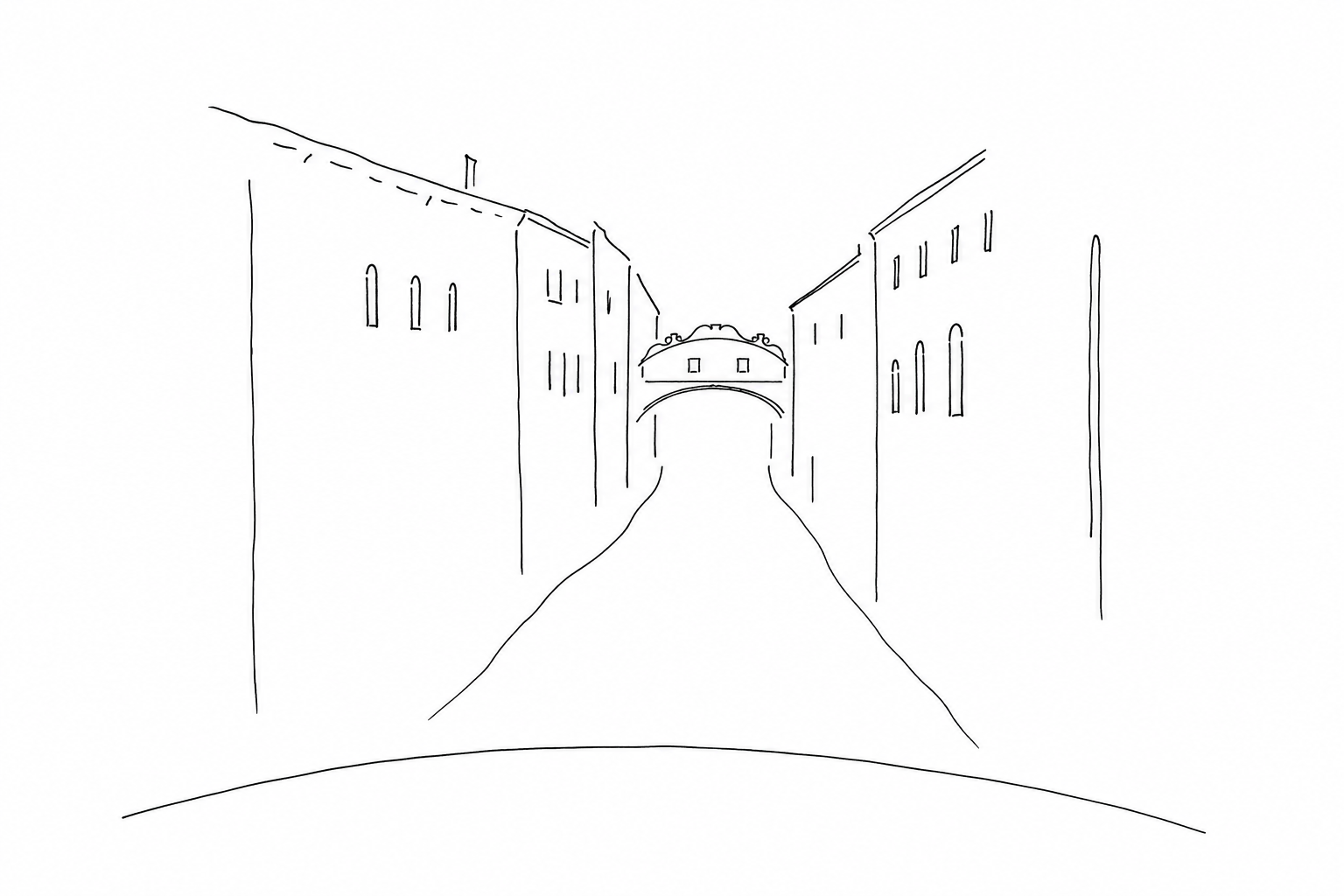
The photographic fortune of this spot does not depend only on the obligatory passage toward the Riva degli Schiavoni. From the parapet above the Rio di Palazzo the gaze runs almost on axis along the canal: on the left the mass of the Doge’s Palace, on the right the New Prisons, in the center the Bridge of Sighs, enclosed and pale in Istrian stone.
The visual relationship is decisive: the observer stands on an open, public crossing, while framing a covered connection, created for an internal and guarded use. That structure, attributed to Antonio Contin and built at the beginning of the seventeenth century, joined the courtrooms to the prison spaces. The small perforated windows were not designed to offer a romantic panorama, but to filter light and view.
From a boat the angle is lower and more unstable; from the opposite bank the image loses depth. From here, instead, distance and height transform the canal into a perspective view: the walls become wings, the suspended arch becomes the center, and Ponte della Paglia remains the true invisible director of the photograph.
The name: straw, boats and everyday use
Before becoming the most sought-after balcony for framing the Sighs, Ponte della Paglia indicated a much more earthly function: boats loaded with straw docked or stopped here. The reference is not poetic, but commercial and everyday. In pre-modern Venice that material was used for bedding, stables, packaging, transport, small craft activities; it arrived by water, like almost every commodity, and was unloaded near the shore.
The toponym therefore preserves a memory of work. Alongside the power of the Doge’s Palace and the monumentality of the St Mark’s area, there existed a minute logistics made of boats, porters, sellers and temporary warehouses. This coexistence is precisely what explains the strength of the place: in the same gaze enter the ceremonial of the Venetian State, the passage of the condemned toward the prisons and a name born from humble goods.
Calling it this means remembering that the city was not only scenery: it was a practical organism, fed by ordinary traffic right beneath the most photographed architecture.
Looking at it beyond the shot
To truly understand the place, it is useful to shift attention from the photographic frame alone to the relationship between three elements: the Riva degli Schiavoni behind, the Rio di Palazzo below, and the enclosed passage that crosses the water farther ahead. Those who photograph the Sighs stand on a public and busy overlook, facing an urban hinge: on one side the St Mark’s area and the Doge’s Palace, on the other the New Prisons.
The most useful reading is vertical. Below passes the canal, a service and connection route; halfway up runs the famous corridor in Istrian stone, built at the beginning of the seventeenth century and attributed to Antonio Contin; on the sides justice, government and detention face one another. It is therefore not only a romantic view: it is a compact section of Venetian power. Looking carefully, you can distinguish the small perforated windows of the passage, designed more to filter light and the gaze than to offer a panorama. The photo works because everything is close; the place is understood when one notices how controlled that brief route was.
Looking at the Bridge of Sighs from Ponte della Paglia does not only mean seeking the same photograph as everyone else. It means stopping, even for a few minutes, in a point where representation and urban life coexist: the Doge’s Palace, the rio, the boats, the Riva degli Schiavoni, the memory of a name linked to the simplest goods. If observed carefully, Ponte della Paglia ceases to be a platform for taking pictures and becomes a small threshold from which to understand how Venice transforms even an ordinary passage into a place dense with history.