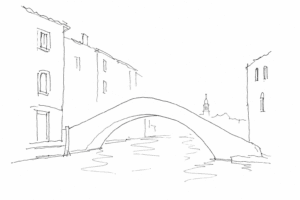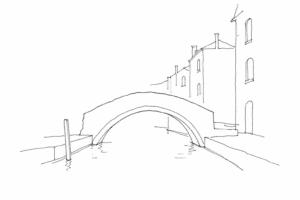

The Ponte dei Tre Archi is a small exception within a city accustomed to more discreet crossings: not a simple connection between two banks, but an urban presence that stands out for its rhythm, proportions and position. In Cannaregio, along one of the canals that is more open and less compressed by tourist flow, this bridge interrupts the Venetian custom of the single arch and invites you to look at the city more carefully. Its three arches tell of a rare technical and visual choice, linked to the history of the sestiere, to its daily movements and to an idea of Venice that is less scenic, but deeply constructed in its details.
Why this bridge surprises in Venice
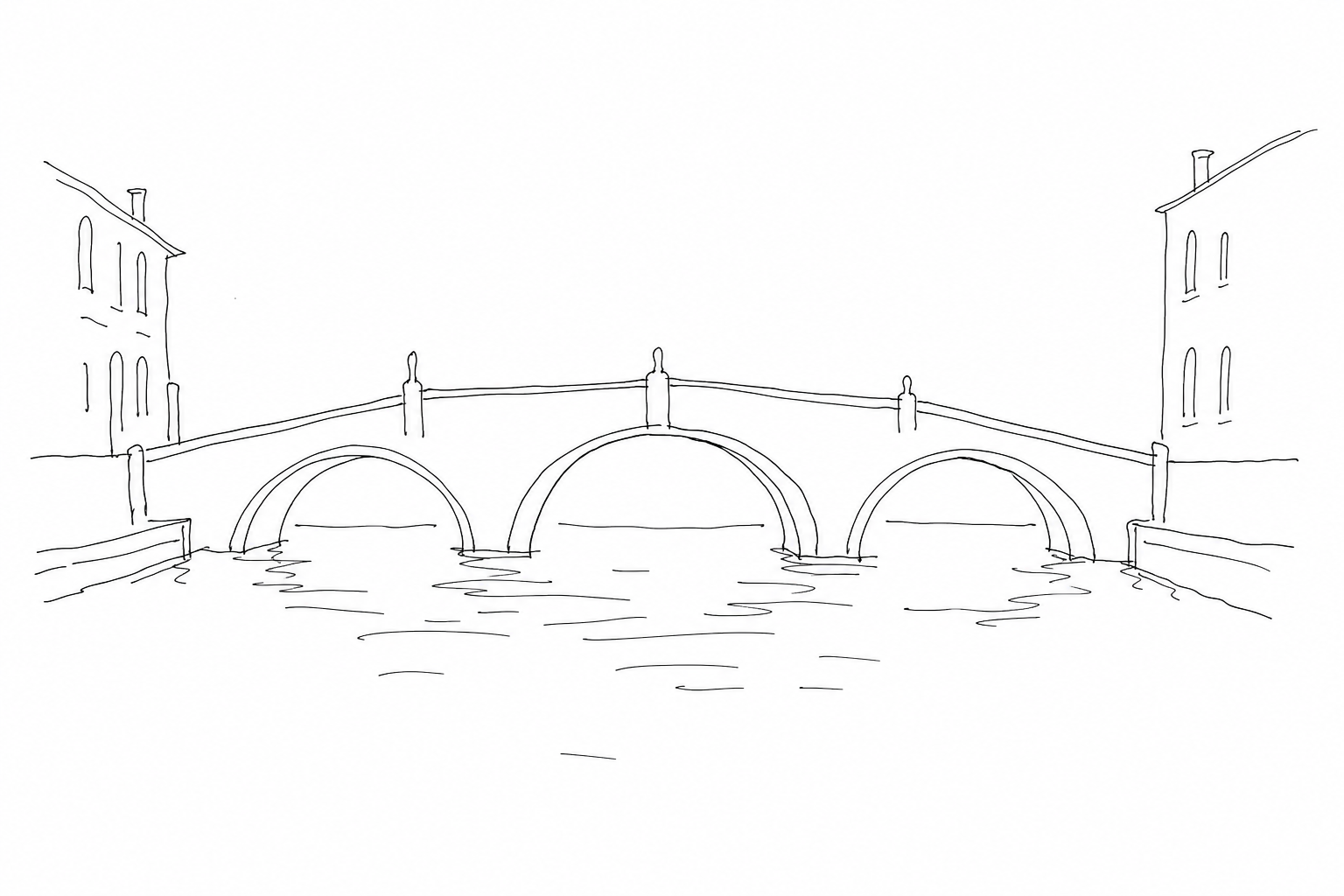
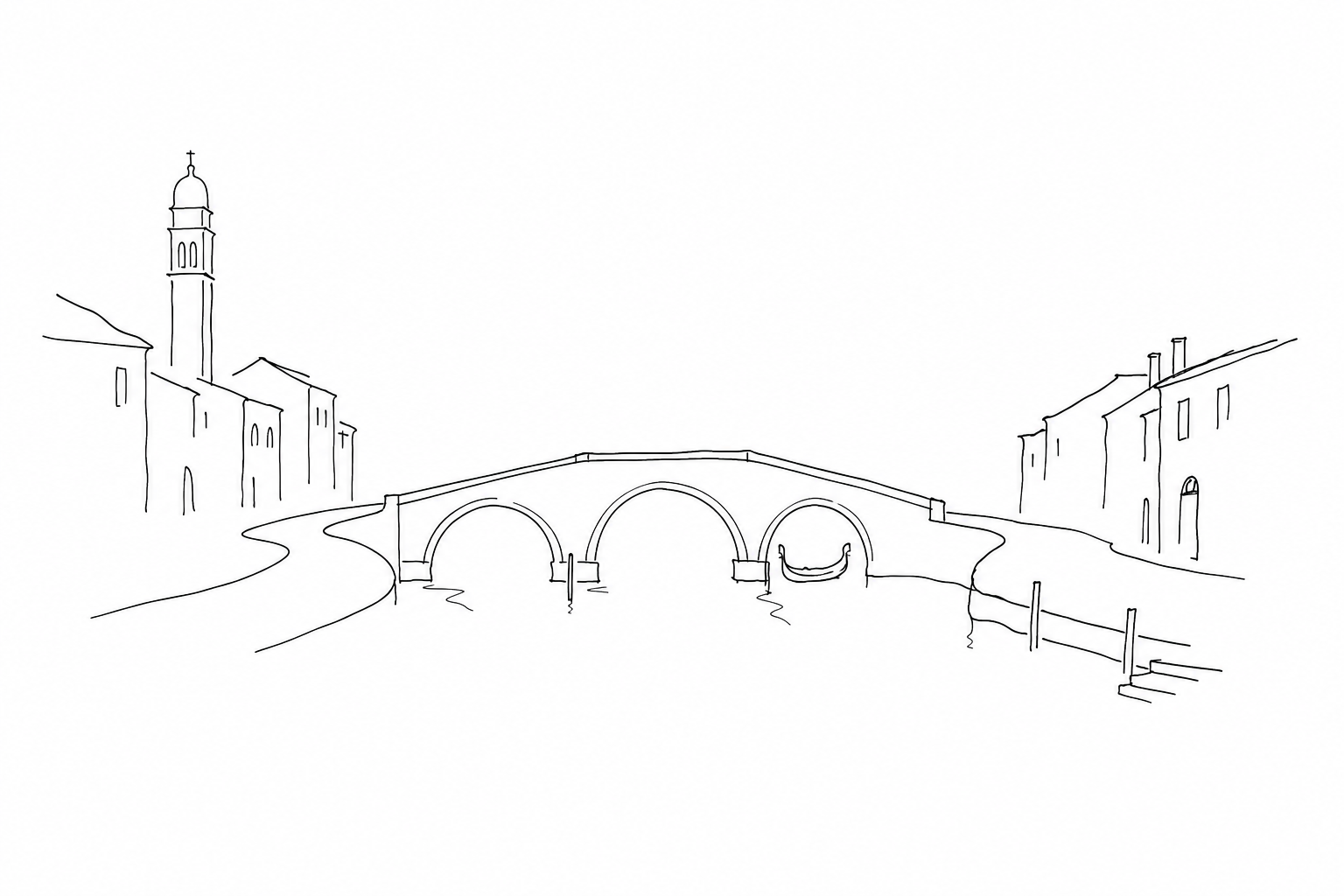
In Venice, a bridge is usually recognized by a simple line: a single arch that spans a narrow rio, with the curve designed to let boats pass and connect two very close banks. The Ponte dei Tre Archi, in the sestiere of Cannaregio, immediately breaks this visual habit: it does not have a single arch, but three openings, with the central one wider and two smaller side ones.
The effect is unusual because the bridge does not cross just any secondary canal, but the Cannaregio Canal, a wide waterway historically important for entry into the city from the north-western lagoon area. Its form therefore responds to a different scale: more monumental, more extended, less “domestic” than the small Venetian bridges.
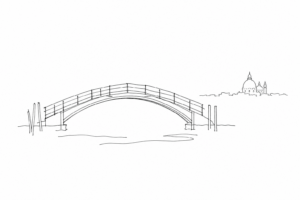
This anomaly is also its identity: the Ponte dei Tre Archi is remembered as the only Venetian bridge with three arches still in existence, a presence that interrupts the rule and makes this stretch of Cannaregio recognizable.
Where it is and what role it has in the sestiere
The Ponte dei Tre Archi is located on the Cannaregio Canal, not on one of the small and winding rii that form the more internal fabric of the sestiere. It is positioned in the western stretch, between the Fondamenta Cannaregio and the Fondamenta San Giobbe, in an area where Venice changes scale: the water is wider, the perspectives open up and the pedestrian crossing has the task of stitching together two very busy banks.
This position explains part of its form. The Cannaregio Canal was an important entrance axis toward the city, connected to the Grand Canal and to the northern lagoon; boats and traffic passed through here that required a wider water space than the secondary canals. The three-span crossing is therefore not only an aesthetic curiosity, but an urban response to a more demanding point in the Venetian fabric.
In the district, the structure also works as a threshold: on one side it points toward San Giobbe and the station area, on the other toward the Ghetto and the more inhabited fondamenta. For this reason it is not an isolated episode, but a node that makes the structure of the sestiere legible.
History and architecture of the three arches
The current form dates back to the seventeenth-century reconstruction, generally attributed to Andrea Tirali and dated 1688. Previously there was a simpler crossing, linked to transit needs along the San Giobbe axis; the reconstruction transformed that passage into a monumental structure, recognizable from afar for its three-span rhythm.
The unusual element is precisely the tripartition. In everyday Venice the single arch prevails, suitable for spanning narrow rii; here, instead, the width of the watercourse required a more articulated solution, with a larger central span and two lower side openings. The piers in the water are not only supports: they mark the perspective and make the work resemble a small urban infrastructure, not a simple pedestrian passage.
The brick masonry dialogues with the Istrian stone of the edges and parapets, creating a contrast typical of Venetian building between structure and finish. The stepped ascent also contributes to the scenic effect: instead of disappearing into the continuity of the fondamenta, the crossing imposes itself as an architectural pause. It is this combination of function, scale and profile that makes it one of the most anomalous presences along the Cannaregio Canal.
To understand the Ponte dei Tre Archi on site, it is best not to cross it right away. Stop first on the bank and look at it from the side: from here its peculiarity can be read better, that is, the presence of three distinct spans instead of the usual single passage. The central span, wider and raised, dominates the composition; the side ones seem to accompany it, creating a rare rhythm in Venetian building.
During the climb, observe the relationship between steps, parapets and water. The structure is not only a pedestrian connection: it builds a small urban scene, with boats passing underneath and the fondamenta framing it. Changing side also changes the perception: from afar it appears almost monumental, up close it reveals its everyday function.
- From below: notice the shadows in the openings and the broken reflection on the water.
- At the top: look at the axis of the Cannaregio Canal and the long perspective toward the inner lagoon.
- Going down: compare this structure with the nearby crossings, more ordinary and compact.
Observing the Ponte dei Tre Archi during a slow walk means allowing yourself the time to read a side of Venice made of practical solutions and unexpected forms. Its peculiarity lies not only in the number of arches, but in the way it modifies the perception of the canal, opens the view and dialogues with the ordinary life of Cannaregio. Stopping here, even for a few minutes, helps to understand that the city is not composed only of its most famous places, but also of architectural details capable of telling of balance, transformations and the daily use of space.