
After Venice, Mestre city center is not simply a return to the mainland: it is a change of scale, light and rhythm. Piazza Ferretto, with its porticoes, layered facades and the everyday life that passes through it, makes it possible to read a different city, yet one linked to the lagoon by centuries of exchanges, work and passage. Here attention shifts from famous monuments to urban details: a sign, a tower, a coffee under the porticoes, the movement of the people who truly inhabit the center.
From the lagoon to the mainland: changing rhythm
Arriving in Mestre city center after a day in Venice means immediately perceiving a change of scale. The lagoon remains close, but the pace becomes more everyday: fewer bridges, fewer calli, more wide pavements, shop windows, bicycles, buses and people returning from work or doing the shopping.
The symbolic passage is the Ponte della Libertà, the twentieth-century threshold that connects Venice to the mainland. Once that line has been crossed, Mestre should not be read as the simple “back” of the historic city, but as an urban center with its own memory: Piazza Ferretto, the porticoes, the Civic Tower, the Duomo of San Lorenzo and the pedestrian streets tell of a city of markets, meetings and services.
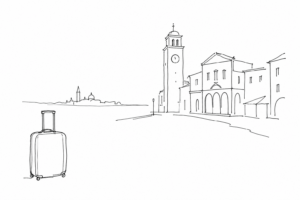
In this return, the beauty lies precisely in the normality. After the visual intensity of Venice, Mestre offers a more direct pause: sitting under the porticoes, crossing the square, observing facades and signs, recognizing a city that is lived in before it is visited.
Piazza Ferretto: the civic center of Mestre
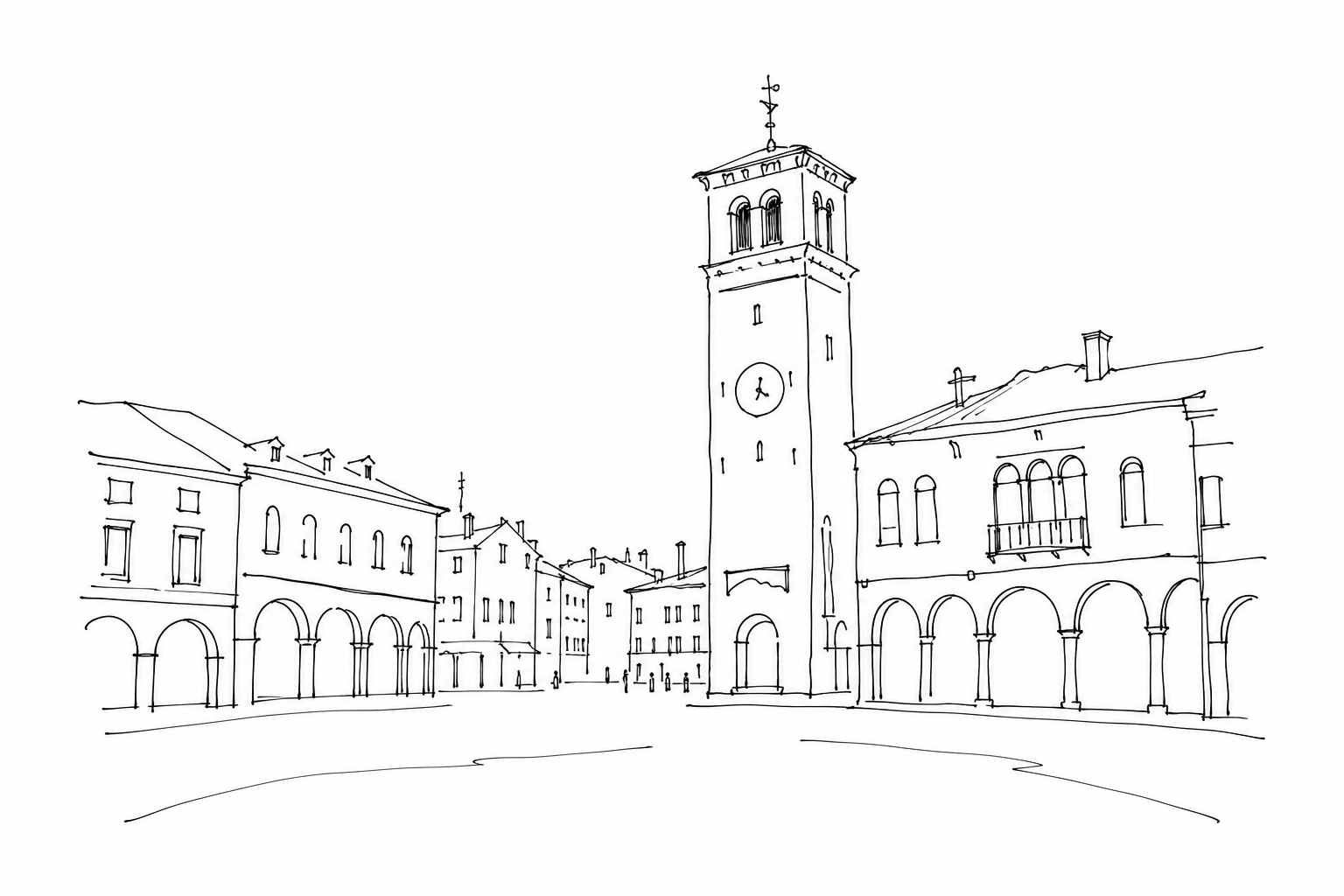
The return to the mainland finds its most legible point in Piazza Ferretto, a pedestrian space where public life is not merely scenery. Here the historic center gathers into a clear form: a long square, flanked by porticoes, shops, cafés and facades from different periods, designed for passing through but also for stopping.
The name recalls Erminio Ferretto, a Venetian partisan, and places the site within a twentieth-century memory that coexists with much older signs. The Clock Tower, towards one end, recalls the medieval fortified layout of the settlement; not far away, the Duomo of San Lorenzo maintains the religious and symbolic role of the center. In the square, the fountain with the sculpture by Alberto Viani adds a twentieth-century artistic reference to an everyday context.
The porticoes are decisive: they protect from the sun and rain, guide the gaze along the shop windows, and turn passage into an urban stroll. After the lagoon calli and bridges, Piazza Ferretto restores a different measure: not monumental in a tourist sense, but civic, commercial, inhabited.
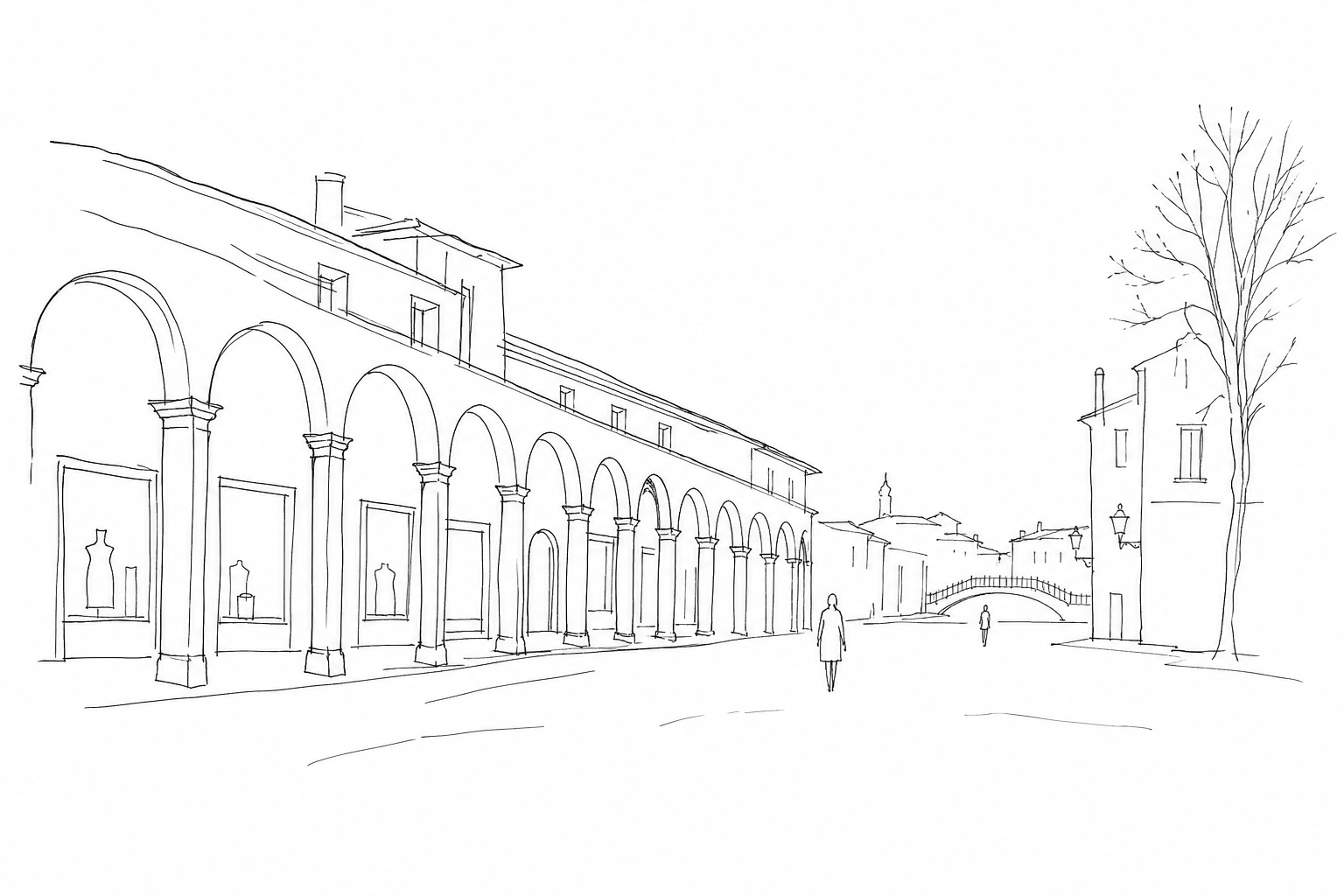
Porticoes, facades and details to observe
To read Piazza Ferretto without crossing it in a hurry, it is worth slowing your pace and raising your gaze at intervals. The porticoes are not only shelter: they mark the commercial edge of the public space and create a continuous threshold between shop windows, entrances and walking. The bays reveal differences in height, rebuilt pillars, older or simplified arches, traces of later adaptations.
On the facades, the rhythm of the windows often distinguishes the piano nobile from the service levels. Frames, windowsills, colored plasterwork and shutters tell of a minute stratification, less spectacular than the lagoon palaces but decisive for understanding urban everyday life. Even the signs deserve attention when they respect or interrupt the order of the openings.
At the end of the sequence, the Clock Tower functions as a vertical reference: it recalls the fortified phase of the settlement and closes the route in perspective. On ordinary days these details coexist with bicycles, small tables, paving, thresholds and passers-by: precisely this coexistence makes the architecture legible as a part in use, not as a separate backdrop.
How to include it in a short stay
In an itinerary of a few days, this passage works best as a gradual return from the lagoon to the mainland. It does not require a long visit: it can become a thoughtful pause before dinner, or an orientation walk when arriving from the station or urban transport. It is best to focus on a compact perimeter: Piazza Ferretto, the Clock Tower as a visual point, the entrance to via Palazzo, Galleria Matteotti and the exterior of the Duomo of San Lorenzo.
- On arrival: use it to understand the local rhythm, among shops, covered passages and pedestrian routes.
- On the return from the lagoon: stopping here avoids ending the day only with transport.
- With little time: choose a slow walk under the porticoes, observing thresholds, historic signs and facades.
For connections, any internal openings or specific services, it is prudent to check updated information, without basing the visit on fixed data.
Including Mestre city center in a short stay means allowing yourself an intelligent pause between arrivals, departures and denser visits. Piazza Ferretto does not ask for a spectacular detour, but for a slow gaze: at the porticoes, the proportions of the buildings, the continuity between city history and the everyday use of spaces. After the lagoon, this part of the city helps you return to a more ordinary dimension, where Venice remains close but the journey changes tone, becoming more concrete, urban and observable in small gestures.
Related Posts
Returning to Mestre after Venice: why the end of the day changes the way you experience the trip
An outline on how returning to Mestre after Venice changes the rhythm, choices and memory of a short stay.First evening in central Mestre: what to do when you arrive too late to go straight into Venice
Concrete ideas for making good use of your first evening in central Mestre without rushing toward Venice: dinner, a walk, urban details and preparation for…
From central Mestre to Venice in the morning: how to set up a slow day without starting in a rush
A practical outline for leaving from central Mestre toward Venice in the morning, with relaxed timing, sensible stops and first destinations suited to a slow…Questions Answered
How does Mestre's city center differ from Venice?
It offers a slower, everyday urban rhythm with wider pavements and local life.What makes Piazza Ferretto significant?
It acts as the civic center, showcasing the city’s history, commerce, and social gathering.What architectural features are important in Mestre?
The porticoes, facades, and details on buildings show historic layering and use.How can Mestre be included in a short itinerary?
As a gradual, thoughtful pause or orientation walk around Piazza Ferretto.
From a Mestre base to the lagoon
How can accommodation, transport and local places fit together without treating Mestre as a mere transit point?
 M9 in Mestre: the museum of the twentieth century for understanding the city before and after VeniceA route for reading M9, central Mestre and the relationship with Venice through history, architecture and everyday life.
 Forte Marghera: the green threshold between Mestre, the lagoon and military memoryEditorial guide to Forte Marghera: history, green spaces, water and its role between central Mestre and the lagoon.
 Staying in Mestre to Visit Venice: When the Mainland Makes Your Trip EasierChoosing where to stay when visiting Venice is not a secondary decision. The lagoon city has an extremely strong character: beautiful, fragile,...How to get from Mestre to Venice: transport, travel times and parkingGetting from Mestre to Venice is straightforward by bus, tram or train. Buses and trams terminate at Piazzale Roma, the road gateway...