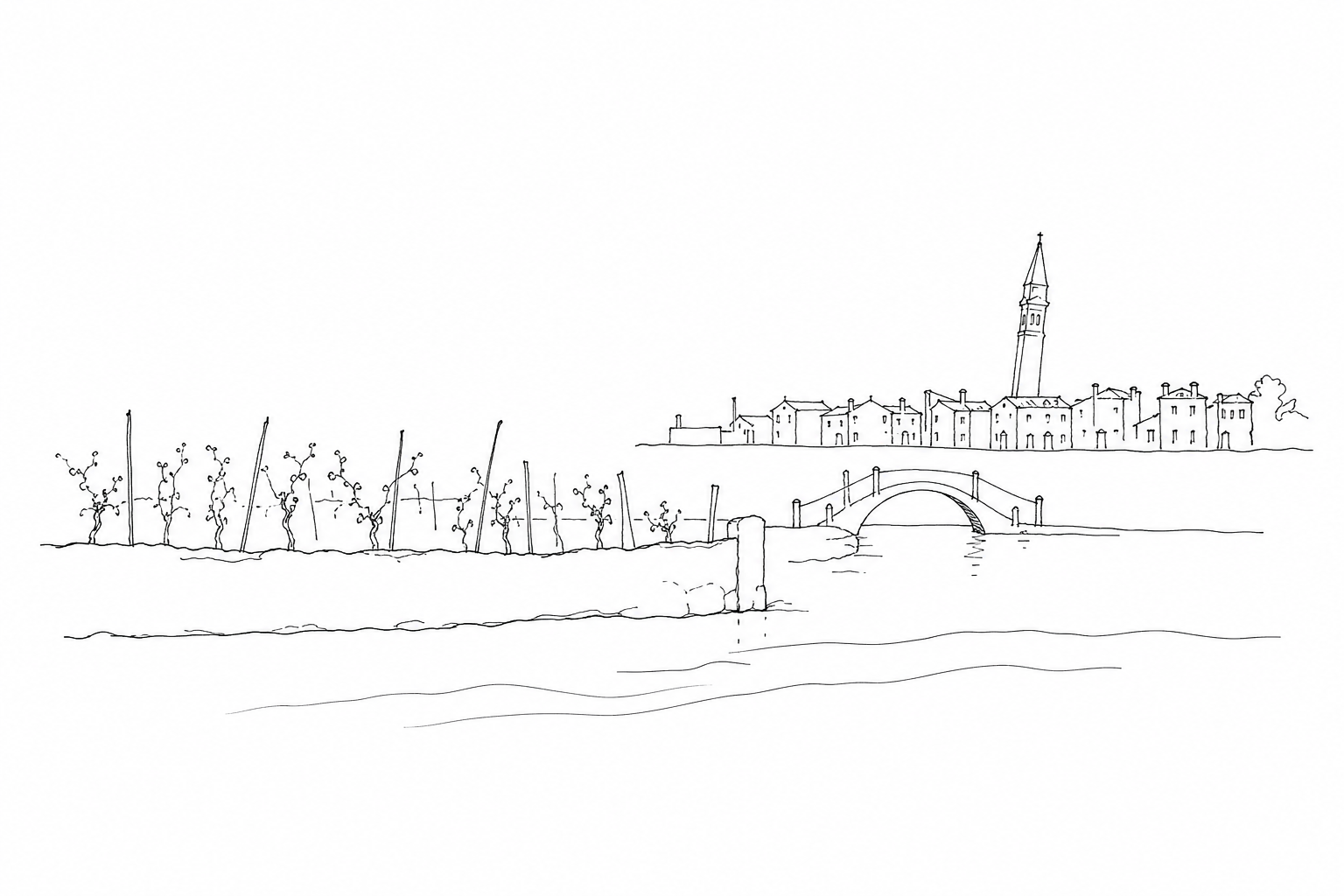

The Hall of the Great Council is not only one of the largest rooms in the Doge’s Palace: it is the place where Venice staged its own idea of the State. Here politics had to have space, measure and visibility, because the Great Council brought together hundreds of patricians and transformed government into a collective ritual. The architecture, surprisingly free of columns, and the great pictorial decoration created after the fire of 1577 construct a precise narrative: an ancient, orderly, powerful republic, capable of presenting itself as immense without losing control of its own image.
A hall created to contain the Republic
The Hall of the Great Council, in the Doge’s Palace, was not conceived as a simple ceremonial room: it was the spatial machine of Venetian politics. Here the Great Council met, the assembly of patricians that embodied the institutional base of the Republic. After the Serrata of 1297, access to government became increasingly and more stably linked to belonging to the registered noble families, and the hall literally had to contain this collective aristocracy.
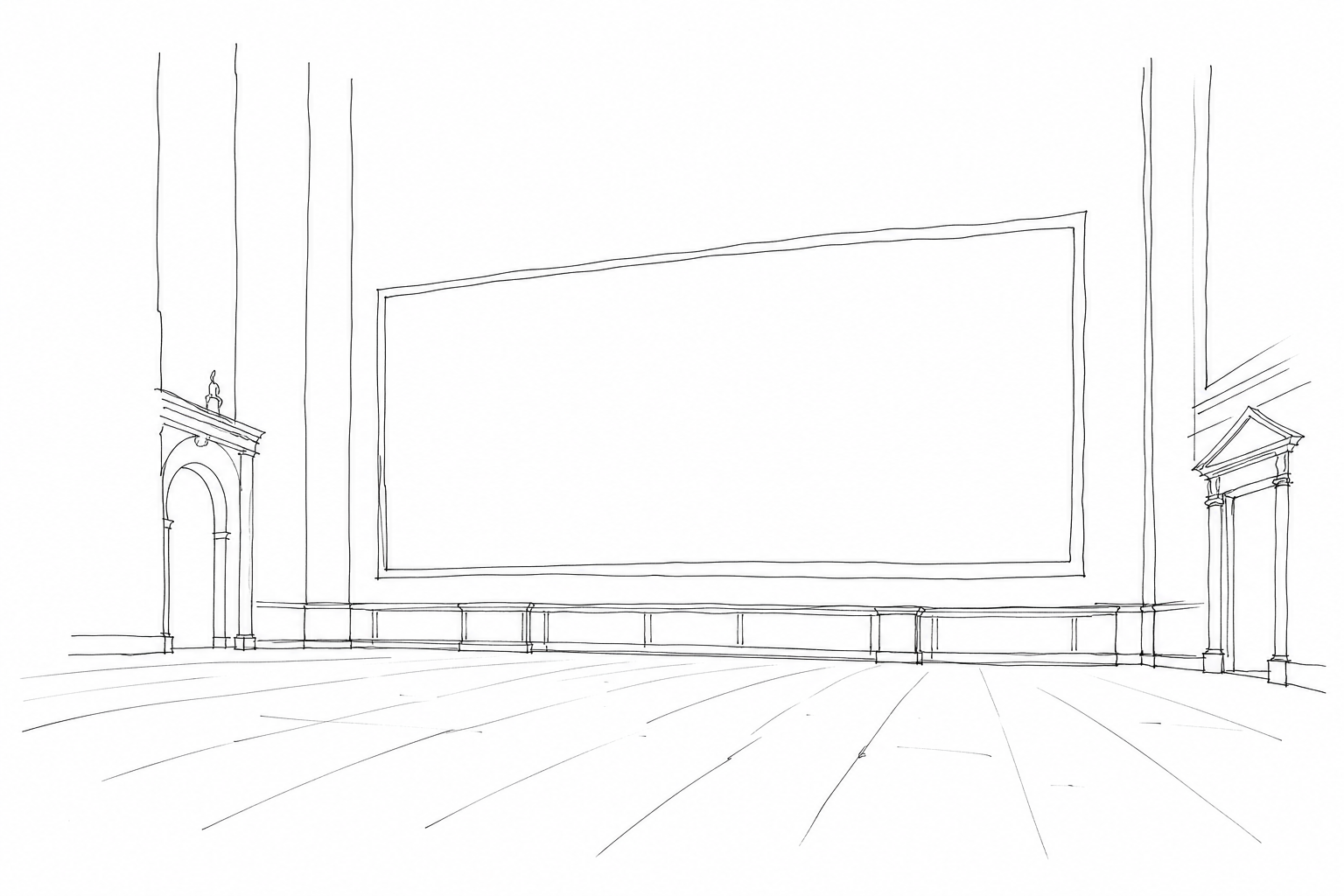
Its exceptional dimensions, about 53 metres long by 25 wide, tell better than many chronicles the idea Venice had of itself: not power concentrated in a sovereign, but a vast, orderly, choral republic. The absence of internal columns made the space open and solemn, capable of accommodating hundreds of members during deliberations.
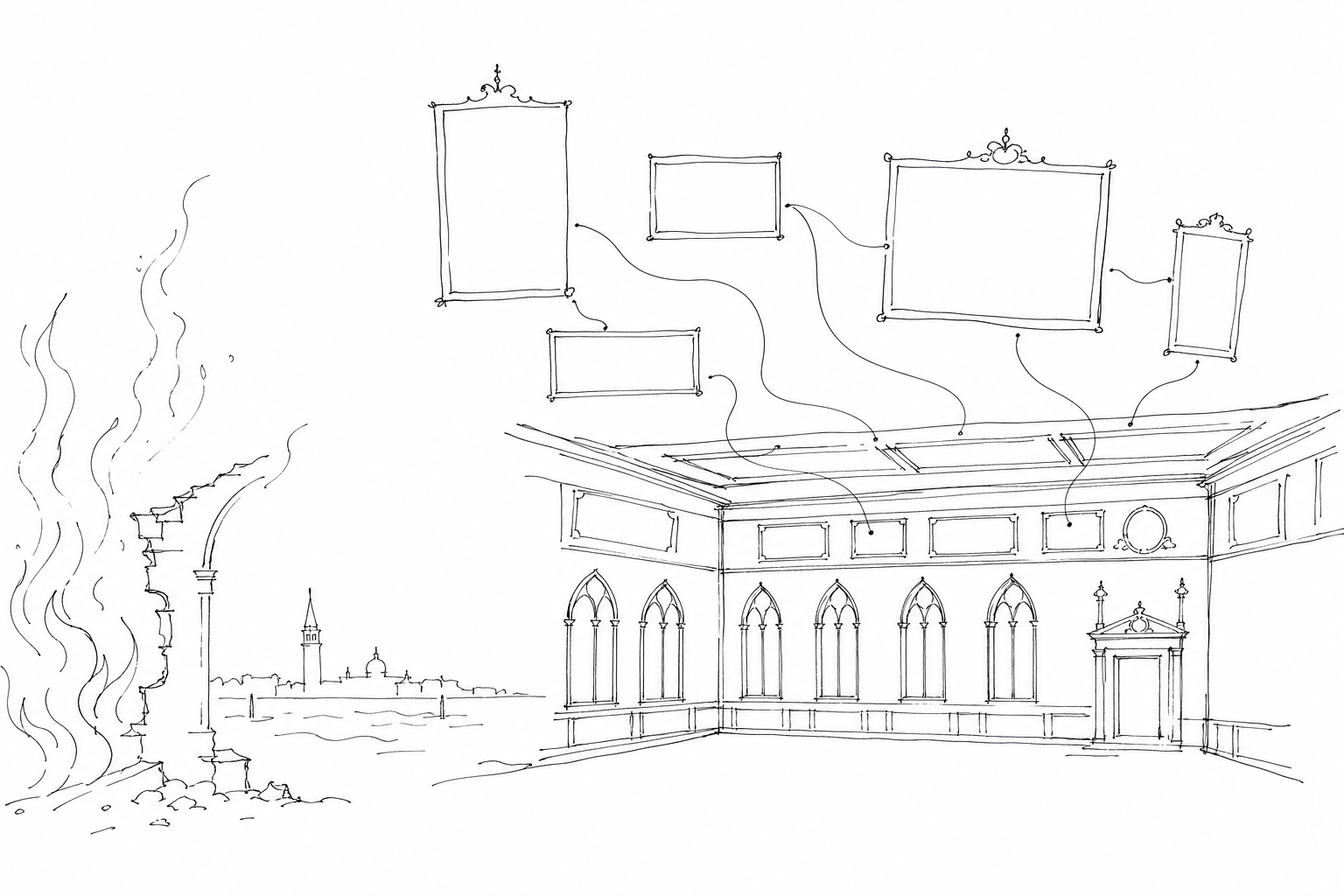
When, after the fire of 1577, the decoration was renewed, that political function became image: the hall was not only to host Venice, but to show it as historical, military and institutional greatness.
Architecture: emptiness, breadth and control
The power of the Hall of the Great Council begins before the paintings: it begins with emptiness. The large rectangular room, over fifty metres long and about twenty-five wide, forgoes central columns, pillars and visual obstacles. This choice is not only technical; it is political. Those who entered perceived a collective body gathered in a single, orderly, legible space.
The breadth does not produce dispersion, but control. The walls function as continuous wings, the lowered and gilded ceiling compresses the gaze towards the assembly, while the side windows regulate the light without breaking the hierarchy of the whole. The architecture made visible a Venetian principle: many patricians, one Republic.
The absence of an isolated monumental point is also significant. The doge does not appear as an absolute sovereign, but as part of a broader institutional machine. The room, with its exceptional scale, transformed deliberation into a disciplined spectacle: Venice painted itself, but even before that it constructed itself as a spatial order.
Painting after the fire of 1577
The fire of 1577 erased much of the fourteenth- and fifteenth-century apparatus, forcing the Doge’s Palace to rewrite its own visual memory. The response was not a simple restoration: it was a new celebratory programme, entrusted to the great painters of the late sixteenth century, designed to transform the hall into an atlas of Venetian power.
On the eastern wall, behind the doge’s throne, the Paradise by Jacopo Tintoretto, later completed with the help of the workshop and his son Domenico, replaced the old fresco by Guariento. The enormous dimensions and the crowd of the blessed gave the scene a precise value: above earthly rulers stood a higher, luminous and judging order.
The ceiling and walls received canvases by Paolo Veronese, Palma il Giovane, Francesco Bassano and other masters. Allegories, naval triumphs, embassies and victories constructed a coherent narrative: the Serenissima presented itself as wise, protected by justice, victorious at sea and recognised by foreign powers.
Even the series of doges took part in this staging. The darkened place of Marino Faliero, condemned for treason, recalled that collective glory mattered more than individual ambition.
To read the monumental space, it is not useful to look for a single masterpiece, but to follow the overall staging. The visitor is placed before a visual machine that transforms space into an argument: out-of-scale dimensions, gilded ceiling, walls dense with episodes and portraits declare that power belongs to a collective body, not to an isolated figure.
A practical key is to distinguish three registers. Above, allegories and virtues present the lagoon government as a just and protected order. On the walls, battles, embassies and naval triumphs translate history into proof of legitimacy. At the far end, Tintoretto’s Paradise, placed behind the doge’s area, moves earthly authority under a religious and universal gaze.
Observing from a distance helps: the individual details matter less than the cumulative effect. The Serenissima shows itself as immense because it organises memory, faith and maritime dominion into a single public image.
Visiting the Hall of the Great Council means reading Venice at the moment when it speaks of itself with the greatest awareness. The dimensions, the central emptiness, the portraits of the doges, the monumental canvases and Tintoretto’s Paradise are not isolated elements, but parts of a political and visual staging. In this hall the Republic does not merely celebrate victories and institutions: it organises memory, disciplines the visitor’s gaze and transforms history into self-representation. For this reason it remains one of the most eloquent spaces in Venice, more complex than its sheer greatness suggests.
Related Posts
Tintoretto’s Paradise at the Doge’s Palace: the enormous painting that closes a history of government
Guide to Tintoretto’s Paradise in the Great Council Hall: scale, history, reading, and political meaning.The Golden Staircase of the Doge’s Palace: ascending toward power amid stucco and political control
The Golden Staircase as a political threshold of the Doge’s Palace: architecture, stucco, access and messages of power in the Venice of St. Mark.
The Scuola Grande di San Rocco: Tintoretto and the pictorial cycle that transforms a confraternity into sacred theater
History, rooms and reading of Tintoretto’s cycle at the Scuola Grande di San Rocco, between confraternity, architecture and sacred theater.Questions Answered
What was the purpose of the Hall of the Great Council's architecture?
To embody a collective republic and maintain clear visual control without a sovereign focus.How did the 1577 fire affect the hall's decoration?
It prompted a new celebratory artistic programme reflecting Venice’s power and legitimacy.What messages do the paintings in the hall convey?
They depict Venice as just, victorious, and unified under collective authority.How does the hall represent the balance between individual and collective power?
By diminishing individual doge’s sovereignty and highlighting the supremacy of the Republic as a whole.
From the square to the rooms of power
Would you like to follow other places showing how Venice represented itself at the heart of St Mark’s?
 The Piombi and Pozzi: the prisons of the Doge’s Palace beyond the legend of CasanovaHistory, spaces and meaning of the prisons of the Doge’s Palace, from the Piombi to the Pozzi, beyond the myth of Casanova’s...
 Palazzo Contarini Fasan: the so-called house of Desdemona and the fragile charm of Venetian GothicHistory, legend and Gothic details of Palazzo Contarini Fasan, a small façade on the Grand Canal linked to the myth of Desdemona.
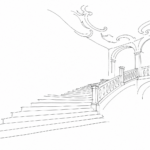 The Golden Staircase of the Doge’s Palace: ascending toward power amid stucco and political controlThe Golden Staircase as a political threshold of the Doge’s Palace: architecture, stucco, access and messages of power in the Venice of...
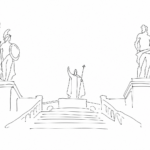 The Giants’ Staircase: where the doge became doge before the cityHistory, ritual and details of the Giants’ Staircase in the courtyard of the Doge’s Palace.