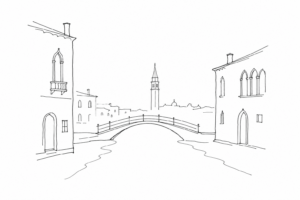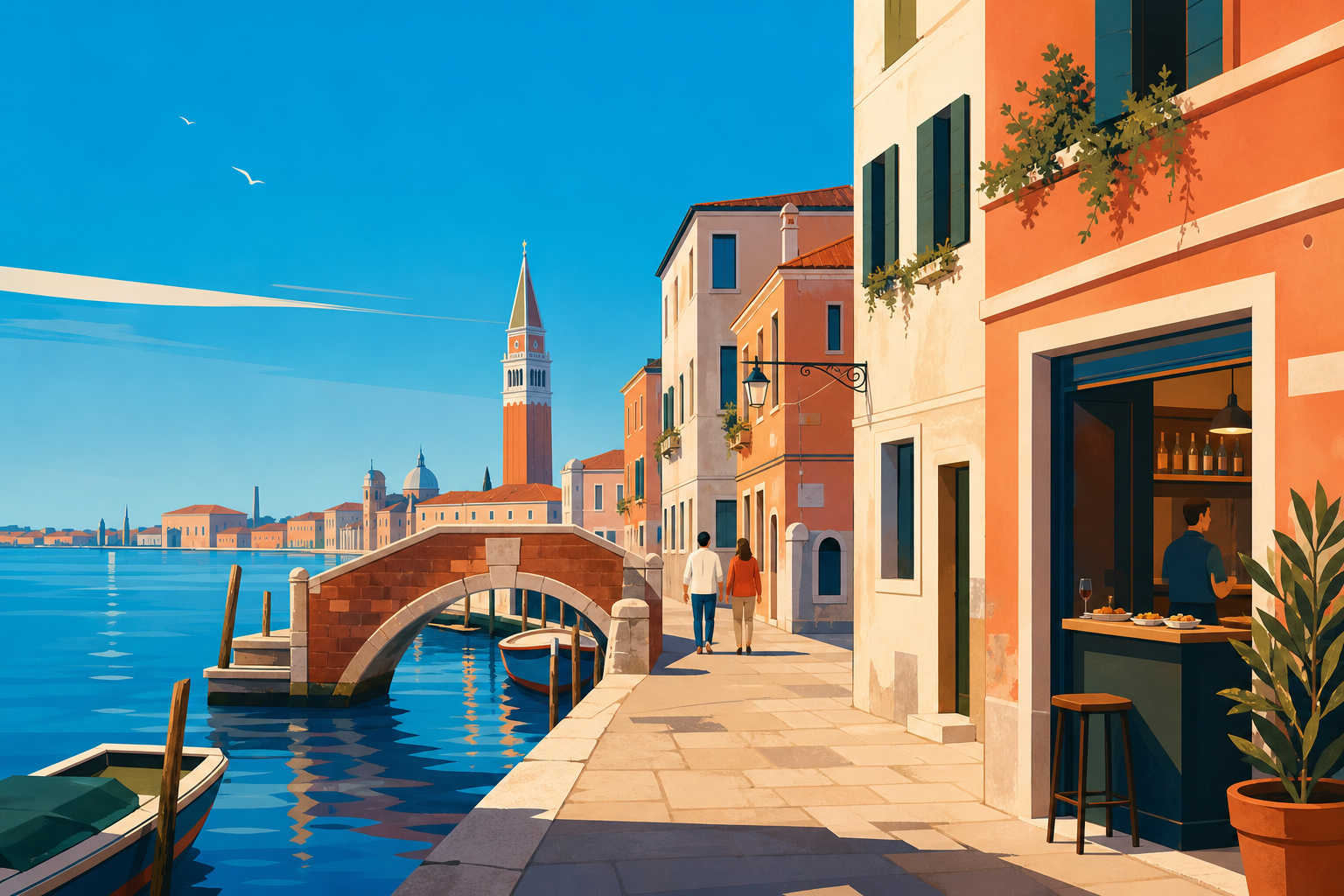
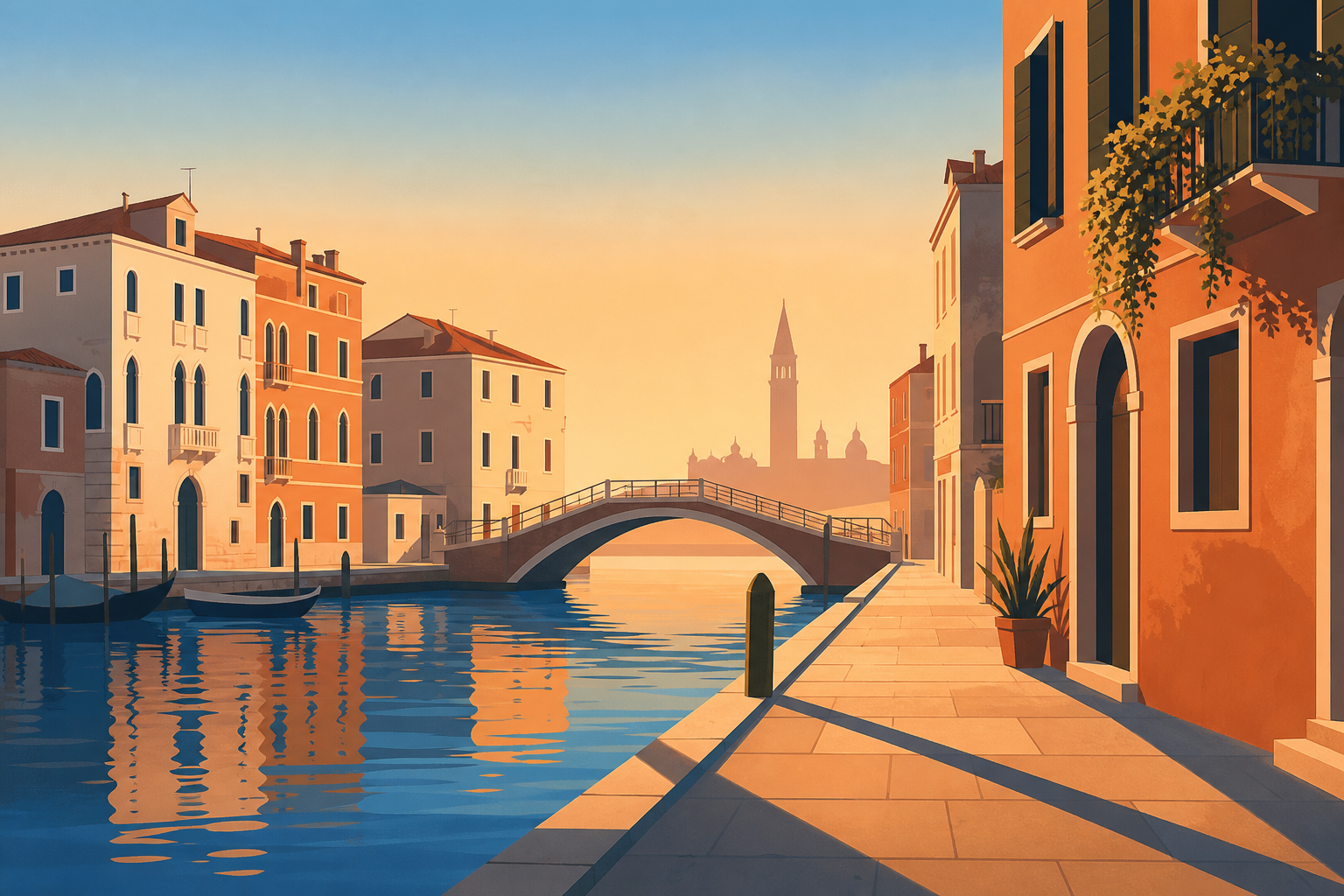

In Venice, sunset is not just a beautiful light: it is a change of pace. The calli empty out at times, the water takes on color, steps become slower and even the best-known places seem to ask for less haste. You just need to choose well where to go: a wide fondamenta, a side campo, a bridge to cross without chasing the perfect photo. On this route we move through Dorsoduro, Zattere, Cannaregio, San Polo, Rialto and Castello, following the city as the day withdraws and makes room for quieter, practical and true details.
When Venice changes pace
At sunset Venice does not stop: it simply slows down. The low light cuts into the calli, slips over the bridges, touches the rii and makes the nizioleti legible, those signs painted on the walls that guide you among campi and campielli. It is the hour when a wellhead, a worn door or the reflection on a canal is worth more than a rush between Rialto and San Marco.
For a slow walk, it is best to choose a few stops and stay faithful to the rhythm of daily life. A stretch of Cannaregio, a fondamenta in Dorsoduro, a quiet passage in San Polo or towards Castello can be enough. Look up at the altane, the moored boats, people coming home with shopping, the bacari that begin to fill up for an ombra and two cicchetti.
Start about an hour before sunset, with comfortable shoes: there are many bridges and the stones are tiring. If you are moving as a couple or in a small group, avoid the most crowded entrances and already think about the return. Those who have a base in Mestre to visit Venice can head back calmly towards the station and end the evening in central Mestre, among Piazza Ferretto, Torre Civica and M9.
Dorsoduro and Zattere, broad light on the lagoon
At the Zattere, sunset arrives without haste. The light opens onto the lagoon, slips over the water of the Giudecca Canal and makes the details more legible: the altane above the roofs, the façades worn by salt, the boats returning, the long shadows on the fondamenta. It is a slow walk, suitable for a couple or a small group, especially on a short stay when you are looking for a Venice less compressed among calli, bridges and campielli.
The most beautiful stretch is the one that leads from the Zattere towards Punta della Dogana. You walk with the water always beside you, looking at San Marco from a quieter distance. Every now and then it is worth turning around: Dorsoduro changes rhythm depending on the hour, and among a side rio, a nizioleto and a wellhead you can still feel the inhabited city, not only the one being crossed.
A simple stop before dark
Before reaching the point, choose a stop without complicating the route: an ombra, that is, a small glass of wine, or a few cicchetti in the nearby bacari, heading back towards the inner campi. It is a concrete way to end the day, even if you have a base in Mestre to visit Venice or arrive from central Mestre after Piazza Ferretto, Torre Civica or M9.
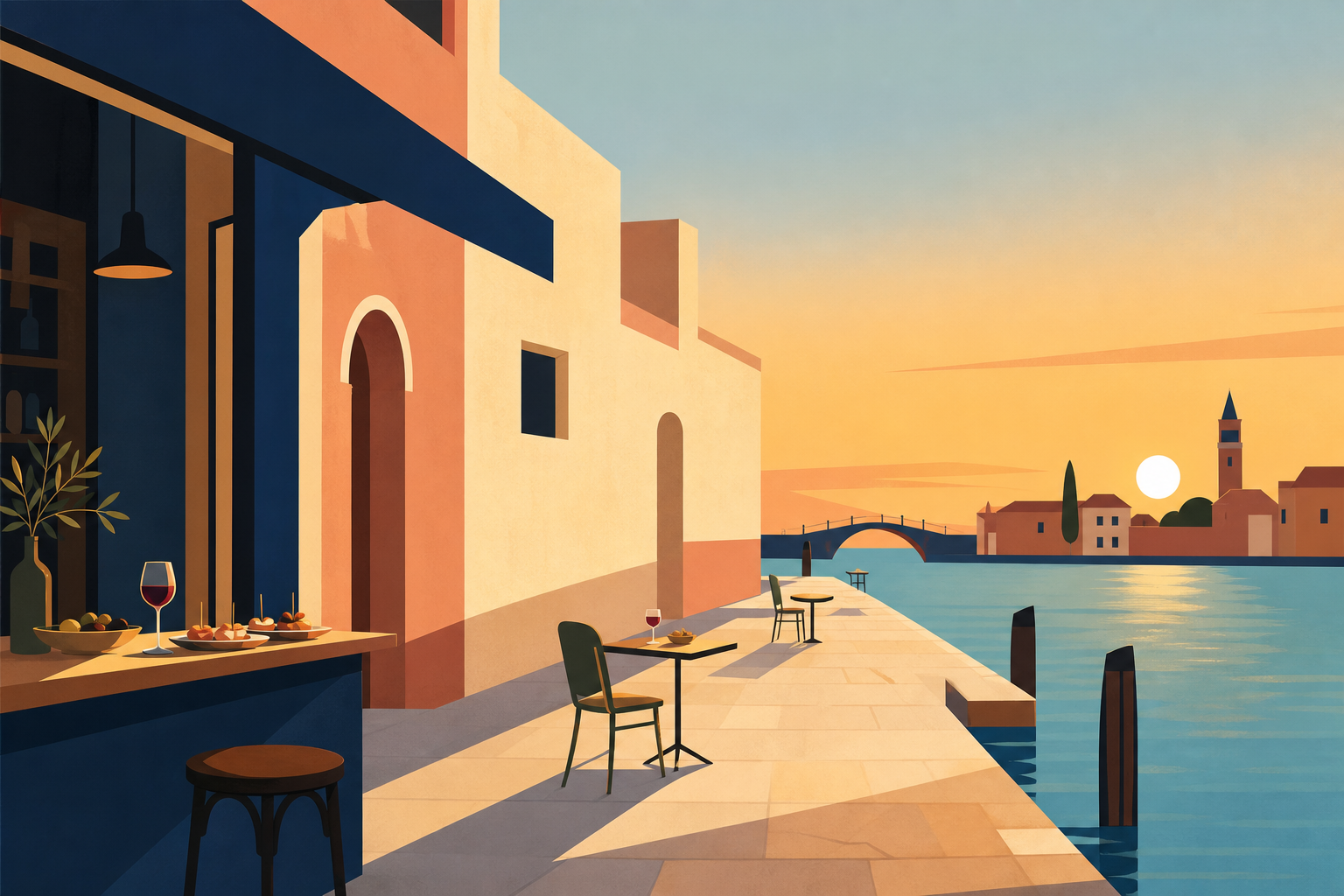
At sunset Cannaregio changes pace without ceasing to be everyday. On the fondamenta della Misericordia, the tables of the bacari fill up slowly, someone orders an ombra and two cicchetti, others return with shopping bags. It is an inhabited Venice, not posed: the reflection on the rii arrives between a shutter coming down, a boat passing slowly, the nizioleti at the corners of the calli.
From here it is worth slipping into the side campielli, where the wellheads, the worn parapets and the altane above the roofs tell more than many guides. Walking towards San Polo, crossing small bridges and narrow canals, the light becomes lower and the façades take on color. It is a slow walk suited to a couple or a small group, especially on a short stay when you want to understand the rhythm of the sestieri without running between San Marco, Dorsoduro and Castello.
Rialto deserves a side approach: better to arrive from Santa Croce or from San Polo, avoiding the fullest passage. Stop before the bridge, look at the Grand Canal calmly, then continue. If you have chosen a base in Mestre to visit Venice, the return to central Mestre can wait a few more minutes.
Castello, return and base in Mestre
When the sunset slips away, Castello is one of the sestieri where Venice begins to speak more quietly again. After San Marco, it is enough to walk towards via Garibaldi, the side campielli and the fondamenta that lead to Sant’Elena: fewer voices, more footsteps, a few dogs on leashes, the nizioleti on the walls, a wellhead in the center of a campo. It is a slow walk inside an inhabited city, with the rii reflecting the last light of the lagoon.
For a couple or a small group, the advice is not to stretch the time too much: calculate the return before you get tired, especially if you have already crossed Rialto, Cannaregio, Dorsoduro or San Polo. From Sant’Elena or Giardini the vaporetto helps put the rhythm back in order, without turning the evening into a race among bridges and calli.
If the trip is a short stay, central Mestre can be a real base for visiting Venice: Piazza Ferretto, the Torre Civica and M9 provide clear reference points, with bacari, cicchetti and an ombra before returning. Sleeping in Mestre to visit Venice does not mean staying outside the journey: it means choosing a practical, legible break, close to the canals but also to daily life.
Seeing Venice at sunset means accepting that you do not want to do everything. Better a well-chosen walk, a stop by the water, a bacaro without too much scene, a quiet return towards Castello or towards Mestre if you sleep off the island. The city, at that hour, rewards those who observe: a lit window, a boat passing slowly, the sound of footsteps on the stones. There is no need to seek the most famous spot: often the best light arrives where you stop by chance, when Venice stops being an itinerary and becomes a presence.