
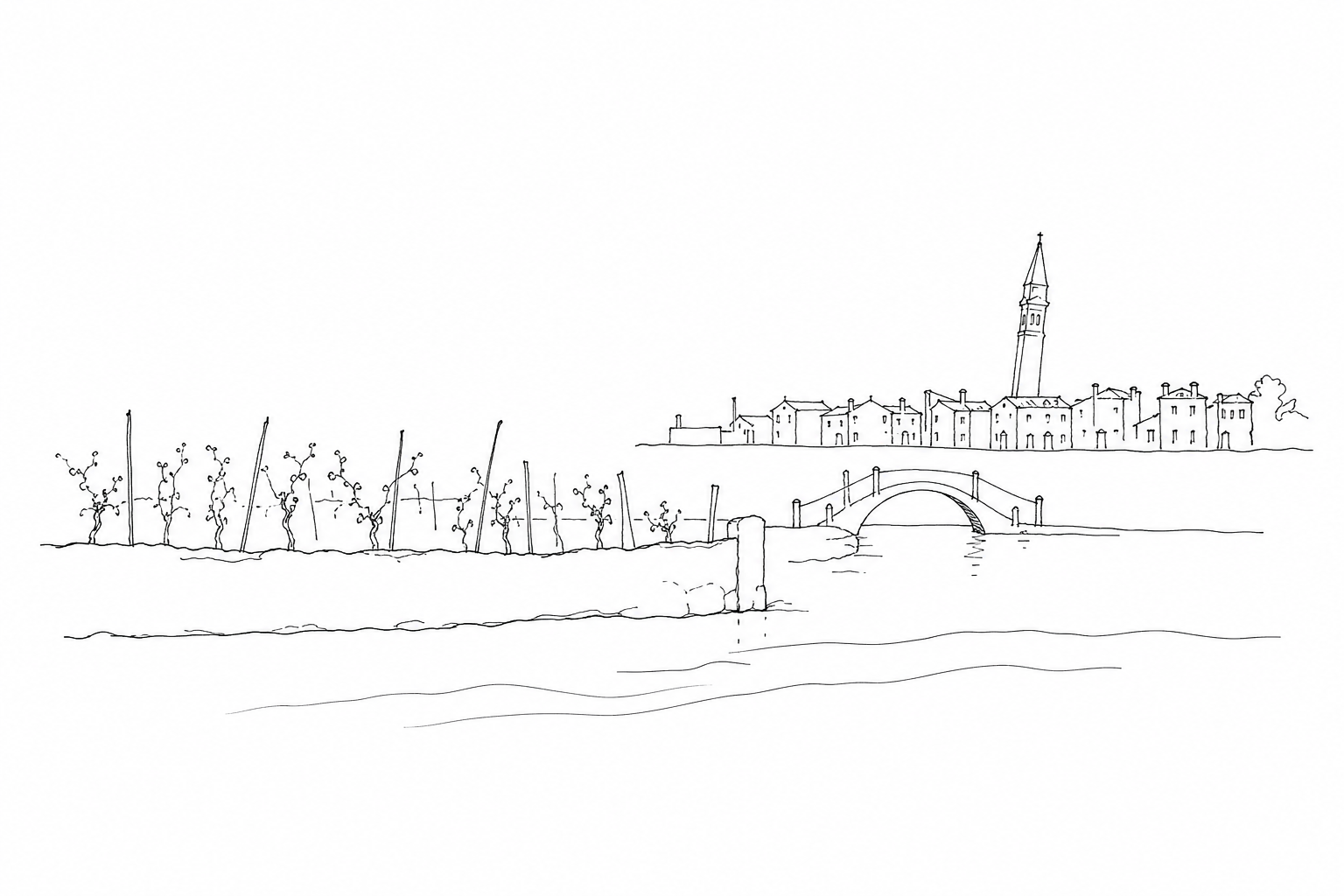
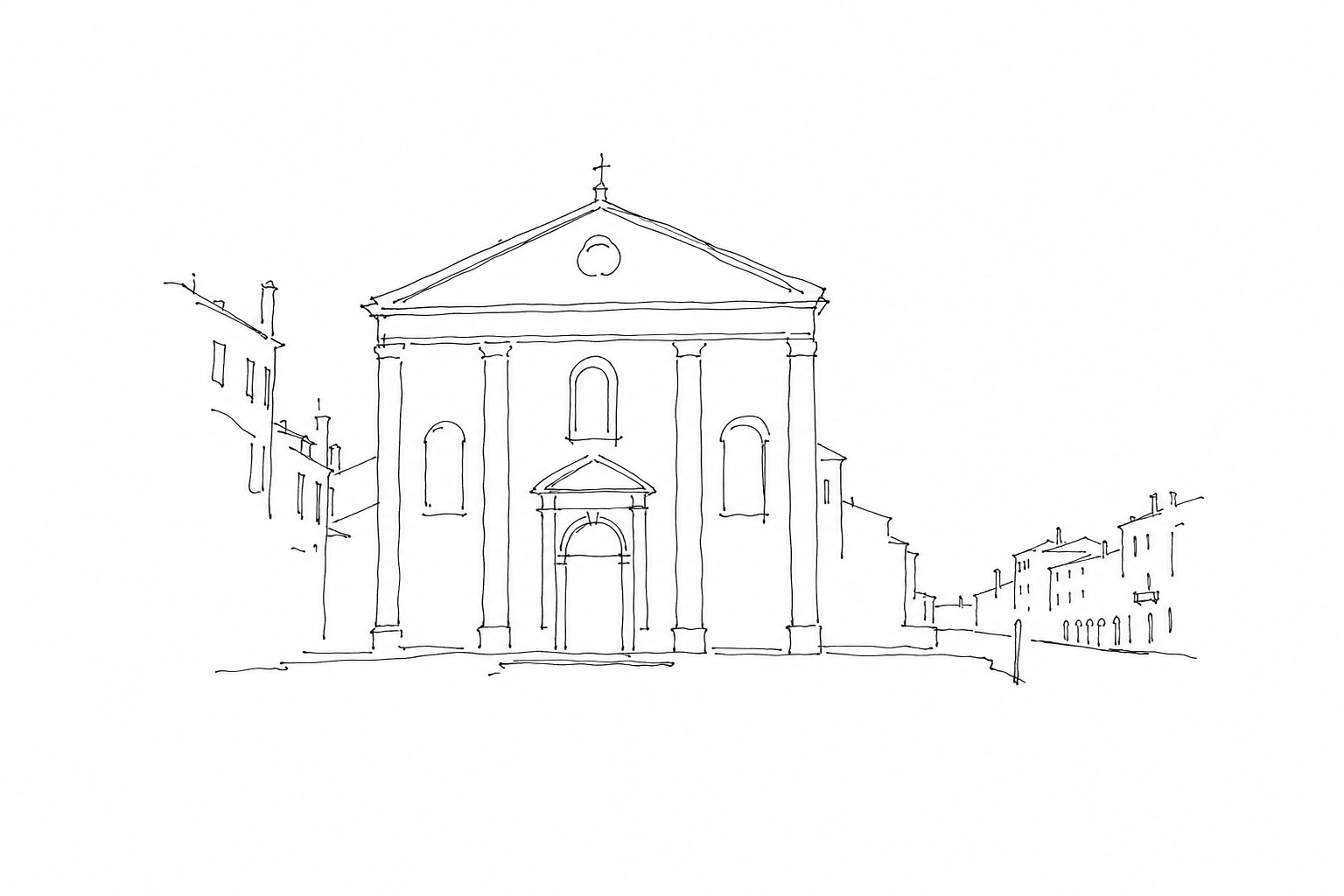

San Salvador is one of those Venetian churches that you come across almost by chance, in the dense and everyday stretch between Rialto and St. Mark’s. Its central location makes it familiar and, precisely for this reason, easy to underestimate: you pass in front of the facade, follow the flow of the calli, postpone going inside. And yet, beyond that threshold, a measured Renaissance space opens up, built with rigor, where the urban history of Venice intersects with some decisive artistic presences, from Titian to Giovanni Bellini.
Between Rialto and St. Mark’s, a church right on the thoroughfare
San Salvador is located in one of the most crossed points of Venice: the pedestrian route that connects the Rialto Bridge to St. Mark’s Square. Here the pace tends to quicken, guided by the commercial calli, the signs and the continuous flow of residents, workers and visitors. Precisely for this reason the church risks becoming a backdrop: a monumental facade seen obliquely, an entrance beside the movement of daily life.
And yet its position is part of its importance. In the sestiere of San Marco, a short distance from Rialto, San Salvador belongs to the central Venice of confraternities, workshops, major patrons and families who wanted to leave a memory in visible places. It is not an isolated church to be deliberately sought out: it is a church you encounter. Entering means interrupting for a few minutes the city’s most practical route and discovering, behind the passageway, an interior linked to Titian, Bellini and the Venetian Renaissance period.
A Renaissance reconstruction in the heart of the city
The San Salvador visited today is not merely a container for famous works: it is the result of a reconstruction begun at the start of the sixteenth century, when Venice was translating the language of the Renaissance into monumental spaces even within its most crowded fabric. The previous medieval building was replaced by a larger and more regular structure, linked to the names of Giorgio Spavento and Tullio Lombardo, with later interventions that brought the internal arrangement to completion.
Its urban importance arises precisely from this position: not an isolated complex, but a sacred place grafted onto the commercial spine of the Mercerie and into the city’s everyday routes. The interior, marked by pillars, arches and aligned domes, introduces a classical measure where outside narrow calli, workshops and continuous passageways prevail.
For this reason San Salvador matters in Venetian history: it shows how the architectural modernity of the early sixteenth century entered the living center of the city, preparing the context in which the altarpieces by Titian and Bellini gain their full meaning.
Titian and Bellini: what to really look at
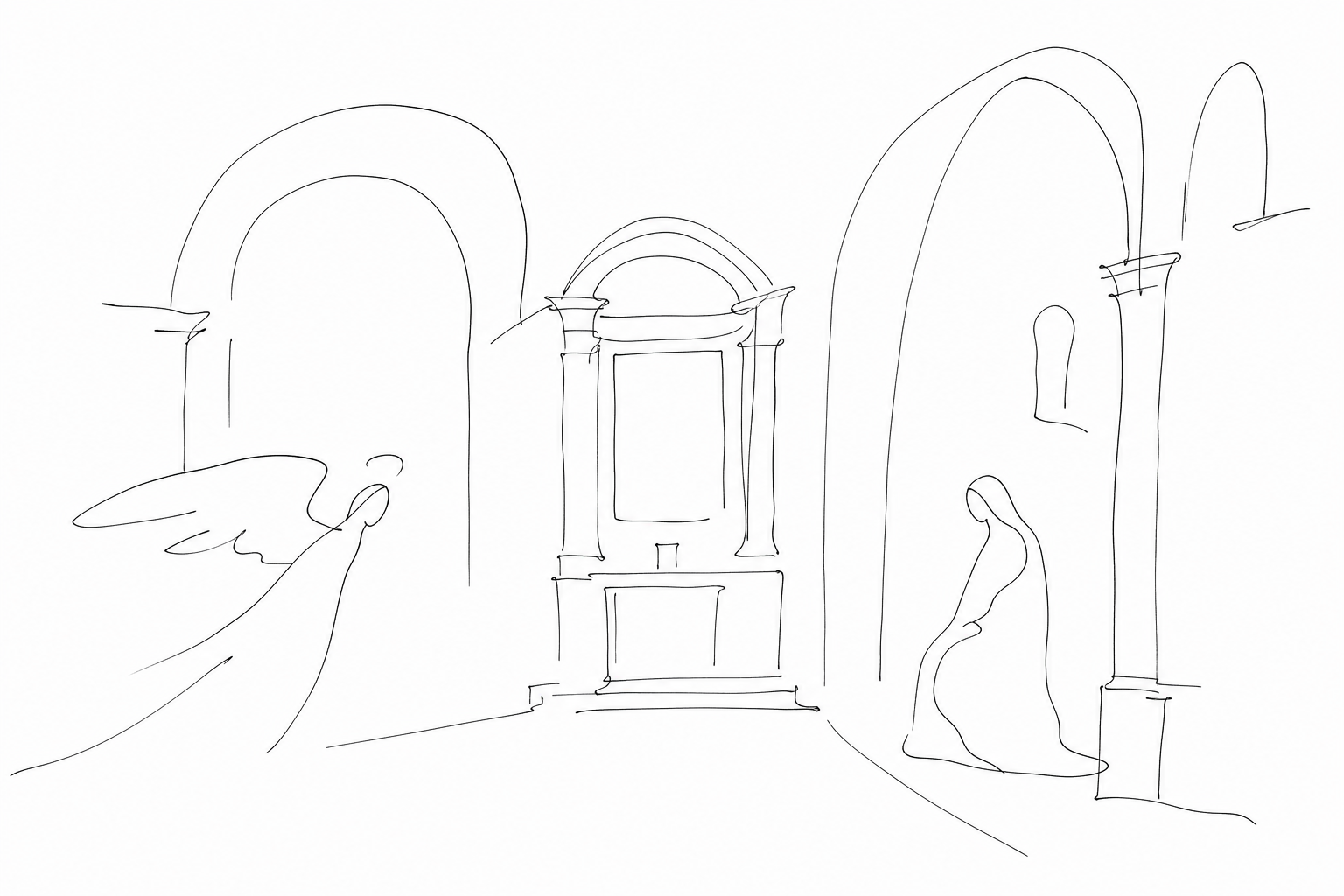
In front of Titian’s canvases in San Salvador it is best to avoid the hasty search for the “famous name” and instead pause over the way painting dialogues with the Renaissance space. In the Annunciation, attributed to the master’s late phase, the scene is not pacified: the angel bursts in, Mary draws back, the light seems to move the air rather than simply describe the bodies. It is a painting of energy, not of devotion alone; the broad and vibrant brushstrokes call for viewing from a distance and then for a slow approach.
The Transfiguration shows another decisive point: Titian builds the contrast between the divine radiance above and the bewilderment of the apostles below. It is not only an episode from the Gospel, but a visual machine conceived for an altar, where verticality, light and gesture guide the eye toward the theological center of the image.
With Giovanni Bellini the pace changes. His painting should be read in the calm of the tonal transitions, in the measure of the faces, in the silence that surrounds the figures. If Titian tends toward dramatic tension, Bellini holds emotion within a more meditative light. The comparison between the two is the real reason not to pass through this building distractedly: here, in just a few meters, one sees the passage from fifteenth-century composure to the chromatic power of the full Venetian sixteenth century.
How to visit it attentively, without variable data
To truly understand San Salvador, it is best to treat it as a slow stop, not as a corridor between two crowded areas. As soon as you enter, stop for a few minutes in the central nave: the Renaissance plan, with regular bays and domes in succession, prepares the eye for the altarpieces more than it may seem.
A good method is to proceed in three stages. First observe the whole: proportions, light, pale stone, rhythm of the arches. Then move closer to the works without immediately looking for the iconographic detail. Finally step back a few paces: many canvases created for side or main altars work better from a distance.
Avoid relying on remembered opening hours or outdated information: openings, any restorations and access procedures can change. Check the practical details before setting out, but once inside leave room for attention: here the visit is measured more by the quality of the gaze than by the number of minutes.
Visiting San Salvador means slowing down at a point in the city that usually invites you to speed up. There is no need to look for the spectacular exception: it is enough to observe the proportion of the nave, the relationship between light and stone, the placement of the works, the way Titian and Bellini dialogue with a building born in the operational heart of Venice. It is a brief but dense stop, capable of changing the perception of a much-traveled route and of reminding us that, often, the most interesting discoveries are precisely in the places we pass through without really looking at them.