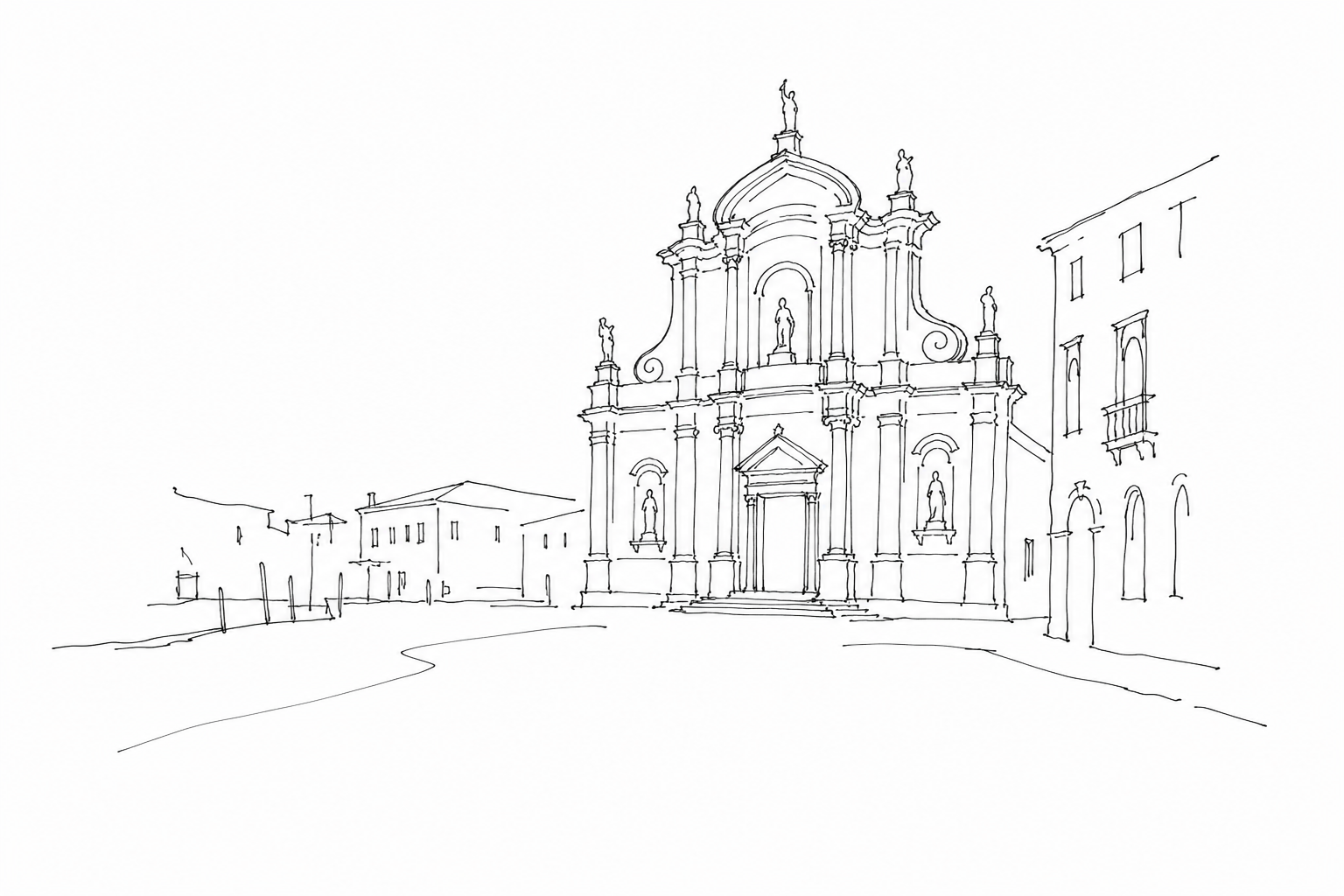

A few steps from the elegant bustle of Campo Santa Maria del Giglio, the church seems to announce Marian devotion. But one only has to look up at the façade to understand that the story takes another direction. Here the stone speaks above all of the Barbaro family: of Antonio, of his military and diplomatic offices, of family memory transformed into public architecture. Statues, maps, inscriptions and trophies form a kind of celebratory self-portrait, unusual even for Venice. Reading this façade means entering a point where art, power and the city overlap with surprising clarity.
Those who arrive in front of Santa Maria del Giglio would expect a declaration of Marian devotion: the name refers to the lily of the Annunciation and to the Virgin, and the church is indeed linked to an ancient dedication, also known as Santa Maria Zobenigo. Yet the seventeenth-century façade mainly tells another story: that of the Barbaro family, a Venetian patrician family that transformed the front into a true dynastic monument.
The surprise arises precisely from this gap. Instead of an iconographic program centered on the Madonna, the visitor finds statues, coats of arms, military trophies and references to the public careers of the family. The patron Antonio Barbaro, who died in 1679, wanted the new façade to celebrate his own role and that of his brothers, rather than visually introduce the building’s Marian worship.
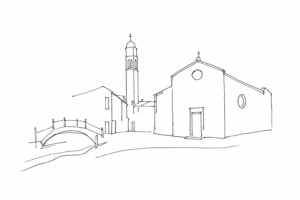
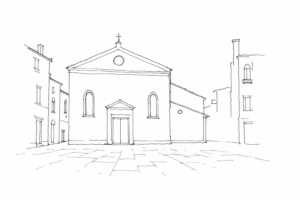
Designed by Giuseppe Sardi, the front thus functions as a page of noble self-representation: Venice, war, diplomacy and family prestige occupy the space that, in a church dedicated to Mary, one would expect to be reserved for the Virgin.
Antonio Barbaro and a family commission
The protagonist of this façade is Antonio Barbaro, a Venetian patrician linked to the military and administrative offices of the Serenissima. His initiative should not be read as a simple embellishment of the church: it is a construction of public memory, designed to transform stone into a family archive exposed to the city.
The sculpted maps of the places where Barbaro had served Venice — including Candia, Corfu, Zara, Spalato, Padua and Rome — shift attention from devotion to the political curriculum. They are not decorative views: they function as visual proof of loyalty to the State, of diplomatic experience and of presence in the strategic territories of the Republic.
The statues of members of the Barbaro family also participate in this logic. Clothing, armor, poses and inscriptions compose a genealogy of service, presenting the family as indispensable to Venetian greatness. For this reason the façade seems to speak less of the worship inside and more of a message addressed outward: to remind passersby that the Barbaro family had served Venice in its decisive spaces, from the lagoon to the eastern Mediterranean.
Statues, maps and symbols: how to read the front
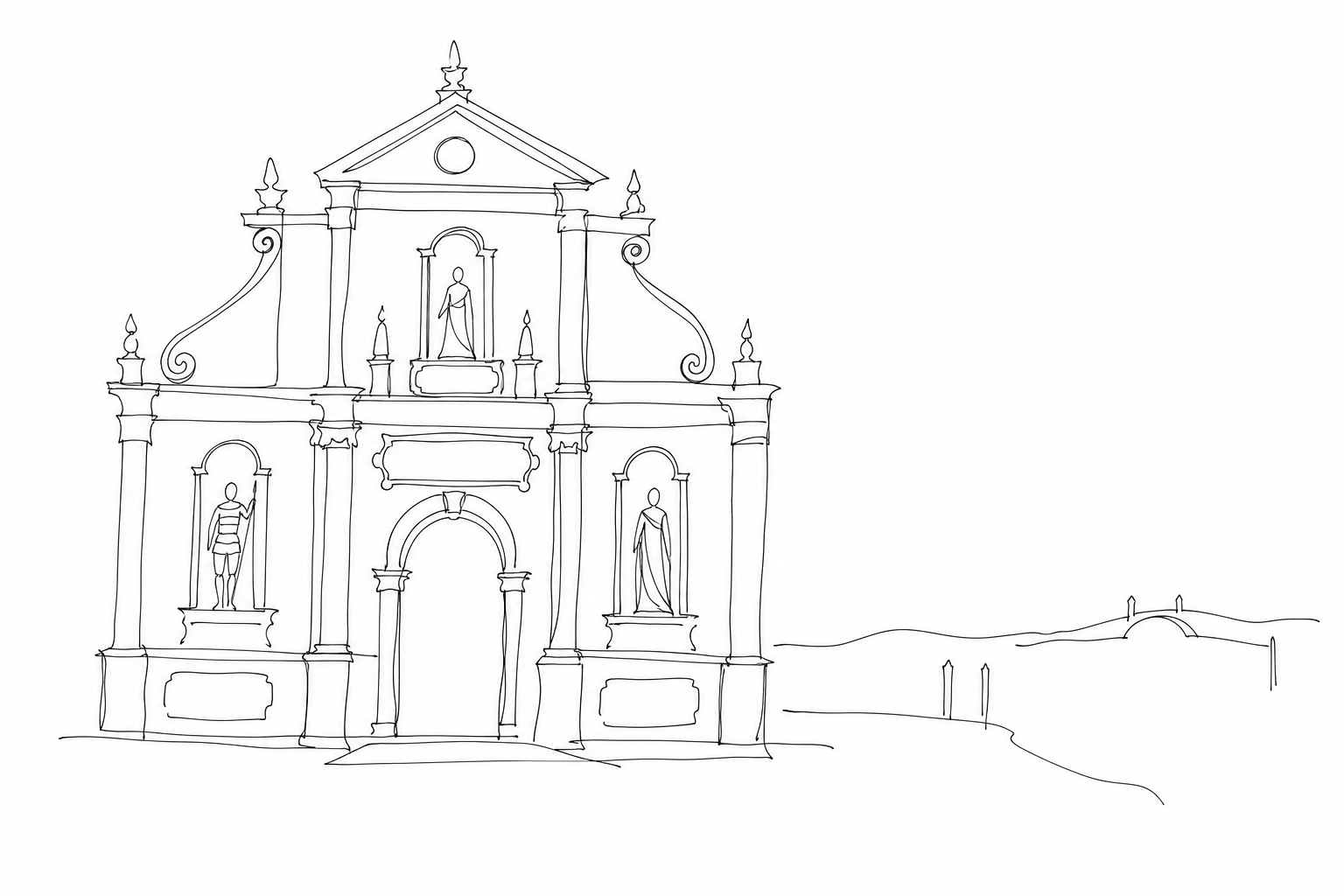
To understand why the exterior of Santa Maria del Giglio seems to speak more of the Barbaro family than of the Madonna, it is best to start from the bottom. The reliefs show plans of cities, ports and territories linked to the public career of the family: Candia, Corfu, Zara, Spalato, Padua and Rome are read as stages of service, command and representation. They are not simple geographical ornaments: they transform stone into a family atlas.
The gaze then rises toward the sculpted figures. Antonio Barbaro dominates the center, not a patron saint; around him, the statues of relatives build a visible genealogy, almost a dynastic monument applied to a sacred building. The virtues, military trophies and coats of arms also work in the same direction: they suggest valor, loyalty to the Serenissima, administrative prestige.
The most effective reading, therefore, does not first seek a Marian narrative, but a strategy of memory. Giuseppe Sardi’s architectural order offers a solemn frame; within that frame, inscriptions, maps and statues declare who wanted to be remembered and for which civil and military merits.
The value of Santa Maria del Giglio lies not only in its Baroque richness, but in the short circuit it produces: in front of a sacred building, the visitor first encounters a family and political memory. It is a document in stone on seventeenth-century Venice, when public prestige, military service and devotion could occupy the same space without appearing contradictory to the patrons.
The practical key is to look at the front as a page of noble autobiography. The figures do not first invite prayer; they ask for recognition. The maps do not merely decorate; they transform appointments and theaters of war into visual arguments. In this sense, the Barbaro façade helps us understand how much the Republic was also a society of honor, career and dynastic memory.
It still matters because it makes visible a current question: who has the right to speak in public space, and with which symbols? Here the seventeenth-century answer is sculpted with great skill and little discretion.
Santa Maria del Giglio remains a valuable stop precisely because it unsettles expectations. It is not only a church to be observed for its position or for its decorative richness: it is an urban document, a family manifesto carved in stone, capable of recounting private ambitions within a religious space. Pausing in front of the façade, without hurry, makes it possible to grasp a less obvious Venice: not only a city of devotion and beauty, but also of representation, social strategies and memories constructed with great visual skill.