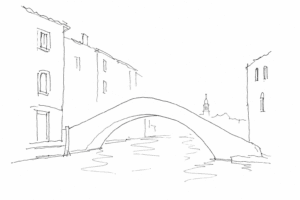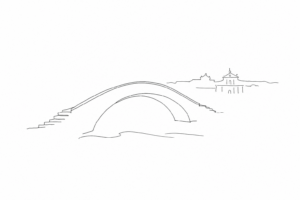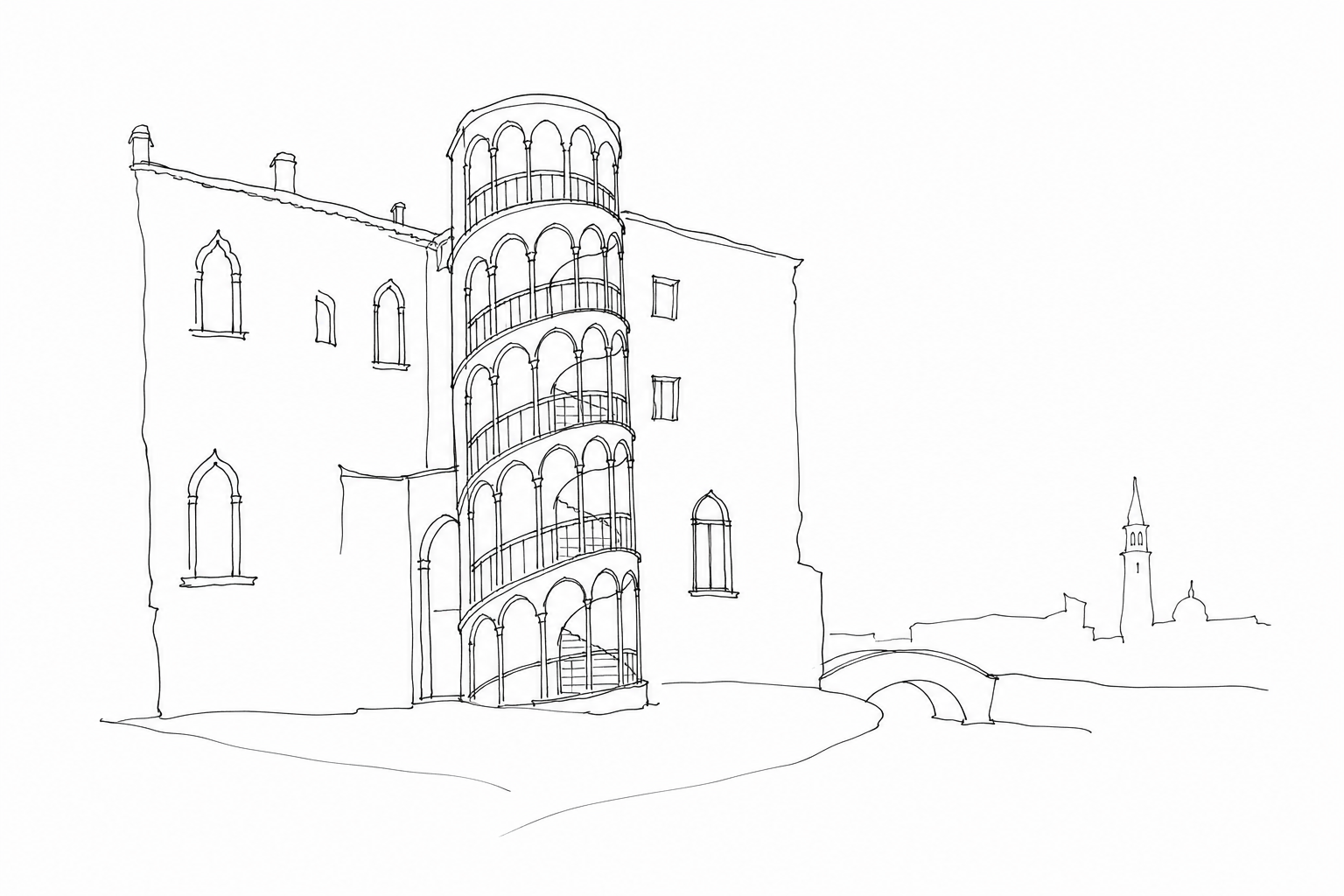

The Ponte delle Guglie is not only a crossing over the rio di Cannaregio: it is a point where Venice changes rhythm. On one side, the daily passage between the station, Lista di Spagna and Strada Nova; on the other, the entrance toward the Ghetto, with its complex history still legible in the urban space. The four spires, unusual in a city accustomed to more essential bridges, make this bridge recognizable and almost anomalous. Observing it carefully means reading architecture, movement, memory and neighborhood life together.
A bridge that marks a threshold of Cannaregio
The Ponte delle Guglie crosses the Canale di Cannaregio at a decisive point in the city: it is not only a connection between two banks, but a true urban threshold. Those who arrive from the area of the railway station and proceed toward the heart of Venice encounter here one of the most recognizable passages of the sestiere, where pedestrian traffic intertwines with the presence of the canal, the fondamenta and the calli that lead toward the Ghetto.
Its function is clear already from its position: the bridge relates the Strada Nova and the commercial axis of Cannaregio with the more internal branches, including the route that leads to Campo del Ghetto Nuovo. For this reason it is both a practical and symbolic point of orientation.
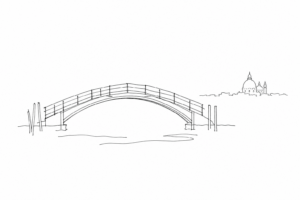
The name derives from the stone obelisks placed at the four corners, rare elements in Venetian bridges and capable of making it immediately identifiable in the lagoon landscape.
The spires: four obelisks in a city of sober bridges
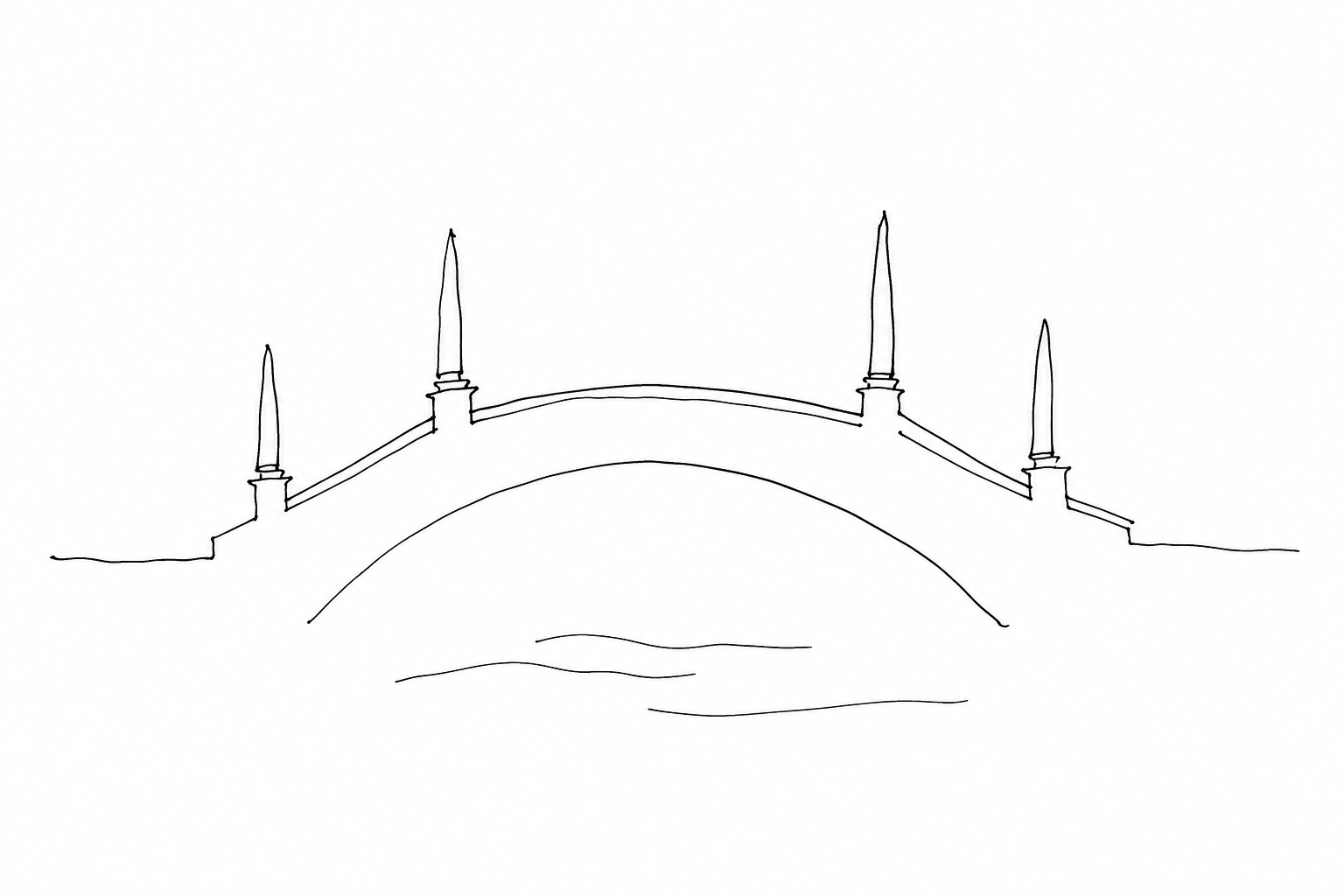
What is striking here is not a decoration widespread in the rest of Venice: at the four corners of the parapet appear small obelisks in Istrian stone, set on squared bases and legible even from afar along the Canale di Cannaregio. They are vertical, pointed elements, almost landing signals, which interrupt the customary low and functional line of Venetian crossings.
Their presence explains the name of the structure and defines its character. They do not have an indispensable structural function: rather, they serve to mark the corners, to give rhythm to the silhouette and to transform an everyday passage into a recognizable point. In a city where many stone connections aim for sobriety, these cusps introduce a controlled scenic accent.
Seen from the level of the fondamenta, the spires dialogue with the balustrades and with the breadth of the canal: they are not monumental in a Roman sense, but unusual enough to fix in memory the entrance toward the area of the Ghetto and the long direction of Cannaregio.
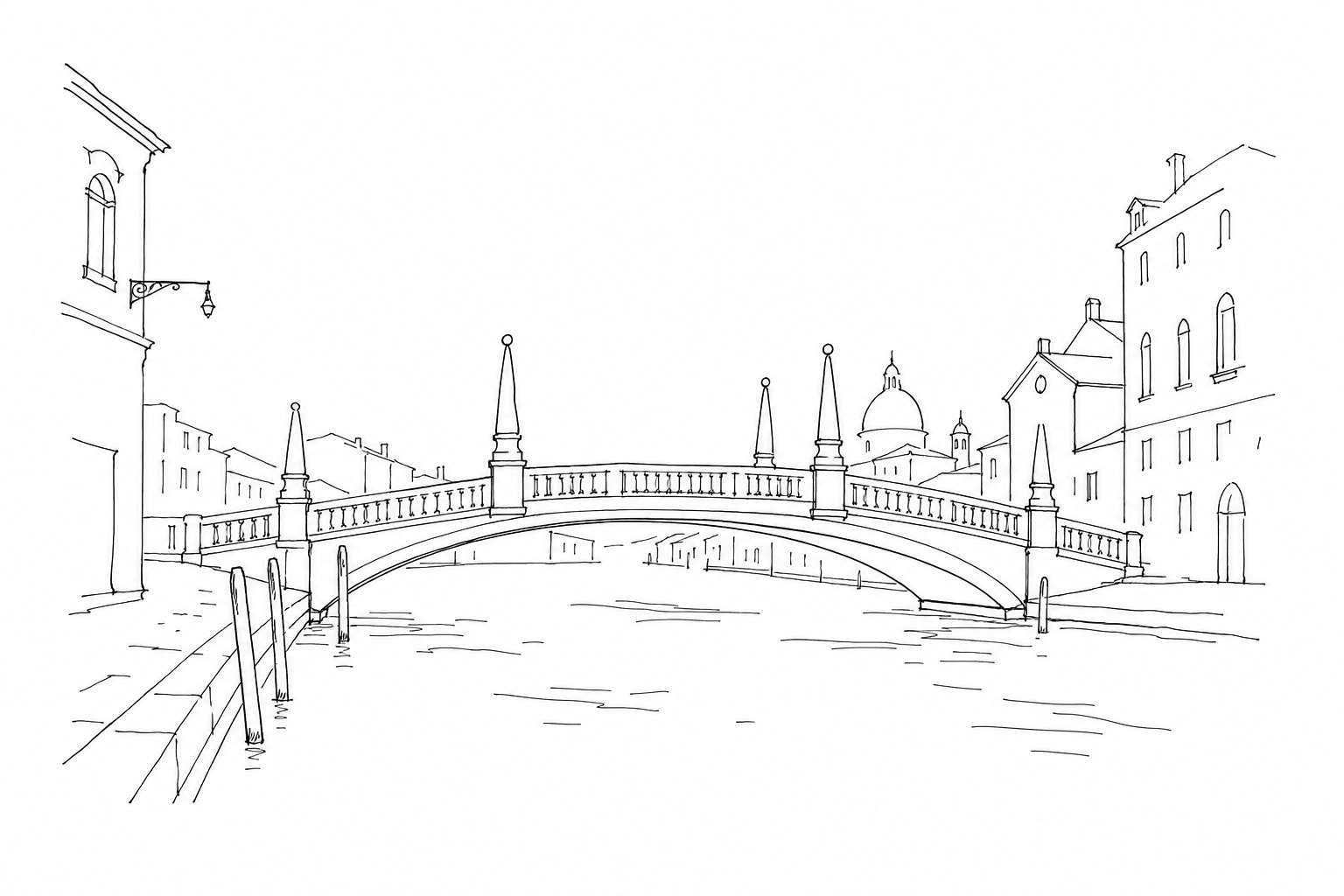
Before taking on the stone image that today marks the entrance to the Venetian Jewish area, this crossing began as a wooden structure. Documentary tradition places it already in the 13th century, in a strategic point: goods, residents and travelers passed here, moving between the mainland landing place, the calli of Cannaregio and the commercial heart of the city.
In the late sixteenth century the walkway was replaced by a more stable masonry construction, suited to the traffic of an area by then densely inhabited. The current form is the result of subsequent maintenance and reconstructions, with a nineteenth-century appearance recognizable in the stone details and in the ordered design of the parapets. The four decorative points, added in that phase, transformed a functional infrastructure into an immediately identifiable urban sign.
Its history, therefore, should not be read as that of an isolated monument: it is rather the sedimentation of practical needs, water controls, daily routes and neighborhood memory. It is precisely this continuity that explains why the passage is still perceived as a threshold between the great city route and the Ghetto.
After crossing the stone bridge, the reading of the place changes scale: from the broad route that leads to the station and to Strada Nova, one passes to a finer weave, made of fondamenta, narrow calli and sottoportici. Here the structure does not function only as a connection over the canal, but as a point of orientation: on one side the main pedestrian traffic, on the other the side access that leads to the historic Jewish area.
The route should be observed without imagining a single monumental threshold. The Ghetto Nuovo, established by the Republic in 1516, was reached through entrances that were controlled and closed at night; later the spaces of the Ghetto Vecchio and the Nuovissimo were added. Today’s perception arises precisely from the contrast between the openness of the banks and the compression of the internal accesses.
To orient oneself, it is useful to read three elements together: the water line, which orders arrivals; the fondamenta, which distributes footsteps; and the side opening, which introduces a neighborhood marked by rules, trades, hidden synagogues and urban memory.
Crossing the Ponte delle Guglie slowly helps one understand Cannaregio beyond the surface of tourist flows. Its decorative cusps, the transformation from wooden structure to stone bridge, its position along a very frequented route and its relationship with the nearby Ghetto make it a place of passage but also of interpretation. There is no need to look for an isolated monument: here the value lies in the threshold, in the way a bridge connects different spaces and invites one to look at them with greater precision.