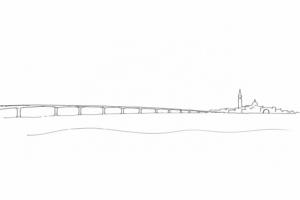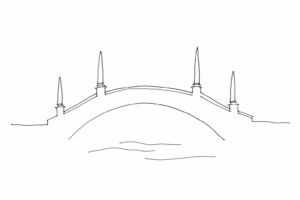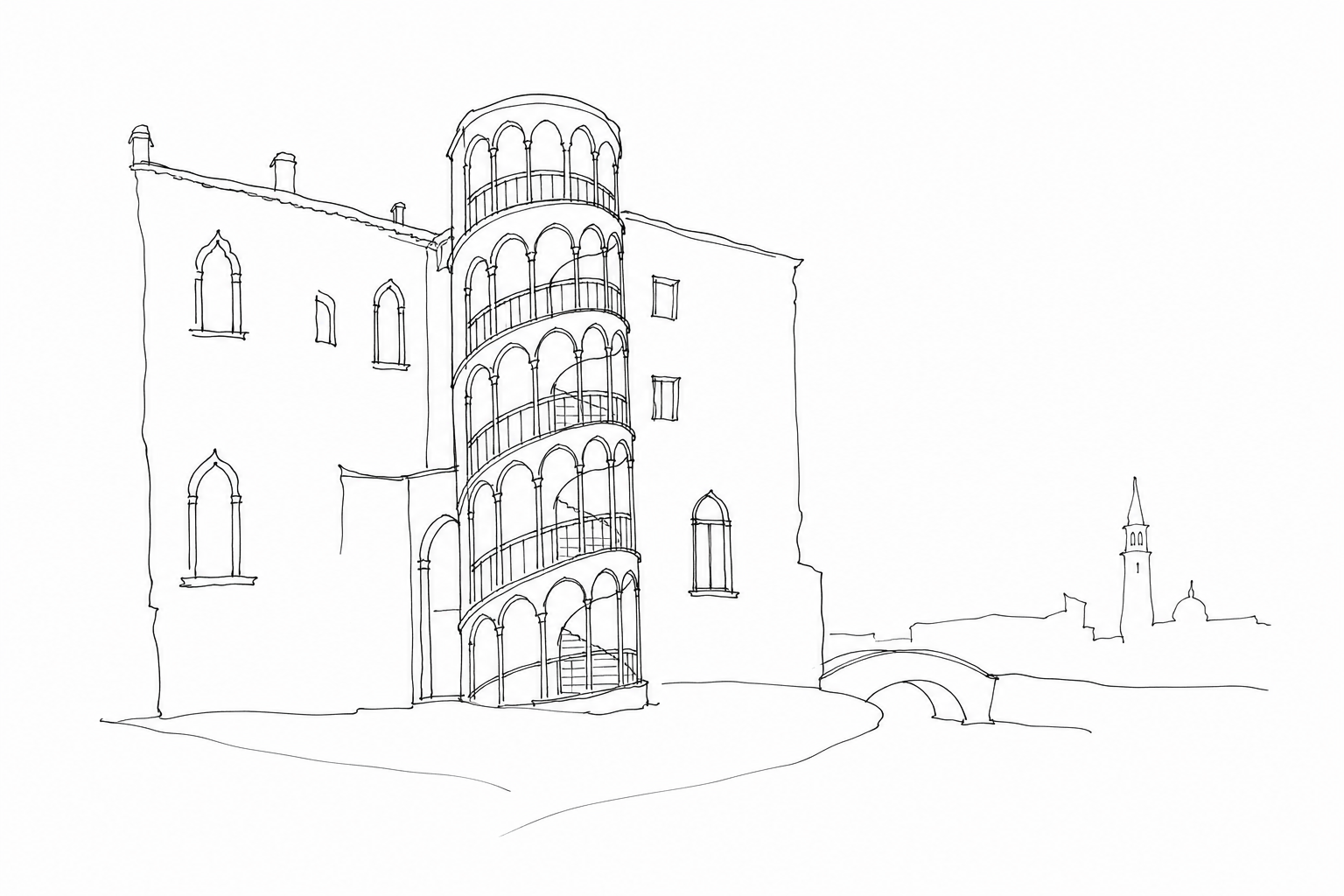

Ponte degli Scalzi is one of the first urban gestures that Venice offers to those arriving by train: a few steps outside Santa Lucia and the Grand Canal immediately interrupts the rhythm of the journey. Crossing it means entering the city not from a monumental square, but from a concrete, crowded, everyday threshold. The bridge connects the station to the area of the church of the Scalzi and to Lista di Spagna, bringing together movement, history and views over the water. It is not only a useful passage: it is a point from which to understand how Venice organizes arrivals, distributes flows and transforms even a short crossing into a precise visual experience.
The first threshold after Santa Lucia
Leaving Venezia Santa Lucia station, Ponte degli Scalzi is often the first true Venetian crossing: not a simple shortcut, but the passage that translates arrival by train into entry into the city of water. Behind remain tracks, platforms and the straight rhythm of railway travel; ahead opens the Grand Canal, with the slow traffic of vaporetti, water taxis, service boats and gondolas.
The bridge connects the station bank, in the Cannaregio sestiere, with the Santa Croce area. Its name recalls the nearby church of Santa Maria di Nazareth, known as degli Scalzi, linked to the Discalced Carmelites. The current stone structure, designed by Eugenio Miozzi and inaugurated in 1934, replaced an earlier nineteenth-century metal bridge.
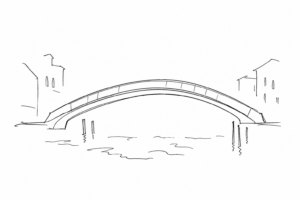
Its urban function is immediate: raise your gaze, change pace, get your bearings. The steps force you to leave the logic of the station and enter pedestrian Venice, made of banks, calli and sudden views over the Grand Canal.
Name, church and history of the arch
The name Ponte degli Scalzi does not come from the railway, but from the nearby church of Santa Maria di Nazareth, linked to the Discalced Carmelites. The Baroque façade, overlooking Lista di Spagna, predates the arrival of the tracks by centuries: it reminds us that this point of the Grand Canal was already an important urban edge before it became an entrance gate for those arriving by train.
The first stable crossing in this position was built in the nineteenth century, during Austrian rule, to a design by the engineer Alfred Neville: a metal structure, functional for the new railway hub but little loved in the Venetian landscape. In the 1930s it was replaced by the current work in Istrian stone, designed by Eugenio Miozzi and inaugurated in 1934.
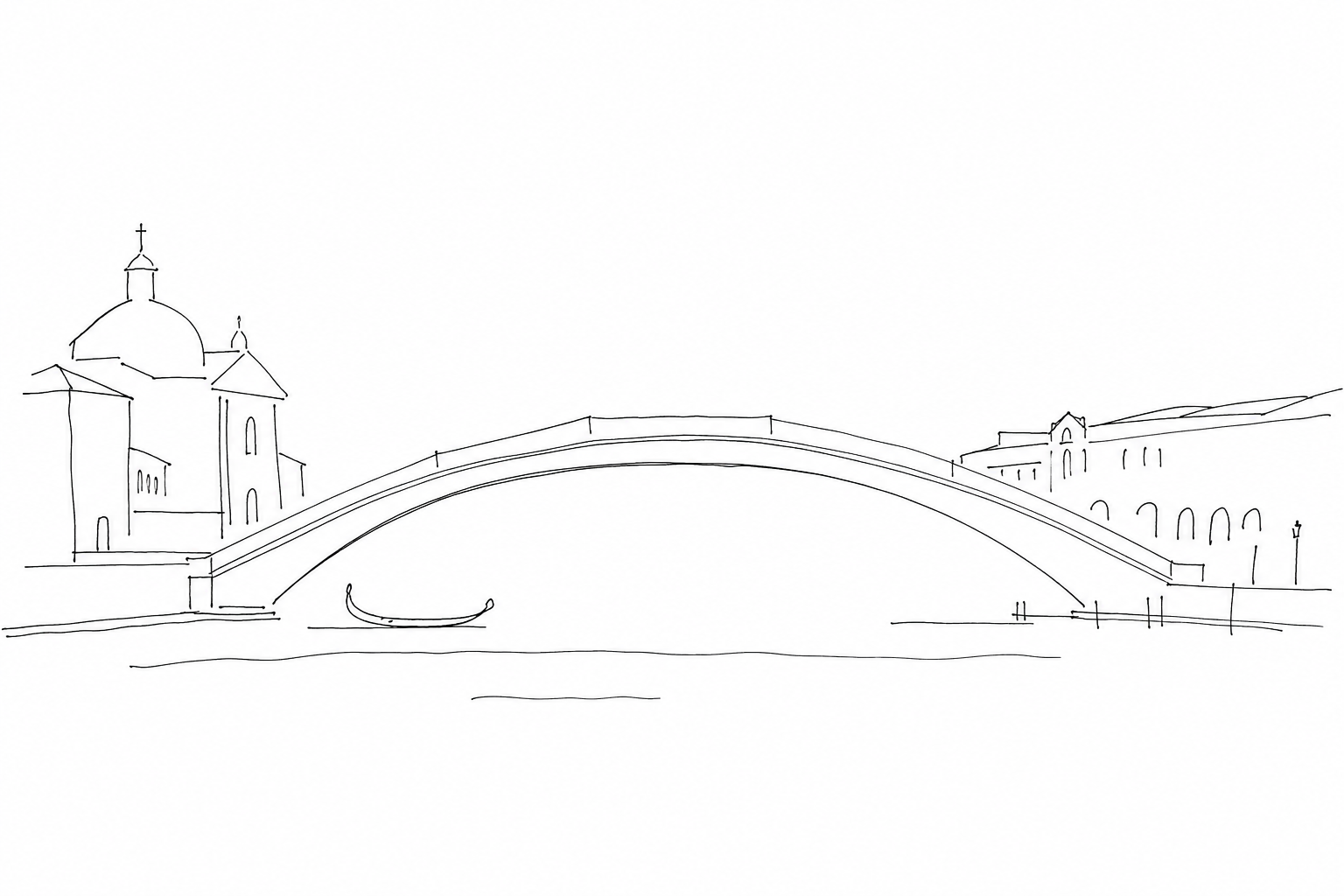
Its wide single arch leaves the canal free for navigation and, at the same time, creates a precise scene: on one side the church and the fondamente, on the other the bank in front of Santa Lucia station. The short route thus preserves two overlapping memories: religious and conventual Venice, and the modern Venice of travelers just off the train.
Form, stone and crossing
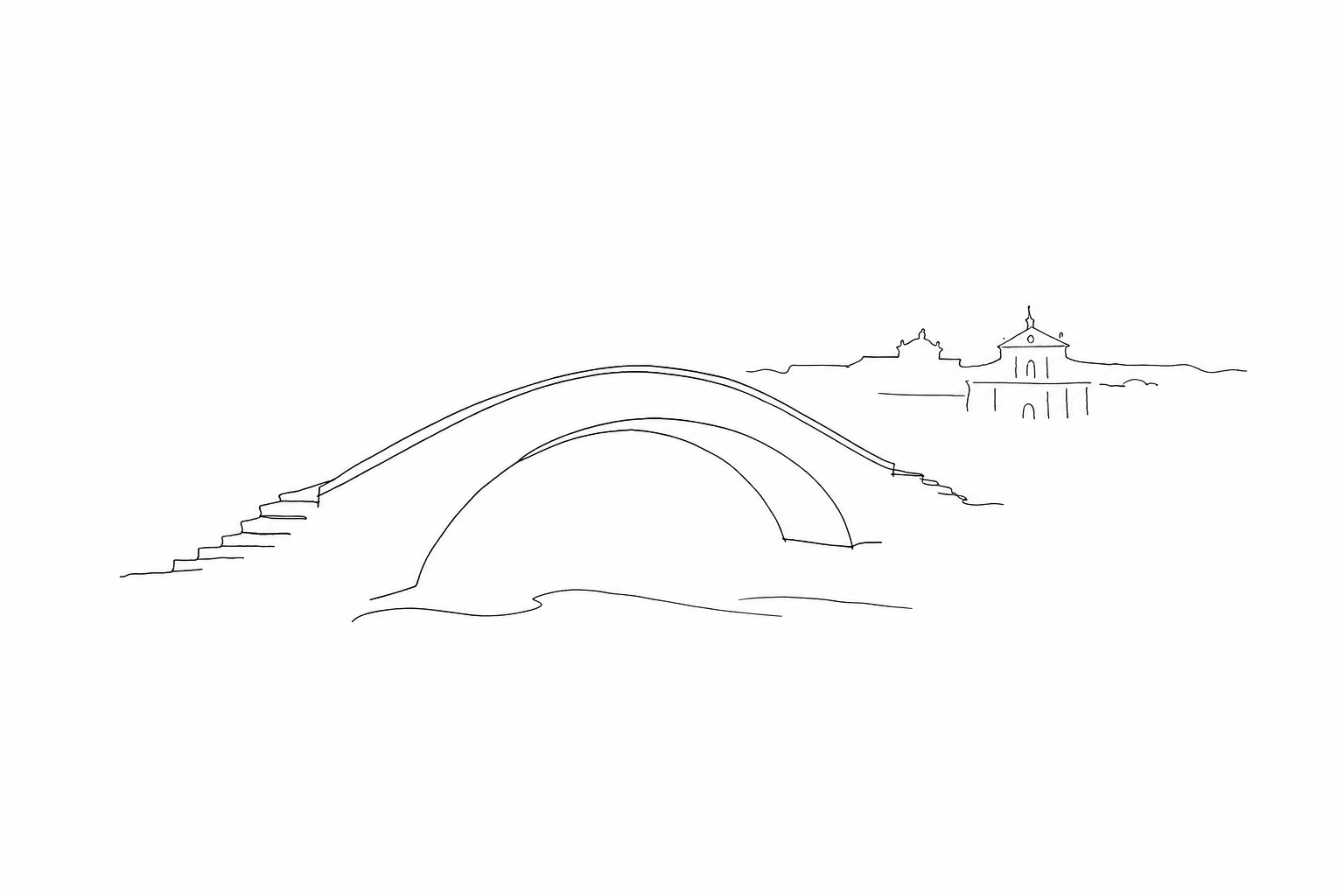
The work encountered when leaving Venezia Santa Lucia should first of all be read as a simple gesture: a single arch in Istrian stone that crosses the water with a clear course, without intermediate supports. The current version, designed by Eugenio Miozzi and inaugurated in 1934, replaced the previous nineteenth-century metal structure, more linked to railway engineering than to the Venetian stone language.
The choice of light stone is not only aesthetic. It places the structure within the city’s urban vocabulary, where steps, banks, balustrades and façades often converse through compact and luminous surfaces. The solid parapets guide the gaze toward the central curve, while the sequence of steps makes the crossing a small change in level: you go up, see the water traffic from above, then descend again toward Lista di Spagna or toward the railway bank.
This architectural form coincides with daily use: tourists with suitcases, residents, commuters and porters use it as an immediate passage between railway arrival and the historic city.
What to observe from the two sides
To get your bearings immediately, it is worth stopping for a moment at the top of the arch. Behind the railway arrival you can read the busiest direction: Lista di Spagna, the entrance toward Cannaregio and the façade of the Carmelite church, recognizable for its light marble and for its position almost leaning against the passage.
On the other bank, toward Santa Croce, the gaze meets San Simeon Piccolo: the large green dome and the neoclassical pronaos function as an immediate visual marker. It is one of the most useful reference points for understanding that you have crossed the water and entered a system of less straight calli, where the route quickly fragments.
- Looking along the water: you notice the curve of the Grand Canal, which prevents an infinite view and makes Venice appear in sequences.
- Observing the banks: landings, fondamente and palace entrances show how pedestrian traffic and water traffic touch without coinciding.
- In the practical details: steps, parapets and flows of suitcases help you choose when to stop and when to leave the passage clear.
Stopping on Ponte degli Scalzi, even for just a few minutes, helps you read Venice just beyond the initial impression. On one side is the station, with its continuous coming and going; on the other begin calli, fondamente, churches and routes that gradually move away from the noise of the entrance. Its stone form, its position on the Grand Canal and its link with the nearby church make it a practical but not neutral bridge. It is certainly a place of transit, but also an observation point: it shows an operational, layered Venice, where history and daily life meet even before choosing a direction.