
In the heart of Dorsoduro, the Ponte dei Pugni preserves an unusual memory of popular Venice: not that of the palaces overlooking the Grand Canal, but that of neighborhood rivalries, of bodies balanced on absent parapets, of crowds gathered along the rii. Here the Nicolotti and Castellani challenged each other in ritual combats that blended belonging, controlled violence and urban spectacle. Looking at it today means reading a minute detail of the city — the Istrian stone footprints on the paving — as the trace of a broader history, made up of invisible borders, trades, factions and daily life.
Where the Ponte dei Pugni is located
The Ponte dei Pugni is located in the sestiere of Dorsoduro, over the rio di San Barnaba, in one of the most recognizable points of everyday Venice. It is not a monumental bridge in terms of size, but it occupies a very significant urban node: it connects the area of Campo San Barnaba with the nearby fondamenta, along a well-traveled route between Campo Santa Margherita, Ca’ Rezzonico and the Accademia area.
Its position helps explain why it became the setting for the fights between the Nicolotti and the Castellani. Dorsoduro was a lively edge of the city, crossed by artisans, boatmen, students, vendors and inhabitants of the nearby campi. Here the bridge was not only a passage over the water: it was a symbolic boundary, a point of confrontation between Venetian factions.
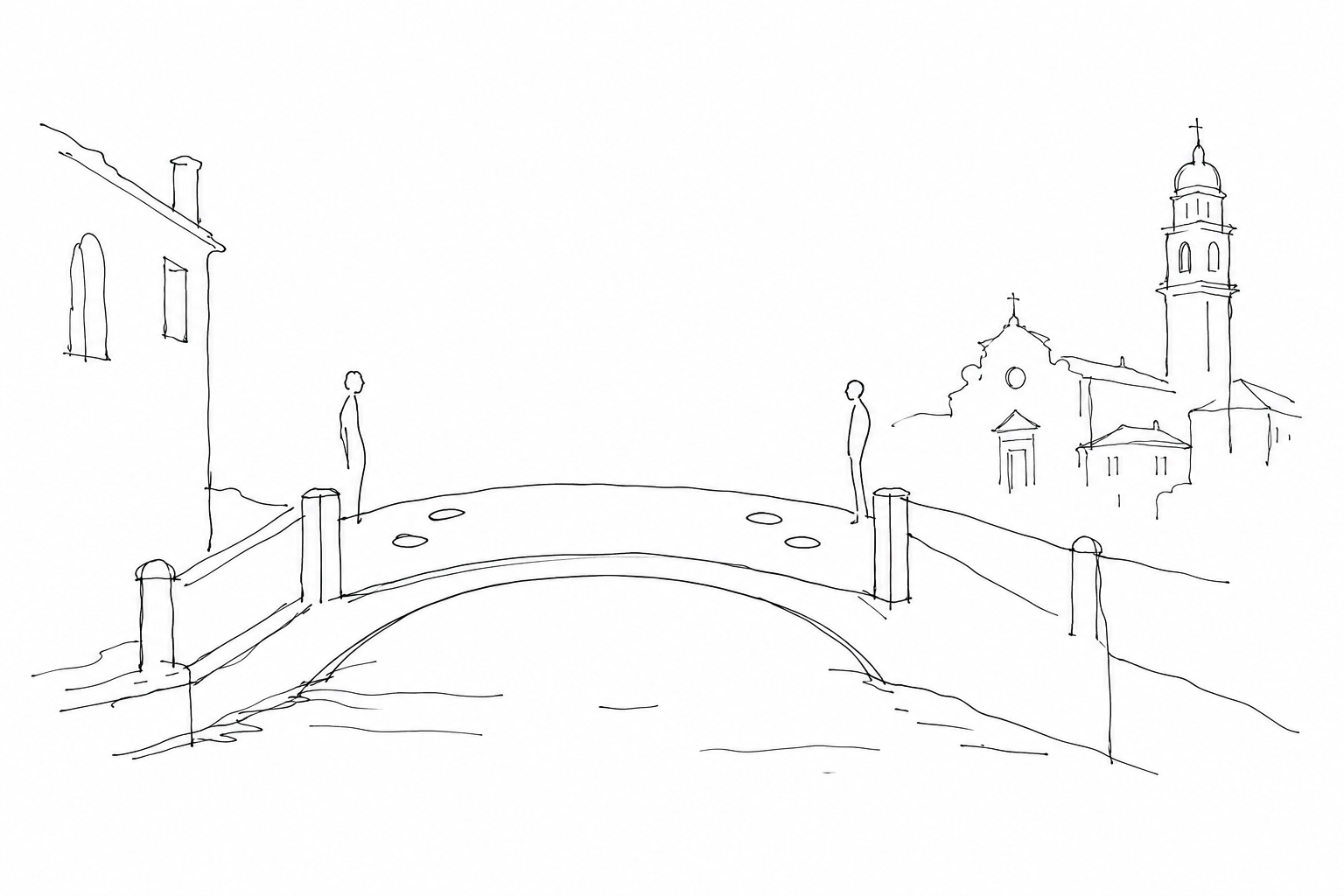
Even today, on the stones of the bridge, one can notice the marble footprints that indicated the fighters’ positions before the clash.
Nicolotti and Castellani: two rival Venices
To understand why the Ponte dei Pugni became a theater of conflict, one must look at popular Venice divided into two large sides. The Nicolotti took their name from San Nicolò dei Mendicoli, the western area of the city: between Dorsoduro, Santa Croce and San Polo there were strong communities of fishermen, boatmen and workers linked to lagoon trade. The Castellani, on the other hand, represented the eastern part, especially Castello and the areas near the Arsenale, where many arsenal workers and artisans lived.
They were not political parties in the modern sense, nor noble factions: they were neighborhood identities, pride in a trade and urban belonging. The rivalry was expressed in regattas, physical competitions and above all in the wars of fists, collective combats regulated by customs but often violent.
The location of San Barnaba was significant because it stood in an area of contact between communities and popular routes. The marble footprints still visible were not an ornament: they indicated the starting positions of the contenders, transforming the stone into a kind of codified arena of everyday Venice.
The wars of fists on Venetian bridges
The so-called wars of fists were not improvised brawls, but collective trials with rules recognized by the population. The teams faced each other on narrow, raised crossings, often without parapets, where every meter gained had symbolic value. The goal was to push back the opponents, make them fall into the water or occupy the center of the structure permanently.
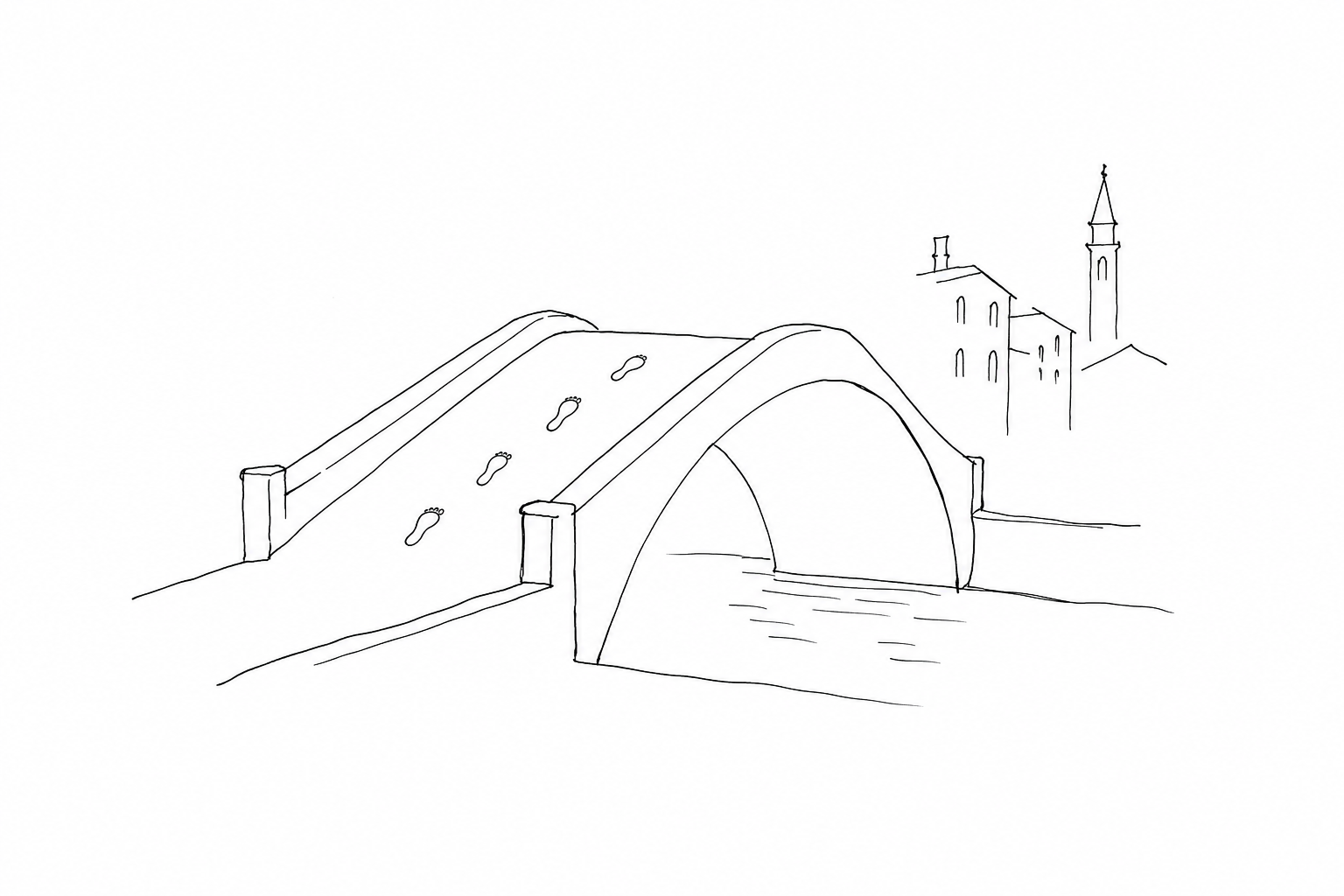
The structure at San Barnaba has become the most famous case because it still preserves the Istrian stone footprints: four marks that fixed the starting positions. From there the clash began, under the gaze of the inhabitants leaning out of windows, on the banks and on the boats. The competition involved men of the people, artisans, boatmen and workers linked to their respective contrade.
It was not the only place for these challenges. Other city crossings as well, such as those in the area of Santa Fosca or the Carmini, were associated with combats between factions. Over time, however, the rituality degenerated: serious injuries, falls into the canals and disorders convinced the authorities of the Serenissima to intervene. At the beginning of the eighteenth century the battles were banned, replaced by less bloody forms of competition, such as the human constructions of the feats of Hercules. The footprints left at San Barnaba are therefore the material trace of a regulated violence, later expelled from public space.
To truly understand this place, it is not enough to cross it: one must stop at the four marks of white stone set into the paving. The footprints indicate the positions from which the contenders set off, two on each side, transforming the passage into a small arena suspended over the rio.
Then observe the reduced width of the structure and the curve of the steps: the space allowed few lateral movements and forced the clash to be frontal. Originally many Venetian crossings lacked parapets; here too the risk of falling into the water was part of the trial and the spectacle.
From the edge of the campo and from the fondamenta one can sense the role of the public: those watching could see the impact, recognize the colors of the companies and measure the honor of their own group. The footprints are therefore not a simple ornament, but a minimal map of the contest.
The Ponte dei Pugni is not just a curiosity to photograph during a walk in Dorsoduro. It is a point where Venice shows one of its less decorative layers: the city of internal conflicts, of sestiere identities, of unwritten rules that organized public space. Its footprints remind us that even a minor bridge can become a historical document, if observed carefully. Stopping here, between Campo San Barnaba and the nearby calli, allows one to grasp a more concrete Venice: less monumental, perhaps, but closer to the real life that for centuries animated its neighborhoods.
Related Posts
Ponte Chiodo in Cannaregio: the bridge without a parapet that Venice has almost forgotten
History, form and context of Ponte Chiodo, a rare Venetian bridge without a parapet in Cannaregio.Ponte delle Guglie: obelisks, Cannaregio and the passage toward the Ghetto
History, form and urban context of the Ponte delle Guglie, a threshold between Cannaregio, the canal and the Ghetto.
Ponte Chiodo in Cannaregio: one of the last Venetian bridges without a parapet
History, form and urban context of Ponte Chiodo, a rare Venetian bridge without a parapet in the Cannaregio district.Questions Answered
Where is the Ponte dei Pugni located and why is it important?
It links key areas in Dorsoduro and serves as a symbolic boundary.Who were the Nicolotti and Castellani?
Rival neighborhood groups with distinct trades and cultural identities.What were the wars of fists?
Ritual fistfights on bridges with rules and symbolic meaning.Why did the battles stop and what remains today?
Banned in 18th century due to violence; footprints remain as evidence.
Stay a little longer in Dorsoduro
Would you like to move from this place to nearby stories among churches, palaces and fondamenta?
 The Church of San Sebastiano: Veronese’s pictorial refuge hidden in DorsoduroGuide to the church of San Sebastiano in Dorsoduro, where Veronese worked for years and was buried.
 Santa Maria dei Carmini: the Tiepolo ceiling that many miss while rushing toward DorsoduroA brief guide to the Carmini: church, Scuola Grande and Tiepolo ceiling, often skipped between Campo Santa Margherita and Dorsoduro.
 Campo Santa Margherita: how to read a Venetian square that is still a space of daily lifeA concrete reading of Campo Santa Margherita: history, urban edges, daily uses and details that help understand a lively square in Dorsoduro.
 Angelo Raffaele: Tobias, the dog and a Dorsoduro church with an almost narrative toneA reading of the church of Angelo Raffaele in Dorsoduro, between Tobias, the dog, Guardi and the sacred story in Venetian space.