
On 21 November, you may notice something unusual in Venice: people walking through the narrow streets carrying long candles. Families with children, elderly residents, students and Venetians who may rarely go to church during the year, but who still make their annual visit to the Madonna della Salute. Some bring a candle to ask for protection, others to give thanks. And some simply come because they have done so since childhood.
Festa della Madonna della Salute 2026 takes place on Saturday 21 November, although celebrations begin earlier in the week and continue until Monday 23 November. A temporary bridge returns across the Grand Canal, religious services fill the Basilica and the surrounding streets become lively with candle stalls, sweets and local families.
It is one of Venice’s most cherished traditions, and one that belongs as much to the city’s residents as to its religious history. Here is the updated programme, practical advice for attending and a few stories that explain why the celebration still matters after almost four centuries.
Festa della Salute 2026: dates and programme
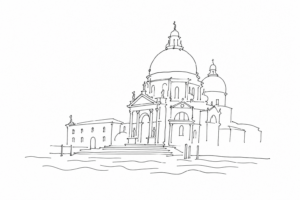
The main celebration falls on Saturday 21 November 2026, the Catholic feast of the Presentation of the Blessed Virgin Mary. Most ceremonies take place at the Basilica di Santa Maria della Salute, in Dorsoduro, near the entrance to the Grand Canal.
| Date | Main events |
|---|---|
| Thursday 19 November | Blessing and scheduled opening of the temporary votive bridge at 3:00 pm. Masses at 10:00 am, 11:00 am and 4:00 pm. Rosary and litanies at 4:45 pm, followed by an evening pilgrimage involving lay associations and movements. |
| Friday 20 November | Basilica open from 8:00 am to 8:00 pm. Masses at 9:00 am, 10:00 am, 11:00 am, 3:00 pm, 4:00 pm and 5:00 pm. Solemn opening of the city pilgrimage at 2:30 pm. |
| Saturday 21 November | Festa della Madonna della Salute. Basilica open from 5:40 am to 10:20 pm. Solemn Mass celebrated by the Patriarch at 10:00 am, Rosary at 4:30 pm and Compline at 10:00 pm. |
| Sunday 22 November | Masses at 10:00 am, 11:00 am, noon, 4:00 pm and 5:30 pm. Rosary at 3:00 pm. Youth pilgrimage at 6:00 pm, departing from Campo San Maurizio. |
| Monday 23 November | Final scheduled celebrations, with Masses at 11:00 am and 4:00 pm. |
On Saturday 21 November, Masses are scheduled at 6:00 am, 7:00 am, 8:00 am, 10:00 am, 1:00 pm, 2:00 pm, 3:00 pm, 4:00 pm, 5:00 pm, 6:00 pm, 7:00 pm and 8:00 pm. The 10:00 am solemn Mass will be celebrated by Patriarch Francesco Moraglia and broadcast on Antenna 3 and the Gente Veneta Facebook page.
Important change to the youth pilgrimage: originally planned for Friday 20 November, it has been rescheduled for Sunday 22 November at 6:00 pm because of the announced strike. Participants will meet in Campo San Maurizio before setting off with the Patriarch.
The votive bridge: where it is and when to cross it
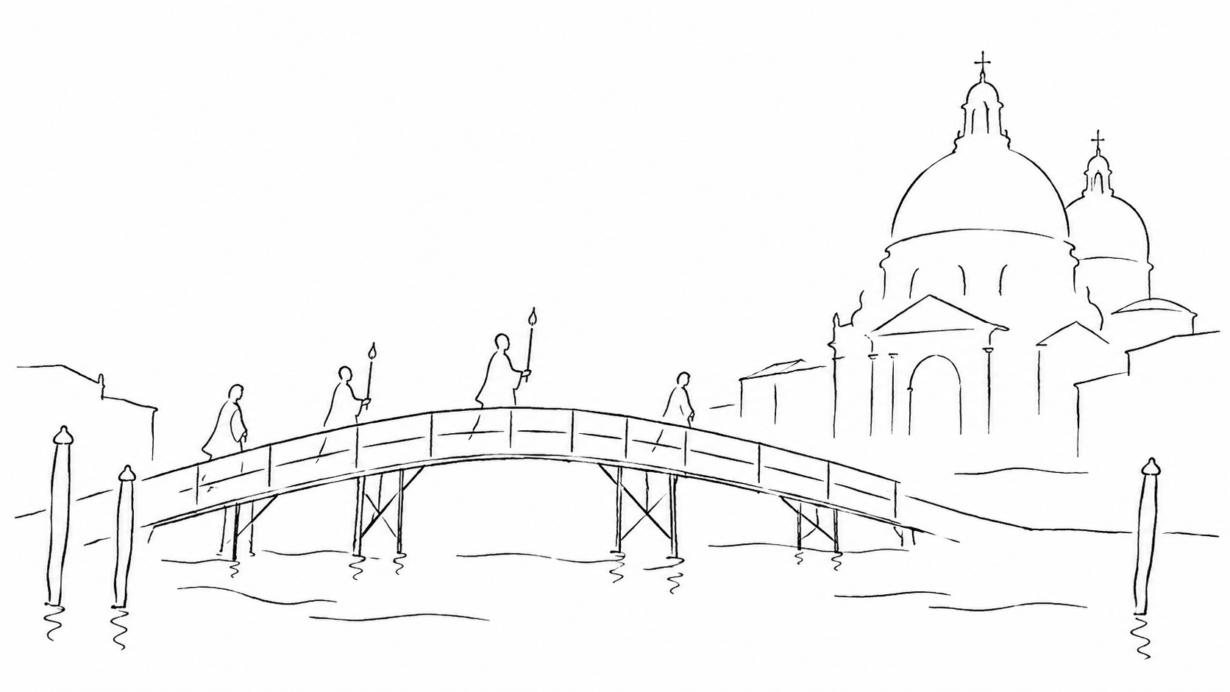
For just a few days each year, a crossing appears between Santa Maria del Giglio and San Gregorio. This is the ponte votivo, a temporary pedestrian bridge connecting the San Marco and Dorsoduro districts across the Grand Canal.
Its official opening is scheduled for Thursday 19 November at 3:00 pm. Once opened, subject to local arrangements, it allows pilgrims and visitors to reach the Basilica without making the longer walk across the Accademia Bridge.
To find the bridge from the San Marco side, head towards the Church of Santa Maria del Giglio, a short walk from San Moisè. The crossing leads towards San Gregorio, from where you can continue on foot to the Basilica.
But this is more than a convenient shortcut. The bridge is perhaps the clearest physical expression of the festival: for a few days, Venice changes its own geography, joining two banks of the canal that are normally separated by water.
Transport notice: the Santa Maria del Giglio waterbus landing is closed from 7:00 am on 17 November until 5:00 pm on 30 November 2026 because of operations connected with the temporary bridge. Services that normally use this stop are affected. Check the latest ACTV service notices before travelling.
How to visit: a practical route and useful advice
If you have never experienced Festa della Salute before, the most characteristic approach begins in San Marco, crosses the votive bridge and continues to the Basilica. You do not need to devote an entire day to it, although queues and pedestrian congestion are possible, particularly on 21 November.
If you only have one hour
Follow this simple walking route: Santa Maria del Giglio → votive bridge → San Gregorio → Basilica della Salute → Punta della Dogana.
It is a short walk if you exclude possible waiting times. After visiting the Basilica, continue to Punta della Dogana, where the view opens towards the San Marco Basin and the islands beyond.
Entry to the Basilica is free. However, on the festival day it is primarily a place of worship and pilgrimage. If you would rather explore its architecture and artworks at a leisurely pace, another day will be more suitable. You can discover more about its origins in our guide to Santa Maria della Salute, the church born from the plague.
Public transport strikes on 20 and 21 November
Getting around Venice and travelling from the mainland may require extra planning this year:
- Friday 20 November: a 24-hour general strike affects ACTV buses, trams and waterbuses. Guaranteed bus and tram departures from their starting terminals are scheduled between 6:00 and 8:59 am and between 4:30 and 7:29 pm. Minimum waterbus services are also planned.
- From 9:00 pm on Friday 20 November until 8:00 pm on Saturday 21 November: a nationwide rail strike may cause train cancellations and timetable changes.
If you are travelling from Mestre, check both your outbound and return journeys carefully. Our guide to getting from Mestre to Venice explains the usual transport options, but remember that normal timetables may not apply during strike periods.
One useful detail for visitors: the Venice Access Fee does not apply during Festa della Salute. The scheduled 2026 charging period ended on 26 July.
What else is happening on 21 November?
Although the religious pilgrimage is at the heart of the celebration, the festival also coincides with a number of cultural and community events.
Punta della Dogana: free exhibitions for local residents and students
On Saturday 21 November 2026, Punta della Dogana offers free admission to Lorna Simpson. Third Person and Paulo Nazareth. Algebra for residents of the Metropolitan City of Venice and students enrolled at Venetian universities.
Between 3:00 pm and 6:00 pm, the venue also offers ATLAS, a free cultural mediation programme connected with Paulo Nazareth’s exhibition. Both exhibitions close on 22 November, making this one of the final opportunities to visit.
The venue is just a few minutes’ walk from the Basilica, so the two visits can easily be combined. Read more about the history of Punta della Dogana, from maritime customs house to contemporary art museum, and check the Pinault Collection’s official event page for admission conditions.
Festa della Salute in Mestre
The tradition is not confined to Venice’s historic centre. Mestre has its own sanctuary dedicated to the Madonna della Salute, with religious celebrations scheduled from 20 to 22 November.
On Saturday 21 November, the sanctuary will be open from 7:00 am to 9:00 pm, with Masses throughout the day and continuous Rosary prayers from 1:00 to 3:00 pm.
Also on Saturday, Via Manin in Mestre hosts a local Festa della Madonna della Salute from 9:00 am to 8:00 pm, organised by Tutto in Piazza. The programme includes handmade crafts, nature-themed workshops for children and other community activities as part of the municipality’s Città in Festa calendar.
Why does Venice celebrate the Madonna della Salute?
The story begins in 1630, when a devastating plague struck Venice. The Republic tried to contain the epidemic through the public health measures available at the time, but also made a solemn vow: if the city were delivered from the disease, a great church would be built in honour of the Virgin Mary.
The Venetian Senate entrusted the project to the young architect Baldassare Longhena. Construction took decades, and the Basilica was completed in 1687. The result was one of Venice’s most recognisable landmarks, but also something more unusual: a monumental church that represented a collective promise rather than the wealth or devotion of an individual family.
Every 21 November, the pilgrimage symbolically renews that vow. That is why Festa della Salute remains more than a religious observance. It is also an act of shared remembrance, embedded in the city’s identity.
Local traditions and lesser-known stories
The Madonna’s icon came from Crete
There is a remarkable detail about the image before which Venetians light their candles. It was not originally created for the Basilica at all. The sacred icon came from Candia, present-day Heraklion on the island of Crete.
Known as the Mesopanditissa, a name traditionally interpreted as “mediator of peace”, the icon arrived in Venice in 1670, brought by Francesco Morosini following the loss of Candia. On 21 November that same year, it was placed on the Basilica’s high altar.
So the festival does not only preserve the memory of the plague. The image at the centre of its devotion also tells a story about Venice’s centuries-old connections with the eastern Mediterranean.
A candle, a sweet treat and a family ritual
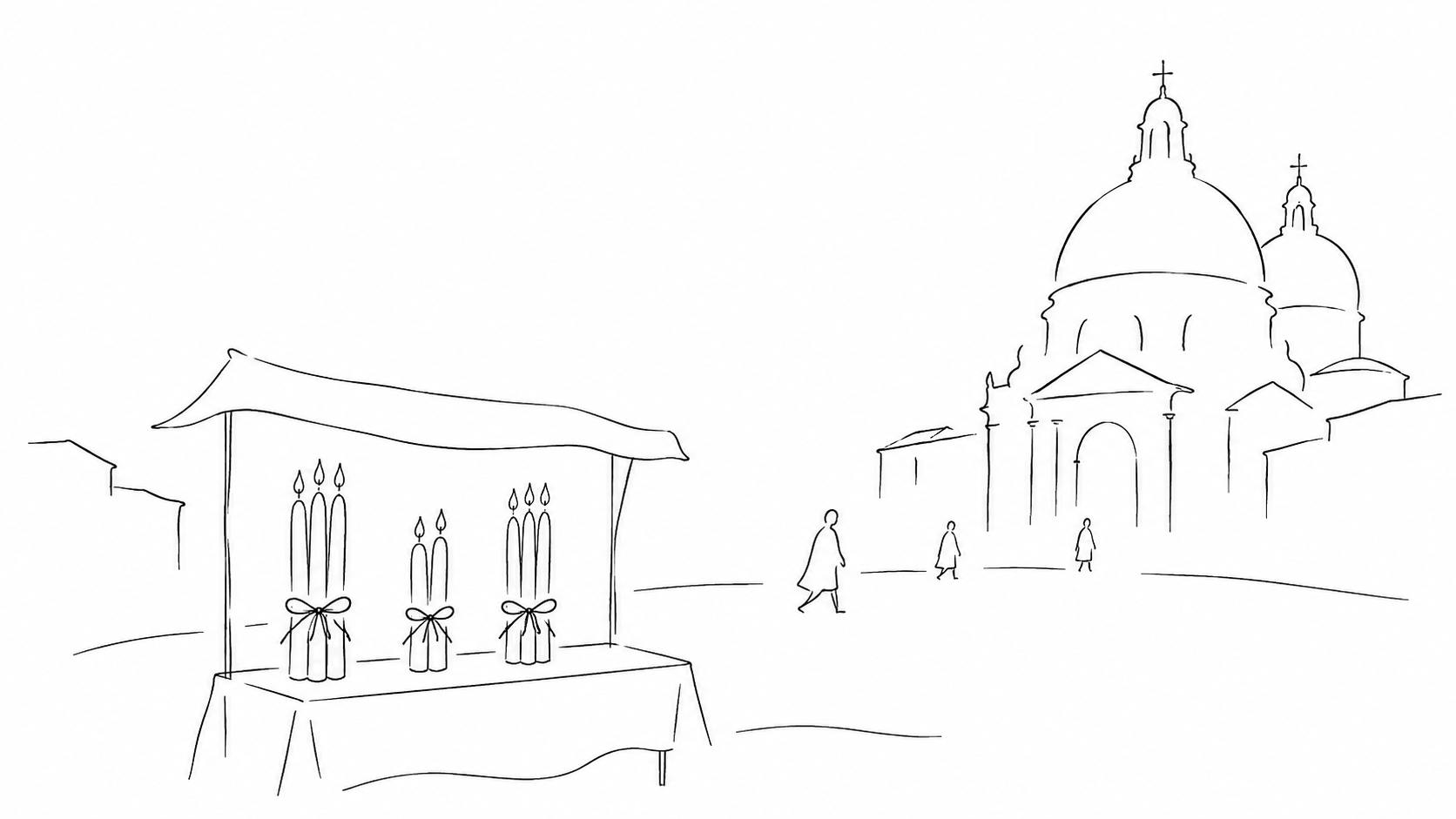
Much of the festival’s character lies in small gestures. People buy long, slender candles, enter the Basilica and stop for a moment before the image of the Madonna. Outside, stalls selling sweets have been part of the experience for generations of Venetian families.
This mixture of religious devotion and everyday tradition is what makes the celebration distinctive. For many residents, 21 November is also a chance to return to a place they first visited as children, perhaps holding a parent’s or grandparent’s hand.
Castradina: the traditional dish of Festa della Salute
One dish is inseparable from the festival: castradina, traditionally made with salted and smoked mutton, slowly cooked with Savoy cabbage.
It is hearty, strongly flavoured and quite different from the Venetian food most visitors know. According to local tradition, its association with the plague is linked to supplies arriving from Dalmatia, when preserved foods were especially important for maritime trade and survival.
The dish tells a story much wider than a single recipe. You can explore it in our article about castradina, the plague and Venice’s connections with Dalmatia.
Festa della Salute and the Redentore: two plague festivals, two different atmospheres
Venice has two major votive celebrations born from different epidemics. The Festa del Redentore on Giudecca commemorates the plague of 1575–1577, while Festa della Salute recalls the epidemic of 1630–1631.
Both involve a monumental church and a temporary pedestrian bridge, yet their atmosphere is very different. Redentore has also become a great summer celebration on the water, with decorated boats and fireworks. Festa della Salute is usually quieter and more personal: a candle, a walk and a visit to the Madonna.
A festival that still belongs to Venice
The most interesting part of Festa della Salute is not simply the chance to cross the Grand Canal on a bridge that does not exist for most of the year. It is seeing how a tradition born almost four centuries ago still has a place in the everyday life of a city that has changed enormously.
Among the candle stalls, children choosing sweets and people waiting to offer their prayers, Venice reveals a side of itself that was never created as a tourist attraction. It continues because Venetians themselves continue to take part.
And perhaps that is the best reason to visit on 21 November: to experience, respectfully, a celebration that is not merely something to see, but something the city still lives.
Information updated on 16 November 2026. Event schedules, religious services and transport arrangements may change. Please check announcements from the Basilica della Salute, the Patriarchate of Venice and local transport operators before visiting.